
Test 14 of 25 · 20 questions · Free 2026
AR Permit Practice Test 14
Jump to the test ↓A fixed 20 question set from the Arkansas bank with answers and plain English explanations.
Question 1 of 20 · 0 right so far
All 20 questions in test 14
Every question below comes from the Arkansas question bank on this page. Open a question to see the correct answer and the explanation. Nothing here is hidden behind a signup.
1. When may a driver use the shoulder of an Arkansas street or road?
- Any time traffic is heavy and the lanes are full
- To pass a slow vehicle traveling on the right side
- Whenever the shoulder is paved and wide enough
- Only when a police officer directs the driver there
Show answer
Only when a police officer directs the driver there. The shoulder is not a travel lane or a passing lane in Arkansas. A driver may use it only when a police officer directs the vehicle there. Heavy traffic does not open the shoulder for driving, and a slow vehicle ahead does not make a right side pass on the shoulder lawful. A paved surface changes nothing, because other drivers never expect traffic on the shoulder and may pull off without looking. Stay in the marked lanes unless an officer sends you elsewhere.
Study this in the handbook: Pavement Markings and Lane Use
2. After passing the pictured sign you reach a flagger holding a STOP paddle. Where should you stop?
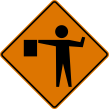
- Right beside the flagger so you can ask what to do
- Just past the flagger so you are ready to go first
- At the designated spot, or a car length away
- Wherever the car ahead of you happened to stop
Show answer
At the designated spot, or a car length away. The guide says that when you meet a flagger you should stop promptly at the designated location, or at least a car length away from the flagger, and then wait for directions to proceed. You should also keep a safe distance between your vehicle and the flagger, workers, and equipment. Stopping close to or past the flagger puts workers at risk and makes it hard to see what the flagger signals.
Study this in the handbook: Work Zones
3. You are adjusting the inside mirror before you drive. How should it be set, according to the Arkansas guide?
- So you can see mostly the roof and the back seat of your own car
- So the side of your own car shows in the mirror
- So you can see the entire rear window by moving only your eyes
- So you must tilt your head to see the traffic behind
Show answer
So you can see the entire rear window by moving only your eyes. The guide says to adjust the inside mirror so that you can see the entire rear window from the driver's seat. You should only have to move your eyes, not your head, when using the mirror. That setting lets you check traffic behind you quickly without taking your attention from the road. The guide adds that you should adjust your mirrors before you start driving, and that mirrors do not show objects in blind spots.
Study this in the handbook: Seat Belts, Child Seats and Littering
4. You need to drop off a passenger on a busy street with traffic passing steadily. Where should you stop?
- At a safe spot well away from moving traffic
- In the travel lane for just a few seconds
- Beside the nearest car, in the next lane over
- At the next green light in the lane
Show answer
At a safe spot well away from moving traffic. The guide says that when you stop to pick up or let off passengers, you should try to find a safe place to stop away from traffic. It also says never to stop in travel lanes for any reason, including passenger drop-off. Stopping in a lane, even briefly, puts you in the path of following drivers, and a quick exchange in traffic is exactly when rear-end crashes happen.
5. A person is legally crossing the road ahead of you in Arkansas. What must you do?
- Keep driving because paint is required for yielding
- Pass closely so the person hurries across
- Wave the person back to the curb
- Yield where necessary to avoid striking the person
Show answer
Yield where necessary to avoid striking the person. A person on foot who is crossing lawfully needs space and time, and your car must not force a dodge. Slow or stop as needed, even away from painted lines, and wait until the path is clear. Paint helps drivers spot a crossing place, but legal crossing duties reach beyond paint. Passing close can frighten or clip someone who stumbles. Waving someone backward can push that person toward another lane. Patience here costs seconds and prevents the worst kind of crash.
Study this in the handbook: Right of Way at Intersections
6. Your vehicle loses control and drifts toward oncoming traffic and people on foot. How should you use the horn?
- Tap it lightly twice to be polite
- Save it so you can concentrate on steering
- Sound a sharp blast to warn others
- Use it only after the vehicle comes to a stop
Show answer
Sound a sharp blast to warn others. The guide lists situations of real danger when you should sound a sharp blast on your horn, including when you lose control of your vehicle and are moving into the lane of oncoming traffic or toward pedestrians. A short sharp sound gives people and drivers the best chance to move out of the way. A polite tap, silence, or waiting until you stop gives no warning when it is needed.
Study this in the handbook: Headlights, Horn and Signals
7. In Arkansas, what amount of 80 proof liquor counts as a single drink?
- Three ounces of liquor served in one large shot glass
- One shot glass of liquor, straight or with a mixer
- Six ounces of liquor poured over ice in a tall glass
- Half an ounce of liquor mixed into a large soda
Show answer
One shot glass of liquor, straight or with a mixer. One shot glass holds the single drink measure for eighty proof liquor, whether it is taken straight or mixed with something else. Three ounces doubles that measure, and six ounces amounts to several drinks in one glass. Half an ounce falls short of the stated measure. Mixed drinks served at gatherings often hide more than one measure, so counting glasses can understate how much alcohol was actually consumed. Knowing the shot glass measure helps a person track intake honestly before deciding about transportation.
Study this in the handbook: Drinking and Driving
8. On a wet road your vehicle begins to slide after a sudden stop. What driver behavior most often causes such a skid?
- Driving with the headlights switched on
- Traveling too fast for the conditions
- Keeping both hands on the steering wheel
- Using the turn signal before a lane change
Show answer
Traveling too fast for the conditions. The guide explains that skids happen when tires can no longer grip the road, and that the vast majority of skids are caused by drivers traveling too fast for the conditions. Driving at a high speed increases the chance of a skid if you turn or stop suddenly, and roads are even more dangerous when covered with water, snow, or ice. Headlights, a firm grip, and signals are not causes of skids.
Study this in the handbook: Vehicle Emergencies and Crashes
9. Heavy rain and fog cut your view and high beams only add glare. Which headlights does the guide say to use?
- Low beams, or fog lights if you have them
- High beams on top of your low beams for more light
- Parking lights alone to avoid glare
- Hazard lights while you keep moving
Show answer
Low beams, or fog lights if you have them. The guide says that when driving in fog, snow, or heavy rain you should use your low headlight beams, because the light from high beams reflects and causes glare, making it more difficult to see the road. Some vehicles have fog lights that may be better suited to use in fog, rain, or snow. Parking lights are for parked cars, and driving with only parking lights is illegal in Arkansas.
Study this in the handbook: Headlights, Horn and Signals
10. A driver who takes insulin is adjusting to a new dose and may skip a meal. What does the guide say about driving?
- Do not drive when shock is possible
- Drive if you carry a snack and a phone
- Drive only on short trips close to home
- Drive if you feel normal when you leave
Show answer
Do not drive when shock is possible. The guide says that diabetics who take insulin should not drive when there is a chance of going into shock, which could result from skipping a meal or snack or from taking the wrong amount of insulin. It also says you should have someone else drive while adjusting to a new insulin dosage. Feeling normal at the start of a trip does not mean the risk is gone.
11. In Arkansas, which sound and light signals mark an emergency vehicle that motorists must move over for?
- A horn honk and a solid white light
- A siren and a solid green light only
- A siren or air horn, and a red or blue flashing light
- An air horn and a yellow parking light at every stop along the route
Show answer
A siren or air horn, and a red or blue flashing light. Two warning cues work together in the Arkansas description. The sound cue is a siren or an air horn, and the light cue is a red or blue flashing light. Either sound paired with those flashing colors signals an emergency vehicle that needs the road cleared. A silent vehicle with only parking lights showing is a different picture. Listening for the horn or siren while watching for red or blue flashes helps a driver react early and pull toward the right side.
Study this in the handbook: Emergency Vehicles and the Move Over Law
12. In Arkansas, who is accountable for what may be thrown from a vehicle onto a city street or state highway?
- Back seat passengers riding in the vehicle
- The agency that maintains that city street
- The driver who is operating the vehicle
- Nobody when throwing was accidental
Show answer
The driver who is operating the vehicle. Arkansas places this duty squarely on the person behind the wheel. Holding a driver license brings responsibility for knowing road laws, and the driver answers for items thrown from the vehicle onto a city street or state highway. Passengers do not take over that accountability, and the crew that maintains the road did not release the item. Calling the act accidental does not remove the duty either. The practical habit is to keep every item inside until it can reach a proper container.
13. A flagger holds your lane while traffic from the other direction creeps past a crew. What does the guide say you should expect?
- One direction held while the other passes slowly
- Both directions released together at low speed
- Your lane to be opened as soon as the crew sees you
- Traffic to be sent through at normal speed in turns
Show answer
One direction held while the other passes slowly. Among the things the guide says to expect in a work zone is one-way traffic. Traffic is held in one direction while the other direction is allowed to pass slowly, often guided by a flagger or a pilot car. If a flagger stops you, wait for directions to proceed. The traffic is not released in both directions at once, and it moves slowly rather than at normal speed.
Study this in the handbook: Work Zones
14. You enter a high-speed road from an entrance ramp while traffic flows steadily. How should you use the ramp?
- Stay slow on the ramp and merge when you can
- Wait at the start of the ramp until it is empty
- Speed past traffic and cut in at the end
- Build up to the speed of traffic, then merge
Show answer
Build up to the speed of traffic, then merge. The guide says that when you merge with traffic, you should try to enter at the same speed as the other traffic. High-speed roadways have ramps to give you time to build up speed, so use the ramp to reach the speed of other vehicles before you pull onto the road. Merging much slower than traffic forces others to brake, and speeding ahead of traffic to cut in leaves no margin.
Study this in the handbook: Speed Limits and Road Conditions
15. Which use of the horn does the Arkansas guide say to avoid?
- Warning a child about to run into the street
- Encouraging other vehicles to speed up
- Alerting a driver who does not see you
- Warning others before a blind curve
Show answer
Encouraging other vehicles to speed up. The guide gives uses for the horn, such as alerting others to danger, and also a list of times not to use it. You should not use the horn to encourage other vehicles to speed up, to inform other drivers of a mistake, or to greet a friend on the road. The horn is a safety device, so using it to hurry others up misuses it. The other choices are the warning uses the guide supports.
Study this in the handbook: Headlights, Horn and Signals
16. In Arkansas traffic, what is generally the safest speed to drive?
- Ten miles per hour below all other traffic
- Five miles per hour above all other traffic
- The posted maximum in every condition
- The same speed as other vehicles
Show answer
The same speed as other vehicles. Vehicles moving in one direction at a shared pace are less likely to run into each other. Going much faster forces constant passing, and each pass adds a chance that someone changes lanes suddenly. Going much slower causes traffic to pile up behind you. Matching the flow keeps spacing steadier and makes your moves easier for others to predict. Adjust that pace when weather or road conditions make the flow itself unsafe.
Study this in the handbook: Speed Limits and Road Conditions
17. During an Arkansas lane change, after signaling, what should the driver check in the mirrors?
- The desired lane stays empty past the next signal
- The desired lane is empty and nobody is passing
- No car waits at the nearest side street
- Headlights behind hold steady within the far lane
Show answer
The desired lane is empty and nobody is passing. A mirror check before moving over must answer two questions at once. The space you want to enter has to be empty, and no driver behind you can be starting to overtake at the same moment. Looking only far ahead, watching a side street, or judging headlight brightness leaves one of those risks unchecked. After the mirrors, a brief shoulder glance covers the hidden area beside the car before you change position on the road.
Study this in the handbook: Turns, Lane Changes and Passing
18. Where should the diagonal strap of a safety belt sit on an Arkansas driver?
- Behind the back
- Across the upper chest
- Under one arm only
- Loosely around the neck
Show answer
Across the upper chest. The diagonal strap belongs across the upper chest, lying where it can spread crash force over a strong part of the body. Putting it behind the back or under an arm removes that protection and lets the upper body pitch forward. A strap near the neck is also poorly placed and may cause a driver to loosen or move it. Wear the strap across the chest every trip.
19. You are about to change lanes on a busy road. How should you check for motorcycles?
- Look only at the lane ahead of your car
- Rely on the turn signal alone to warn nearby riders
- Check for cars only, since riders keep clear
- Check mirrors and blind spots before moving over
Show answer
Check mirrors and blind spots before moving over. The guide says that motorcyclists are often hidden in a vehicle's blind spot or missed in a quick look because of their smaller size. It tells drivers to always make a visual check for motorcycles by checking mirrors and blind spots before entering or leaving a lane of traffic and at intersections. A signal helps, but it does not replace the check.
Study this in the handbook: Trucks, Motorcycles and Bicycles
20. You see a work vehicle with flashing green, yellow, or white lights moving slowly ahead. What should you expect?
- A mobile work zone, so slow down and stay alert
- A tow truck that is clearing a crash from the road
- A school bus about to stop for children
- A police car that wants you to pull over
Show answer
A mobile work zone, so slow down and stay alert. The guide describes a mobile work zone as one where work vehicles have flashing green, yellow, or white lights, and there may be signs showing that work is ahead. Work vehicles in a mobile work zone also have signs on the back saying fines double. Mobile work zones may travel slowly with periodic stops, so you should slow down, stay alert, and give the crew room.
Study this in the handbook: Work Zones
Every question is written from the official Arkansas Driver License Study Guide. Need paper? Printable AR practice test with answer key.
Last verified 2026-10-05. How we check every question · Study all 500 as flashcards
Frequently asked questions
How many questions are on this Arkansas practice test?
This fixed set has 20 questions. It is test 14 of 25 from the 500 question Arkansas bank.
How does this fixed test relate to the full Arkansas bank?
Each numbered test is a fixed set of questions in a fixed order, so you can retake the same test later and compare. Every test mixes road signs and the other topics in about the same proportion as the full bank. Tests 1 to 25 together cover every question in the Arkansas bank once. The full practice page mixes the whole bank at random.
Last verified 2026-10-05. See the Arkansas DMV facts page for sourced state details.
Return to the full Arkansas practice test · Study road signs