
Test 2 of 10 · 20 questions · Free 2026
AR Permit Practice Test 2
Jump to the test ↓A fixed 20 question set from the Arkansas bank with answers and plain English explanations.
Question 1 of 20 · 0 right so far
All 20 questions in test 2
Every question below comes from the Arkansas question bank on this page. Open a question to see the correct answer and the explanation. Nothing here is hidden behind a signup.
1. After a minor Arkansas crash, what does state law say to do with your vehicle if it can be moved?
- Leave it exactly where it stopped for the police
- Drive home and report later
- Push it into the median
- Move it from the roadway so it does not block traffic
Show answer
Move it from the roadway so it does not block traffic. Arkansas law says that if you are in a traffic crash you should move the vehicle from the roadway so it does not block traffic. Leaving it in the lane creates a second hazard, and driving home is not allowed because you must stop, and after an injury or death crash you cannot leave until police have talked with you. The median is not the safe spot the guide describes.
Study this in the handbook: Vehicle Emergencies and Crashes
2. What is the minimum age to apply for an Arkansas instruction permit?
- 16
- 15
- 14
- 13
Show answer
14. An applicant must be at least 14 to apply for an Arkansas instruction permit, and must pass the knowledge exam and vision test to receive it. Fifteen and 16 are not the permit age; 16 is when a Class M motorcycle license becomes available, and 13 is too young. The permit is issued for two years from the date of the passed knowledge exam.
Study this in the handbook: Instruction Permits and Graduated Licenses
3. What should you do if you reach a stationary object before finishing the four second sight distance count?
- Speed up to finish the count sooner
- Slow down because you are going too fast for the conditions
- Keep the same speed because the object is stationary
- Stop in the travel lane and wait for the object to move
Show answer
Slow down because you are going too fast for the conditions. The four second sight distance rule checks whether your speed matches what you can see ahead. Choose a stationary object and count one one thousand through four one thousand. If you reach it before finishing the count, slow down because you are traveling too fast for the conditions. Speeding up makes the sight distance problem worse, and holding speed ignores the guide's warning. Stopping in a travel lane creates a hazard. Use the rule on hills, curves, in darkness, or whenever visibility changes, then reduce speed enough to stop within the distance you can clearly see.
Study this in the handbook: Speed Limits and Road Conditions
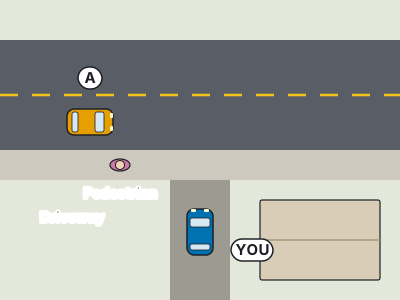
4. A driver enters a road from a driveway. To whom must the driver yield?
- No one because the driveway is private
- Only traffic approaching from the left
- Only traffic approaching from the right
- Vehicles already on the main road
Show answer
Vehicles already on the main road. Traffic already traveling on the main road has priority over a vehicle emerging from a driveway, alley, or roadside. The driver entering must look for traffic in both directions and wait for a safe opening. A private driveway does not grant priority, and the left-only or right-only choices ignore vehicles approaching from the other side. The maneuver should begin only after the roadway is clear enough to merge.
Study this in the handbook: Right of Way at Intersections
5. How should a driver approach an intersection controlled by a flashing yellow light?
- Stop and remain stopped until green
- Proceed with caution
- Accelerate without checking cross traffic
- Turn around before entering the intersection
Show answer
Proceed with caution. A flashing yellow signal allows movement, but it tells the driver to approach carefully and watch for conflicts. It is not a stop command like a flashing red signal, so remaining stopped until green is unnecessary. Accelerating without checking cross traffic discards the caution instruction, and turning around is unrelated. Reduce speed, scan the intersection for vehicles and pedestrians, and proceed only when the movement can be completed safely.
Study this in the handbook: Traffic Lights and Arrows
6. You are driving on a multilane highway and approach a stopped law enforcement vehicle with its lights on. What does Arkansas law require when possible?
- Stop in the lane beside the law enforcement vehicle
- Change to the farthest lane from the stopped vehicle
- Pass in the nearest lane after sounding your horn
- Turn around before reaching the stopped vehicle
Show answer
Change to the farthest lane from the stopped vehicle. On a multilane highway, move to the farthest lane away from a stopped law enforcement vehicle with its lights turned on whenever changing lanes is possible. The rule creates working space beside the shoulder for officers and people involved in the stop. Stopping beside the vehicle leaves traffic close to the hazard, while a horn does not provide the required separation. If a lane change cannot be made safely, reduce speed and use due caution as you pass. A useful roadside cue is flashing emergency lighting beside a stationary authorized vehicle: create maximum lateral distance before continuing.
Study this in the handbook: Emergency Vehicles and the Move Over Law
7. When is driving on an Arkansas sidewalk allowed?
- Only during a school dismissal period
- Whenever no pedestrian is visible
- Whenever the vehicle is moving below 5 mph
- Only to cross it while entering or exiting a driveway, alley, or parking lot
Show answer
Only to cross it while entering or exiting a driveway, alley, or parking lot. Driving on a sidewalk is illegal except for the brief crossing needed to enter or leave a driveway, alley, or parking lot. The exception does not depend on a low speed, an empty-looking sidewalk, or school hours. Even during that permitted crossing, the driver must yield to pedestrians. Think of the sidewalk as a pedestrian space that a vehicle may cross carefully, not a lane for travel.
Study this in the handbook: Right of Way at Intersections
8. A person under 21 convicted of buying or possessing alcohol may face what driving-related consequence?
- A permanent Class D license upgrade
- Automatic restoration of all driving privileges
- Only a warning with no licensing effect
- Suspension, revocation, or disqualification of driving privileges
Show answer
Suspension, revocation, or disqualification of driving privileges. An under-21 alcohol purchase or possession conviction can affect driving privileges through suspension, revocation, or disqualification. The wording does not promise that every case receives the same result, but it clearly allows a licensing consequence. The warning-only choice understates the risk, while automatic restoration and a Class D upgrade are unrelated outcomes. Young drivers should treat alcohol violations as matters that can reach beyond a fine.
Study this in the handbook: Drivers Under 21 and Alcohol
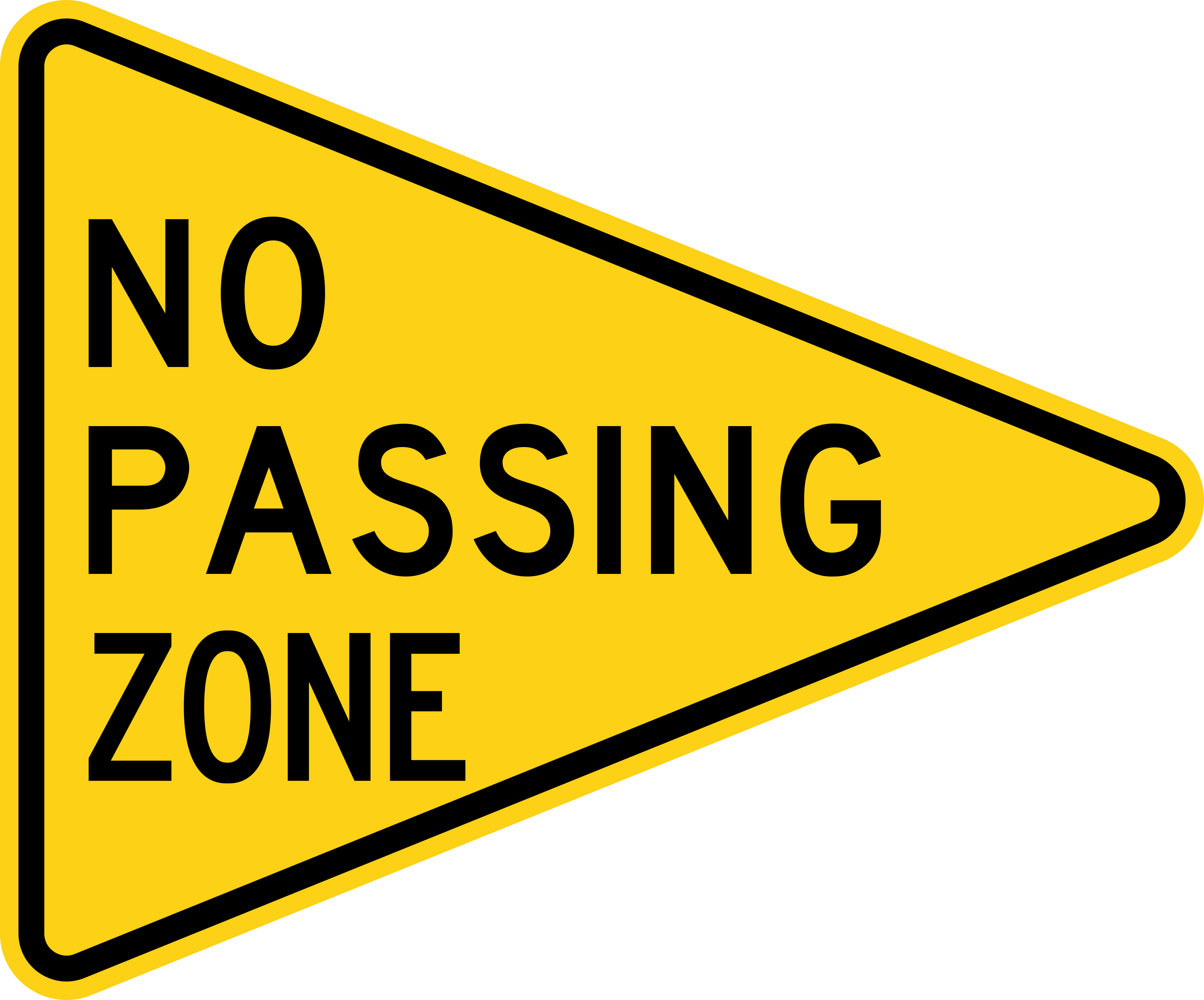
9. What does the pennant-shaped sign shown here identify on a two-lane road?
- A railroad crossing that is exempt from stopping
- A no passing zone
- A lane reserved for slow moving vehicles
- A temporary detour around a work zone
Show answer
A no passing zone. The pennant shape is used for a no passing zone sign on a two-lane road. It tells the driver that passing is prohibited in the marked area, so the vehicle should remain behind the slower traffic until the restriction ends and a legal opportunity appears. The railroad choice refers to a different sign, and the slow vehicle choice describes a warning triangle rather than this pennant. Do not judge the pass only by whether the road looks empty. The sign marks a roadway condition where sight distance, hills, curves, or opposing traffic make overtaking unsafe.
Study this in the handbook: Warning and Railroad Crossing Signs
10. Which roadway warning sign is listed in the Arkansas manual?

- Left Turn Required
- No Vehicles May Merge
- One-Way Street Ends
- Merging Traffic
Show answer
Merging Traffic. Merging Traffic is one of the common warning signs shown in the roadway signs section. The warning alerts drivers to a traffic pattern that may require attention to vehicles joining or combining with their lane. The other choices describe restrictions or directions that are not listed in this group of warning signs. Begin checking mirrors and the adjacent lane early, reduce speed if needed, and leave enough space for traffic entering the roadway.
Study this in the handbook: Stop, Yield and Regulation Signs
11. On a 90 degree day, how quickly does the inside of a closed vehicle reach the outdoor temperature, according to the Arkansas guide?
- Within about five minutes
- Within about an hour
- Only after half an hour
- It never gets hotter than outdoors
Show answer
Within about five minutes. The guide warns that within five minutes on a 90 degree day the inside of a vehicle reaches the outdoor temperature, and every nine minutes after that it rises another 15 degrees. An hour or half an hour greatly overstates how long it takes, and a parked car does get hotter than the outdoors because heat is trapped inside. Prior air conditioning does not keep it cool, so never leave children or pets unattended.
Study this in the handbook: Seat Belts, Child Seats and Littering
12. Under the Arkansas seat belt law, which adults must wear a safety belt?
- Only the driver
- Only passengers over 65
- The driver and the front-seat passenger
- No one if the car has airbags
Show answer
The driver and the front-seat passenger. Arkansas law makes it illegal to drive or to be a front seat passenger without a safety belt, and since June 30, 2009 an officer can stop a vehicle for that violation alone. The fine is up to $25 plus court costs. Limiting the rule to the driver misses the front passenger, the age choice is invented, and airbags do not replace belts. Children under 15 must wear appropriate restraints while the vehicle is in motion.
Study this in the handbook: Seat Belts, Child Seats and Littering
13. How close to a crosswalk at an intersection may you park in Arkansas?
- No closer than 20 feet
- No closer than 10 feet
- No closer than 50 feet
- Right up to the crosswalk line
Show answer
No closer than 20 feet. Arkansas prohibits parking within 20 feet of a crosswalk at an intersection. Ten feet and the edge of the line are too close, and 50 feet is the railroad crossing distance. Twenty feet is also the distance from a fire station driveway on the same side of the street, which is why these two are easy to mix up. Parking is also banned in an intersection and within 30 feet of a traffic signal, stop sign, or yield sign.
Study this in the handbook: Parking Rules and Accessible Parking
14. What does eating food do if you are drinking alcohol, according to the Arkansas guide?
- It prevents intoxication
- It speeds up sobering
- It slows the rate alcohol enters the blood but does not prevent intoxication
- It cancels out one drink per meal
Show answer
It slows the rate alcohol enters the blood but does not prevent intoxication. Food slows the rate at which alcohol enters the blood, but it will not prevent you from becoming intoxicated. It does not speed sobering or cancel drinks. The only thing that sobers you up is time; coffee, fresh air, exercise, or a cold shower will not help. The body rids itself of alcohol at about one drink per hour. A single drink is 1.5 ounces of 80 proof liquor, a 6 ounce glass of wine, or a 12 ounce beer.
Study this in the handbook: Drinking and Driving
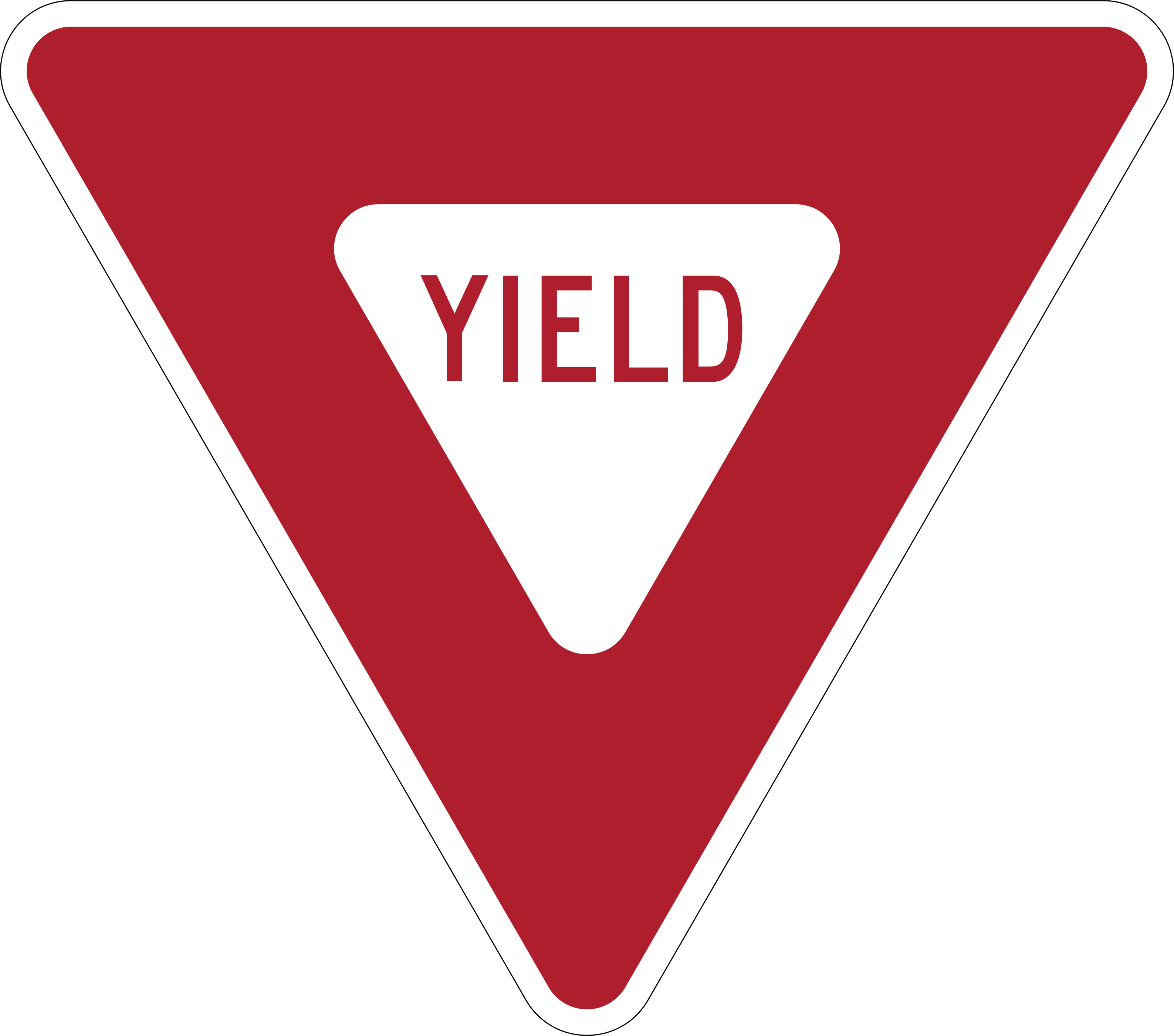
15. What does an Arkansas yield sign require a driver to do?
- Accelerate so crossing traffic must wait
- Stop every time before entering the intersection
- Slow down, yield to traffic, and stop when necessary
- Yield only to vehicles approaching from the left
Show answer
Slow down, yield to traffic, and stop when necessary. A yield sign calls for reduced speed and right of way to traffic in the intersection or to traffic the driver is crossing or entering. Stop when necessary, but do not treat the sign as an automatic stop in every empty situation. Accelerating reverses the instruction, and the duty is not limited to vehicles coming from one side. Look for vehicles and pedestrians, ease toward the intersection, and be prepared to stop. A useful memory cue is that yield controls who proceeds first, while the stop decision depends on whether giving way requires it.
Study this in the handbook: Stop, Yield and Regulation Signs
16. When must Arkansas drivers turn on their headlights?
- 30 minutes after sunset, 30 minutes before sunrise, or whenever you cannot see a person or object clearly within 500 feet
- Only after full darkness
- Only when it rains
- From 9 p.m. to 5 a.m.
Show answer
30 minutes after sunset, 30 minutes before sunrise, or whenever you cannot see a person or object clearly within 500 feet. Turn on your headlights a half hour after sunset, a half hour before sunrise, or anytime you cannot see a person or object clearly within 500 feet. Parking lights are for parked cars, and it is illegal in Arkansas to drive using only parking lights. Use high beams when no vehicles are oncoming, and dim them for approaching traffic and when following another vehicle.
Study this in the handbook: Headlights, Horn and Signals
17. What must a driver do at a stop sign when an obstruction blocks the view of the intersection?
- Stop in the middle of the intersection
- Roll through slowly because the view is blocked
- Proceed without stopping if no vehicle is immediately visible
- Stop completely, then pull forward carefully to see
Show answer
Stop completely, then pull forward carefully to see. A blocked view does not remove the stop-sign obligation. First make a complete stop, then creep forward only enough to obtain a safe view of the crossing traffic. Rolling through the first stopping point can violate the rule and expose the vehicle to a hidden road user. Stopping in the intersection creates a new obstruction. Use the marked stop line or crosswalk when present, pause, look, and advance cautiously for the second sight check.
Study this in the handbook: Traffic Lights and Arrows
18. At an intersection without a stop sign or traffic signal, which vehicle should yield?
- The vehicle on the right must always yield
- The vehicle approaching from the left yields to the vehicle on the right
- The vehicle traveling faster has priority
- Neither vehicle yields because there is no sign
Show answer
The vehicle approaching from the left yields to the vehicle on the right. When an intersection has no stop sign or traffic signal, drivers must yield to vehicles approaching from the right. The rule resolves the order of movement even when no control device is present. Reversing that relationship creates a collision risk, and speed does not establish priority. The absence of a sign does not remove the duty to yield. Approach slowly enough to identify traffic from both directions, then allow the vehicle on the right to proceed first. Continue to watch for pedestrians and never rely on a technical priority to justify entering when the path is not safe.
Study this in the handbook: Right of Way at Intersections
19. When are Arkansas drivers required to turn on their headlights because of weather?
- Only when following another vehicle within 200 feet
- Only when driving after midnight
- When windshield wipers are needed because of rain, snow, or fog
- Whenever the parking lights are easier to see
Show answer
When windshield wipers are needed because of rain, snow, or fog. Arkansas requires headlights when windshield wipers are needed, including rainy, snowy, or foggy conditions. The lights help the driver see and help other road users notice the vehicle. Midnight is not the trigger, and the 200 foot rule concerns low beams when following another vehicle rather than the weather requirement. Parking lights alone are not a lawful substitute for driving with headlights. Turn them on as soon as weather requires the wipers, then use a speed and following gap that match the reduced visibility and traction.
Study this in the handbook: Headlights, Horn and Signals
20. Who may hold an Arkansas Motorized Bicycle Certificate, and what does it allow?
- Persons ages 14 to 16, to operate a motorized bicycle or motorcycle of 50 cc or less
- Anyone over 18, for any motorcycle
- Persons under 14, for electric scooters
- Persons ages 16 to 18, for motorcycles up to 250 cc
Show answer
Persons ages 14 to 16, to operate a motorized bicycle or motorcycle of 50 cc or less. The Motorized Bicycle Certificate is a restricted certificate issued to persons between the ages of 14 and 16. It limits the holder to a motorized bicycle or motorcycle displacing 50 cubic centimeters or less. Larger motorcycles require a motorcycle license or endorsement with its own knowledge and skills testing. The certificate is a first step toward riding, not a general license.
Study this in the handbook: Who Needs a License and Vision Rules
QualitySpace is expanding to Arkansas
We are a California-based independent insurance brokerage working on licensing in more states. We cannot help with Arkansas insurance yet. Leave your email and we will let you know when we can.
Every question is written from the official Arkansas Driver License Study Guide. Need paper? Printable AR practice test with answer key.
Last verified 2026-10-05. How we check every question · Study all 200 as flashcards
Frequently asked questions
How many questions are on this Arkansas practice test?
This fixed set has 20 questions. It is test 2 of 10 from the 200 question Arkansas bank.
How does this fixed test relate to the full Arkansas bank?
Each numbered test is a fixed set of questions in a fixed order, so you can retake the same test later and compare. Every test mixes road signs and the other topics in about the same proportion as the full bank. Tests 1 to 10 together cover every question in the Arkansas bank once. The full practice page mixes the whole bank at random.
Last verified 2026-10-05. See the Arkansas DMV facts page for sourced state details.
Return to the full Arkansas practice test · Study road signs