
Test 17 of 25 · 20 questions · Free 2026
AR Permit Practice Test 17
Jump to the test ↓A fixed 20 question set from the Arkansas bank with answers and plain English explanations.
Question 1 of 20 · 0 right so far
All 20 questions in test 17
Every question below comes from the Arkansas question bank on this page. Open a question to see the correct answer and the explanation. Nothing here is hidden behind a signup.
1. Where must a driver never block or stop the vehicle in Arkansas?
- At a stop line
- In a parking space
- On the shoulder after a breakdown
- In a crosswalk
Show answer
In a crosswalk. A crosswalk must stay clear so people on foot can cross without stepping around a stopped vehicle. Arkansas tells drivers never to block or stop a vehicle within a crosswalk, and to watch for pedestrians in or near crosswalks at red lights. Stopping at a stop line is required at stop signs, and parking in a parking space is normal lawful parking. A breakdown stop on the shoulder can be necessary in an emergency. Keep the crosswalk open at all times.
Study this in the handbook: Traffic Lights and Arrows
2. Your vehicle has antilock brakes and you must stop very fast. How should you use the brake pedal?
- Pump it quickly to avoid sliding into a skid
- Press lightly and release in short taps
- Press hard and then let up when it pulses
- Press as hard as you can and keep pressing
Show answer
Press as hard as you can and keep pressing. The guide says that if you have an antilock braking system and need to stop quickly, you should press on the brake pedal as hard as you can and keep pressing on it. You might feel the brake pedal pushing back when the ABS is working, and you should not let up, because the ABS system will only work with the pedal pushed down. Pumping or releasing the pedal defeats the system.
Study this in the handbook: Vehicle Emergencies and Crashes
3. What does alcohol do to a driver's reflexes, vision, and alertness according to the Arkansas guide?
- It slows reflexes, blurs vision, and dulls alertness
- It speeds up your reflexes but still blurs your vision
- It sharpens your vision but slows down your alertness
- It helps alertness for a short time only
Show answer
It slows reflexes, blurs vision, and dulls alertness. The guide says alcohol slows your reflexes and reaction time, reduces your ability to see clearly, and makes you less alert. As the amount of alcohol in your body increases, judgment worsens and skills decrease, which causes problems judging distances, speeds, and the movement of other vehicles. By the time you feel the effect, your judgment is already severely affected.
Study this in the handbook: Drinking and Driving
4. In Arkansas, trouble appears ahead and stopping in time looks doubtful. Why should you think about turning instead?
- Turning always needs less room than stopping
- Turning lets you keep full speed safely
- A vehicle can often be turned quicker than stopped
- A turn works even with locked front wheels
Show answer
A vehicle can often be turned quicker than stopped. Steering can change your path in less time and distance than braking needs to kill all forward speed. That is why a quick lane change or turn onto a clear escape route can beat a late stop attempt. Turning does not always need less room, so check that the new path is clear first. Keeping full speed shrinks your control and your margin for error. Locked front wheels slide straight ahead, so ease off enough to roll. Pick the escape path early and commit to it smoothly.
Study this in the handbook: Vehicle Emergencies and Crashes
5. After you pass the pictured sign, the light ahead turns to a steady yellow as you approach. What should you do?
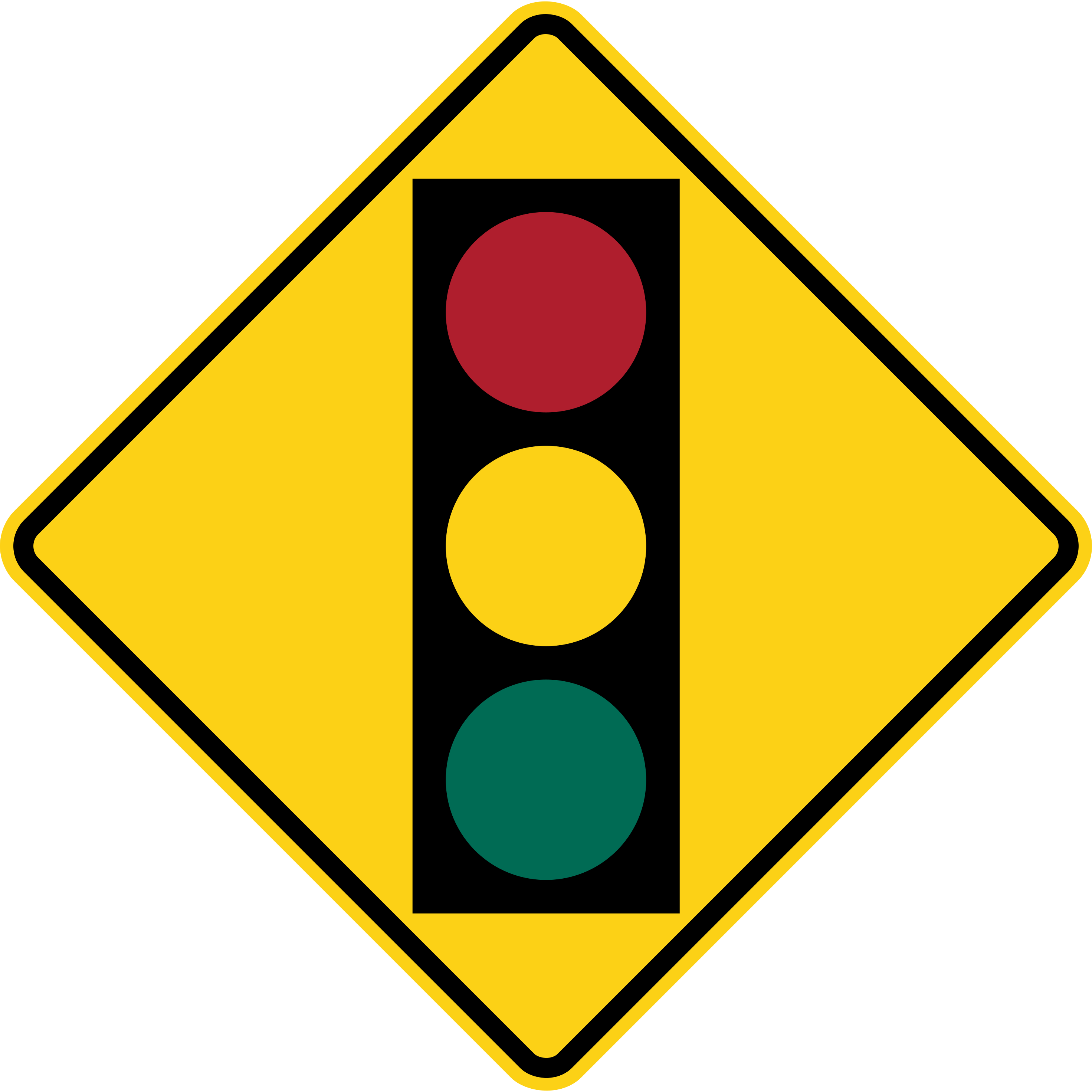
- Stop if it is safe to do so
- Speed up to clear the light before it turns red
- Slow down and go through without stopping
- Stop only if cross traffic is already moving
Show answer
Stop if it is safe to do so. The guide says a steady yellow light means caution and that the traffic signal is changing from green to red. You must stop if it is safe to do so, and if you are already stopped at an intersection or a stop line you may not proceed. Speeding up to beat the red or rolling through treats the yellow as an invitation to go, which it is not.
Study this in the handbook: Traffic Lights and Arrows
6. You drive at night on an unfamiliar road with no oncoming traffic and people may be walking near the edge. What does the guide suggest?
- Use your high beams to see approaching objects
- Use only your parking lights to avoid glare
- Keep the low beams on and drive faster
- Turn off the headlights to let your eyes adjust
Show answer
Use your high beams to see approaching objects. The guide says to use your high beams whenever there are no oncoming vehicles, and that on unfamiliar roads, in construction zones, or where there may be others along the side of the road you should use high beams to see approaching objects. High beams let you see twice as far as low beams. You must dim them when you come within 500 feet of an oncoming vehicle.
Study this in the handbook: Headlights, Horn and Signals
7. You have trouble seeing others while driving in Arkansas. What should you do with your headlights?
- Switch to parking lights while still moving
- Turn them off until it is fully dark
- Turn them on so others can see you better
- Use them only after another driver flashes first
Show answer
Turn them on so others can see you better. Headlights do two jobs at night and in poor light. They help you see the road, and they help other people see your vehicle sooner. If you are struggling to spot others, they may also be struggling to spot you. Turning the lights on early makes your car stand out in rain, dusk, or shadow. Waiting until darkness is complete leaves a gap where your vehicle can blend into the background.
Study this in the handbook: Headlights, Horn and Signals
8. In Arkansas, what do railroad crossing warning signs warn drivers about?
- The possibility of a train at the crossing just ahead
- A train station located within one mile of the crossing
- Trains crossing the road only during daylight hours
- A train that already passed through the crossing safely
Show answer
The possibility of a train at the crossing just ahead. Railroad crossing warning signs give early notice that tracks cross the road and a train could be near. Treat every such sign as a reason to slow down, look along the tracks in both directions, and listen before you reach the rails. The sign does not report a train that already passed, and it does not limit trains to daylight hours or point out a station. Trains can arrive at any time, so prepare to stop whenever the warning appears on your approach.
Study this in the handbook: Warning and Railroad Crossing Signs
9. When entering an Arkansas roadway from a curb or driveway, which road users need an especially careful look?
- Delivery trucks, buses, and vans with bright lights
- Parked trailers, campers, and cars inside garages
- Motorcycles, bicycles, and people walking nearby
- Tow trucks and road crews on duty here
Show answer
Motorcycles, bicycles, and people walking nearby. Small road users are easy to overlook when a driver pulls away from a curb or leaves a driveway. A motorcycle, bicycle, or person on foot may be hidden behind a parked car and may arrive sooner than the driver expects. Large trucks and parked equipment are visible obstacles, but they are not the group the guide singles out for this careful look. Scan both ways with smaller users in mind before entering the roadway.
Study this in the handbook: Turns, Lane Changes and Passing
10. A train far down the Arkansas tracks looks slow and distant. What driving error must you avoid?
- Check the far track carefully before starting across
- Wait before the rails while you gain a clearer view
- Stop quietly on the rails themselves to study the closing gap
- Judge the closing train as slower than it truly is moving
Show answer
Judge the closing train as slower than it truly is moving. Trains fool the eye because a large front with few nearby reference points can look slow while closing very fast. Distance shrinks quicker than most drivers expect at a crossing. When doubt exists, wait before the rails and let the train pass first. Looking along every track and pausing for a better view both add safety. A gap that feels generous can vanish during a stall or a slow climb across rough rails near the crossing.
Study this in the handbook: Warning and Railroad Crossing Signs
11. A blind pedestrian with a white cane is near your path in Arkansas. What should you avoid doing?
- Slowing down to give the person more room
- Watching the cane and the person movement
- Blasting your horn at the person
- Waiting until your path is fully clear
Show answer
Blasting your horn at the person. A horn blast gives a blind walker noise without a clear direction, and a startle can cause a step into traffic. Quiet patience works better. Slow down, stop when needed, and watch how the cane sweeps and where the person turns. Extra room protects against a sudden change in direction. Moving before the path clears risks contact with someone who cannot see your car. Let the person settle on a course, then proceed slowly with a wide margin.
Study this in the handbook: Right of Way at Intersections
12. Before a trip you notice a safety belt is twisted instead of lying flat. Why should you straighten it?
- A twisted belt locks up and can no longer be unlatched
- A twist leaves less surface to spread crash force
- A twisted belt will not fit across the lap
- A twisted belt makes the buckle click louder
Show answer
A twist leaves less surface to spread crash force. The guide says to check that seat belts are not twisted and that they lie flat across your upper chest and upper thigh. If a belt becomes twisted, the pressure that would occur in a collision has less surface area on which to be distributed, so more force is concentrated on a smaller part of your body. A flat belt spreads the force over a larger area and protects you better.
13. You need to watch traffic beside you while your main focus stays on the road ahead. How should you check the sides?
- Turn your head fully and hold the look for a while
- Rely on your peripheral vision alone
- Use your side mirrors and glance to the side
- Check only when another car honks
Show answer
Use your side mirrors and glance to the side. The guide says that peripheral vision lets you spot vehicles and other trouble on either side of you while you look ahead. But because you cannot focus on things to the side, you should use your side mirrors and glance to the side. Holding a look away from the road takes your eyes off what is ahead, and relying on peripheral vision alone gives you only a blurry view.
14. A lane is too narrow for a car and a bicycle to share safely. What is the safest way to handle it?
- Pass closely and keep to the center line
- Let the bicycle take the full lane
- Follow and honk until the rider moves right
- Pass on the left shoulder when you can
Show answer
Let the bicycle take the full lane. The guide lists times when a bicyclist should be allowed full use of the lane, and one is when the lane is too narrow for both a car and a bicycle to safely share it. In that case it is safest to let the bicycle take the full lane. A close pass in a narrow lane squeezes the rider, and honking pressures the rider to move into a hazard.
Study this in the handbook: Trucks, Motorcycles and Bicycles
15. You are in an intersection when an ambulance with its siren comes up behind you. What should you do?
- Stop in the intersection and let it pass
- Pull to the right edge of the intersection at once
- Back up to clear space for the ambulance
- Drive through the intersection, then pull over
Show answer
Drive through the intersection, then pull over. The guide says that when an emergency vehicle is approaching with flashing lights and sirens, you should pull over to the right edge of the road or as near to the right as possible. If you are in an intersection, go ahead and drive through the intersection before pulling over. Stopping inside the intersection blocks the path of the ambulance and the cross traffic.
Study this in the handbook: Emergency Vehicles and the Move Over Law
16. Traffic moves steadily ahead, but you keep catching and passing one car after another. What risk grows from this habit?
- Your tires wear out faster on the highway
- Each pass adds another chance of a collision
- The cars you pass will lose their right of way
- Your following distance shrinks to zero at once
Show answer
Each pass adds another chance of a collision. The guide explains that if you are going faster than other traffic, you will have to keep passing vehicles, and each time you pass another vehicle there is a chance of a collision. The car you pass may change lanes suddenly, or on a two-lane road an oncoming car may appear. The guide advises slowing down and keeping pace with other traffic, since speeding does not save more than a few minutes an hour.
Study this in the handbook: Speed Limits and Road Conditions
17. Two slow cars are ahead of you on a two-lane Arkansas road. How does the guide say to pass them?
- Pass one vehicle at a time
- Pass both at once with one burst of speed
- Count on enough time to clear them together
- Pass the pair as soon as you see a short gap
Show answer
Pass one vehicle at a time. The guide's passing distance rule says that whenever signs and road markings allow you to pass, you must judge whether you have enough space and time. It warns you not to count on having enough time to pass several cars at once, and it says that, as a rule, you should pass only one vehicle at a time. When passing a vehicle you must judge whether or not you have enough space and time to safely pass, so judge it again for each vehicle.
Study this in the handbook: Stopping Distance and Following
18. A motorcyclist rides near you as large trucks pass in the other lane. Why should you give the rider extra room?
- Motorcycles cannot slow down quickly in dry weather
- A wind gust can push it across a whole lane
- Motorcycles need two full lanes to turn safely
- Trucks passing force riders to stop at once
Show answer
A wind gust can push it across a whole lane. The guide says a strong gust of wind can move a motorcycle across an entire lane if the rider is not prepared for it, and that wind gusts from large trucks in the other lane can be a hazard. Giving the rider extra room means that a sudden push will not carry the motorcycle into your path. The guide also says motorcycles are entitled to a full lane.
Study this in the handbook: Trucks, Motorcycles and Bicycles
19. Why can a wide right turn in Arkansas confuse the driver behind you?
- It hides both brake lights so the driver behind cannot tell the vehicle is slowing down at all
- It makes the turn signal cancel early so the driver behind thinks the turn was called off
- It looks like the vehicle is parking, so the driver behind may stop and wait in the lane
- It looks like a lane change or a left turn, so that driver may pass on your right
Show answer
It looks like a lane change or a left turn, so that driver may pass on your right. A wide right turn swings the vehicle in a way that can look like a lane change or the start of a left turn. The driver behind may read that swing wrongly and try to pass on the right, straight into the path of the turn. Brake lights stay visible during the swing, and the signal keeps working until the driver turns it off. The turn also does not resemble parking when the vehicle keeps moving. Keep the turn tight so the driver behind reads it correctly.
20. When turning in Arkansas, which lane error must a driver avoid?
- Entering the closest lane after completing the turn
- Crossing over into the opposite lane of traffic
- Signaling well before reaching the turn area
- Slowing the vehicle before reaching the corner
Show answer
Crossing over into the opposite lane of traffic. A turning driver must stay out of the opposite lane of traffic. Swinging across that lane puts the vehicle head on with drivers who expect their lane to stay clear. Entering the closest lane is exactly what Arkansas asks drivers to do when no signs or markings say otherwise. Signaling before the turn warns others, and slowing before the corner keeps control. A tight, lawful path into the near lane keeps everyone in the lane they expect.
Every question is written from the official Arkansas Driver License Study Guide. Need paper? Printable AR practice test with answer key.
Last verified 2026-10-05. How we check every question · Study all 500 as flashcards
Frequently asked questions
How many questions are on this Arkansas practice test?
This fixed set has 20 questions. It is test 17 of 25 from the 500 question Arkansas bank.
How does this fixed test relate to the full Arkansas bank?
Each numbered test is a fixed set of questions in a fixed order, so you can retake the same test later and compare. Every test mixes road signs and the other topics in about the same proportion as the full bank. Tests 1 to 25 together cover every question in the Arkansas bank once. The full practice page mixes the whole bank at random.
Last verified 2026-10-05. See the Arkansas DMV facts page for sourced state details.
Return to the full Arkansas practice test · Study road signs