
Test 5 of 10 · 20 questions · Free 2026
AR Permit Practice Test 5
Jump to the test ↓A fixed 20 question set from the Arkansas bank with answers and plain English explanations.
Question 1 of 20 · 0 right so far
All 20 questions in test 5
Every question below comes from the Arkansas question bank on this page. Open a question to see the correct answer and the explanation. Nothing here is hidden behind a signup.
1. For a first littering conviction in Arkansas, what is the maximum fine described in the study guide?
- $250
- $500
- $1,000
- $2,000
Show answer
$1,000. The first-offense littering penalty can reach one thousand dollars, with community service also possible. Two thousand dollars is associated with subsequent convictions, so it is too high for the first offense described here. The smaller amounts understate the maximum. A quick way to separate the figures is to pair first conviction with 1,000 and later convictions with 2,000, while remembering that the guide also mentions eight and twenty-four hours of community service respectively.
Study this in the handbook: Seat Belts, Child Seats and Littering
2. What should an Arkansas driver do when rain or ice makes the posted speed unsafe?
- Maintain the posted number because it is always safe
- Adjust speed to current road conditions
- Increase speed to reduce time on the road
- Use the posted speed only after turning on hazard lights
Show answer
Adjust speed to current road conditions. Arkansas treats posted speed limits as values for ideal conditions. Rain, ice, poor visibility, and heavy traffic can require a lower safe speed, even when the vehicle remains under the numerical limit. Maintaining the sign's number ignores the condition-based duty, and increasing speed makes stopping harder. Hazard lights do not create a special exception. The useful cue is that a posted limit is a ceiling for ideal conditions, not a promise that the same speed fits every roadway situation.
Study this in the handbook: Speed Limits and Road Conditions
3. How much following space should a driver allow behind a motorcycle?
- At least four to six seconds
- The same one second used behind a passenger car
- One car length at every speed
- No more than two seconds because motorcycles stop quickly
Show answer
At least four to six seconds. The guide calls for at least four to six seconds when following a motorcycle. The guide explains that this cushion gives the motorcyclist enough time to maneuver or stop in an emergency, since even slight contact can mean a spill or injury for the rider. A fixed car length changes meaning with speed, while one or two seconds may leave too little room for a sudden maneuver. Choose a stationary reference, count after the motorcycle passes it, and increase the gap further for wet pavement, gravel, metal surfaces, or other conditions that can reduce the rider's stability.
Study this in the handbook: Trucks, Motorcycles and Bicycles
4. What information does an Emergency Notification System sign at a highway rail crossing provide?
- A detour route for every nearby road
- The train's exact arrival time and speed
- The posted speed limit for the highway
- A railroad contact and the specific crossing identification
Show answer
A railroad contact and the specific crossing identification. An Emergency Notification System sign supplies critical contact information for a highway rail crossing. It lets the public reach the railroad responsible for that crossing and identify the specific crossing during an emergency. It is not a timetable, speed display, highway speed limit sign, or universal detour map. If a vehicle is stuck, a crossing signal malfunctions, or another rail emergency occurs, read the sign and report the location accurately. Knowing that the sign connects a caller to both the railroad and the crossing location makes it useful even when no train is visible.
Study this in the handbook: Warning and Railroad Crossing Signs
5. What does a dashed white line between lanes of traffic indicate?
- The lane is reserved for emergency vehicles
- Passing is prohibited in both directions
- You may cross it to change lanes when safe
- Traffic on the other side travels toward you
Show answer
You may cross it to change lanes when safe. A dashed white line separates lanes moving in the same direction and indicates that a driver may cross it to change lanes when the movement is safe. It does not mark opposing traffic, which is identified by yellow markings. It also does not create an emergency-only lane or ban every lane change. Before crossing, check mirrors and blind spots, signal, and confirm that the destination lane has enough space. The word dashed is the visual cue: white plus broken means same-direction lanes with a permitted change when conditions allow.
Study this in the handbook: Pavement Markings and Lane Use
6. What must a driver do when pedestrians are in or about to enter a crosswalk?

- Stop only if the crosswalk has a traffic signal
- Sound the horn and continue first
- Pass through the crosswalk before they enter
- Yield to the pedestrians
Show answer
Yield to the pedestrians. Arkansas directs a driver to yield to pedestrians who are in a crosswalk or about to enter one. Yielding means reducing speed or stopping as needed so the person can cross safely, rather than using the vehicle to claim space. The horn choice does not replace the duty to yield, and crossing before a pedestrian enters defeats the protection the rule provides. The duty is not limited to signalized crosswalks. Watch the edges of the roadway and the crossing path, especially where a person may step forward unexpectedly, and leave enough room to stop smoothly.
Study this in the handbook: Pedestrians, Sidewalks and Traffic Circles
7. What does a broken yellow line between opposing lanes indicate?
- Passing is prohibited in both directions
- A driver may cross to pass if no opposing traffic is present
- The lane is reserved for emergency vehicles
- The roadway has become one-way
Show answer
A driver may cross to pass if no opposing traffic is present. A broken yellow line between opposing lanes permits a driver to cross to pass when no opposing traffic is present. That permission is conditional, so the driver must still check sight distance, speed, and the full path before moving left. A solid double yellow line has the opposite passing rule, and neither an emergency reservation nor one-way travel is created by this broken marking. Use the break as a possible passing cue, then make the safety check before crossing it.
Study this in the handbook: Pavement Markings and Lane Use
8. What should the driver anticipate after seeing this yellow curve warning sign?

- A curve ahead that calls for slower speed before entering
- A mandatory right turn at the next intersection
- A detour that permits driving through a work zone
- A straight roadway where speed may be increased
Show answer
A curve ahead that calls for slower speed before entering. A curved-arrow warning identifies a change in roadway direction ahead. Slow before entering the curve so the vehicle is already controlled when sight distance and lane alignment change. The sign is not a mandatory intersection turn, a work-zone detour, or an invitation to accelerate on a straight segment. Warning signs advise drivers to slow and prepare for a hazard or special situation ahead. Let the arrow shape guide your eyes toward the bend, then maintain a speed suitable for the pavement and visibility.
Study this in the handbook: Slippery Roads and Hydroplaning
9. How close to a railroad crossing may you park in Arkansas?
- No closer than 15 feet
- No closer than 100 feet
- No closer than 50 feet
- No closer than 20 feet
Show answer
No closer than 50 feet. Arkansas prohibits parking within 50 feet of a railroad crossing. Fifteen feet is the hydrant distance, 20 feet is the crosswalk and fire station distance, and 100 feet is not the Arkansas parking figure. A car parked near the tracks can block the view of drivers watching for trains. School buses, by law, must stop at every railroad crossing, and drivers behind them should expect it.
Study this in the handbook: Parking Rules and Accessible Parking
10. When must you dim your high beams for an oncoming vehicle in Arkansas?
- Within 1,000 feet
- Within 200 feet
- Within 500 feet
- Only if the other driver flashes you
Show answer
Within 500 feet. Arkansas tells drivers to dim high beams whenever they come within 500 feet of an oncoming vehicle. Waiting until 200 feet or for the other driver to flash you leaves them blinded too long, and 1,000 feet is not the Arkansas figure. Use high beams when there is no oncoming traffic, since they let you see twice as far as low beams.
Study this in the handbook: Headlights, Horn and Signals
11. A driver's license was revoked in another state. When can that driver qualify for an Arkansas license?
- Immediately, since Arkansas ignores other states
- After 30 days
- Only after 10 years
- Once one year has passed from the revocation
Show answer
Once one year has passed from the revocation. An applicant must not be suspended, revoked, expired, or denied by Arkansas or any other state, or one year must have passed from any revocation. Arkansas does consider other states' actions, so qualifying immediately is wrong. Thirty days is the out of state expiration window, not a revocation period, and ten years is not in the guide. Applicants also cannot have judgments pending for a moving traffic violation.
Study this in the handbook: Who Needs a License and Vision Rules
12. How long do you have to file a crash report with the Arkansas Office of Driver Services?
- Within 24 hours
- Within 10 days
- Within 30 days
- Within one year
Show answer
Within 30 days. The crash report must be filed within 30 days of the accident. If you are injured and unable to complete it, someone may file on your behalf. Twenty four hours and ten days are shorter than the rule, and one year is far longer. Forms are available at Office of Driver Services offices or from most insurance agents. The report is required for injury, death, or more than $3,000 in damage to one person's property.
Study this in the handbook: Vehicle Emergencies and Crashes
13. With a green light and no green arrow, a driver waiting to turn left should:
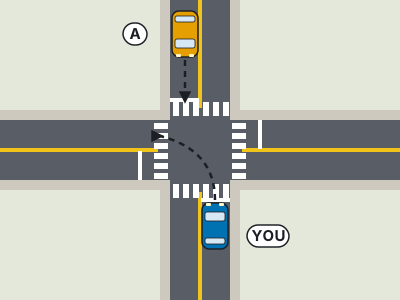
- Turn immediately before opposing vehicles arrive
- Yield to oncoming traffic, then turn when the way is clear
- Remain stopped until the signal becomes red
- Assume opposing vehicles must stop for the green light
Show answer
Yield to oncoming traffic, then turn when the way is clear. A green circular signal permits movement, but it does not protect a left turn. Arkansas says a driver stopped on a green light must let opposing traffic already in the intersection clear before proceeding, and drivers turning left must yield to oncoming cars traveling straight ahead. Turning immediately could cut across a vehicle going straight, and opposing drivers have no duty to stop for your green. Waiting for red is not the rule. A light green arrow is the protected left turn indication.
Study this in the handbook: Traffic Lights and Arrows
14. At what rate does the body rid itself of alcohol, according to the Arkansas guide?
- About one drink per hour
- About three drinks per hour
- About one drink every 10 minutes
- It depends on coffee intake
Show answer
About one drink per hour. The body rids itself of alcohol at a rate of one drink per hour, where a drink is 1.5 ounces of 80 proof liquor, a 6 ounce glass of wine, or a 12 ounce beer. Specialty drinks can hold several normal drinks. There is no way to sober up quickly; coffee, fresh air, exercise and cold showers do not help. Food slows absorption but does not reduce the alcohol.
Study this in the handbook: Drinking and Driving
15. What penalty can an Arkansas driver face for failing to yield at a yield sign?
- A fine up to $1,000 and a 180 day license suspension
- A warning only
- A $25 fine
- Two points and no fine
Show answer
A fine up to $1,000 and a 180 day license suspension. At a yield sign you must yield to other vehicles and stop when necessary, and a driver who fails to yield could receive a fine of up to $1,000 and suspension of their driver's license for 180 days. The sign itself is a red and white or yellow and black triangle showing YIELD or YIELD RIGHT OF WAY. Slow enough that you can stop if the way is not clear.
Study this in the handbook: Stop, Yield and Regulation Signs
16. How much did Arkansas work zone crashes rise from 2018 to 2021, according to the study guide?
- By about 5 percent
- By more than 70 percent
- They fell by half
- They stayed flat
Show answer
By more than 70 percent. From 2018 to 2021, work zone crashes rose by more than 70 percent in Arkansas, and in 2024 there were more than 1,600 work zone crashes resulting in more than 53 serious injuries or fatalities. Construction and maintenance workers are at high risk from vehicles moving through the area. Fines double in work zones, including mobile work zones marked on the back of ARDOT vehicles.
Study this in the handbook: Work Zones
17. What field of vision does Arkansas require for a driver with two functional eyes?
- 140 degrees, or 105 degrees for a person with one functional eye
- 90 degrees
- 180 degrees
- No field of vision requirement
Show answer
140 degrees, or 105 degrees for a person with one functional eye. Besides visual acuity, your field of vision must be 140 degrees for a person with two functional eyes or 105 degrees for a person with one functional eye. A vision test or a vision referral form is valid for one year from the test date, and referral forms must be completed by an Arkansas optometrist; out of state or online optometrists are not accepted. Peripheral vision is what lets you catch a car entering from the side.
Study this in the handbook: Who Needs a License and Vision Rules
18. When may a driver proceed after stopping for a school bus with flashing red lights?
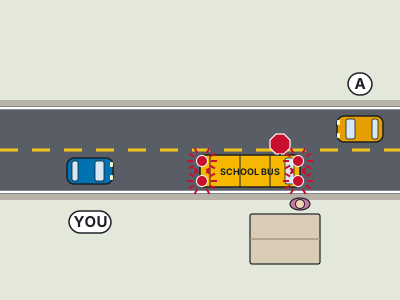
- When an approaching vehicle passes the bus
- As soon as the driver sees no children near the roadway
- After waiting ten seconds, even if the lights remain on
- After the bus begins moving without its red lights flashing
Show answer
After the bus begins moving without its red lights flashing. A stopped school bus controls the roadway until it has completed receiving or discharging passengers and starts moving without its red warning lights flashing. Seeing no child nearby is not enough, because the bus may still be loading or unloading. A ten second delay has no authority in this rule, and another vehicle passing does not release your obligation. The useful cue is the bus status, not a countdown: remain stopped while the red lights flash and wait for movement with those lights off.
Study this in the handbook: Stopping for School Buses
19. Besides passenger stops, where must an Arkansas school bus stop?
- At every intersection with a traffic signal
- At every gas station entrance
- At every hospital driveway
- At every railroad crossing
Show answer
At every railroad crossing. The additional stop required for a school bus is at every railroad crossing. That safety stop is independent of whether children are being loaded or unloaded at that location. The other destinations are not listed as universal stopping points for school buses. A driver following a bus should anticipate the stop, leave space, and avoid treating the absence of children near the roadway as permission to pass.
Study this in the handbook: Stopping for School Buses
20. How far should an Arkansas driver sit from the steering wheel air bag?
- As close as possible
- At least 24 inches
- About 10 inches, measured from the center of the wheel to the breastbone
- Distance does not matter
Show answer
About 10 inches, measured from the center of the wheel to the breastbone. Since the risk zone for driver air bags is the first two to three inches of inflation, placing yourself 10 inches from the air bag provides a clear margin of safety. The distance is measured from the center of the steering wheel to your breastbone. Sitting as close as possible places your body inside that inflation risk zone, which is why the guide gives a specific distance to keep.
Study this in the handbook: Seat Belts, Child Seats and Littering
QualitySpace is expanding to Arkansas
We are a California-based independent insurance brokerage working on licensing in more states. We cannot help with Arkansas insurance yet. Leave your email and we will let you know when we can.
Every question is written from the official Arkansas Driver License Study Guide. Need paper? Printable AR practice test with answer key.
Last verified 2026-10-05. How we check every question · Study all 200 as flashcards
Frequently asked questions
How many questions are on this Arkansas practice test?
This fixed set has 20 questions. It is test 5 of 10 from the 200 question Arkansas bank.
How does this fixed test relate to the full Arkansas bank?
Each numbered test is a fixed set of questions in a fixed order, so you can retake the same test later and compare. Every test mixes road signs and the other topics in about the same proportion as the full bank. Tests 1 to 10 together cover every question in the Arkansas bank once. The full practice page mixes the whole bank at random.
Last verified 2026-10-05. See the Arkansas DMV facts page for sourced state details.
Return to the full Arkansas practice test · Study road signs