
Test 2 of 10 · 20 questions · Free 2026
CT Permit Practice Test 2
Jump to the test ↓A fixed 20 question set from the Connecticut bank with answers and plain English explanations. The real CT exam is 25 questions, 80 percent to pass; take the full length version on the main practice page.
Question 1 of 20 · 0 right so far
All 20 questions in test 2
Every question below comes from the Connecticut question bank on this page. Open a question to see the correct answer and the explanation. Nothing here is hidden behind a signup.
1. Under Connecticut's Move Over Law, what must drivers do when any vehicle is pulled over on a highway or road?
- Maintain the posted speed and stay in the same lane
- Move onto the shoulder without reducing speed
- Stop in the travel lane until the vehicle leaves
- Slow below the posted speed limit and move over one lane when safe
Show answer
Slow below the posted speed limit and move over one lane when safe. The Move Over Law applies when any vehicle is pulled over on a highway or road. Drivers must first reduce speed below the posted limit and then move over one lane when that change can be made safely. Staying at the limit omits the required slowdown, while stopping in a travel lane creates a hazard for following traffic. Moving onto the shoulder without reducing speed also misses the rule. Scan early, ease off the accelerator, and create a lane of separation only when the adjacent lane is clear.
Study this in the handbook: Emergency Vehicles, Move Over and School Buses
2. When may a driver cross a double yellow line to pass slow-moving traffic in Connecticut?
- Whenever the vehicle ahead is traveling below the posted limit
- When the pass is legal for that situation and there is enough sight distance to do it safely
- Only after driving on the shoulder first
- Whenever an oncoming vehicle is close enough to see
Show answer
When the pass is legal for that situation and there is enough sight distance to do it safely. Connecticut permits crossing a double yellow line to pass certain slow-moving traffic, including bicycles, but the permission is conditional. The driver must be able to see far enough ahead and complete the maneuver safely. A slow vehicle alone does not make every pass lawful, and using the shoulder is not a required step. An oncoming vehicle that is already close reduces the available opening, so wait for a genuinely clear view.
Study this in the handbook: Right of Way at Intersections
3. How should a driver pass a horseback rider on the roadway?
- Drive close to the rider to remain visible
- Sound the horn repeatedly so the rider moves aside
- Accelerate past before the animal can react
- Slow down and leave at least three feet while passing
Show answer
Slow down and leave at least three feet while passing. A person riding or driving an animal is a vulnerable user, and Connecticut requires drivers to allow three feet when passing. Slowing down gives the rider and animal more time to respond, while the space reduces the chance that a sudden movement becomes a collision. Repeated horn use can startle an animal, and accelerating or crowding the rider removes the safety margin. Wait for a safe opening, pass smoothly with the required clearance, and return to the lane only after the rider is well clear.
Study this in the handbook: Pedestrians, Bicyclists and Horses
4. How much clear road does the Connecticut manual say you need to pass safely at 55 mph?
- Over 1,600 feet, about one third of a mile
- About 5 miles
- About 200 feet
- About 500 feet
Show answer
Over 1,600 feet, about one third of a mile. At 55 mph you travel over 800 feet in 10 seconds, and so does an oncoming vehicle, so you need over 1,600 feet, about one third of a mile, to pass safely. It is hard to judge the speed of oncoming vehicles at that distance; they do not seem to be coming as fast as they really are. When in doubt, wait.
Study this in the handbook: Changing Lanes and Passing
5. Where does Connecticut's 0.02 percent zero tolerance limit for drivers under 21 apply?
- Only on interstate highways
- Only on public roads
- Only when a crash occurs
- On both public roads and private property
Show answer
On both public roads and private property. The zero tolerance rule for drivers under 21 defines a measurable amount of alcohol as two hundredths of one percent (0.02) or more, and it applies on both public roads and private property. Limiting it to public roads or interstates is wrong, and no crash is needed. A result at 0.02 or higher after an arrest brings a suspension of at least 45 days and an ignition interlock for at least one year.
Study this in the handbook: Alcohol, Testing and DUI Suspensions
6. What does the Connecticut manual warn about a motorcycle's flashing turn signal?
- It always means a turn is imminent
- It means the rider wants you to pass
- Do not assume it is turning, since signals may not self cancel; wait until it actually begins to turn
- It means the motorcycle is stopping
Show answer
Do not assume it is turning, since signals may not self cancel; wait until it actually begins to turn. Do not assume a motorcycle is turning when you see its signal flashing. Motorcycle turn signals may not self cancel and the rider may have forgotten to turn them off, so do not pull out in front of a motorcycle until you see it actually beginning to turn. A motorcycle's much smaller profile can also make its speed and distance harder to judge as it approaches, and some motorcycles have no turn signals at all, so leave the rider enough space to maneuver.
Study this in the handbook: Motorcycles, Trucks and Slow Vehicles
7. A farm tractor displays an orange slow-moving vehicle decal. How should you respond?
- Pass without checking because the decal gives you priority
- Follow closely until the tractor reaches a hill
- Assume the tractor will turn left at the next driveway
- Slow early and allow room rather than approaching at the traffic speed
Show answer
Slow early and allow room rather than approaching at the traffic speed. The orange triangle warns that a farm tractor, animal-drawn vehicle, or roadway maintenance vehicle generally travels at 25 mph or less. Seeing it early gives you time to change lanes or reduce speed smoothly. Following close removes that cushion, and the emblem does not reveal a turn or grant passing priority. Use the warning as a cue to scan ahead, predict possible slowdowns, and leave generous space.
Study this in the handbook: Changing Lanes and Passing
8. How close to a fire hydrant may you park in Connecticut?
- No closer than 15 feet
- No closer than 25 feet
- No closer than 10 feet
- No closer than 5 feet
Show answer
No closer than 10 feet. The Connecticut manual lists 10 feet as the minimum distance from a fire hydrant, so 15 feet is not the Connecticut figure and 5 feet is too close. Twenty five feet is the Connecticut distance for stop signs and pedestrian safety zones, not hydrants. Keeping the hydrant clear lets firefighters connect hoses quickly. Also check for signs, because the manual notes that some parking restrictions are shown by posted signs or colored curb markings.
Study this in the handbook: Right of Way at Intersections
9. What roadway feature does the yellow plus-shaped warning identify?

- A crossroad intersection ahead
- A hospital entrance ahead
- A place where every turn is prohibited
- A divided roadway with a median
Show answer
A crossroad intersection ahead. The CROSSROAD symbol warns of an intersection ahead where traffic may cross your path. Approach with a controlled speed, scan both sides, and be ready for vehicles, bicycles, or pedestrians entering from the intersecting road. The plus shape does not mark a hospital, prohibit every turn, or announce a median. Start looking for the cross street before you reach it, since a vehicle may appear from a side road with little warning.
10. What does a flashing yellow traffic light require?
- Accelerate before opposing traffic moves
- Come to a full stop and wait for green
- Slow down and proceed with caution
- Treat it exactly like a flashing red light
Show answer
Slow down and proceed with caution. A flashing yellow signal tells the driver to reduce speed and continue only with careful observation. It does not impose the complete stop required by a flashing red signal, and it does not invite acceleration through the intersection. Scan for crossing traffic, pedestrians, and roadway changes before proceeding. The signal is a warning that caution is needed, not permission to treat the crossing as clear.
Study this in the handbook: Traffic Lights, Arrows and HAWK Signals
11. A Connecticut driver finishes operator retraining and then gets another moving violation two years later. What happens?
- Nothing, retraining clears the record
- A license suspension of at least 30 days
- A second retraining class only
- A $25 fine
Show answer
A license suspension of at least 30 days. After completing operator retraining, an additional moving violation within three years of the completion date results in a license suspension of at least 30 days. Two years later is inside that window. Retraining does not wipe the slate clean, the manual does not offer a second class instead, and a small fine is not the consequence it lists. The DMV describes operator retraining as its program for repeat offenders who commit moving violations, and finishing it starts a three year period in which a new violation brings that suspension.
Study this in the handbook: Teen Suspensions and Operator Retraining
12. When may a driver enter an intersection under Connecticut's instruction not to block it?
- Whenever the light is green, even if traffic is stopped
- Only when the driver can get completely through without stopping
- Only after sounding the horn
- Whenever the vehicle has entered halfway
Show answer
Only when the driver can get completely through without stopping. The driver should not enter an intersection unless there is room to get all the way through without stopping. A green light permits movement, but it does not justify occupying the intersection when congestion prevents clearance. A horn and partial entry do not solve the blockage. Before crossing the stop line, look beyond the intersection and confirm open space. This habit keeps cross traffic, pedestrians, and turning vehicles from being trapped behind your vehicle.
Study this in the handbook: Right of Way at Intersections
13. What movement is prohibited by a red slash over a left-turn arrow?
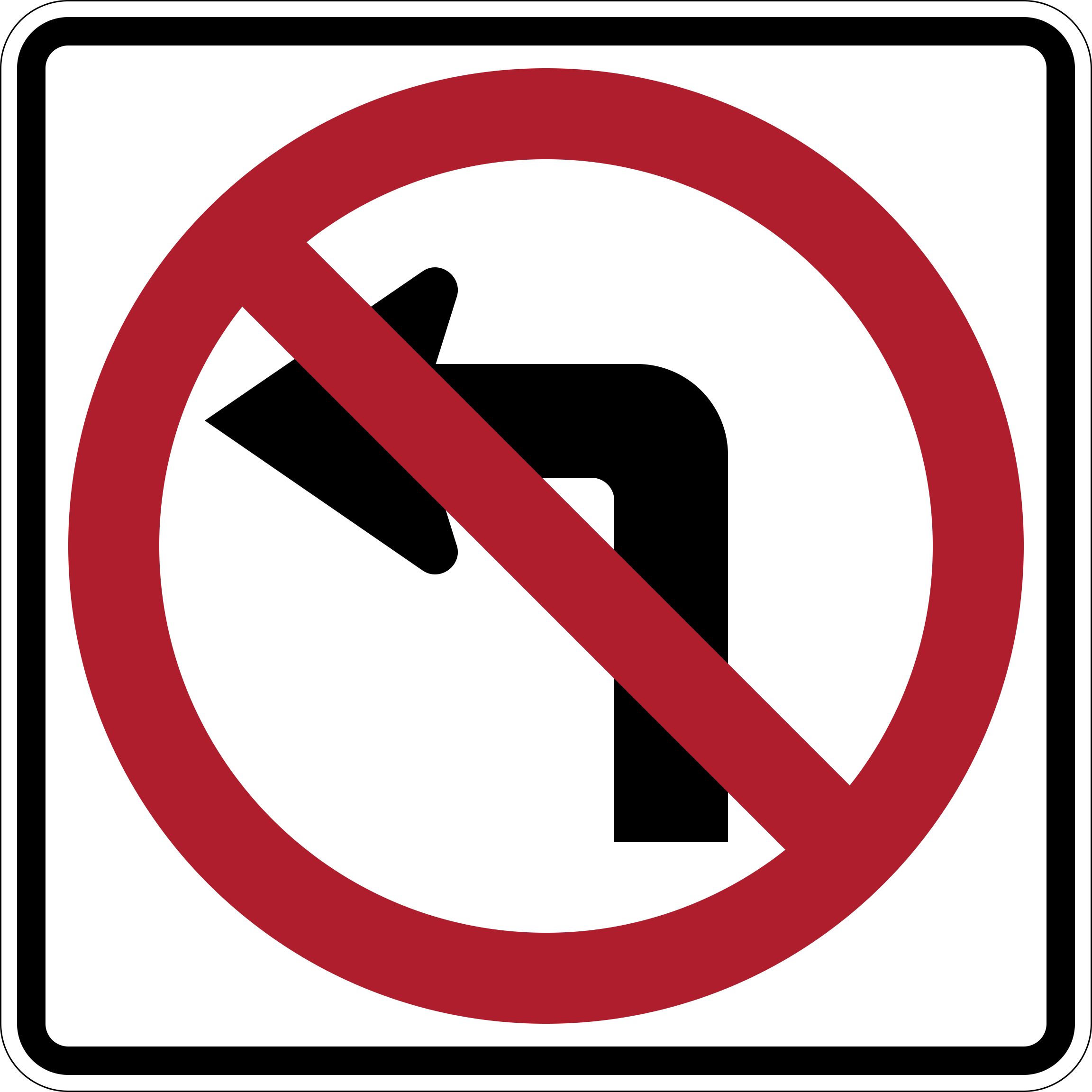
- Turning left from that approach
- Turning around in the roadway
- Changing lanes to the left
- Driving straight through the intersection
Show answer
Turning left from that approach. A red circle and slash over a left-turn symbol prohibits the left-turn movement shown by the symbol. It is a movement restriction for that approach, not a general ban on changing lanes, making a U-turn, or continuing straight. Read the arrow beneath the slash precisely: the barred action is the one depicted. If the route requires a left turn, select a permitted alternative only after checking lane markings, traffic signals, and surrounding traffic.
Study this in the handbook: Sign Shapes and Regulatory Signs
14. When this arrow bends around a central obstruction, where should your vehicle travel?
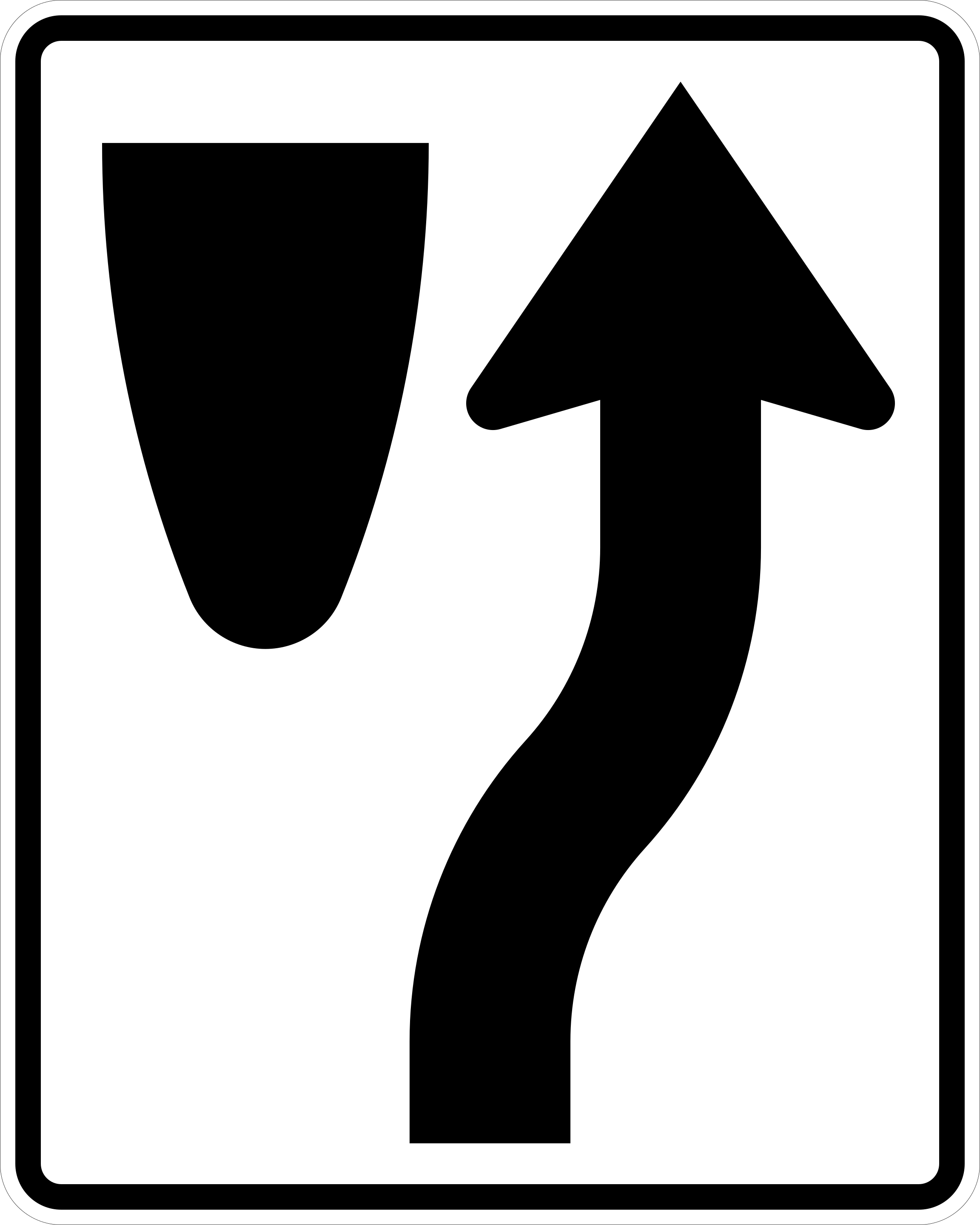
- On the side indicated by the arrow
- On the shoulder until the obstruction ends
- In the lane closest to oncoming traffic
- Across the median if the road is clear
Show answer
On the side indicated by the arrow. KEEP RIGHT signs guide vehicles around traffic islands, medians, or other obstructions in the middle of the roadway. Follow the arrow and pass the obstruction on the indicated side. The shoulder is not a substitute travel lane, and crossing a median or moving toward opposing traffic creates a serious conflict. The sign gives a path around a fixed object, so identify the arrow direction early and position the vehicle smoothly before reaching the obstruction.
Study this in the handbook: Sign Shapes and Regulatory Signs
15. What do blue guide signs identify along the roadway?
- The start of a construction detour
- Services such as rest areas, gas stations, and hospitals
- A mandatory no-turn movement
- The distance to a state boundary only
Show answer
Services such as rest areas, gas stations, and hospitals. Blue guide signs point drivers toward services along the roadway. Common examples include rest areas, gas stations, campgrounds, and hospitals. They are not the normal color for construction warnings, regulatory turn prohibitions, or destination-distance guidance. If you need a service, scan for the blue background and read the symbol or wording, then plan the maneuver safely rather than braking abruptly. Green signs handle destinations and distances, so separating blue services from green guidance is a useful sign-reading cue.
Study this in the handbook: Warning, School and Guide Signs
16. Why can higher speed make a wet roadway more dangerous?
- Only a completely bald tire can hydroplane
- Wet pavement always improves tire grip
- The vehicle's tires become wider in rain
- Higher speed can make tires ride up on water and lose traction
Show answer
Higher speed can make tires ride up on water and lose traction. On a wet road, most tires have good traction only up to about 35 mph. As speed increases, the tires can ride up on the water like water skis, which is hydroplaning. Heavy rain can remove all traction, and worn tires can lose it at lower speeds. Wet pavement does not improve grip, and a tire does not need to be completely bald to hydroplane. Ease off the accelerator and reduce speed before water buildup or rain leaves the tires unable to steer or stop normally.
Study this in the handbook: Slippery Roads, Hydroplaning and Curves
17. What spacing should a driver leave behind a vehicle that may have to stop at a railroad crossing?
- No extra room unless a train is visible
- Less than one second, so another driver cannot enter the gap
- Extra room, especially behind vehicles carrying hazardous materials
- Enough room only for a motorcycle to pass
Show answer
Extra room, especially behind vehicles carrying hazardous materials. The manual lists vehicles carrying hazardous materials among those that may be required to stop at railroad crossings. A driver following such a vehicle should leave extra room, allowing for an unexpected stop and a safe view of the crossing. Waiting for a visible train misses the reason for the spacing rule. A very short gap removes the escape space needed if the truck stops, and a motorcycle-sized opening is not the standard. The cue is to create space before the crossing, not after braking begins.
Study this in the handbook: Space Cushion and Following Distance
18. What restraint does Connecticut require for a 6 year old child who weighs 48 pounds?
- A 5-point harness or booster seat
- A rear-facing seat only
- No restraint in the back seat
- A lap belt only
Show answer
A 5-point harness or booster seat. A child age 5 to 8, or weighing between 40 and 60 pounds, must use a 5-point harness or a booster seat. A rear-facing seat is for children under 2 or under 30 pounds. Riding unrestrained is never allowed, since Connecticut requires children under 16 to be secured. A lap belt alone does not meet this age and weight rule. A child moves to a booster seat or seat belt at age 8 and 60 pounds or more.
Study this in the handbook: Seat Belts, Child Seats and Phone Laws
19. In Connecticut, whose job is it to make sure a 12 year old passenger is wearing a seat belt?
- The child's parent, even if the parent is not in the car
- The driver
- No one; children over 8 are exempt
- The child alone
Show answer
The driver. Connecticut puts the duty on every driver to make sure any passenger between 7 and 16 years old is wearing a seat safety belt. So the driver is responsible, whether or not a parent is present. Children over 8 are not exempt, and a 12 year old is not left to decide alone. All drivers and passengers must be belted, and each person who is not wearing one can be cited and fined $75.
Study this in the handbook: Teen Suspensions and Operator Retraining
20. For a driver age 21 or older who fails a chemical test for the first time, what IID period is listed?
- Two years
- One year
- Six months
- Three years
Show answer
Six months. The adult first-offense baseline is at least six months with an ignition interlock device after a failed chemical test. One year is the minimum the manual lists for drivers under 21 at .02 percent and for anyone who refuses the test, and the passage gives no two year or three year figure. The age and offense history must be read together because Connecticut uses different periods for adults and drivers under 21. Use 21 or older plus first failure as the six-month cue.
Study this in the handbook: Alcohol, Testing and DUI Suspensions
QualitySpace is expanding to Connecticut
We are a California-based independent insurance brokerage working on licensing in more states. We cannot help with Connecticut insurance yet. Leave your email and we will let you know when we can.
Every question is written from the official Connecticut Driver's Manual. Need paper? Printable CT practice test with answer key.
Last verified 2026-10-05. How we check every question · Study all 210 as flashcards
Frequently asked questions
How many questions are on this Connecticut practice test?
This fixed set has 20 questions. It is test 2 of 10 from the 210 question Connecticut bank. The real CT exam asks 25 questions and you need 20 correct.
What is the passing score for the real Connecticut test?
20 of 25 correct (80%) That figure comes from the official Connecticut source cited on the DMV facts page.
How does this fixed test relate to the full Connecticut bank?
Each numbered test is a fixed set of questions in a fixed order, so you can retake the same test later and compare. Every test mixes road signs and the other topics in about the same proportion as the full bank. Tests 1 to 10 together cover 200 of the 210 questions in the Connecticut bank, each once. The full practice page mixes the whole bank at random.
Last verified 2026-10-05. See the Connecticut DMV facts page for sourced state details.
Return to the full Connecticut practice test · Study road signs