
Test 5 of 10 · 20 questions · Free 2026
CT Permit Practice Test 5
Jump to the test ↓A fixed 20 question set from the Connecticut bank with answers and plain English explanations. The real CT exam is 25 questions, 80 percent to pass; take the full length version on the main practice page.
Question 1 of 20 · 0 right so far

All 20 questions in test 5
Every question below comes from the Connecticut question bank on this page. Open a question to see the correct answer and the explanation. Nothing here is hidden behind a signup.
1. What condition does a STOP AHEAD sign warn you to expect?
- The current stop sign has ended
- A stop sign is ahead, so slow down and prepare to stop
- Stopping is prohibited until the next signal
- A railroad gate will stop traffic immediately
Show answer
A stop sign is ahead, so slow down and prepare to stop. STOP AHEAD gives advance notice that a stop sign is coming. Slow down early and prepare for a complete stop at the later stop sign or its marked stopping point. The warning does not end a restriction, prohibit stopping, or identify a railroad gate. Look beyond the warning for the stop sign, the stop line, a crosswalk, and traffic that may require you to wait after stopping. Early preparation prevents a hard last-second brake application.
Study this in the handbook: Warning, School and Guide Signs
2. A curved arrow appears before the roadway bends. What does the warning identify?

- A change in road direction or a curve ahead
- A lane reserved for turning at a signal
- A mandatory detour around construction
- A one-way road beginning at the sign
Show answer
A change in road direction or a curve ahead. A curved-arrow warning identifies a change in direction or a curve ahead. Slow before entering the bend so the vehicle remains stable and you can respond to hazards that are hidden around it. The sign is not a traffic signal instruction, a construction detour, or proof that the road becomes one-way. Look for an advisory speed plaque below the warning, but remember that the posted advisory figure is not a replacement for judging weather and traffic.
3. When may a driver enter a signalized intersection during heavy traffic?
- Whenever the light is green, even if vehicles are stopped ahead
- Only when there is enough room to clear it without blocking traffic
- After stopping in the middle to wait for space
- When the driver can leave part of the vehicle in a crosswalk
Show answer
Only when there is enough room to clear it without blocking traffic. A green signal does not give permission to enter and then wait in a blocked intersection. The driver must have enough space on the opposite side to get completely through without obstructing vehicles or pedestrians. Stopping in the middle or leaving part of the vehicle in a crosswalk creates the blockage the rule is intended to prevent. Look beyond the signal before moving, and wait behind the line if traffic ahead cannot clear your vehicle.
Study this in the handbook: Right of Way at Intersections
4. What do warning signs tell drivers?
- That a destination's distance is being shown
- That a parking space is legally reserved
- That the road is always one-way
- That a special situation or hazard is ahead
Show answer
That a special situation or hazard is ahead. Warning signs alert drivers to a special situation or hazard ahead and tell them to slow down and be prepared to stop if needed. They do not by themselves create a parking reservation, establish one-way travel, or serve as distance-only guide signs. Connecticut says these signs are usually yellow with black lettering or symbols and are often diamond-shaped. The cue is to change attention and speed when the sign appears, then be ready for the curve, crossing, signal, work area, or other condition it previews.
Study this in the handbook: Warning, School and Guide Signs
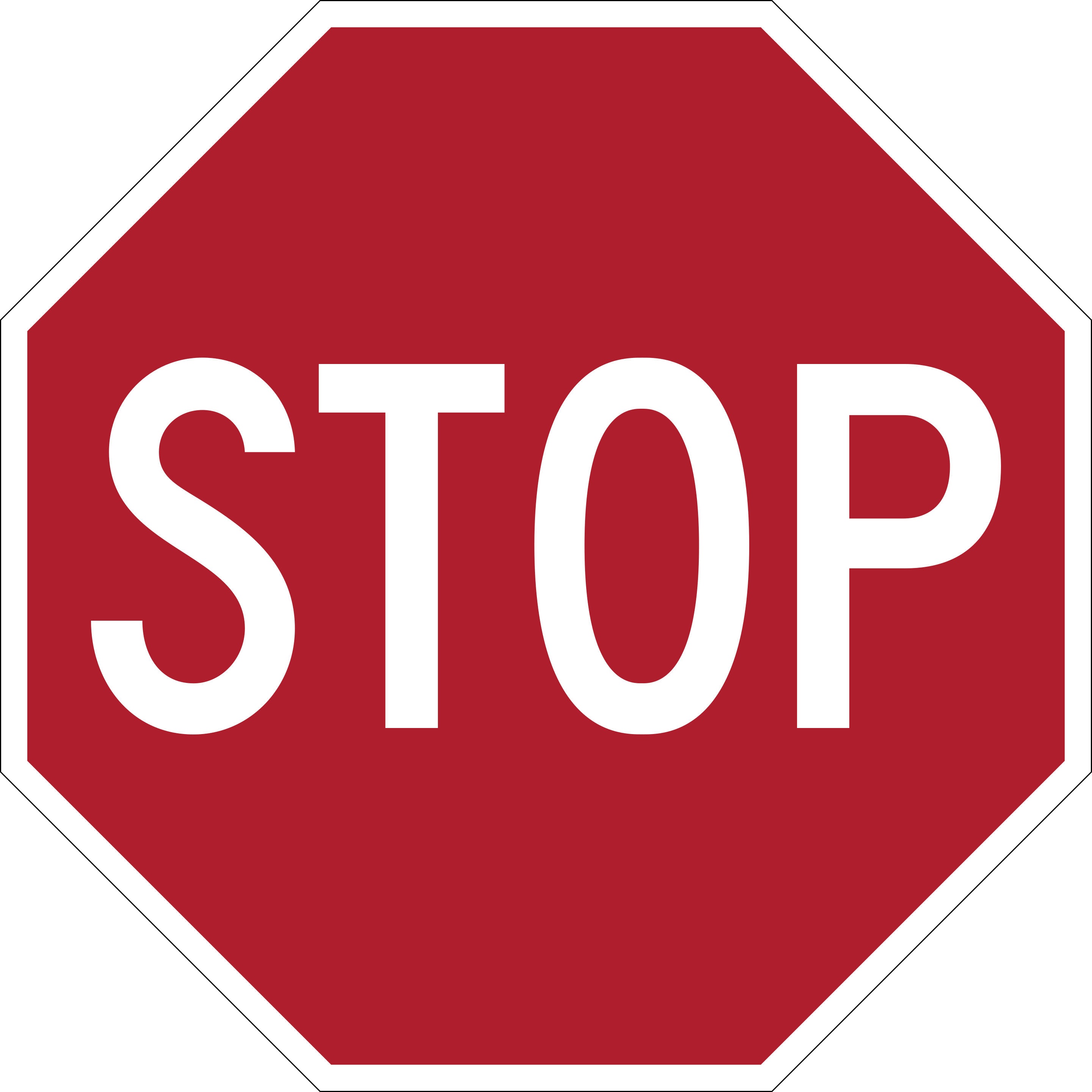
5. At this red eight-sided sign, what action is required?
- Slow and continue if the intersection appears empty
- Make a full stop at the sign, stop line, crosswalk, or curb, then yield
- Stop only when another vehicle is approaching
- Yield without stopping if pedestrians are absent
Show answer
Make a full stop at the sign, stop line, crosswalk, or curb, then yield. An octagonal STOP sign requires a complete stop. The manual identifies several possible stopping points: the sign itself, a stop line, a pedestrian crosswalk, or the curb. After stopping, the driver yields to approaching vehicles and pedestrians and proceeds only when safe. An empty-looking intersection does not cancel the stop, and yielding by slowing is not enough. The unusual eight-sided shape is a useful recognition cue, but the required behavior is the full stop followed by a safety check.
Study this in the handbook: Sign Shapes and Regulatory Signs
6. When a signal displays a green arrow, what movement does it authorize?
- Turn only after yielding to all oncoming traffic despite the arrow
- Turn in any direction without checking for pedestrians
- Treat the signal as a stop sign until the arrow disappears
- Safely turn in the direction shown while opposing and crossing traffic are absent
Show answer
Safely turn in the direction shown while opposing and crossing traffic are absent. A green arrow permits a turn in the direction it points, and the manual says there should be no oncoming or crossing traffic while it is green. This is more specific than treating the arrow like a stop sign, but it does not remove the need to watch the intersection. The driver still needs to confirm that the path is clear, including for people crossing. The opposing-traffic choice describes a different signal situation and ignores the protected movement provided by the arrow.
Study this in the handbook: Traffic Lights, Arrows and HAWK Signals
7. What fine can a Connecticut driver face for speeding or endangering a highway worker in a work zone?
- Up to $1,000, plus possible points and retraining
- Up to $100
- A flat $25
- No fine, only a warning, if no worker is hurt
Show answer
Up to $1,000, plus possible points and retraining. Anyone convicted of speeding, disobeying traffic control devices, using an improper lane, or endangering a highway worker in a work zone could face fines of up to $1,000. Points can also be assessed and the driver may have to complete the retraining program. The $100 and $25 figures are far too low, and the manual does not limit the penalty to cases where a worker is hurt. In any work zone the manual tells drivers to slow down, obey posted limits, and follow the instructions on warning signs and those given by flaggers.
Study this in the handbook: Railroad Crossings and Work Zones
8. A 16 year old in Connecticut has a learner's permit and is practicing with a qualified trainer. Which extra passengers may ride along?
- Any friends who hold learner's permits
- Up to two siblings
- Only the teen's parent or legal guardian
- Anyone wearing a seat belt
Show answer
Only the teen's parent or legal guardian. For the whole time a 16 or 17 year old holds a learner's permit, no passengers are allowed except a licensed driving instructor and people with that instructor, or one qualified trainer who is at least 20 and has held an unsuspended license for four consecutive years. Parents or a legal guardian may accompany the instructor. Friends with permits, siblings, and anyone else are not allowed, and wearing a seat belt does not create an exception. Breaking permit rules can lead to a permit suspension.
Study this in the handbook: Teen Training, Passengers and Curfew
9. When an emergency vehicle approaches from any direction using a siren or flashing lights, where should you stop?
- At the next intersection, without pulling over
- In the left lane so the emergency vehicle can use the shoulder
- Along the right edge of the road, or as near to the right as possible
- On the center line until the vehicle passes
Show answer
Along the right edge of the road, or as near to the right as possible. Connecticut requires a driver to yield to police vehicles, fire engines, ambulances, and other emergency vehicles using a siren, air horn, or red or blue flashing lights. Pull to the right edge, or as close to the right as possible, and stop. Remain stopped until the emergency vehicle has passed unless an officer or firefighter directs otherwise. Stopping in the left lane or center line can obstruct the response path. If you are in an intersection, clear it first and then perform the pull-over maneuver.
Study this in the handbook: Pedestrians, Bicyclists and Horses
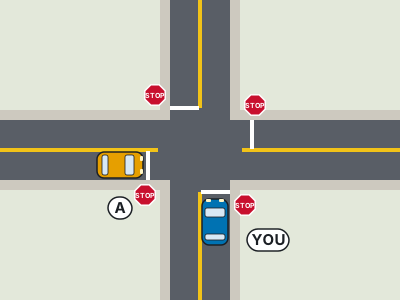
10. Two vehicles reach a four-way stop at the same time. Which one proceeds first?
- The vehicle with more passengers
- The vehicle on the left
- The vehicle going straight
- The vehicle on the right
Show answer
The vehicle on the right. When vehicles arrive simultaneously at a four-way stop, the vehicle on the right proceeds first. The ordinary first-arrival rule does not settle a tie, so the right-side rule resolves it. A vehicle going straight does not automatically outrank a turning vehicle in this circumstance, and passenger count has no bearing on the order. Come to a complete stop, confirm the tie, let the right-side vehicle move, then proceed when the intersection is clear.
Study this in the handbook: Right of Way at Intersections
11. When entering a traffic circle or rotary, which traffic has priority?
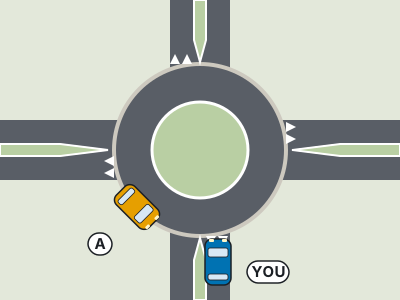
- Drivers already in the circle
- Vehicles entering from the left
- The fastest approaching vehicle
- The vehicle that signals first
Show answer
Drivers already in the circle. A driver entering a traffic circle or rotary must yield to drivers already circulating. The vehicle inside the circle has an established path, so entering traffic must wait for a safe opening. Speed, approach direction, and signaling do not create priority over traffic already in the circle. Slow before entry, scan for vehicles and pedestrians, and yield until the circulating lane is clear. Where a modern roundabout has more than one approach lane, the manual says to follow the posted signs and lane use controls to pick the proper lane for your intended movement.
Study this in the handbook: Roundabouts, Traffic Circles and U-Turns
12. If the gas pedal sticks and the engine keeps speeding up, which sequence is recommended?
- Turn the ignition to lock while the vehicle is moving
- Pump the accelerator while staying in the lane
- Shift to neutral, pull off safely, then turn off the engine
- Apply the parking brake suddenly and steer into traffic
Show answer
Shift to neutral, pull off safely, then turn off the engine. A stuck accelerator requires the driver to reduce the engine's connection to the drive wheels and regain a safe stopping path. Keep looking at the road, shift quickly to neutral, pull off when it is safe, and turn off the engine. Turning the ignition to the lock position while moving can lock the steering, while pumping the pedal does not address the fault. Jerking the parking brake and steering into traffic is not part of the listed steps and puts other vehicles at risk. The order matters: neutral first, a controlled move away from traffic second, and engine shutdown after reaching a safe position.
Study this in the handbook: Vehicle Emergencies and Equipment Failure
13. Before crossing railroad tracks, what must a driver make sure of?
- That the vehicle can stop on the tracks if traffic changes
- That there is room for the vehicle on the far side
- That a train was not recently seen at the crossing
- That the driver can shift gears while crossing
Show answer
That there is room for the vehicle on the far side. The driver must slow down, look and listen for a train, and confirm that the far side has enough room for the entire vehicle. Entering without an exit space can leave the vehicle stopped on the tracks, which creates a severe hazard even when no train is immediately visible. A prior empty crossing proves nothing about the next approach. The manual also advises against shifting gears on the tracks because the vehicle could stall. The cue is never enter until the vehicle can clear the rails completely.
Study this in the handbook: Railroad Crossings and Work Zones
14. What does a first street racing conviction bring a Connecticut teen driver?
- A 30 day suspension
- A $100 fine
- A six month suspension, a $175 restoration fee, and court fines or up to one year in jail
- No penalty beyond points
Show answer
A six month suspension, a $175 restoration fee, and court fines or up to one year in jail. Street racing under section 14-224(c) brings a 16 or 17 year old a six month suspension, a $175 license restoration fee, and court fines or imprisonment of not more than one year or both, and a second offense brings a one year suspension. The same table lists reckless driving at six months and speeding 20 over at 60 days. Every entry also requires the $175 restoration fee before the license is returned.
Study this in the handbook: Teen Suspensions and Operator Retraining
15. For a driver under 21, what alcohol rule does Connecticut apply?
- No rule on private property
- A rule beginning at .08 percent only
- Zero tolerance for .02 percent or more
- A rule applying only after a crash
Show answer
Zero tolerance for .02 percent or more. Connecticut applies zero tolerance to drivers under 21. The manual defines measurable alcohol for this rule as .02 percent or more, and it applies on public roads and private property. The .08 choice is not the youth threshold, while a crash or private property does not create the listed exception. For study purposes, pair the age condition with .02 percent and remember that the rule reaches beyond public highways.
Study this in the handbook: Zero Tolerance for Drivers Under 21
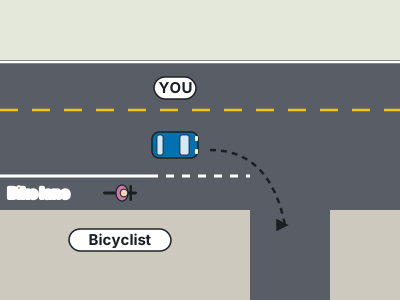
16. You have just passed a bicyclist and plan to turn right. What should you do?
- Turn immediately because passing has already been completed
- Slow down and let the bicyclist clear the intersection before turning
- Sound the horn and turn across the bicycle's path
- Move into the bicycle lane and stop beside the bicyclist
Show answer
Slow down and let the bicyclist clear the intersection before turning. A vehicle that has passed a bicycle can reach the corner before the rider has cleared it. Connecticut guidance says to slow down and allow the cyclist to get through the intersection before making the right turn. Immediate turning creates a crossing conflict, while a horn does not give permission to cut across the rider. The safest cue is to check the bicycle's position again after passing, then turn only when the cyclist is clear.
Study this in the handbook: Pedestrians, Bicyclists and Horses
17. If an officer's hand signal conflicts with a traffic light, which instruction controls?
- The signal given by another driver
- The traffic light
- The last signal a driver noticed
- The officer's hand signal
Show answer
The officer's hand signal. A driver must obey signals given by a law enforcement officer, even when those signals contradict the traffic signal. Do not choose the light merely because it normally controls the intersection, and do not follow another driver's gesture or whichever signal you noticed last. Reduce speed, watch the officer's position and gestures, and proceed only as directed. This rule appears first in the manual's list of right-of-way rules, ahead of the rules for pedestrians and turning vehicles.
Study this in the handbook: Traffic Lights, Arrows and HAWK Signals
18. How far behind a truck can its blind spot stretch, according to the Connecticut manual?
- About 20 feet
- About 50 feet
- About 1,000 feet
- About 200 feet
Show answer
About 200 feet. Truck drivers cannot see cars directly behind or beside them, and the manual says their blind spots may stretch up to 20 feet in front of the cab and about 200 feet behind the truck. The 20 foot figure is the zone in front of the cab, not behind. Fifty feet understates the rear zone and 1,000 feet overstates it. If you cannot see the driver's face in the side view mirror, the driver cannot see you.
Study this in the handbook: Motorcycles, Trucks and Slow Vehicles
19. Before entering an intersection, what should you check first?
- Both left and right for approaching vehicles, bicycles, and pedestrians
- Only the lane directly ahead
- Only the traffic signal above the intersection
- The rear seat before looking outside
Show answer
Both left and right for approaching vehicles, bicycles, and pedestrians. An intersection can contain crossing traffic, bicycles, or pedestrians arriving from either side. The manual calls for checking both left and right before entering, then checking again just before moving if you were stopped. Looking only ahead misses a vehicle approaching from the side, while relying on a signal ignores people who may disobey it. Make the side-to-side scan a routine cue whenever a road, driveway, shopping center entrance, or parking lot entrance crosses your path. That habit gives you information before your vehicle reaches the conflict point and leaves more time to stop.
Study this in the handbook: Railroad Crossings and Work Zones
20. What do two solid yellow center lines separate?
- A shoulder that may be used as a travel lane
- Two lanes moving in the same direction where passing is required
- A bus lane from a bicycle lane
- Opposing traffic lanes, with crossing allowed for certain left turns
Show answer
Opposing traffic lanes, with crossing allowed for certain left turns. Two solid yellow lines mark the center of a road where traffic moves in opposite directions. They are not a general invitation to pass. The manual permits crossing solid yellow lines for a left turn to or from an alley, private road, driveway, or street. The marking does not separate same-direction lanes, and it does not identify a shoulder or special-use lane. The visual cue is the pair of solid yellow lines at the roadway center: expect opposing traffic and cross only for the listed turning purpose when it is safe.
Study this in the handbook: Pavement Markings and Special Lanes
QualitySpace is expanding to Connecticut
We are a California-based independent insurance brokerage working on licensing in more states. We cannot help with Connecticut insurance yet. Leave your email and we will let you know when we can.
Every question is written from the official Connecticut Driver's Manual. Need paper? Printable CT practice test with answer key.
Last verified 2026-10-05. How we check every question · Study all 210 as flashcards
Frequently asked questions
How many questions are on this Connecticut practice test?
This fixed set has 20 questions. It is test 5 of 10 from the 210 question Connecticut bank. The real CT exam asks 25 questions and you need 20 correct.
What is the passing score for the real Connecticut test?
20 of 25 correct (80%) That figure comes from the official Connecticut source cited on the DMV facts page.
How does this fixed test relate to the full Connecticut bank?
Each numbered test is a fixed set of questions in a fixed order, so you can retake the same test later and compare. Every test mixes road signs and the other topics in about the same proportion as the full bank. Tests 1 to 10 together cover 200 of the 210 questions in the Connecticut bank, each once. The full practice page mixes the whole bank at random.
Last verified 2026-10-05. See the Connecticut DMV facts page for sourced state details.
Return to the full Connecticut practice test · Study road signs