
Test 10 of 10 · 20 questions · Free 2026
CT Permit Practice Test 10
Jump to the test ↓A fixed 20 question set from the Connecticut bank with answers and plain English explanations. The real CT exam is 25 questions, 80 percent to pass; take the full length version on the main practice page.
Question 1 of 20 · 0 right so far
All 20 questions in test 10
Every question below comes from the Connecticut question bank on this page. Open a question to see the correct answer and the explanation. Nothing here is hidden behind a signup.
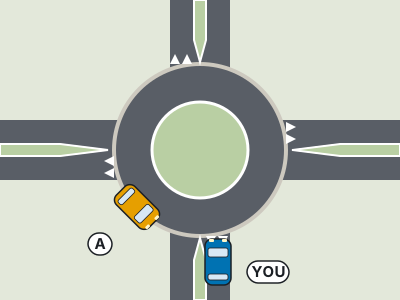
1. Before entering a roundabout, to whom must an entering driver yield?
- No one when entering from the right
- Only traffic approaching from the left
- Vehicles waiting behind the entrance
- Traffic already circulating in the roundabout
Show answer
Traffic already circulating in the roundabout. Entering traffic yields to vehicles already circulating in the roundabout. The entering driver should slow, assess the circulating lane, and wait for a sufficient gap. The direction of approach does not cancel the yield, and vehicles behind the entrance do not control the conflict. Once inside, do not stop simply to let another vehicle enter. Think of the circle as already occupied space that must be joined without interrupting its flow.
Study this in the handbook: Roundabouts, Traffic Circles and U-Turns
2. What does a dashed yellow center line mean?
- Traffic travels in the same direction only
- Passing is forbidden in both directions
- Passing is allowed when safe
- The lane is reserved for buses
Show answer
Passing is allowed when safe. Dashed yellow lines separate single lanes moving in opposite directions and indicate that passing is allowed. That permission is not automatic: the driver still must check sight distance, oncoming traffic, and other road conditions before crossing the line. A solid yellow marking can restrict passing, while lane lines for traffic moving in the same direction are white. The bus-lane choice concerns a reserved lane, not a center line. The cue is yellow for opposing flows and dashed for a possible passing movement when safe.
Study this in the handbook: Pavement Markings and Special Lanes
3. What does the Connecticut manual say about a train's apparent speed at a crossing?
- Trains cannot exceed 30 mph at crossings
- Trains always look faster than they are
- Trains are easy to judge
- Trains are large and may be moving faster than they seem
Show answer
Trains are large and may be moving faster than they seem. Remember that trains are large and may be moving faster than they seem, so never try to beat one across. The manual calls it wise not to shift gears while crossing the tracks, since you might stall, and a blue Emergency Notification System sign at the crossing lists a number for reporting problems or emergencies. Never start across unless there is room for your vehicle on the far side.
Study this in the handbook: Warning, School and Guide Signs
4. What does the Connecticut manual say to do when a vehicle comes toward you with its high beams on?
- Flash your headlights quickly a couple of times
- Keep your bright lights on
- Look at the center of the road
- Turn your headlights off
Show answer
Flash your headlights quickly a couple of times. If a vehicle comes toward you with its high beams on, the manual says to flash your headlights quickly a couple of times. If the driver still fails to dim the lights, look toward the right side of the road so you are not blinded and can see enough of the road edge to stay on course. Do not try to get back at the other driver by keeping your bright lights on, because both of you may be blinded. Dim your own high beams within about one block of an oncoming vehicle.
Study this in the handbook: Headlights, Horn and Turn Signals
5. What should a driver do if the vehicle begins to skid?
- Turn sharply opposite the intended path
- Lock the brakes and hold the wheel straight
- Stay off the brake and steer where the vehicle should go
- Accelerate until the tires regain grip
Show answer
Stay off the brake and steer where the vehicle should go. During a skid, Connecticut's manual says to stay off the brake because braking may make the skid worse before the vehicle slows. The driver should turn the wheel in the direction the vehicle is supposed to travel, then keep correcting left and right until control returns. Locking the brakes removes useful tire grip, and a sharp opposite turn can start another skid. Acceleration does not restore traction. The key cue is to make smooth steering corrections and wait for the tires to regain contact instead of adding an abrupt control input.
Study this in the handbook: Avoiding Collisions and After a Crash
6. What does the blue Emergency Notification System sign at a Connecticut rail crossing provide?
- The train schedule
- A 24/7/365 phone number to report problems or emergencies at that crossing
- The speed limit
- The railroad's business hours
Show answer
A 24/7/365 phone number to report problems or emergencies at that crossing. A blue Emergency Notification System sign can be found at highway rail grade crossings and provides the public with a 24/7/365 telephone number to call to report problems or emergencies at that railroad location. The manual also says it is wise not to shift gears while crossing tracks because you might stall, and it reminds drivers that trains are large and moving faster than they seem, so never try to beat one across.
Study this in the handbook: Warning, School and Guide Signs
7. What happens to the fine in Connecticut for failing to yield the right-of-way to a bicyclist?
- It is waived for a first offense
- It is doubled
- It is the same as a parking fine
- There is no fine, only points
Show answer
It is doubled. Fines are doubled for failure to yield the right-of-way to a bicyclist. Drivers must yield to cyclists in intersections, where a bike path or lane crosses the road, and in a bike lane before turning across it. The manual gives no first offense waiver, does not treat it as a parking offense, and does not replace the fine with points. When passing a cyclist, Connecticut also requires at least three feet of distance.
Study this in the handbook: Pedestrians, Bicyclists and Horses
8. What must a Connecticut applicant pay for a license after passing the road test?
- $84
- $150
- $25
- Nothing, the permit fee covers it
Show answer
$84. To begin the road test you need your learner's permit, proof of completing the 8 hour safe driving course on form CS-1, the license fees, and a medical clearance letter if one was required. You must pay $84 for a license after you pass the road test. Applicants who are 16 or 17 also need the parent training and driver education certification.
Study this in the handbook: The Learner's Permit and License Tests
9. What does a yellow turn arrow indicate?
- Cross traffic must stop while the arrow remains yellow
- The protected turn has just begun and must be accelerated
- The turn is prohibited until the next day
- Protection from the green arrow is ending, so prepare to stop
Show answer
Protection from the green arrow is ending, so prepare to stop. A yellow arrow warns that the protected phase provided by a green arrow is ending. A driver turning in that direction should prepare to stop, subject to the ordinary safety rules for the intersection. It does not call for acceleration, announce a daily prohibition, or guarantee that cross traffic will remain stopped. Watch the signal change, check the space ahead, and stop if doing so is safe instead of trying to force the turn through the transition.
Study this in the handbook: Traffic Lights, Arrows and HAWK Signals
10. What does the eight-sided shape of a stop sign tell a driver?
- The sign warns of a railroad crossing
- The sign is a stop instruction
- The sign marks a school zone
- The sign identifies a guide route
Show answer
The sign is a stop instruction. The eight-sided outline is a shape cue for stop. It tells the driver to make a complete stop and then yield before proceeding. A railroad warning uses a circle, a school-zone warning uses a pentagon, and guide information is commonly shown in other shapes and colors. Shape recognition helps when the face is hard to read, so begin braking when the octagonal outline becomes visible rather than waiting to identify every word.
Study this in the handbook: Sign Shapes and Regulatory Signs
11. What does an eight-sided traffic sign require the driver to do?
- Yield only to pedestrians
- Reduce speed without stopping
- Come to a complete stop
- Proceed if no vehicle is visible
Show answer
Come to a complete stop. The octagon is reserved for a stop instruction. The driver must stop at the sign, stop line, crosswalk, or curb, then yield to approaching vehicles and pedestrians before moving. Merely reducing speed is not enough, and the absence of visible traffic does not erase the stopping duty. Treat the unusual eight-sided outline as an immediate visual cue to stop completely, check both directions, and proceed only when the crossing area is clear.
Study this in the handbook: Sign Shapes and Regulatory Signs
12. Which condition can make the posted speed unsafe even when the number on the speedometer matches the sign?
- Wet or icy pavement, poor visibility, or heavy traffic
- A dry road with light traffic and clear visibility
- A clean windshield on a sunny day
- Driving on a road with no nearby driveway
Show answer
Wet or icy pavement, poor visibility, or heavy traffic. Connecticut's manual treats a speed limit as a figure for ideal conditions, not a guarantee that the same speed is safe in every circumstance. Wet or icy pavement reduces traction, poor visibility shortens the distance available to react, and heavy traffic creates more conflicts. Those conditions call for slowing down, and the driver can still be ticketed for traveling too fast for the road. A dry, clear roadway does not create the same warning. Match speed to what you can see, stop, and control.
Study this in the handbook: Traffic Lights, Arrows and HAWK Signals
13. How can a driver check whether the following distance behind a truck is too short?
- Wait until the truck driver flashes the headlights
- Use a roadside landmark and count three seconds after the truck passes it
- Keep less than one second because trucks accelerate slowly
- Match the truck's length with the vehicle's hood
Show answer
Use a roadside landmark and count three seconds after the truck passes it. The three-second method uses a fixed landmark rather than the truck's size or a signal from its driver. Watch the rear of the truck pass a sign, pole, or other stationary point, then count at a normal pace. If your vehicle reaches the same point before the count ends, the gap is too short and you should drop back. A larger truck blocks your view, so maintaining space improves both reaction time and visibility.
Study this in the handbook: Motorcycles, Trucks and Slow Vehicles
14. A 17 year old in Connecticut just got a motorcycle endorsement. When may the teen carry a passenger on the motorcycle?
- Right away
- After 30 days
- After six months from the endorsement
- Never before age 21
Show answer
After six months from the endorsement. Connecticut bars learner's permit holders and 16 and 17 year old drivers from carrying any passenger on a motorcycle for six months after the motorcycle endorsement is issued. It is not allowed right away or after only 30 days. Age 21 is not the cutoff. Carrying a passenger on a motorcycle during that time is listed among the graduated license violations, which bring a suspension and a $175 restoration fee.
Study this in the handbook: Teen Training, Passengers and Curfew
15. What must a Connecticut 16 or 17 year old learner's permit holder expect after breaking the permit rules?
- Nothing, since permits are not licenses
- Automatic permanent loss of driving privileges
- Only a warning letter to the parents
- A possible permit suspension
Show answer
A possible permit suspension. The manual warns that failure to follow the learner's permit rules, such as the passenger restrictions, may result in a permit suspension. A permit is still a driving privilege, so breaking its rules has consequences. The manual does not describe a permanent loss for this, and it does not limit the response to a letter home. Driving in violation of permit requirements is also listed among offenses that can require operator retraining.
Study this in the handbook: Teen Training, Passengers and Curfew
16. What suspension does a Connecticut 16 or 17 year old face for a second conviction of using a cell phone or texting while driving?
- 90 days
- 30 days
- One year
- No suspension
Show answer
90 days. The teen suspension table lists cell phone and text messaging violations at 30 days for a first offense, 90 days for a second, and 6 months for a third, each with a $175 license restoration fee and court fines. Thirty days is only the first offense, one year belongs to repeat reckless driving or street racing, and a teen conviction for phone use always brings a suspension.
Study this in the handbook: Teen Suspensions and Operator Retraining
17. An adult driver in Connecticut fails a chemical test after a DUI arrest. What is the minimum license suspension?
- At least 7 days
- At least 45 days
- At least 1 year
- No suspension until a court conviction
Show answer
At least 45 days. If you fail the blood, breath, or urine test after a DUI arrest, your license is suspended for at least 45 days, and you must install and maintain an ignition interlock device as a condition of reinstatement, for at least six months for adults. Seven days is too short, one year is not the minimum, and the manual ties the suspension to the failed test itself rather than to a later court conviction; penalties come from both the courts and the Commissioner of Motor Vehicles. Refusal brings the same 45 day minimum.
Study this in the handbook: Alcohol, Testing and DUI Suspensions
18. What minimum visual acuity does Connecticut list for all license classes, with or without corrective lenses?
- 20/30
- 20/70
- 20/50
- 20/40
Show answer
20/40. Connecticut lists at least 20/40 visual acuity for all license classes, and the requirement applies with or without glasses or contact lenses. The 20/30 choice describes sharper vision than the manual demands, so it is not the licensing threshold. The weaker 20/50 and 20/70 figures fall below the stated minimum. The manual separately discusses visual-field requirements for some applicants, so do not replace the acuity figure with a field measurement when the question asks about how clearly the applicant must see.
Study this in the handbook: The Learner's Permit and License Tests
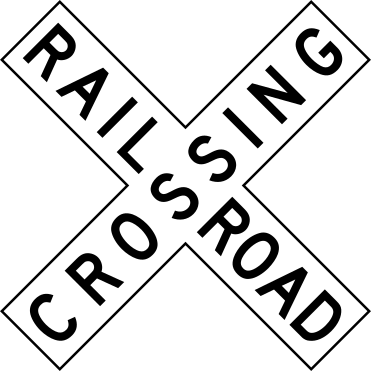
19. What does a white railroad crossbuck require when trains are crossing?
- Stop only if a gate is lowered
- Speed up to clear the tracks first
- Yield to crossing trains
- Treat the tracks as a normal intersection with no special duty
Show answer
Yield to crossing trains. A railroad crossbuck carries a yield meaning for trains. Approach the tracks cautiously, reduce speed, look and listen, and give the train the right-of-way. Do not race to clear the crossing or wait for a gate before taking the warning seriously. A crossbuck is not an ordinary intersection sign with no special duty. If signals, gates, or a train indicate danger, remain clear of the tracks until the crossing is safe.
Study this in the handbook: Railroad Crossings and Work Zones
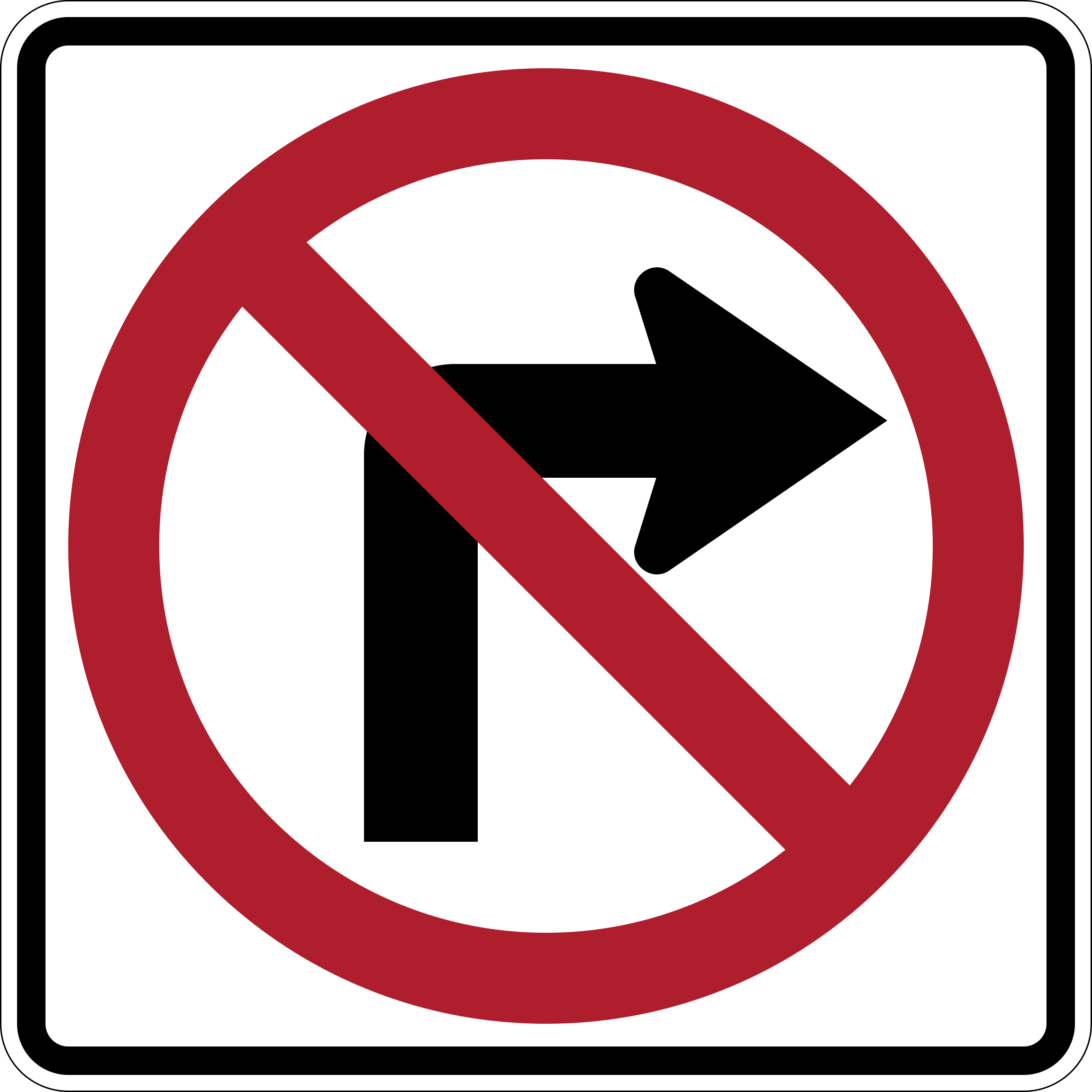
20. A red slash crosses a right-pointing arrow. Which movement may not be made?
- A left turn after yielding to traffic
- A lane change before the intersection
- A straight movement through the junction
- A right turn from the signed approach
Show answer
A right turn from the signed approach. The symbol shows a right arrow crossed by a red slash, so the signed approach does not allow a right turn. The restriction is narrower than a prohibition on all lane changes or all turns. A straight movement or left turn could still be governed by other signs, signals, or lane markings, so inspect the full intersection before proceeding. The key cue is to match the barred arrow with the exact movement you are considering.
Study this in the handbook: Sign Shapes and Regulatory Signs
QualitySpace is expanding to Connecticut
We are a California-based independent insurance brokerage working on licensing in more states. We cannot help with Connecticut insurance yet. Leave your email and we will let you know when we can.
Every question is written from the official Connecticut Driver's Manual. Need paper? Printable CT practice test with answer key.
Last verified 2026-10-05. How we check every question · Study all 210 as flashcards
Frequently asked questions
How many questions are on this Connecticut practice test?
This fixed set has 20 questions. It is test 10 of 10 from the 210 question Connecticut bank. The real CT exam asks 25 questions and you need 20 correct.
What is the passing score for the real Connecticut test?
20 of 25 correct (80%) That figure comes from the official Connecticut source cited on the DMV facts page.
How does this fixed test relate to the full Connecticut bank?
Each numbered test is a fixed set of questions in a fixed order, so you can retake the same test later and compare. Every test mixes road signs and the other topics in about the same proportion as the full bank. Tests 1 to 10 together cover 200 of the 210 questions in the Connecticut bank, each once. The full practice page mixes the whole bank at random.
Last verified 2026-10-05. See the Connecticut DMV facts page for sourced state details.
Return to the full Connecticut practice test · Study road signs