
Test 7 of 10 · 20 questions · Free 2026
CT Permit Practice Test 7
Jump to the test ↓A fixed 20 question set from the Connecticut bank with answers and plain English explanations. The real CT exam is 25 questions, 80 percent to pass; take the full length version on the main practice page.
Question 1 of 20 · 0 right so far
All 20 questions in test 7
Every question below comes from the Connecticut question bank on this page. Open a question to see the correct answer and the explanation. Nothing here is hidden behind a signup.
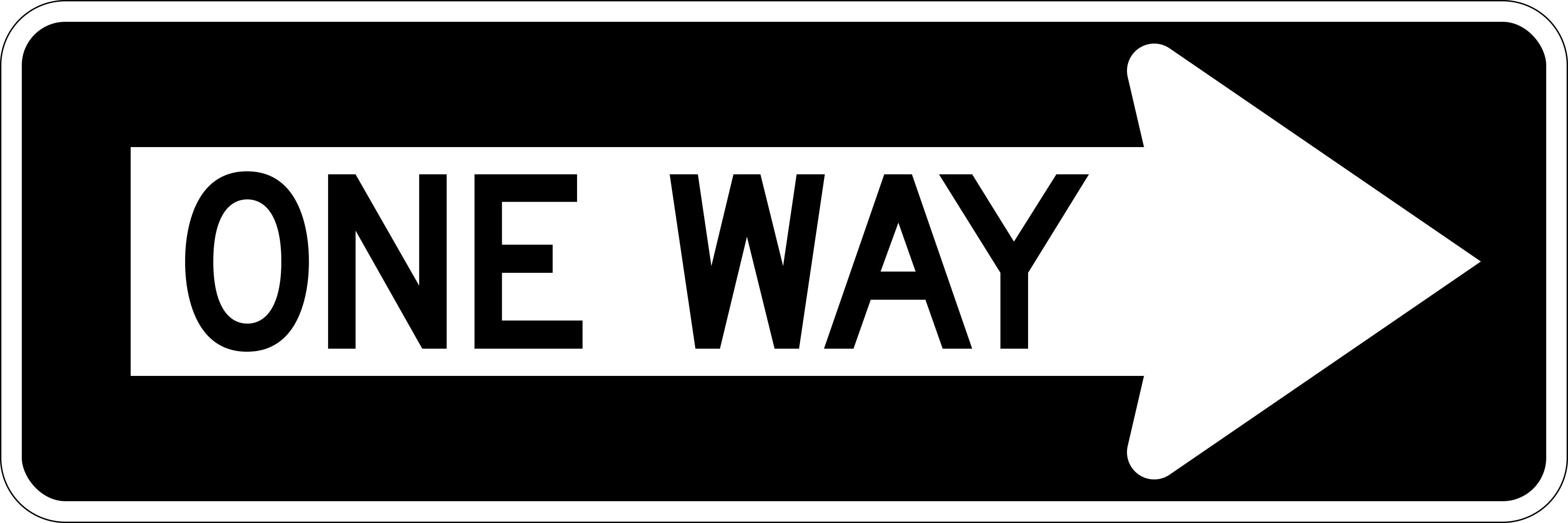
1. On a one-way street, what does the black-and-white arrow sign require?
- Travel only in the arrow's direction
- Turn toward the nearest side street
- Reserve the lane for buses
- Reverse direction at the next driveway
Show answer
Travel only in the arrow's direction. A ONE WAY sign controls the direction of travel on a one-way street or driveway. Follow the arrow and do not enter the roadway against that flow. The sign does not instruct you to turn at the next side street, create a bus lane, or reverse direction at a driveway. Before moving, compare the arrow with your intended path and make sure your vehicle is aligned with the permitted direction. That quick check prevents an otherwise ordinary turn from becoming wrong-way travel.
Study this in the handbook: Sign Shapes and Regulatory Signs
2. After stopping for an ice cream truck with its stop arm extended, how may you proceed past it in Connecticut?
- At a reasonable speed up to 5 mph, yielding to pedestrians going to or from the truck
- At the posted speed limit
- Only after the truck drives away
- At up to 25 mph with the horn sounding
Show answer
At a reasonable speed up to 5 mph, yielding to pedestrians going to or from the truck. After stopping, a driver may pass the ice cream truck at a reasonable speed, no faster than 5 mph, and must yield to any pedestrian crossing to or from the truck. You do not have to wait until it leaves, and the posted limit or 25 mph is far too fast near children buying ice cream. Sounding the horn is not a substitute for slowing down. You must first stop at least 10 feet from the truck.
Study this in the handbook: Right of Way at Intersections
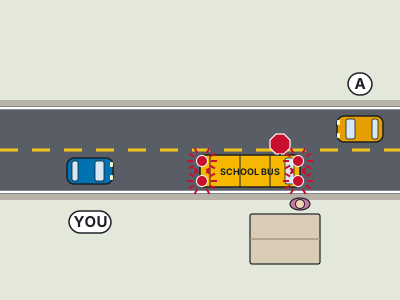
3. What must a driver do when approaching a school bus displaying flashing red lights?
- Continue at the posted speed until a child enters the lane
- Pass slowly if the bus is stopped on the opposite side
- Stop and remain stopped while the bus red lights flash, then proceed only after children have left the roadway and it is safe
- Stop only during the first hour of school
Show answer
Stop and remain stopped while the bus red lights flash, then proceed only after children have left the roadway and it is safe. A school bus stopped with red lights flashing requires a stop whether the bus is on your side, across the road, or at an intersection you are approaching, unless a median or physical barrier separates the roadways. After the lights stop, wait until children have completely left the roadway and it is safe to proceed. Passing slowly or waiting for a child to enter your lane ignores the statewide stopping rule. School hours do not limit the duty created by the flashing red lights.
Study this in the handbook: Right of Way at Intersections
4. What information does a diamond-shaped traffic sign generally provide?
- A prohibition against entering a one-way street
- A command to park only in the marked area
- A route number and distance to a destination
- A warning about a special condition or hazard ahead
Show answer
A warning about a special condition or hazard ahead. Diamond signs alert drivers to conditions that may require extra caution, such as a curve, a merge, or an intersection. They are warnings rather than parking commands, route markers, or one-way restrictions. The shape should prompt the driver to look farther ahead, adjust speed, and be prepared to stop if the developing hazard requires it. Treating the sign as ordinary information can leave too little time to react.
Study this in the handbook: Sign Shapes and Regulatory Signs
5. What does Connecticut require of bicyclists when they turn or stop, and why might one fail to do it?
- Nothing; bicyclists are exempt from signaling
- They must sound a bell before every turn
- They must dismount and walk the bicycle through the turn
- They must use hand signals, but may be unable to if they need both hands on the handlebars
Show answer
They must use hand signals, but may be unable to if they need both hands on the handlebars. Bicyclists are required to use hand signals when turning and stopping, just as drivers must signal. The manual adds a caution for drivers: a rider may not be able to signal when road or traffic conditions require both hands on the handlebars, so look for other clues such as a turned head or a glance over the shoulder. A bell, dismounting, and an exemption are not what the law says. Give a bicyclist room to make the move you think is coming, and never pass closely just because no signal was shown.
Study this in the handbook: Pedestrians, Bicyclists and Horses
6. What is the purpose of a shared center lane marked with opposing left-turn arrows?
- Long-term parking during busy periods
- Passing through the intersection without stopping
- Left turns, and permitted U-turns, for traffic moving in either direction
- A lane reserved only for vehicles traveling straight
Show answer
Left turns, and permitted U-turns, for traffic moving in either direction. A shared center lane is a two-way turning area, not a regular travel lane. It is reserved for left turns and for U-turns where those turns are permitted, and its arrows alternate because drivers from both directions may use it. Driving straight through the lane or using it to pass defeats its purpose and creates a head-on conflict with an opposing turning vehicle. Enter only when the maneuver is safe, and watch the yellow lines and arrows as a cue that the space is for turning rather than cruising.
Study this in the handbook: Pavement Markings and Special Lanes
7. What kind of information do vertical rectangular traffic signs generally give?
- Instructions or traffic laws
- The location of recreational parks only
- A warning that trains are approaching
- The beginning of a no-passing zone only
Show answer
Instructions or traffic laws. The manual uses the orientation of a rectangular sign as a clue. Vertical rectangles generally provide instructions or tell you the law, such as a speed limit, while horizontal rectangles may provide directions or information. That makes a vertical regulatory sign something to obey, not merely a suggestion. A circle identifies a railroad crossing, a pennant marks no passing, and park signs are guide signs with different content. When reading a sign, combine its shape, orientation, color, and words before deciding how to act.
Study this in the handbook: Sign Shapes and Regulatory Signs
8. In the Connecticut manual's push/pull steering method, where does the pulling hand grip the wheel?
- At 6 o'clock
- At 3 and 9 o'clock without moving
- At the 1 or 11 o'clock position, then pull down
- At 12 o'clock only
Show answer
At the 1 or 11 o'clock position, then pull down. In the push/pull method, the driver holds the outside rim firmly with knuckles facing outward. Push one hand up to the 12 o'clock position while the wheel slides through the other hand, bring that hand to the 1 or 11 o'clock position, and pull down while the other hand slides back to its starting point. Repeat as needed. The manual says that when this is done correctly, the two hands never cross and stay on the wheel the whole time. Hand over hand is a separate technique the manual suggests for sharp corners.
Study this in the handbook: Space Cushion and Following Distance
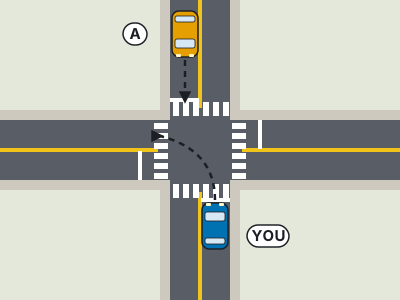
9. Before turning left across traffic, what should you look for?
- Only vehicles behind you
- A safe opening in the oncoming traffic
- No traffic if your turn signal is on
- Vehicles parked along the opposite curb
Show answer
A safe opening in the oncoming traffic. A left turn crosses the path of oncoming traffic, so the first task is finding a safe opening before moving across. A signal announces an intention but does not create a gap, and traffic behind you does not clear the path ahead. Check the street you will enter for vehicles, bicycles, and pedestrians as well. The important visual cue is the available space between approaching vehicles: if you cannot see a safe opening, remain stopped. Move only after the opening is large enough for the complete turn, not merely large enough for the front bumper.
Study this in the handbook: Railroad Crossings and Work Zones
10. What does the chemical test requested after a DUI arrest show?
- The vehicle's emissions level
- The driver's blood alcohol content
- The driver's vision acuity
- The vehicle's tire pressure
Show answer
The driver's blood alcohol content. After an arrest for driving under the influence, the manual describes a blood, breath, or urine test that shows the driver's blood alcohol content. Emissions, vision, and tire pressure are unrelated measurements. This item tests what the chemical procedure measures, not the later suspension or interlock consequence. Remember the acronym BAC and connect it with blood alcohol content. Keeping the test purpose separate from the penalty timeline prevents mixing two different parts of the alcohol rules.
Study this in the handbook: Alcohol, Testing and DUI Suspensions
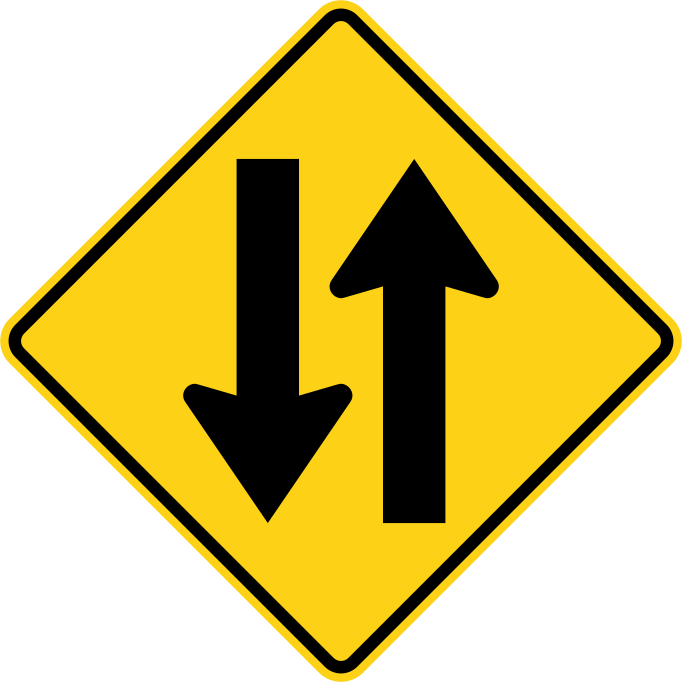
11. What change in roadway operation is shown by two opposing arrows?
- Passing is automatically allowed in both directions
- Both directions may use any lane
- A second median is beginning
- You are leaving a divided roadway and entering a two-way highway
Show answer
You are leaving a divided roadway and entering a two-way highway. The TWO-WAY ROAD WAY sign means the divided roadway is ending and you will drive on a two-way highway. Expect opposing traffic and keep a careful position within your lane. It does not make every lane available to both directions, authorize passing, or announce another median. As the roadway changes, reduce speed if needed, watch for oncoming vehicles, and check pavement markings that separate the opposing flows.
Study this in the handbook: Warning, School and Guide Signs
12. How many hours of behind the wheel, on the road training must a 16 or 17 year old Connecticut applicant complete before licensing?
- At least 10 hours
- At least 20 hours
- At least 100 hours
- At least 40 hours
Show answer
At least 40 hours. All 16 and 17 year old applicants must have at least 40 hours of behind the wheel training, which can be any combination of driving school instruction and home training. Ten and twenty hours are below the requirement. One hundred hours is more than the law sets as the minimum. Teens must also finish an eight hour safe driving practices course that includes two hours of parent training.
Study this in the handbook: The Learner's Permit and License Tests
13. You hit an unattended parked car in Connecticut and cannot find the owner. What must you do?
- Leave a visible note with the date, time, and how the owner can reach you
- Drive away and call your insurer later
- Wait at the car for up to 24 hours
- Nothing if the damage is small
Show answer
Leave a visible note with the date, time, and how the owner can reach you. If a crash involves a parked vehicle, you must try to find the owner. If you cannot, leave a note where it can be seen with the date and time of the crash and how the owner can reach you. Driving away without doing that is not allowed, the manual sets no 24 hour wait, and small damage does not excuse you.
Study this in the handbook: Avoiding Collisions and After a Crash
14. What suspension does a Connecticut 16 or 17 year old face for speeding 20 mph over the limit?
- A 30 day suspension
- A 60 day suspension, a $175 restoration fee and court fines
- A one year suspension
- A warning
Show answer
A 60 day suspension, a $175 restoration fee and court fines. For a 16 or 17 year old, speeding 20 mph over the speed limit under section 14-219 brings a 60 day suspension, a $175 license restoration fee and court fines, with longer suspensions for repeat offenses. Cell phone use brings 30 days, and reckless driving and street racing bring six months. Two violations before age 25 also require operator retraining.
Study this in the handbook: Teen Suspensions and Operator Retraining
15. Who must complete Connecticut's operator retraining program?
- Anyone 24 or younger with two or more moving or suspension violations
- Only drivers over 65
- Anyone with one speeding ticket
- All new drivers
Show answer
Anyone 24 or younger with two or more moving or suspension violations. Anyone age 24 or younger who commits two or more moving violations or suspension violations must complete the DMV certified operator retraining program, which covers the principles of motor vehicle operation, how attitude contributes to aggressive driving, and the need to practice safe driving. A motorist 25 or older is held to a higher threshold, since attendance is required after three or more such convictions.
Study this in the handbook: Teen Suspensions and Operator Retraining
16. Which vehicles must receive the right-of-way when using a siren, air horn, or red or blue flashing light?
- Any vehicle that sounds its horn twice
- Only police cars displaying a blue flashing light
- Police vehicles, fire engines, ambulances, and other emergency vehicles
- Only ambulances traveling in the same lane
Show answer
Police vehicles, fire engines, ambulances, and other emergency vehicles. The rule covers police vehicles, fire engines, ambulances, and other emergency vehicles when they use the listed warning equipment. It is not limited to police cars, one light color, or a vehicle traveling directly behind you. An ordinary horn signal does not create emergency-vehicle priority. The practical cue is to identify the siren, air horn, or red or blue flashing light, then yield promptly and safely so the emergency response can continue.
Study this in the handbook: Right of Way at Intersections
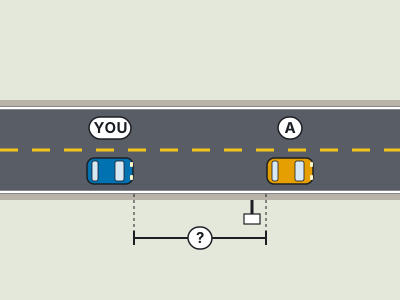
17. How can a driver check whether the following gap is long enough under the manual's three-second rule?
- Wait until the vehicle ahead changes lanes before measuring the gap
- Keep exactly one car length between the vehicles at every speed
- Use the rearview mirror to estimate whether the gap looks wide
- Count the seconds after the vehicle ahead passes a fixed object until you reach it
Show answer
Count the seconds after the vehicle ahead passes a fixed object until you reach it. The manual's method uses a stationary reference point, such as a sign or pole. Watch the rear of the vehicle ahead pass it, then count until your vehicle reaches that same point. Reaching it before three seconds have elapsed means you are too close, so drop back and check again. The one-car-length idea changes with speed and is not the stated test. A mirror view cannot measure the time your vehicle needs to cover the same distance. Use the three-second count as a quick cue whenever traffic speed or spacing changes.
Study this in the handbook: Space Cushion and Following Distance
18. What phone use does Connecticut permit an adult driver to use while operating on a public highway?
- Hand-held calls whenever traffic is light
- Only hands-free mobile telephone accessories, subject to listed exceptions
- Texting while stopped at a traffic signal
- Any device use if the driver keeps one hand on the wheel
Show answer
Only hands-free mobile telephone accessories, subject to listed exceptions. For adult drivers, Connecticut prohibits hand-held cell phones and mobile electronic devices on public highways. The general permission is limited to hands-free mobile telephone accessories, while separate emergency and qualifying public-safety exceptions are listed in the manual. A traffic stop does not authorize texting or other device use, and keeping one hand on the wheel does not make a hand-held call lawful. Remember the contrast: adults have a hands-free rule, while 16- and 17-year-olds cannot use these devices at all.
Study this in the handbook: Distractions, Fatigue and Aggressive Driving
19. What does the Connecticut manual say about its relationship to the Connecticut General Statutes?
- It replaces the statutes
- It lists an exact fine for every violation
- It is not a precise statement of the statutes
- It applies only to license applicants
Show answer
It is not a precise statement of the statutes. The manual describes itself as a general guide to safe and lawful vehicle operation, not as the definitive wording of Connecticut law. Its disclaimer says the contents are not a precise statement of the General Statutes and directs readers to the most recent statutes for exact legal language. The choice claiming a complete fine schedule goes beyond that statement, while replacement of the statutes is expressly inconsistent with it. The license applicant option is also too narrow because the manual addresses drivers and road users more broadly.
20. What right-of-way does a pedestrian with a guide dog or white cane have?
- Priority only after making eye contact
- Right-of-way only at a signalized crossing
- Absolute right-of-way, and drivers should not use the horn
- No special right-of-way
Show answer
Absolute right-of-way, and drivers should not use the horn. A pedestrian using a guide dog or carrying a white cane has absolute right-of-way. The manual also tells drivers not to use the horn because a sudden sound can confuse or frighten the person. The rule is broader than a marked crossing and does not depend on eye contact. Stop and allow the pedestrian to pass safely. The useful cue is guide dog or white cane, paired with absolute priority and no horn.
Study this in the handbook: Traffic Lights, Arrows and HAWK Signals
QualitySpace is expanding to Connecticut
We are a California-based independent insurance brokerage working on licensing in more states. We cannot help with Connecticut insurance yet. Leave your email and we will let you know when we can.
Every question is written from the official Connecticut Driver's Manual. Need paper? Printable CT practice test with answer key.
Last verified 2026-10-05. How we check every question · Study all 210 as flashcards
Frequently asked questions
How many questions are on this Connecticut practice test?
This fixed set has 20 questions. It is test 7 of 10 from the 210 question Connecticut bank. The real CT exam asks 25 questions and you need 20 correct.
What is the passing score for the real Connecticut test?
20 of 25 correct (80%) That figure comes from the official Connecticut source cited on the DMV facts page.
How does this fixed test relate to the full Connecticut bank?
Each numbered test is a fixed set of questions in a fixed order, so you can retake the same test later and compare. Every test mixes road signs and the other topics in about the same proportion as the full bank. Tests 1 to 10 together cover 200 of the 210 questions in the Connecticut bank, each once. The full practice page mixes the whole bank at random.
Last verified 2026-10-05. See the Connecticut DMV facts page for sourced state details.
Return to the full Connecticut practice test · Study road signs