
Test 4 of 10 · 20 questions · Free 2026
CT Permit Practice Test 4
Jump to the test ↓A fixed 20 question set from the Connecticut bank with answers and plain English explanations. The real CT exam is 25 questions, 80 percent to pass; take the full length version on the main practice page.
Question 1 of 20 · 0 right so far
All 20 questions in test 4
Every question below comes from the Connecticut question bank on this page. Open a question to see the correct answer and the explanation. Nothing here is hidden behind a signup.
1. During which period does the Connecticut manual allow studded tires?
- November 15 through April 30
- October 1 through February 28
- January 1 through March 1
- They are never allowed in Connecticut
Show answer
November 15 through April 30. Connecticut permits studded tires from November 15 through April 30. The manual also warns that these tires can damage roads, so they are not allowed in many areas or on certain roads. That second point means the calendar period is not a universal permission for every roadway. The October-to-February option ends too early, and the total-ban option ignores the stated seasonal allowance. Use both cues together: the dates establish when they may be permitted, while local or road-specific restrictions can still apply.
Study this in the handbook: Slippery Roads, Hydroplaning and Curves
2. If the vehicle you are passing begins slowing or stopping, what must you do?
- Sound the horn and maintain speed
- Continue because the pass has started
- Move onto the shoulder to finish faster
- Yield to that vehicle
Show answer
Yield to that vehicle. The driver being overtaken retains the relevant protection even if that vehicle slows or stops. The passing driver must yield rather than treating the maneuver as an entitlement to continue. Finishing on the shoulder or using the horn does not remove the conflict. Abort the pass when necessary, return safely or remain behind, and keep a cushion around both vehicles. The cue is simple: a slowing vehicle can change the gap while you are alongside it.
Study this in the handbook: Right of Way at Intersections
3. An emergency vehicle approaches while you are already in an intersection. What should you do first?
- Stop in the intersection immediately
- Back up to the previous stop line
- Drive through the intersection, then pull over
- Turn left and continue without stopping
Show answer
Drive through the intersection, then pull over. The emergency-vehicle rule requires a driver to pull to the right and stop, but the manual gives a specific instruction for a vehicle already in an intersection: drive through the intersection before pulling over. Stopping in the middle can block the emergency vehicle and create a second conflict with cross traffic. Reversing is unpredictable, and continuing after clearing the intersection without stopping ignores the duty to yield. Clear the intersection safely, then move as far right as possible and remain stopped until the vehicle passes.
Study this in the handbook: Emergency Vehicles, Move Over and School Buses
4. What hazard does a circular yellow RXR sign announce?

- A pedestrian-only plaza ahead
- A railroad crossing ahead
- A circular traffic island ahead
- A roadway with no passing ahead
Show answer
A railroad crossing ahead. The manual describes the railroad crossing sign as a round yellow warning sign with an X symbol and black RR letters, placed along the road before you get to a railroad crossing. When you see the circular shape, slow down, look, and listen for trains. The shape does not describe a roundabout, pedestrian plaza, or no-passing restriction. Closer to the tracks, watch for a crossbuck, flashing lights, or gates, and yield to any crossing train.
Study this in the handbook: Sign Shapes and Regulatory Signs
5. What qualifies a person to supervise a Connecticut learner's permit holder as a trainer, outside a driving school?
- Any licensed driver age 18 or older
- At least 20 years old with a license held four or more consecutive years
- At least 25 years old with any license
- A parent, regardless of license status
Show answer
At least 20 years old with a license held four or more consecutive years. Connecticut requires a qualified trainer to be at least 20 years old, to have held a driver's license for four or more consecutive years, and to have had no suspension during the four years before training. An 18 year old driver or a parent without a license does not qualify, and 25 is not the Connecticut age. The trainer must sit in the front passenger seat and be ready to take over control of the vehicle.
Study this in the handbook: Teen Training, Passengers and Curfew
6. When a HAWK signal is flashing red, what may a driver do after stopping?
- Proceed when pedestrians have cleared the crosswalk
- Continue immediately because the signal is deactivating
- Turn across the crosswalk while pedestrians remain
- Proceed without stopping if the roadway looks empty
Show answer
Proceed when pedestrians have cleared the crosswalk. The flashing-red phase of a HAWK pedestrian signal means the system is about to deactivate, but it still requires a stop. Movement can resume only after pedestrians have cleared the crosswalk. The signal is not permission to continue immediately, turn through people, or skip the stop because the road appears empty. Watch the crossing itself, keep the vehicle stopped while someone remains in it, and proceed only when the pedestrian movement has ended.
Study this in the handbook: Traffic Lights, Arrows and HAWK Signals
7. What does the Connecticut manual say about wearing only part of a two part seat belt?
- Wearing either the lap or shoulder belt alone greatly reduces protection
- The lap belt alone is enough
- The shoulder belt alone is enough
- Either part alone is fully effective
Show answer
Wearing either the lap or shoulder belt alone greatly reduces protection. If your vehicle has a two part seat belt system, wear both the lap belt and the shoulder belt, because wearing either part alone greatly reduces your protection. With an automatic shoulder belt, buckle the lap belt as well, or you could slide out of the belt and be hurt in a collision. Belts also help you keep control, since a side impact or quick turn could push you sideways away from the wheel.
Study this in the handbook: Seat Belts, Child Seats and Phone Laws
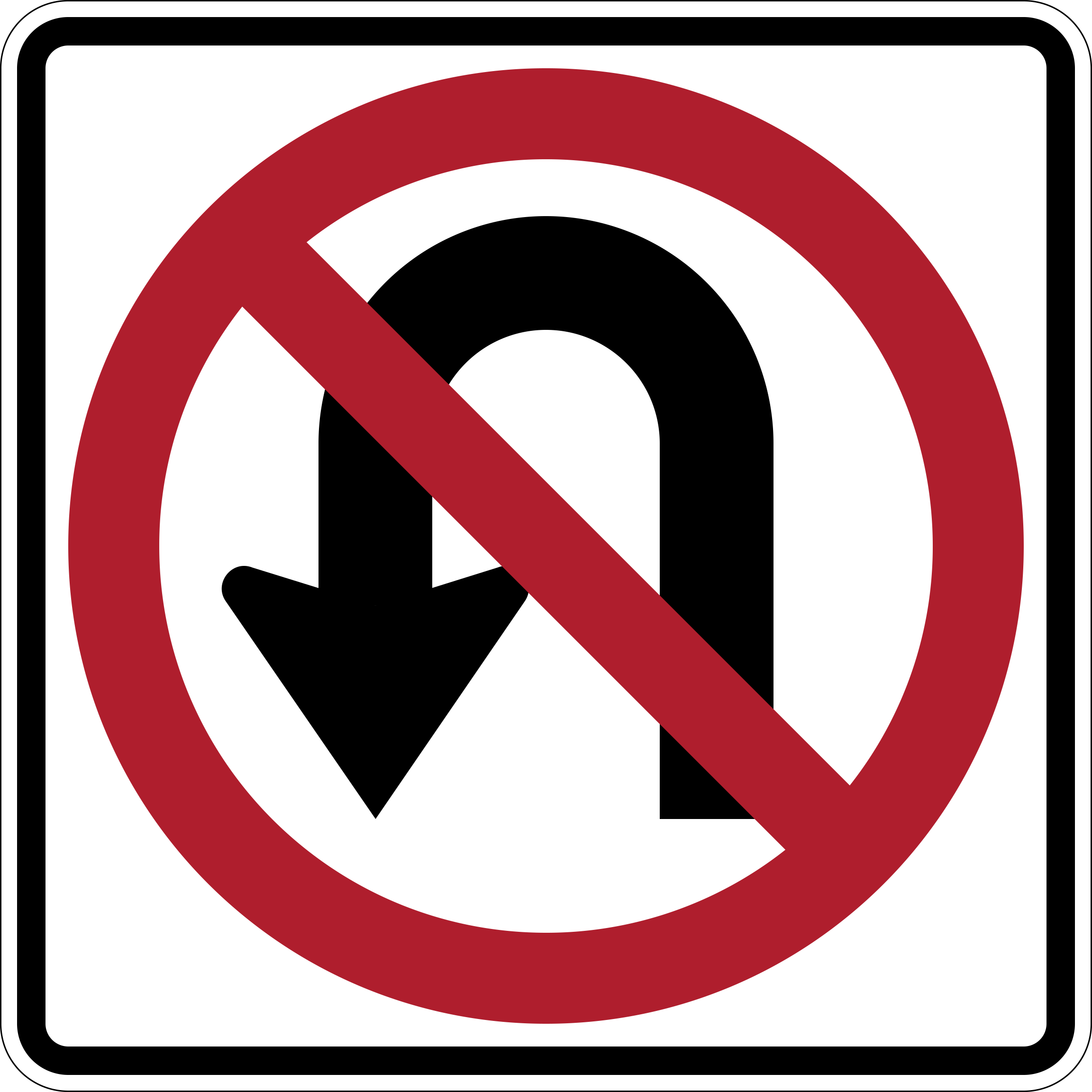
8. A circular slash covers a U-shaped arrow. Which maneuver is forbidden?
- Passing a slower vehicle
- Turning left into a driveway
- Making a U-turn
- Turning right at the intersection
Show answer
Making a U-turn. The crossed U-shaped arrow is a NO U-TURN sign, so it prohibits reversing direction through a U-turn at that location. It does not automatically prohibit every left turn, ordinary passing, or a right turn. Watch especially for this sign at an opening in a divided highway, where a driver might otherwise cross the median opening to reach the opposite side. If you need to reverse direction, continue to a location where the maneuver is permitted and visibility is adequate.
Study this in the handbook: Sign Shapes and Regulatory Signs
9. When should a driver use a turn signal?
- Every time the driver changes direction, even when no one else is visible
- Only when another vehicle is close enough to be affected
- Only after the vehicle begins turning
- Only for left turns and lane changes
Show answer
Every time the driver changes direction, even when no one else is visible. Connecticut tells drivers to signal every time they change direction, including when no other road user is obvious. Someone can be easy to miss, and the signal gives that person time to understand your plan. Waiting until the turn begins is late, while restricting signals to left turns ignores right turns, merging, parking, and lane changes. The no-one-visible choice also overlooks pedestrians and cyclists. Build the habit before the maneuver, then cancel the signal after the turn or lane change.
Study this in the handbook: Headlights, Horn and Turn Signals
10. When is a driver required to move one lane away from a vehicle stopped on the roadside?
- Only after stopping completely behind the vehicle
- Only when the stopped vehicle is displaying blue lights
- Whenever it can be done safely after slowing below the posted speed limit
- Never on a road with two or more lanes
Show answer
Whenever it can be done safely after slowing below the posted speed limit. The Move Over instruction is conditional on safety. After slowing below the posted speed limit, a driver must move over one lane whenever that maneuver is safe to do. A blue-light requirement would narrow the rule beyond the manual, which says any vehicle pulled over on the road or highway. A complete stop is not the normal step, and multiple lanes make the spacing maneuver possible rather than forbidden. Scan early, reduce speed, and change lanes only when the adjacent lane is clear enough to protect everyone roadside.
Study this in the handbook: Pedestrians, Bicyclists and Horses
11. What minimum suspension follows a refusal to take a chemical test?
- At least 15 days
- At least 45 days
- At least 90 days
- No suspension
Show answer
At least 45 days. Regardless of age, refusing the chemical test brings a license suspension of at least 45 days. The manual also describes an ignition interlock device as a condition of reinstatement, so refusal is not a way to avoid administrative consequences. The shorter and longer numbers are unsupported alternatives, and no suspension reverses the stated rule. When studying this item, focus first on the refusal trigger, then remember that the rule applies regardless of age.
Study this in the handbook: Alcohol, Testing and DUI Suspensions
12. What information may appear below a turn or curve arrow?

- The legal speed limit for the entire route
- The minimum speed required for every vehicle
- The distance to the next gas station
- An advisory speed for the condition ahead
Show answer
An advisory speed for the condition ahead. A small plaque below a turn or curve arrow may show the advisory speed for the condition ahead. That number helps you choose a safe approach speed for the bend, but it is not a minimum, a service-distance marker, or the legal speed limit for the entire route. Compare the plaque with pavement, visibility, weather, and traffic before entering. The practical cue is to slow before the curve, rather than braking hard once steering demand increases.
Study this in the handbook: Warning, School and Guide Signs
13. Why can a Connecticut driver receive a ticket while traveling at the posted speed limit?
- Posted limits apply only to motorcycles
- The limit is enforceable only in daylight
- Posted limits assume ideal conditions, so the speed may be too fast for wet, icy, low-visibility, or heavy-traffic conditions
- A ticket is possible only when the speedometer is broken
Show answer
Posted limits assume ideal conditions, so the speed may be too fast for wet, icy, low-visibility, or heavy-traffic conditions. Connecticut's posted speed limits are based on ideal conditions. A driver must slow when pavement is wet or icy, visibility is poor, or traffic is heavy, and the manual says a ticket can result even when the vehicle is at the posted number if that speed is too fast for the conditions. The limit is not restricted to daylight or to a particular vehicle type. Treat the sign as an upper reference for favorable conditions, then reduce speed when the road or traffic demands more time and stopping distance.
Study this in the handbook: Speed Limits and Stopping Distance
14. How does Connecticut treat a hand-held phone violation committed in a work zone?
- It is ignored if traffic is stopped
- The fine is cut in half
- It is handled only as a parking ticket
- The distracted driving fine is doubled
Show answer
The distracted driving fine is doubled. Connecticut doubles distracted driving fines for anyone convicted of illegally using a hand-held phone or mobile electronic device while driving in a work zone. Stopped traffic is not a defense, since the hand-held ban covers temporary stops as well. Nothing in the manual cuts the fine in half, and the rule concerns using a device while driving, not where a vehicle is parked. Work zones already carry fines up to $1,000 for speeding and endangering workers.
Study this in the handbook: Railroad Crossings and Work Zones
15. What type of information do regulatory signs provide?
- Only scenic points and recreation areas
- Rules for traffic direction, lane use, turning, speed, or parking
- Only warnings about weather conditions
- Only directions to emergency rooms
Show answer
Rules for traffic direction, lane use, turning, speed, or parking. Regulatory signs communicate rules that govern how traffic may move. The manual lists direction, lane use, turning, speed, parking, and other special situations. They may be square or rectangular, or use a special shape, and often use white, red, or black. Scenic guidance belongs to guide signs, while hazards are generally the work of warning signs. The cue is to treat a regulatory sign as an instruction or legal restriction that must be followed, not as optional route information.
Study this in the handbook: Sign Shapes and Regulatory Signs
16. When must a driver slow or stop for a pedestrian at a crosswalk?
- Only when the crosswalk has painted lines
- When the pedestrian is within any portion of a marked or unmarked crosswalk
- Only after the pedestrian reaches the center of the road
- Only when a crossing guard is present
Show answer
When the pedestrian is within any portion of a marked or unmarked crosswalk. Connecticut recognizes a crosswalk at every intersection, including one without painted lines. A driver must slow or stop and grant the right-of-way when a pedestrian is within any part of that crosswalk. Requiring painted lines or a crossing guard would miss unmarked crossings and ordinary intersections. Waiting until the person reaches the road center also delays the required yield. The practical cue is to imagine the sidewalk or shoulder continuing across the roadway and to scan that entire crossing area before moving.
Study this in the handbook: Pedestrians, Bicyclists and Horses
17. A Connecticut 17 year old is convicted a second time of breaking a graduated license rule, such as the curfew. What suspension applies?
- 30 days
- 90 days
- No suspension, only a fine
- 6 months or until age 18, whichever is longer
Show answer
6 months or until age 18, whichever is longer. For graduated license violations such as passenger limits, curfew, or carrying more passengers than seat belts, a first offense brings a 30 day suspension and a second or later offense brings a 6 month suspension or until age 18, whichever is longer. Each also carries a $175 restoration fee and court fines. Thirty days is the first offense penalty, 90 days is the second offense penalty for teen phone use, and a fine alone is not listed.
Study this in the handbook: Teen Suspensions and Operator Retraining
18. After pumping a failed brake pedal and using the parking brake slowly, what should the driver do if the brakes still do not work?
- Use the parking brake at full force while turning sharply
- Continue driving until the brakes begin working normally
- Turn the vehicle off in the travel lane
- Shift to lower gears and look for a safe place to stop off the roadway
Show answer
Shift to lower gears and look for a safe place to stop off the roadway. Brake failure recovery proceeds in stages. After pumping the pedal and applying the parking brake slowly, the manual says to begin shifting to lower gears and look for a safe place to slow to a stop. The vehicle should be off the roadway, and it must not be driven without brakes. Continuing to drive leaves the emergency unresolved, while pulling the parking brake hard can lock the rear wheels and cause a skid. Stopping in the travel lane leaves the vehicle on the roadway instead of off it.
Study this in the handbook: Vehicle Emergencies and Equipment Failure
19. When may a Connecticut driver enter an intersection?
- Whenever the driver has the right of way
- Whenever the light is green
- Only when able to get through it without stopping inside it
- Whenever traffic ahead has slowed
Show answer
Only when able to get through it without stopping inside it. Drivers may not enter an intersection unless they can get through it without having to stop inside it, because a vehicle stuck in the box blocks cross traffic when the light changes. Drivers entering from a driveway, alley or roadside must yield to vehicles already on the main road, and at a four way stop the driver who reaches the intersection first goes first, with the vehicle on the right going first only when two arrive at the same time.
Study this in the handbook: Right of Way at Intersections
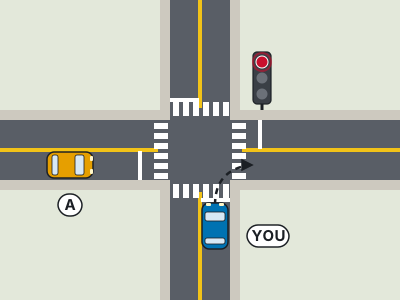
20. Which checks are required before making a right turn on red in Connecticut?
- After a full stop, if traffic is clear and no sign prohibits the turn
- Whenever the driver has waited ten seconds
- Only when another driver waves the vehicle through
- Without stopping when the intersection is empty
Show answer
After a full stop, if traffic is clear and no sign prohibits the turn. A right turn on red is permitted only after a full stop and a careful check for oncoming traffic, pedestrians, and any sign prohibiting the movement. The rule does not depend on a fixed ten-second wait or a wave from another driver. An empty-looking intersection still requires the complete stop. The manual also reminds drivers to watch for pedestrians crossing in front of the vehicle. The useful routine is stop first, check every conflict, read the sign, and turn only when the path is legal and clear.
Study this in the handbook: Traffic Lights, Arrows and HAWK Signals
QualitySpace is expanding to Connecticut
We are a California-based independent insurance brokerage working on licensing in more states. We cannot help with Connecticut insurance yet. Leave your email and we will let you know when we can.
Every question is written from the official Connecticut Driver's Manual. Need paper? Printable CT practice test with answer key.
Last verified 2026-10-05. How we check every question · Study all 210 as flashcards
Frequently asked questions
How many questions are on this Connecticut practice test?
This fixed set has 20 questions. It is test 4 of 10 from the 210 question Connecticut bank. The real CT exam asks 25 questions and you need 20 correct.
What is the passing score for the real Connecticut test?
20 of 25 correct (80%) That figure comes from the official Connecticut source cited on the DMV facts page.
How does this fixed test relate to the full Connecticut bank?
Each numbered test is a fixed set of questions in a fixed order, so you can retake the same test later and compare. Every test mixes road signs and the other topics in about the same proportion as the full bank. Tests 1 to 10 together cover 200 of the 210 questions in the Connecticut bank, each once. The full practice page mixes the whole bank at random.
Last verified 2026-10-05. See the Connecticut DMV facts page for sourced state details.
Return to the full Connecticut practice test · Study road signs