
Test 8 of 10 · 20 questions · Free 2026
CT Permit Practice Test 8
Jump to the test ↓A fixed 20 question set from the Connecticut bank with answers and plain English explanations. The real CT exam is 25 questions, 80 percent to pass; take the full length version on the main practice page.
Question 1 of 20 · 0 right so far
All 20 questions in test 8
Every question below comes from the Connecticut question bank on this page. Open a question to see the correct answer and the explanation. Nothing here is hidden behind a signup.
1. How does stopping distance at 60 mph compare with 30 mph, according to the Connecticut manual?
- Over three times the distance, not twice
- Exactly twice
- About the same
- Half the distance
Show answer
Over three times the distance, not twice. Stopping at 60 mph does not take twice the distance it takes at 30 mph, as one might think, but over three times the distance. The manual explains that the faster a vehicle is going, the more distance it takes to turn, slow, or stop. Driving safely means adjusting your speed for road and traffic conditions, how well you can see, and the posted limits. Going much slower than other traffic can be just as bad as speeding.
Study this in the handbook: Traffic Lights, Arrows and HAWK Signals
2. What is the first response when the tires lose traction on wet pavement?
- Brake hard while turning toward the shoulder
- Ease your foot off the gas pedal
- Accelerate until the tires cut through the water
- Turn the steering wheel sharply back and forth
Show answer
Ease your foot off the gas pedal. During hydroplaning, the manual directs the driver to ease off the gas pedal first. Reducing power helps the tires regain contact without adding a sudden braking or steering input. Hard braking while turning can cause a skid, and acceleration keeps the tires riding on the water. Sharp steering changes can also worsen the loss of control. Keep the wheel straight and avoid stopping or turning until the tires grip the road again, unless an emergency makes a slow turn unavoidable.
Study this in the handbook: Slippery Roads, Hydroplaning and Curves
3. Where might a square sign with a white horizontal line inside a red ball be placed?
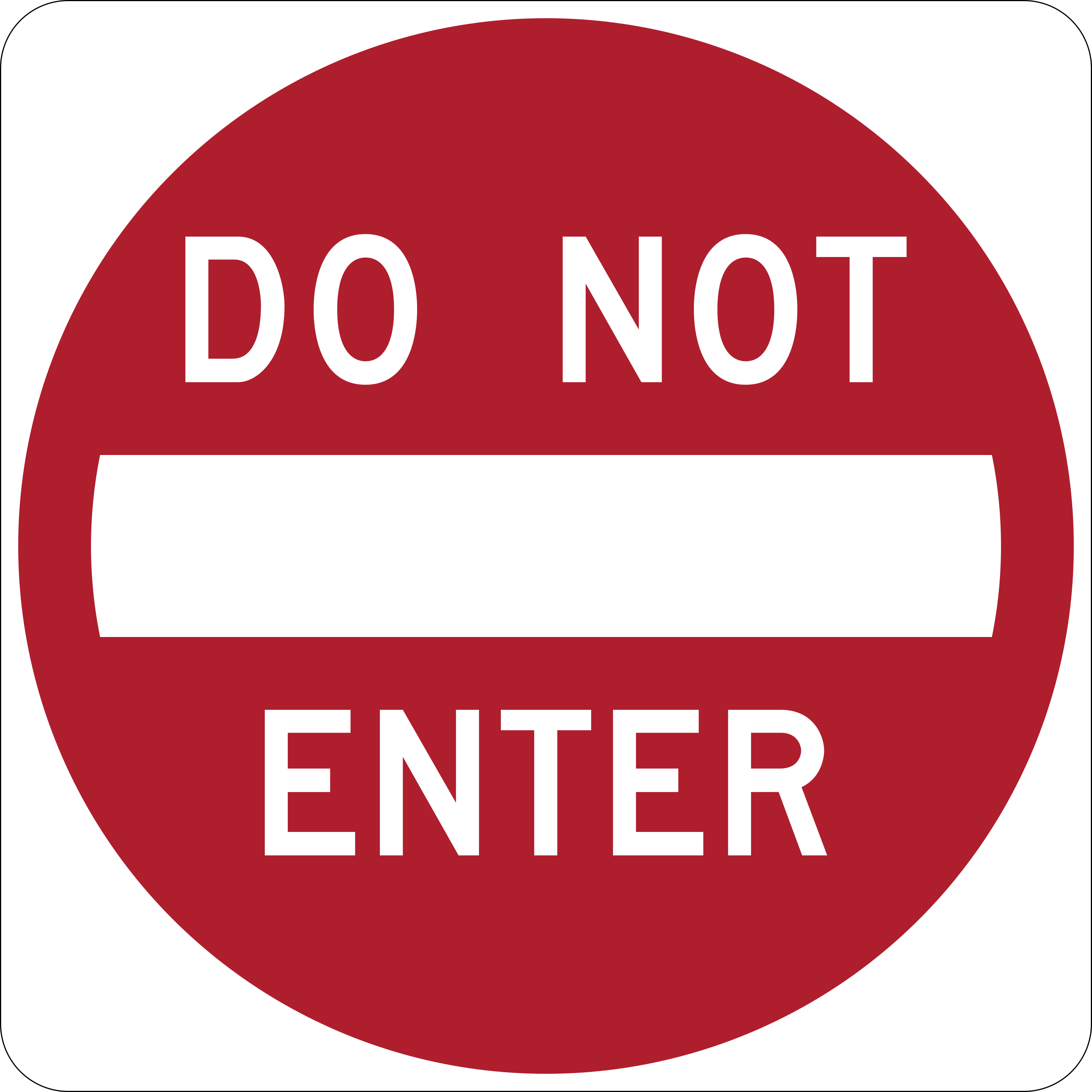
- At a permitted entrance to a two-way street
- At the start of every school zone
- Only beside a legal parking space
- At a roadway opening that should not be entered, such as an exit ramp leading the wrong way
Show answer
At a roadway opening that should not be entered, such as an exit ramp leading the wrong way. The DO NOT ENTER sign prohibits entry at a roadway opening where entering would put the driver in the wrong direction or otherwise violate the intended traffic flow. The manual gives exit ramps, crossovers on divided roads, and one-way streets as examples. It is not a parking or school-zone sign, and a permitted two-way entrance conveys the opposite message. The red ball with a white horizontal bar is the recognition cue. Treat the sign as an immediate instruction to stay out, not as a suggestion to slow down.
Study this in the handbook: Sign Shapes and Regulatory Signs
4. When do passenger restrictions not apply to a Connecticut learner’s permit holder?
- During specific instruction from a licensed driver instructor at a commercial school or driver education program
- During any trip with a licensed adult passenger
- During daylight hours on roads below 30 mph
- During the first six months after receiving a driver’s license
Show answer
During specific instruction from a licensed driver instructor at a commercial school or driver education program. The manual makes an exception while a learner’s permit holder is receiving specific instruction from a licensed driver instructor connected with a commercial driving school or driver education program. That exception is tied to the instructional session, not to daylight, a low speed, or simply having any licensed adult in the vehicle. The first six months after licensing are instead subject to passenger limits. When applying the rule, identify whether the person is still learning under formal instruction or is driving under the newly licensed passenger restrictions.
Study this in the handbook: Teen Training, Passengers and Curfew
5. According to the Connecticut manual, how much alcohol could make a driver under 21 considered impaired?
- Only one drink
- At least three drinks
- Any amount over 0.08 percent
- Only enough to fail a field sobriety test
Show answer
Only one drink. In Connecticut, people under 21 could be considered impaired after only one drink. That fits the zero tolerance limit of 0.02 percent for drivers under 21. Waiting until three drinks, or relying on the 0.08 figure, ignores the one drink warning the manual gives young drivers, and the manual's warning is not tied to failing a roadside test. A drink means 1.5 ounces of 80 proof liquor, 12 ounces of beer, or 5 ounces of wine.
Study this in the handbook: Zero Tolerance for Drivers Under 21
6. In Connecticut, what kind of crosswalk may still give a pedestrian the right-of-way?
- Only a painted crosswalk
- A marked or unmarked crosswalk
- Only a school crosswalk
- Only a crosswalk with a signal
Show answer
A marked or unmarked crosswalk. Connecticut recognizes both marked and unmarked crosswalks for pedestrian right-of-way. Paint is therefore not the condition that creates the driver's duty. A signal or school sign may add control, but an ordinary intersection can still contain an unmarked crossing. Slow before the intersection, look for people entering from either side, and be ready to stop. The key study cue is that an absent stripe does not erase the crosswalk or the duty to yield.
Study this in the handbook: Traffic Lights, Arrows and HAWK Signals
7. A railroad crossbuck has the same meaning as which traffic sign?
- Do Not Enter
- Stop
- Yield
- Speed Limit
Show answer
Yield. The white X-shaped railroad crossbuck carries the meaning of a yield sign, so a driver must yield to crossing trains. That does not mean every crossing requires a routine stop when no train is present, which is why Stop is too broad. The crossbuck is also not a restriction on entry or a speed-limit sign. Slow as you approach, look and listen along the tracks, and enter only when you can yield safely and clear the crossing.
Study this in the handbook: Railroad Crossings and Work Zones
8. You approach a Connecticut roundabout with more than one lane. How do you decide which lane to use?
- Always use the inside lane
- Always use the outside lane
- Follow the posted signs and lane-use controls for your intended movement
- Pick whichever lane is empty
Show answer
Follow the posted signs and lane-use controls for your intended movement. Multi-lane roundabouts assign movements to lanes before you enter, and the posted signs and lane-use controls on the approach tell you which lane serves your intended movement. Choosing by habit or by which lane happens to be empty can leave you in a lane that does not serve your exit. Slow down on the approach, yield to traffic already in the roundabout and to pedestrians in the crosswalk, and enter only when there is a sufficient gap. Do not stop inside the roundabout to let others enter, and use your right turn signal as you reach your exit.
Study this in the handbook: Right of Way at Intersections
9. If the brake pedal goes to the floor while driving, what should you try first?
- Pump the brake pedal several times
- Turn the steering wheel sharply toward the shoulder
- Shift immediately into park while moving
- Accelerate to reach the next intersection
Show answer
Pump the brake pedal several times. A brake pedal that drops to the floor signals a possible braking system failure. The first response in the manual's brake failure steps is to pump the brake pedal several times, which will often build up enough pressure to stop. If that does not work, pull on the parking brake slowly so the rear wheels do not lock, and if that also fails, shift to lower gears and look for a safe place to stop off the roadway. Sharp steering, shifting into park, and accelerating are not part of that sequence.
Study this in the handbook: Vehicle Emergencies and Equipment Failure
10. How much time does the Connecticut manual say you need to pass at 55 mph?
- About 3 seconds
- About 30 seconds
- About 10 seconds, needing a 10 second opening in oncoming traffic
- About 1 second
Show answer
About 10 seconds, needing a 10 second opening in oncoming traffic. At a speed of 55 mph you need about 10 seconds to pass, which means a 10 second opening in oncoming traffic and enough sight distance. Because you and the oncoming vehicle each cover over 800 feet in that time, you need over 1,600 feet, about a third of a mile, and oncoming cars at that distance seem slower than they are.
Study this in the handbook: Changing Lanes and Passing
11. When must police be notified after a Connecticut crash?
- Only when a vehicle cannot be driven
- Only on highways
- Whenever any person is injured or killed
- Never, insurers handle it
Show answer
Whenever any person is injured or killed. If you are involved in an accident you must stop, and if any person is injured or killed the police must be notified; leaving a crash with injury or death before police have talked to you and gathered the information they need is a crime. If you hit a parked vehicle you must try to locate the owner. Exchange names, addresses, license numbers, vehicle details, and insurance company information with the other drivers involved.
Study this in the handbook: Avoiding Collisions and After a Crash
12. What does a downward-pointing red and white triangle tell a driver to do?
- Continue without checking for pedestrians
- Stop for exactly three seconds
- Enter before all vehicles already on the road
- Slow down and yield to traffic in the intersection or roadway
Show answer
Slow down and yield to traffic in the intersection or roadway. A yield sign calls for a speed appropriate to the conditions and requires the driver to give way to traffic in the intersection or roadway being entered. A full stop may be necessary, but the sign does not impose a fixed three-second pause. Entering first or ignoring pedestrians defeats the purpose of yielding. Reduce speed early, look for conflicting road users, and stop if the available gap is not sufficient.
Study this in the handbook: Sign Shapes and Regulatory Signs
13. How should a driver respond when a traffic signal changes from green to steady yellow?
- The signal applies only to pedestrians
- The driver must accelerate through the intersection
- The light is about to change to red, so stop if safe
- The driver may ignore it when turning left
Show answer
The light is about to change to red, so stop if safe. A steady yellow warns that the traffic light is about to change to red. The driver must stop if it is safe to do so. If the vehicle is already in the intersection when yellow appears, the driver should continue through rather than stop in the conflict area. Accelerating to beat the red misunderstands the warning, and the signal governs vehicles as well as pedestrians. The cue is to judge stopping distance immediately, stop safely before the intersection when possible, and never create a new hazard with abrupt braking.
Study this in the handbook: Traffic Lights, Arrows and HAWK Signals
14. Which tire condition increases the effect of hydroplaning?
- A properly adjusted mirror
- A full washer reservoir
- Clean windshield glass
- Worn or bald tread
Show answer
Worn or bald tread. Worn or bald tires have less useful tread to move water away from the contact area, so they increase the effect of hydroplaning and the chance of losing grip on a wet road. The washer reservoir, windshield, and mirror position may affect visibility or vehicle preparation, but they do not create the tire traction problem described here. Check tread and tire condition before wet-weather travel, especially when a route includes standing water or heavy rain.
15. What should a driver do after seeing a SIGNAL AHEAD warning?
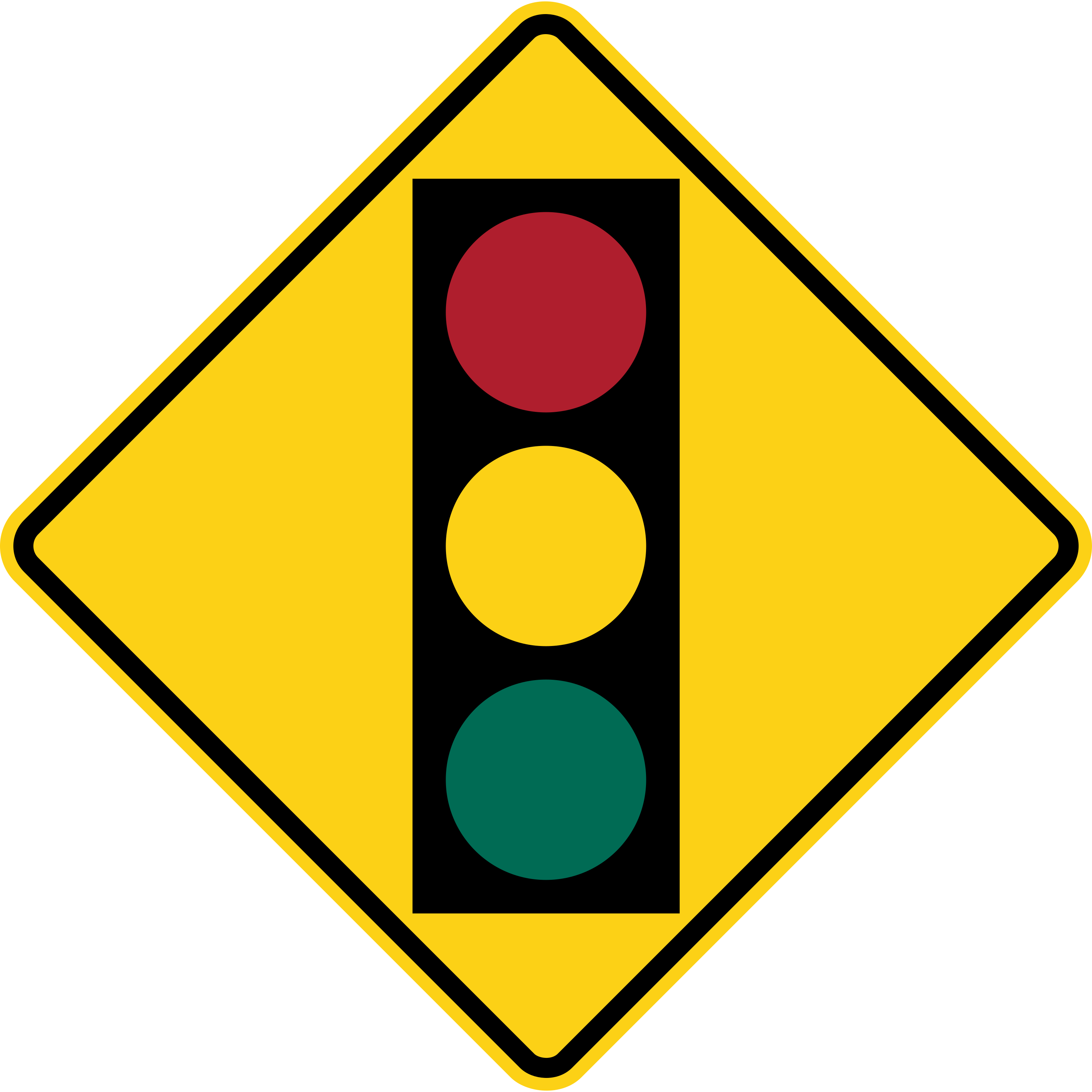
- Stop immediately in the travel lane regardless of traffic
- Speed up to clear the signal before it changes
- Treat the next signal as advisory only
- Slow down and prepare to stop
Show answer
Slow down and prepare to stop. SIGNAL AHEAD warns that traffic signals are coming up. Slow down and prepare to stop so you can respond to the actual signal without abrupt braking. The sign is not permission to race through the intersection or treat the signal as optional. Nor does it require an immediate stop before the signal when the lane is still open. Lift off the accelerator, scan for changing lights and queued traffic, and leave room to stop smoothly.
Study this in the handbook: Warning, School and Guide Signs
16. A Connecticut child is 18 months old and weighs 32 pounds. What type of car seat is required?
- A booster seat
- A rear-facing seat with a 5-point harness
- A forward-facing seat because the child is over 30 pounds
- A seat belt alone
Show answer
A rear-facing seat with a 5-point harness. A child under age 2 or under 30 pounds must ride in a rear-facing car seat with a 5-point harness. When a child's age and weight fall in different categories, the more restrictive requirement applies, so this 18 month old stays rear facing even at 32 pounds. A forward-facing seat, a booster, or a belt alone all loosen the requirement. Connecticut also requires child seats to have a five point harness.
Study this in the handbook: Seat Belts, Child Seats and Phone Laws
17. A steady green signal permits a left turn under what condition?
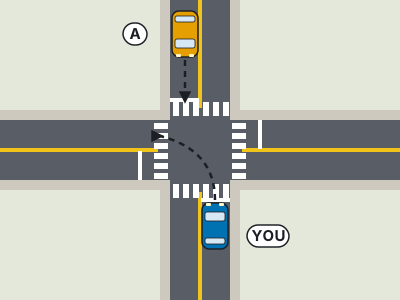
- Enter the intersection and stop across the crosswalk
- Turn immediately because green always gives an unqualified turn
- Wait for the next red light before turning
- Turn only when it is safe after yielding to conflicting traffic
Show answer
Turn only when it is safe after yielding to conflicting traffic. A steady green light permits movement, but it does not erase the conflict created by a left turn. The manual says a driver may turn left on steady green only when it is safe. Check oncoming vehicles, bicycles, pedestrians, and the space into which you will turn before proceeding. Turning immediately can put you across the path of traffic that still has priority, while waiting for red is unnecessary if a safe opening exists. Use the green light as permission to assess and proceed, not as permission to ignore yielding.
Study this in the handbook: Traffic Lights, Arrows and HAWK Signals
18. Near a school or school crossing, which speed instruction applies?
- Always drive 15 mph regardless of signs
- Obey the slower posted speed limit
- Use the normal limit when school is not in session
- Match the speed of school buses
Show answer
Obey the slower posted speed limit. The manual emphasizes that school hours are not the only time children may be present, so drivers must obey the slower posted speed limit near a school or school crossing. Connecticut does not replace every school-area sign with one universal 15 mph rule. The normal limit is not automatically restored after the bell. Look for the posted restriction, slow early, and scan for children beyond the immediate school schedule.
Study this in the handbook: Speed Limits and Stopping Distance
19. How long must applicants who do not complete commercial or secondary school driver education wait after a learner’s permit is issued before taking the driver’s exam?
- 90 days
- 120 days
- 180 days
- 30 days
Show answer
180 days. Applicants who do not complete driver education through a commercial driving school or secondary school must wait 180 days after the learner’s permit is issued before taking the driver’s exam. The 120-day period applies to applicants who successfully complete one of those approved school programs. The 90-day figure belongs to the minimum permit period for applicants age 18 or older, while 30 days is not the waiting period stated here. Separate the training pathway from the permit timeline, then match the exam delay to the applicant group.
Study this in the handbook: Teen Training, Passengers and Curfew
20. During the first six months after a Connecticut 16 year old is licensed, which passenger is allowed?
- One friend under 18
- Any sibling
- Any passenger as long as it is daytime
- The teen's parents or legal guardian, at least one of whom is licensed
Show answer
The teen's parents or legal guardian, at least one of whom is licensed. In the first six months a newly licensed 16 or 17 year old may carry only a licensed driving instructor, the teen's parents or legal guardian with at least one of them licensed, or one person at least 20 who has held a license for four years without suspension. A friend or sibling is not on that list, and the rule has no daytime exception. Immediate family members are added only in months seven through twelve.
Study this in the handbook: Teen Training, Passengers and Curfew
QualitySpace is expanding to Connecticut
We are a California-based independent insurance brokerage working on licensing in more states. We cannot help with Connecticut insurance yet. Leave your email and we will let you know when we can.
Every question is written from the official Connecticut Driver's Manual. Need paper? Printable CT practice test with answer key.
Last verified 2026-10-05. How we check every question · Study all 210 as flashcards
Frequently asked questions
How many questions are on this Connecticut practice test?
This fixed set has 20 questions. It is test 8 of 10 from the 210 question Connecticut bank. The real CT exam asks 25 questions and you need 20 correct.
What is the passing score for the real Connecticut test?
20 of 25 correct (80%) That figure comes from the official Connecticut source cited on the DMV facts page.
How does this fixed test relate to the full Connecticut bank?
Each numbered test is a fixed set of questions in a fixed order, so you can retake the same test later and compare. Every test mixes road signs and the other topics in about the same proportion as the full bank. Tests 1 to 10 together cover 200 of the 210 questions in the Connecticut bank, each once. The full practice page mixes the whole bank at random.
Last verified 2026-10-05. See the Connecticut DMV facts page for sourced state details.
Return to the full Connecticut practice test · Study road signs