
Test 13 of 25 · 20 questions · Free 2026
CT Permit Practice Test 13
Jump to the test ↓A fixed 20 question set from the Connecticut bank with answers and plain English explanations. The real CT exam is 25 questions, 80 percent to pass; take the full length version on the main practice page.
Question 1 of 20 · 0 right so far
All 20 questions in test 13
Every question below comes from the Connecticut question bank on this page. Open a question to see the correct answer and the explanation. Nothing here is hidden behind a signup.
1. What rule covers drinking while taking other drugs?
- One drink is safe with any medicine
- Never drink alcohol while taking other drugs
- Drinking cuts the strength of most medicines down by half
- Only sleeping pills react with alcohol
Show answer
Never drink alcohol while taking other drugs. Alcohol combined with other drugs can multiply the drinking effect or add new effects of its own, cutting driving ability and risking serious health harm or death. No one-drink allowance survives every medicine, and reactions extend well beyond sleeping pills. The safe rule is abstaining from alcohol whenever other drugs are in your system and driving is planned. The combination can be far worse than either one alone.
Study this in the handbook: Alcohol, Testing and DUI Suspensions
2. Why is cutting in front of a truck right after passing it risky?
- Trucks always speed up as soon as a car pulls in front
- It needs more room to stop and may rear-end you
- Your car becomes invisible to the truck only at night
- The truck gives up its right to keep using the lane
Show answer
It needs more room to stop and may rear-end you. A large truck, bus, or RV needs much more room to stop than a car. Cutting in close and then slowing forces its driver to slam the brakes, and a rear-end crash can follow. The risk exists in daylight too, and the truck keeps its right to the lane. Finish a pass with real space ahead before moving back over.
Study this in the handbook: Motorcycles, Trucks and Slow Vehicles
3. How can you warn traffic behind a stalled vehicle on a Connecticut highway?
- Stand in the lane waving both arms
- Leave the trunk open toward traffic
- Flash the headlights at the traffic behind
- Place emergency flares behind the vehicle
Show answer
Place emergency flares behind the vehicle. Flares behind a stalled vehicle mark the hazard early enough for others to change lanes or slow down. An open trunk and flashing headlights communicate poorly, and standing in the lane trades the warning job for your own exposure. Try to warn other road users that your vehicle is there, so approaching drivers see the hazard early and have time to react.
Study this in the handbook: Headlights, Horn and Turn Signals
4. Short white yield lines appear before a mid-block crosswalk. What do they tell drivers?
- Parking ends at the lines
- The crosswalk closes at night
- Buses only may stop beyond them
- Drivers must yield at that location
Show answer
Drivers must yield at that location. Yield lines mark places where drivers owe the right-of-way, such as a mid-block crosswalk away from intersection signals. Stop behind the line when a pedestrian needs to cross. The lines assign no parking, bus, or nighttime meaning. A mid-block crosswalk has no traffic light, so the yield line is the signal that you must give way. Slow down early and be ready to stop for anyone using the crossing, because pedestrians in a crosswalk have the right-of-way at all times.
Study this in the handbook: Pavement Markings and Special Lanes
5. At a HAWK crossing the signal flashes red after walkers entered. You stopped. When may you proceed?
- When pedestrians have cleared the crosswalk
- After thirty seconds pass
- When the signal goes fully dark mid-crossing
- As soon as walkers pass your lane
Show answer
When pedestrians have cleared the crosswalk. Flashing red at a HAWK works like a stop with a release: remain stopped, then proceed once pedestrians have completely cleared the crosswalk. Timers, darkness, and walkers passing your lane alone do not clear the crossing, since others may still be inside it. Solid red before this stage required an unconditional hold. Solid red at a HAWK signal means pedestrians are in the crosswalk and motorists must stop.
Study this in the handbook: Traffic Lights, Arrows and HAWK Signals
6. A HAWK signal starts flashing yellow as you near the crosswalk in Connecticut. What just happened?
- The crossing closed for the day
- The beacon ran its routine self-test
- A pedestrian activated the signal
- Buses requested priority there
Show answer
A pedestrian activated the signal. Flashing yellow at a HAWK announces activation by a pedestrian who pushed the button. A solid yellow, twin reds, and flashing red stages follow in sequence, each tightening driver duties. The crossing remains open, self-tests follow other patterns, and buses hold no trigger. Prepare to stop as the sequence advances toward the red stages. Slow down and watch for a pedestrian who has started to cross.
Study this in the handbook: Traffic Lights, Arrows and HAWK Signals
7. A cyclist ahead seems to be drifting into your lane with no immediate danger. What horn use fits?
- A light tap should be all you need
- A long blast until the rider moves
- No horn use is ever allowed near bikes
- Three taps, then pass at full speed
Show answer
A light tap should be all you need. When danger is not immediate, a light tap warns without startling. A person on foot or a bike moving toward your lane, a driver turning into you, or an inattentive driver all call for that gentle alert. Long blasts panic people into worse moves. Save the sharp blast for real danger, such as a child entering the street. Use the horn sparingly and in a way that will not startle anyone.
Study this in the handbook: Headlights, Horn and Turn Signals
8. Where is a U-turn never allowed in Connecticut?
- On any two-lane rural road
- Beside a school during school hours
- On an expressway, at any point
- Within sight of a divided highway sign
Show answer
On an expressway, at any point. Expressway traffic moves fast with limited access, leaving no safe room to reverse direction. U-turns there are never allowed, whatever the hour or vehicle. Elsewhere, first check for prohibition signs, signal left, stop, scan for traffic, and finish into the outside lane going the other way. Rural roads and school areas follow their posted rules instead. Check for approaching traffic before you start the turn.
Study this in the handbook: Right of Way at Intersections
9. What does a pennant-shaped sign on the left side of a two-way road mark?
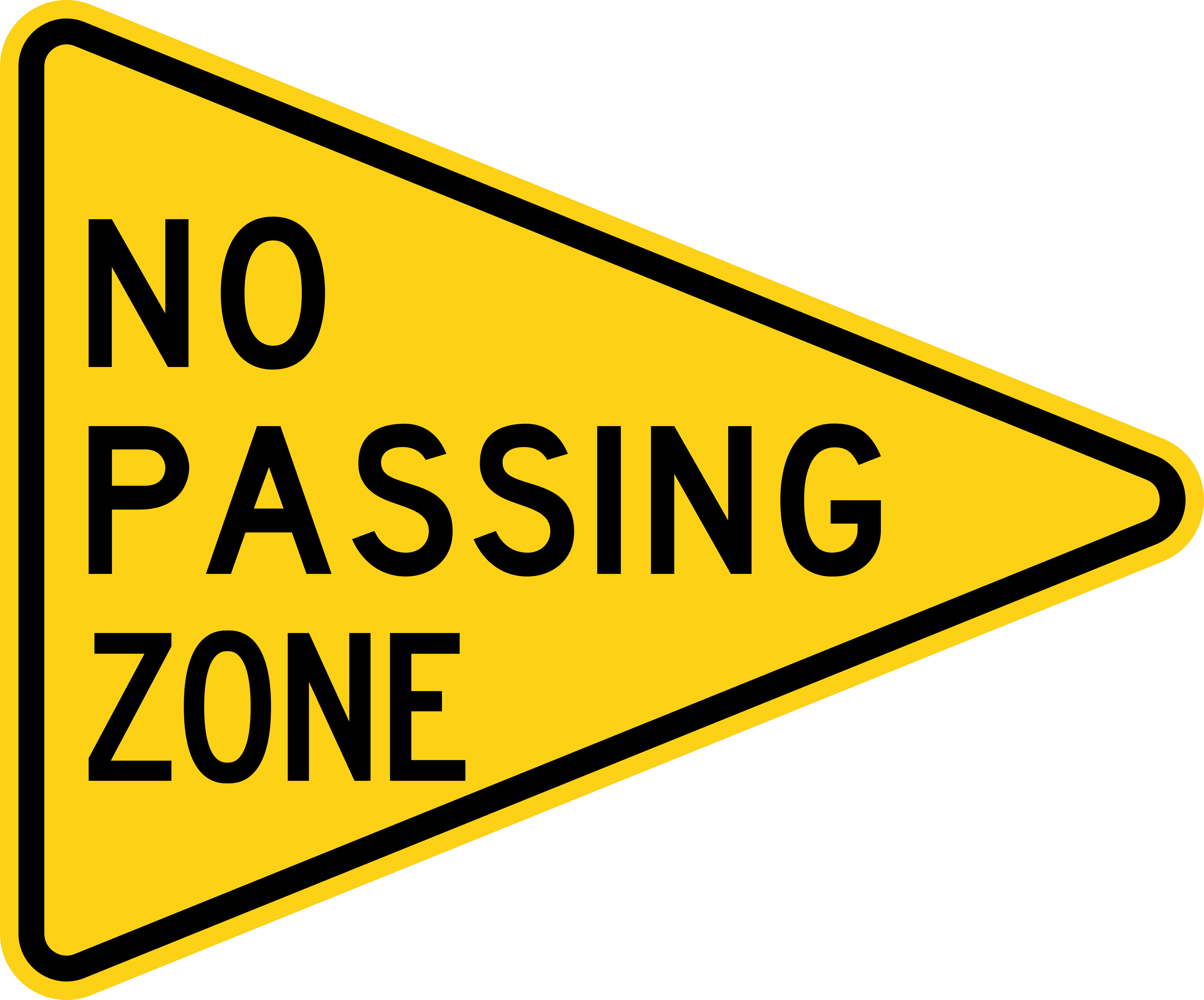
- The end of all passing restrictions
- The beginning of a no-passing zone
- A recreational area entrance
- A railroad crossing at the roadway edge
Show answer
The beginning of a no-passing zone. The pennant-shaped sign marks the beginning of a NO-PASSING ZONE on a two-lane, two-way roadway, and it is posted on the left side of the road where no-passing pavement markings are also used. The manual explains that signs or lane markings for a no passing zone tell you that you cannot see far enough ahead to pass. The sign does not end a restriction or identify a recreation area or rail crossing. Wait for a permitted passing area with enough sight distance.
Study this in the handbook: Sign Shapes and Regulatory Signs
10. A school bus ahead finishes loading and its red lights go out in Connecticut. When may you roll?
- Once children clear and it is safe
- The instant the red lights stop flashing
- When the bus driver waves twice
- Once you reach the bus bumper
Show answer
Once children clear and it is safe. Dark red lights end the stop command but not the danger, since children may still be crossing or walking the roadside. Wait until they have completely left the roadway and the path is safe before proceeding. Instant movement, waved permissions, and bumper distance all gamble on children behaving predictably. Red flashing school bus lights require a stop whether the bus is on your side of the road, the opposite side, or at an intersection you are approaching.
Study this in the handbook: Right of Way at Intersections
11. Your light is red at a Connecticut corner with no prohibiting sign and clear traffic. When may you turn right?
- Without stopping, whenever it looks clear
- Only when a green arrow also appears
- After the driver behind you honks once
- After a full stop, if clear and unbanned
Show answer
After a full stop, if clear and unbanned. Right on red follows a sequence: complete stop, a check for oncoming and crossing traffic and pedestrians, confirmation that no sign bans the turn, and only then the turn itself. Rolling through, rear honks, and waiting for an arrow all misstate the permission. Crosswalks deserve a second glance, since walkers may step out as your attention turns left toward traffic.
Study this in the handbook: Traffic Lights, Arrows and HAWK Signals
12. Why does a bigger space cushion ahead make you safer in Connecticut traffic?
- It impresses drivers behind you
- It raises your fuel economy greatly
- It buys time and room to react to changes
- It lets you check mirrors less often
Show answer
It buys time and room to react to changes. Distance ahead converts directly into seconds for seeing, deciding, and braking when traffic compresses. That cushion absorbs others' sudden stops and lane errors before they become your crash. Impressions and fuel claims miss the mechanism, and mirror duties continue regardless. The more distance you keep between yourself and everyone else, the more time you have to react. Think of this space as a safety cushion that gives you room to brake or steer if something changes ahead.
Study this in the handbook: Motorcycles, Trucks and Slow Vehicles
13. You fear you are outrunning your headlights on a dark Connecticut road. Which check settles it?
- The three-second rule for following distance
- Watching the speedometer only
- Counting telephone poles per mile
- The four-second sight-distance rule
Show answer
The four-second sight-distance rule. Sight distance governs safe night speed. Pick a clear landmark ahead and count four seconds of travel; reaching it sooner means you drive faster than your view supports, so slow down. Following counts govern the car ahead, pole counts measure nothing relevant, and the speedometer cannot see the road. You should use the four-second sight-distance rule at night to make sure you are not over-driving your headlights.
Study this in the handbook: Distractions, Fatigue and Aggressive Driving
14. How close to a hill crest or curve may you start a pass?
- You may pass if you can see half the hill
- Do not start within one-third of a mile of a hill or curve
- Passing there is fine below thirty miles per hour
- You may pass once your front wheels reach the crest
Show answer
Do not start within one-third of a mile of a hill or curve. A hill or curve can hide an oncoming vehicle just out of sight, so treat it like traffic already approaching. Staying out of a pass within one-third of a mile protects the full passing distance. Partial sight, low speed, or reaching the crest still leaves hidden roadway unaccounted for. Wait until the road ahead is fully visible and open. That distance is about ten seconds of travel, which is how far ahead you need to see.
15. You are angry and tense before a short drive. What is the safest choice?
- Give yourself time to cool off before driving
- Drive slowly to burn off the anger
- Grip the wheel harder to stay focused
- Vent by honking at careless drivers
Show answer
Give yourself time to cool off before driving. Strong emotions narrow attention, shorten patience, and invite risk taking behind the wheel. Time to cool off, a short walk, or a brief rest keeps an upset driver off the road until calm returns. Slow driving while angry, a harder grip, or honking at others carries the emotion into traffic. Arriving later and calm beats arriving upset or not at all.
Study this in the handbook: Distractions, Fatigue and Aggressive Driving
16. You reach a Connecticut traffic circle as a car circulates inside toward your entry. Who goes first?
- You; entries always merge free
- Whoever drives the inside lane
- Traffic already in the circle
- Nobody; circles have no order
Show answer
Traffic already in the circle. Entering a traffic circle or rotary means yielding to drivers already circulating, who hold the continuous flow. Wait outside the circle for a gap that fits your entry, then blend without stopping inside. Inside-lane status and merge-free ideas collapse the design that keeps circles moving. Pedestrians on entry crosswalks add a second yield before your wheels reach the circle itself.
Study this in the handbook: Right of Way at Intersections
17. A yellow diamond sign with a small red octagon symbol stands where buildings hide the junction in Connecticut. What is coming and what helps?
- A yield point; coast to save your brakes
- A stop sign; slow down and prepare to stop
- A closed road; turn around now
- A speed trap; dim your lights
Show answer
A stop sign; slow down and prepare to stop. Stop Ahead gives advance notice of a stop sign that may be hard to see until late. Ease off speed and prepare for the full stop the octagon will demand, watching for cross traffic beyond the obstruction. It does not announce a yield point, a closure, or enforcement. Early slowing also protects drivers following you from a surprise stop. At a stop sign you must come to a full and complete stop at the sign or stop line, if one is present.
Study this in the handbook: Warning, School and Guide Signs
18. An orange sign warns on your Connecticut commute. What family does the color announce?
- Construction or maintenance danger ahead
- Guide information for exits
- Recreation and park directions for drivers
- Regulatory commands to obey
Show answer
Construction or maintenance danger ahead. Orange warns of construction and maintenance activity ahead: roadwork, utility projects, and the changing surfaces and detours they bring. Green handles exit guidance, brown handles parks, and red with white or black handles regulatory commands. Most temporary work signs pair the orange background with black letters or symbols, posted right, or on both sides of divided roads. Orange signs alert you to possible dangers ahead.
Study this in the handbook: Sign Shapes and Regulatory Signs
19. Your rear slides sideways on an icy Connecticut curve. What do your feet and hands do first?
- Brake hard and steer away from the slide
- Accelerate hard and steer into the curb
- Stay off the brake; steer where you want to go
- Floor it and hold the wheel rigid
Show answer
Stay off the brake; steer where you want to go. In a skid the tires have already lost grip, and braking only deepens the slide. Stay off the brake and steer toward where the vehicle should go, then counter-steer as it straightens to prevent a swing the other way. Continued smooth corrections restore control as speed bleeds off. Stay off the brake until the vehicle slows, because until then your brakes will not work and could cause you to skid more.
Study this in the handbook: Vehicle Emergencies and Equipment Failure
20. Which warning gear entitles an approaching vehicle to your yielded right-of-way in Connecticut?
- A roof sign carrying the company name and logo
- Siren, air horn, or red or blue light
- Four-way flashers at speed
- A loudspeaker playing music
Show answer
Siren, air horn, or red or blue light. Police vehicles, fire engines, ambulances, and other emergency vehicles claim the yield when using a siren, an air horn, or red or blue flashing lights. Company signage, hazard flashers, and loudspeakers announce nothing official. Respond by pulling right and stopping from any approach direction. Drivers who see or hear one approaching from any direction must pull over to the right edge of the road and stop.
Study this in the handbook: Right of Way at Intersections
Every question is written from the official Connecticut Driver's Manual. Need paper? Printable CT practice test with answer key.
Last verified 2026-10-05. How we check every question · Study all 500 as flashcards
Frequently asked questions
How many questions are on this Connecticut practice test?
This fixed set has 20 questions. It is test 13 of 25 from the 500 question Connecticut bank. The real CT exam asks 25 questions and you need 20 correct.
What is the passing score for the real Connecticut test?
20 of 25 correct (80%) That figure comes from the official Connecticut source cited on the DMV facts page.
How does this fixed test relate to the full Connecticut bank?
Each numbered test is a fixed set of questions in a fixed order, so you can retake the same test later and compare. Every test mixes road signs and the other topics in about the same proportion as the full bank. Tests 1 to 25 together cover every question in the Connecticut bank once. The full practice page mixes the whole bank at random.
Last verified 2026-10-05. See the Connecticut DMV facts page for sourced state details.
Return to the full Connecticut practice test · Study road signs