
Test 12 of 25 · 20 questions · Free 2026
CT Permit Practice Test 12
Jump to the test ↓A fixed 20 question set from the Connecticut bank with answers and plain English explanations. The real CT exam is 25 questions, 80 percent to pass; take the full length version on the main practice page.
Question 1 of 20 · 0 right so far
All 20 questions in test 12
Every question below comes from the Connecticut question bank on this page. Open a question to see the correct answer and the explanation. Nothing here is hidden behind a signup.
1. Solid yellow paint runs on your side beside a broken line on the far side in Connecticut. Who may pass?
- Your side, since paint is fresh
- Neither side under any rule
- Both sides at reduced speed
- Traffic beside the broken line, when safe
Show answer
Traffic beside the broken line, when safe. With paired solid and broken yellow lines, permission follows the broken side. Drivers next to the dash may pass when safe, while drivers next to the solid line may not. Freshness, reduced speed, and universal bans all misread the pairing. As the pattern flips along hills and curves, keep checking which side of the paint your vehicle occupies. Passing is permitted only on the side of the broken line.
Study this in the handbook: Pavement Markings and Special Lanes
2. Fuel may have spilled at a wreck. What two precautions apply?
- Open all fuel caps to vent pressure
- Turn off ignitions and do not smoke
- Start engines briefly to move the cars
- Wash the fuel away with bottled water
Show answer
Turn off ignitions and do not smoke. Running engines and cigarettes both ignite spilled fuel. Switching off every wrecked vehicle's ignition and keeping smoking away removes the spark sources while help arrives. Venting caps, restarting engines, and rinsing fuel spread vapor and flame paths. Fuel spilled at a wreck can catch fire from a spark or a cigarette. Turn off the ignition of each wrecked vehicle and do not smoke around the vehicles, because either one could ignite fuel vapor and turn a crash scene into a fire.
Study this in the handbook: Avoiding Collisions and After a Crash
3. Your vehicle cannot be moved off the roadway after a breakdown. Where should you leave it?
- Just over a hill, where traffic slows anyway
- Just around a curve, out of the lane line
- Where other drivers have a clear view of it
- In the left lane with hazards flashing
Show answer
Where other drivers have a clear view of it. A stalled vehicle survives on being seen early. If it cannot leave the roadway, place it where approaching drivers get a long, clear view rather than a surprise over a crest or around a bend. Hills and curves hide the vehicle until braking room vanishes. Hazard lights help only after drivers can see the vehicle itself. Do not stop just over a hill or just around a curve.
Study this in the handbook: Headlights, Horn and Turn Signals
4. How does Connecticut treat a person riding a bicycle on the roadway?
- As a pedestrian who must use sidewalks only at all times
- As a slow obstacle that drivers may pass at whatever distance they like
- As a vehicle that follows the same road rules as motor vehicles
- As traffic that counts only inside marked bike lanes
Show answer
As a vehicle that follows the same road rules as motor vehicles. A bicyclist on the roadway holds the standing of a vehicle, with matching rights, privileges, and responsibilities under the rules of the road. Expect riders to travel with traffic and to use a left lane when turning, just as another driver would. Sidewalk-only riding, passing at any distance, and bike-lane-only status all misstate that standing. Treat the rider as lawful traffic.
Study this in the handbook: Pedestrians, Bicyclists and Horses
5. A white diamond marks a lane reserved for HOV traffic. What does HOV mean?
- High Occupancy Vehicles
- Heavy Oversize Vehicles only
- Highway Operations Vehicles only
- High Output Vehicles with special plates
Show answer
High Occupancy Vehicles. HOV stands for High Occupancy Vehicles, and the diamond marks lanes reserved for vehicles carrying more than one person, with signs stating the required count. Size, operations fleets, and engine output have nothing to do with the marking. Single drivers must stay out unless signs say otherwise. Look for the diamond-shaped marker to know which lane is reserved, and stay out of it if you are driving alone.
Study this in the handbook: Pavement Markings and Special Lanes
6. What makes a parking spot acceptable beside a Connecticut roadway?
- Close enough to watch it from a store window
- A spot facing traffic for a fast exit
- Any gap between two parked vehicles
- Far from travel lanes and visible from both directions
Show answer
Far from travel lanes and visible from both directions. A parked vehicle must neither squeeze passing traffic nor hide until drivers are upon it. Choose designated areas when possible, place the vehicle far enough from travel lanes, and keep it visible to drivers approaching either way. Gaps between cars and fast-exit facing say nothing about clearance or sight lines. Check traffic before opening any door. Parking within 25 feet of a stop sign or a pedestrian safety zone is not allowed either.
Study this in the handbook: Right of Way at Intersections
7. You approach a Connecticut roundabout where a pedestrian waits in the entry crosswalk. What must you do?
- Yield only to traffic already circulating
- Yield to circling vehicles and pedestrians
- Stop inside the circle until the crosswalk clears
- Enter quickly before the pedestrian steps off
Show answer
Yield to circling vehicles and pedestrians. Entering drivers yield twice at a roundabout approach: to vehicles already circulating and to pedestrians using the crosswalk on the entry leg. Yield signs and pavement yield lines mark that duty. Stopping inside the circle blocks circulation, and hurrying ahead of a pedestrian violates the crosswalk rule. Wait outside the circle until both paths are clear. Pedestrians in a marked or unmarked crosswalk must be given the right-of-way at all times.
Study this in the handbook: Right of Way at Intersections
8. A twenty-year-old drives on a private farm road in Connecticut after drinking. Does the 0.02 rule reach him?
- No; private roads are exempt
- Only with passengers aboard
- Yes, on public roads and private land
- Only within town boundaries
Show answer
Yes, on public roads and private land. The under-twenty-one zero tolerance line of two hundredths percent applies on private property exactly as on public roads. Passengers and town lines do not switch the rule on or off. Young drivers sometimes imagine driveways and farm tracks shelter the drinking; the statute's reach says otherwise. The .02 percent limit for drivers under 21 applies on both public roads and private property. A farm road or a driveway does not make drinking and driving legal for them.
Study this in the handbook: Alcohol, Testing and DUI Suspensions
9. A faster driver comes up behind you in the far left lane of a Connecticut highway. What should you do?
- Move right and let the vehicle pass
- Stay put, since you are at the speed limit
- Speed up until you match that driver
- Brake to show that you object
Show answer
Move right and let the vehicle pass. Do not block the passing lane. Stay out of the far left lane and yield to the right for any vehicle that wants to pass. Holding up faster traffic in that lane is one of the habits that can anger other drivers. Moving right and letting the faster driver by keeps traffic flowing and removes a source of conflict. The left-most lane is intended for passing slower vehicles.
Study this in the handbook: Distractions, Fatigue and Aggressive Driving
10. Below a curve warning hangs a smaller plaque reading 25 MPH in Connecticut. What does that number give?
- An advisory speed for the condition ahead
- The legal minimum for the curve
- A truck-only speed for the bend
- The speed after the curve ends
Show answer
An advisory speed for the condition ahead. Advisory plaques sit below other warnings and state the speed advised for the condition shown, such as a curve's sharpness. It guides your entry pace even though it is not posted as the legal limit sign. Minimums, truck-only values, and after-curve speeds misread its role. Enter at or below the advisory until the road straightens and normal limits resume. Advisory speeds are posted below other warning signs.
Study this in the handbook: Warning, School and Guide Signs
11. A work zone lane closure appears ahead. When should you merge out of the closing lane?
- At the last cone before the closure
- As soon as possible, at first notice of the zone
- Only after passing the flagger station
- When the closing lane physically ends
Show answer
As soon as possible, at first notice of the zone. Early merging keeps traffic flowing at posted speeds and avoids last-second squeezes at the taper. Move to the appropriate lane at first notice of the approaching zone, then adjust position away from workers and equipment. Waiting for cones, flaggers, or the lane end forces the conflicts early merging prevents. Moving over early helps traffic keep flowing at posted speeds and gives you time to adjust to the workers and equipment ahead.
Study this in the handbook: Pedestrians, Bicyclists and Horses
12. Opposing left-turn arrows share the center lane of your Connecticut street. What is the lane built for?
- Left turns both ways; U-turns if allowed
- Passing slow traffic at midday hours
- Parking between business hours
- Bus layovers during rush hour
Show answer
Left turns both ways; U-turns if allowed. The shared center lane serves left turns for traffic in both directions, plus U-turns where they are permitted. Alternating arrows and solid-plus-dashed yellow edges mark its turf. Passing, parking, and bus layovers all misuse space reserved for brief turning refuge. Enter it only to complete a turn, watch for opposing drivers doing the same, and never cruise within it. These lanes are reserved for left turns, and sometimes U-turns.
Study this in the handbook: Pavement Markings and Special Lanes
13. Traffic is heavy at the end of an entrance ramp in Connecticut. What should you avoid doing?
- Slowing down while still on the ramp
- Matching the speed of highway traffic
- Watching the main road for an opening
- Stopping at the end of the ramp
Show answer
Stopping at the end of the ramp. Stopping at the very end of a ramp leaves no room to build speed before merging, and drivers behind you do not expect a stopped vehicle there. Slow down earlier on the ramp instead so space remains to accelerate into an opening. Matching highway speed before merging is the goal of the ramp design, not something to avoid. Slowing early keeps options open if the opening closes.
Study this in the handbook: Motorcycles, Trucks and Slow Vehicles
14. Before changing lanes on a three-lane road, why check the far lane as well?
- Far lane drivers must yield to your signal
- Someone there may be moving into the same lane you want
- Mirrors cannot show the lane directly beside you at any time
- The far lane always travels faster than yours
Show answer
Someone there may be moving into the same lane you want. Two drivers can aim for the same middle lane from opposite sides at the same moment. Checking the far lane catches a vehicle starting that move before you commit. A signal does not make far lane traffic yield, and the far lane is not always the faster one. If you change lanes without looking, you may meet a driver who started toward the same lane from the other side.
Study this in the handbook: Changing Lanes and Passing
15. Another vehicle is about to hit you from the side and open road lies ahead. What may help?
- Brake to a stop directly in the other vehicle's path
- Turn across its front bumper
- Speed up to get out of the danger area
- Reverse quickly toward the vehicle
Show answer
Speed up to get out of the danger area. When impact comes from the side or rear and space ahead is open, accelerating moves your vehicle out of the strike zone. Slow again once the danger passes. Stopping sits you in the path, turning across the bumper invites the hit, and reversing toward the threat closes distance. Use the escape only when forward room truly exists. Sometimes it is best or necessary to speed up to avoid a collision.
Study this in the handbook: Vehicle Emergencies and Equipment Failure
16. Your tires rumble over a shoulder rumble strip. What does that tell you to do?
- Speed up to get back on smooth road
- Turn the radio up to stay awake
- Continue if the car still tracks straight
- Pull off at a safe place and check your alertness
Show answer
Pull off at a safe place and check your alertness. Rumble strips are grooved or raised patterns that shake and sound an alarm when tires leave the lane on a drowsy or drifting path. Running over one is a warning to leave the road at a safe place and honestly check how alert you are. Speeding on, driving straight by luck, or raising the radio ignores a signal built to prevent a fatigue crash.
Study this in the handbook: Distractions, Fatigue and Aggressive Driving
17. What does a red circle with a slash over a symbol mean on a regulatory sign?
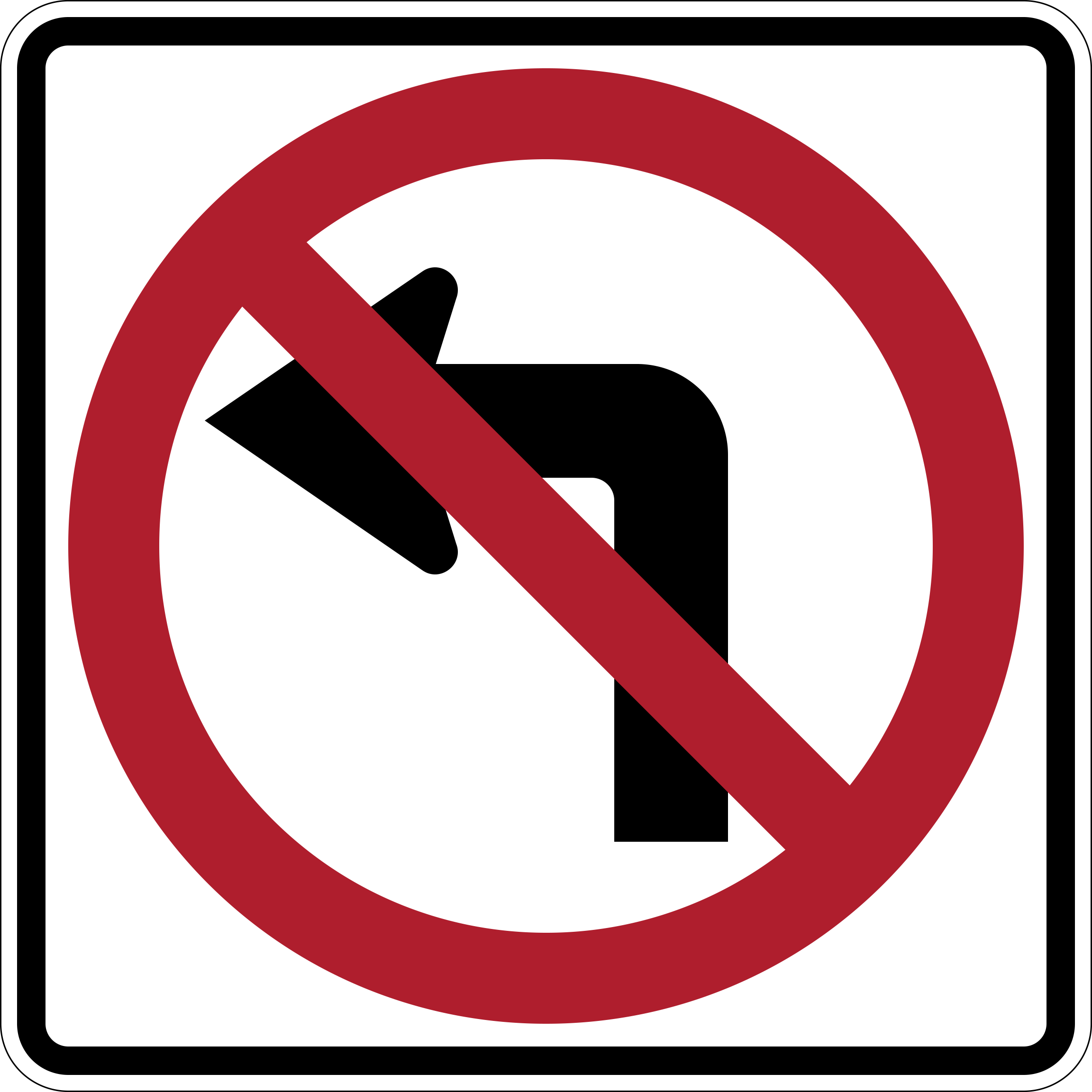
- The symbol identifies a nearby service
- The pictured action is recommended
- The pictured action is prohibited
- The action is allowed only during daylight
Show answer
The pictured action is prohibited. A red circle with a slash is a prohibition symbol. It tells you not to perform the action shown, such as turning left, turning right, or making a U-turn. The slash is not a recommendation, service marker, or time-of-day permission. Regulatory signs communicate rules about traffic direction, lane use, turning, speed, parking, and related situations, so the driver must obey the restriction. The visual cue is the slash across the picture: identify the crossed-out movement before beginning it, especially at an unfamiliar intersection.
Study this in the handbook: Sign Shapes and Regulatory Signs
18. You are going straight at an intersection where right turns on red are allowed. Which lane should you avoid?
- The lane nearest the median
- Any lane with a car in front
- The lane with the most traffic
- The right-hand lane
Show answer
The right-hand lane. In most areas, right-hand turns are allowed after a stop at a red light. If you are not turning right, avoid the right-hand lane, because drivers behind you who want to turn right will be held up and may become frustrated. Choosing the correct lane early keeps traffic moving and prevents the kind of conflict that can lead to road rage.
Study this in the handbook: Distractions, Fatigue and Aggressive Driving
19. Beneath a Connecticut school crossing sign hangs a small downward arrow plaque. What does the plaque pinpoint?
- The actual location of the crosswalk
- Where buses load students
- The school office entrance
- Where guards park their own cars
Show answer
The actual location of the crosswalk. School warning signs may carry a separate downward-pointing arrow plaque that marks exactly where the crosswalk lies, so drivers know where to stop for people crossing rather than somewhere near it. Bus loading zones, school office doors, and guard parking have their own arrangements and are not what the arrow plaque shows. Watch for children at that spot. The plaque shows the real spot where people cross.
Study this in the handbook: Sign Shapes and Regulatory Signs
20. How many people are injured each year in work zone crashes, according to the Connecticut manual?
- About 500
- Approximately 40,000
- About 1 million
- About 5,000
Show answer
Approximately 40,000. Approximately 40,000 people per year are injured as a result of motor vehicle crashes in work zones, and the manual adds that work zones on U.S. highways have become increasingly dangerous places for workers and drivers. Work zones can exist at any time of year but are most common in summer. Because work zones are so numerous, highway agencies work to make them safer, but drivers must slow down, keep following distance and expect sudden stops. Distracted driving fines are doubled for illegal hand held phone use in a work zone.
Study this in the handbook: Railroad Crossings and Work Zones
Every question is written from the official Connecticut Driver's Manual. Need paper? Printable CT practice test with answer key.
Last verified 2026-10-05. How we check every question · Study all 500 as flashcards
Frequently asked questions
How many questions are on this Connecticut practice test?
This fixed set has 20 questions. It is test 12 of 25 from the 500 question Connecticut bank. The real CT exam asks 25 questions and you need 20 correct.
What is the passing score for the real Connecticut test?
20 of 25 correct (80%) That figure comes from the official Connecticut source cited on the DMV facts page.
How does this fixed test relate to the full Connecticut bank?
Each numbered test is a fixed set of questions in a fixed order, so you can retake the same test later and compare. Every test mixes road signs and the other topics in about the same proportion as the full bank. Tests 1 to 25 together cover every question in the Connecticut bank once. The full practice page mixes the whole bank at random.
Last verified 2026-10-05. See the Connecticut DMV facts page for sourced state details.
Return to the full Connecticut practice test · Study road signs