
Test 21 of 25 · 20 questions · Free 2026
CT Permit Practice Test 21
Jump to the test ↓A fixed 20 question set from the Connecticut bank with answers and plain English explanations. The real CT exam is 25 questions, 80 percent to pass; take the full length version on the main practice page.
Question 1 of 20 · 0 right so far
All 20 questions in test 21
Every question below comes from the Connecticut question bank on this page. Open a question to see the correct answer and the explanation. Nothing here is hidden behind a signup.
1. On dry pavement with good tires and brakes, how far to stop from 30 mph?
- About 100 feet in total
- About 300 feet in total
- About 200 feet in total
- About 400 feet in total
Show answer
About 200 feet in total. Seeing a hazard, reacting, and braking consume far more road than most drivers guess. From thirty miles per hour the total reaches about two hundred feet, nearly half a city block, and fifty miles per hour stretches it to about four hundred feet. If your visible road is shorter than the stopping distance for your speed, slow down until the two fit together.
Study this in the handbook: Traffic Lights, Arrows and HAWK Signals
2. If the engine dies while the vehicle is moving, what should you expect from the controls?
- The brakes cannot function at all
- Steering may be harder, and braking may require much more pedal pressure
- The steering wheel must be released
- Both steering and braking will become easier
Show answer
Steering may be harder, and braking may require much more pedal pressure. An engine that stops running does not make the brakes useless. They can still work, but pressing the pedal may require much more force. Steering can also become difficult, so hold the wheel firmly while pulling off the roadway. Releasing the wheel is the opposite of the recommended response. Recognizing the heavier controls helps you keep working them instead of assuming that nothing can be done when the vehicle loses engine power.
Study this in the handbook: Vehicle Emergencies and Equipment Failure
3. Rain-slick pavement makes your tires feel loose and floaty in Connecticut. What is the first response?
- Ease off the gas and hold the wheel straight
- Brake firmly so the tires bite again
- Turn sharply toward the shoulder
- Speed up to clear the water film
Show answer
Ease off the gas and hold the wheel straight. That floating feel is traction leaving the tires. Ease off the accelerator, keep the wheel straight, and avoid stopping or turning until grip returns; any needed turn must be slow. Firm braking, sharp shoulder turns, and speed all convert the float into a skid or spin. Ease your foot off the gas pedal and keep the steering wheel straight. Only try to turn if it is an emergency, and do not try to stop until the tires grip again.
Study this in the handbook: Slippery Roads, Hydroplaning and Curves
4. You finish parallel parking on a Connecticut street. How far out from the curb may your wheels sit?
- Up to two feet from the curb
- No more than one foot from the curb
- Up to three feet if aligned
- Any distance inside the lane line
Show answer
No more than one foot from the curb. Parked wheels must sit no more than one foot from the curb. That keeps the vehicle tight to the edge and clear of passing traffic. Two feet and three feet push the body of the car into the lane, and lane lines never set how far from the curb you may park. Stay close to the curb whenever you park beside the roadway.
Study this in the handbook: Right of Way at Intersections
5. Police arrest a Connecticut driver for DUI and order a chemical test. What does that test reveal?
- How long ago drinking started
- The driver's usual drinking habits
- Whether the driver owns the car
- The driver's blood alcohol content
Show answer
The driver's blood alcohol content. After a DUI arrest, a driver is asked to take a blood, breath, or urine test, and that test shows the driver's blood alcohol content at that time. It does not show when drinking started, it says nothing about the driver's usual habits, and it has no bearing on who owns the car. The result is a measurement of the alcohol in the body right now.
Study this in the handbook: Alcohol, Testing and DUI Suspensions
6. A wide horizontal rectangular sign spans your Connecticut exit. What kind of message should you expect?
- Instructions stating the law
- A parking rule for the shoulder of the exit ramp
- A hazard warning for the ramp
- Directions or information for your trip
Show answer
Directions or information for your trip. Rectangular signs split their message by orientation: vertical panels generally give instructions or state the law, while horizontal panels give directions or information. Expect guidance about places, distances, and exits from a wide board over your exit lane. Hazard warnings wear diamond shapes, and shoulder parking rules belong on vertical regulatory signs, so a wide horizontal board is not where you would find a law or a hazard warning.
Study this in the handbook: Sign Shapes and Regulatory Signs
7. What driving habit prevents most sudden panic stops?
- Riding the brake pedal in traffic
- Seeing events well in advance and slowing early
- Following closely to match traffic stops
- Watching only the vehicle right ahead
Show answer
Seeing events well in advance and slowing early. Panic stops usually expose a driver who was not paying attention early enough. Scanning far ahead lets you slow or change lanes gradually, sometimes avoiding the stop entirely. Riding the pedal, tailgating, and staring at one bumper all force late reactions. Gradual stops also give drivers behind you the time your sudden braking would steal. Slowing down or changing lanes early may mean you do not have to stop at all.
Study this in the handbook: Traffic Lights, Arrows and HAWK Signals
8. A driver tailgates you and there is no right lane to move into. What should you do?
- Speed up until the gap behind you grows again
- Brake firmly one time to warn the driver following close behind you
- Ease off speed gradually once the road ahead is clear
- Weave slightly to block the driver from passing
Show answer
Ease off speed gradually once the road ahead is clear. With no right lane available, wait for clear road ahead and then ease off speed gradually. The slower pace encourages the tailgater to pass without a sudden conflict. Firm braking can trigger the rear-end crash you fear, speeding just raises the stakes, and weaving blocks lawful passing. A calm slowdown hands the problem an exit. Dozens of deadly traffic altercations begin when one driver tailgates another.
Study this in the handbook: Space Cushion and Following Distance
9. Before you pass on a Connecticut road, which hazard can make a driver ahead move into your lane?
- A long straight stretch of dry pavement
- A pothole or patch of ice on the road
- A dashed white line between the lanes
- A broad paved shoulder beside the road
Show answer
A pothole or patch of ice on the road. Look ahead before you pass for road conditions and traffic that may cause other vehicles to move into your lane. A driver may swerve around a patch of ice, a pothole, or something on the road, and people or bicyclists near the road can also push a vehicle toward the passing lane. Scanning for these hazards first helps you avoid losing your space for passing.
Study this in the handbook: Changing Lanes and Passing
10. You miss your exit on a Connecticut highway. What should you do?
- Back up on the shoulder to the exit ramp
- Stop in the travel lane and wait for a gap
- Go on to where you can safely turn around
- Reverse slowly with hazard lights flashing
Show answer
Go on to where you can safely turn around. A missed turn or exit never justifies backing toward traffic that expects forward motion. Continue ahead to a place where turning around is safe and lawful, even when that adds a few minutes. Backing on a shoulder, stopping in a lane, or reversing with hazards all place you against the flow drivers anticipate. Keep moving until you can safely pull off the road or turn around.
11. How is a shared center left-turn lane edged on the pavement?
- Double white dashes on both sides
- Green paint along both outer edges
- Solid yellow and dashed yellow lines on each side
- A single solid white line down the lane's middle
Show answer
Solid yellow and dashed yellow lines on each side. Shared center lanes carry alternating left-turn arrows for both directions and sit between solid yellow and dashed yellow line pairs on each side. Either direction may enter for left turns, plus U-turns where allowed. White dashes, green paint, and a single center stripe describe other markings. Enter only to turn, never to travel or pass. Drivers should enter the lane only to make a left turn.
Study this in the handbook: Pavement Markings and Special Lanes
12. When passing, how quickly should you clear the other driver's blind spot?
- Linger there to confirm your speed first
- Get through it as quickly as you can
- Stop beside the driver and signal
- Blind spots matter only for trucks
Show answer
Get through it as quickly as you can. The rear-side blind zone hides your vehicle from mirrors, so every second spent there risks the other driver moving into you. Pass briskly and predictably, without loitering alongside. Stopping beside another driver or treating blind spots as a truck-only issue prolongs exposure for everyone. Drivers in the other vehicle may not see you there, so spend as little time as possible alongside them while you pass.
Study this in the handbook: Space Cushion and Following Distance
13. Your Connecticut license is new and you are seventeen. A hands-free mount holds your phone. May you use it driving?
- Yes, hands-free gear is always legal
- Yes, below thirty per hour
- No use at all, hands-free included
- Yes, with a parent present
Show answer
No use at all, hands-free included. Licensed drivers aged sixteen and seventeen may not use any cell phone or mobile electronic device while driving, and the ban expressly includes hands-free equipment. Mounts, low speeds, and parental passengers create no exception. Newer teen drivers face the strictest distraction rules because inexperience compounds every glance away. Adults follow a different rule that permits hands-free accessories only. Taking your eyes off the road or your hands off the steering wheel presents obvious driving risks.
Study this in the handbook: Teen Suspensions and Operator Retraining
14. Your route crosses wet pavement, then packed snow, then glare ice. How should speed fall?
- Hold the same limit throughout the entire route
- Add speed to keep tires warm
- Halve on wet and stop only on ice
- Ten less wet, half on snow, crawl on ice
Show answer
Ten less wet, half on snow, crawl on ice. Traction collapses in stages, and speed must follow it down: roughly ten miles per hour less on wet roads, half speed on packed snow, and a crawl on ice. Holding the limit, stopping only for ice, or warming tires with speed all ignore how completely ice deletes grip. Snow tires or chains help on snow. If at all possible, do not drive when the roads are icy.
Study this in the handbook: Slippery Roads, Hydroplaning and Curves
15. Morning traffic flows your way in a lane that reverses by evening in Connecticut. What paint usually marks it?
- Double-dashed yellow lines
- Solid white on both borders
- Red paint during rush hours
- No paint; signs alone control it
Show answer
Double-dashed yellow lines. Reversible lanes usually wear double-dashed yellow lines, announcing that direction itself is borrowed by the clock. Overhead arrows and X signals plus roadside signs then state the current assignment. White borders would suggest fixed same-direction lanes, and rush-hour red paint does not exist. Verify the overhead indication before entering even a familiar reversible lane. A green arrow means you can use the lane beneath it, and a red X means you cannot.
Study this in the handbook: Pavement Markings and Special Lanes
16. A red and white downward triangle faces you as you enter a busy Connecticut street. Cross traffic does not stop. What does the sign require?
- A full stop in every case, like an octagon
- Stop only when pedestrians cross
- Speed up to merge ahead of traffic
- Slow down, yield, and stop if needed
Show answer
Slow down, yield, and stop if needed. The inverted triangle is the yield sign. Slow to a speed reasonable for conditions, give the right-of-way to traffic in the intersection or roadway you are entering, and stop when yielding requires it. It differs from the octagon, which always demands a stop, and it never licenses speeding into a gap or ignoring vehicles while watching only for pedestrians. Yield means giving the right-of-way, and stopping only if necessary.
Study this in the handbook: Sign Shapes and Regulatory Signs
17. A person with a white cane waits at your green light in Connecticut and starts crossing. What do you do?
- Stay stopped and keep the horn silent
- Tap the horn to guide them
- Proceed slowly around the person
- Flash lights so they hurry across
Show answer
Stay stopped and keep the horn silent. Pedestrians using a guide dog or white cane hold absolute right-of-way, and horn use near them risks confusion and fright. Remain stopped until the person clears the road entirely, green light notwithstanding. Edging around or flashing to hurry abandons someone who navigates by sound and touch. Pedestrians using a guide dog or carrying a white cane have absolute right-of-way. Do not use your horn, because it could confuse or frighten the pedestrian.
Study this in the handbook: Traffic Lights, Arrows and HAWK Signals
18. At a divided highway opening, a U-shaped arrow wears a red slash. Which move is banned there?
- Slowing down to check for traffic
- Turning left into the opening
- Crossing to the far roadway
- Making a U-turn at that opening
Show answer
Making a U-turn at that opening. A red circle and slash over a symbol bans the pictured action, and the U-shaped arrow pictures a U-turn. Openings in divided highways and expressways often post this sign where drivers might otherwise cross and reverse direction. Left turns, crossing where allowed, and slowing to check remain separate questions governed by their own signs and markings. U-turns are prohibited at openings marked this way.
Study this in the handbook: Sign Shapes and Regulatory Signs
19. A driver turning left at an intersection must yield to which traffic?
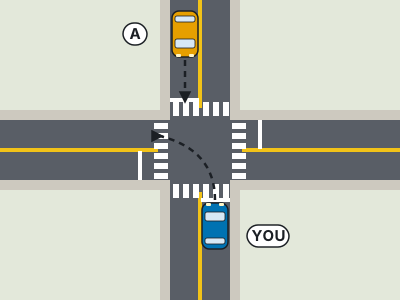
- Oncoming traffic going straight through
- Traffic waiting behind the turning driver
- Only pedestrians on the left sidewalk
- No traffic if the turn signal is on
Show answer
Oncoming traffic going straight through. A left turn crosses the path of vehicles coming toward the driver, so the turning driver must yield to oncoming traffic that is proceeding straight. Signaling communicates intent but does not grant priority. Vehicles behind the turning driver are not the controlling conflict described here, and the turn signal cannot make an unsafe gap safe. Check the approach, wait for oncoming traffic to clear, and turn only when the path is open.
Study this in the handbook: Right of Way at Intersections
20. You pass a Connecticut work zone warning sign but see no workers right away. What should you expect?
- Workers may still be ahead, since some zones are mobile
- The zone has ended, so normal driving resumes right away
- The warning sign was left by mistake and can be ignored
- Only parked construction equipment matters from that point on
Show answer
Workers may still be ahead, since some zones are mobile. Line painting, patching, and mowing crews move along the road, so workers may be working farther ahead even when the area near the warning sign looks empty. Keep following the posted signs until the End Road Work sign appears. Treating an empty stretch as the end of the zone leaves you unprepared for a crew around the next bend or over a crest.
Study this in the handbook: Pedestrians, Bicyclists and Horses
Every question is written from the official Connecticut Driver's Manual. Need paper? Printable CT practice test with answer key.
Last verified 2026-10-05. How we check every question · Study all 500 as flashcards
Frequently asked questions
How many questions are on this Connecticut practice test?
This fixed set has 20 questions. It is test 21 of 25 from the 500 question Connecticut bank. The real CT exam asks 25 questions and you need 20 correct.
What is the passing score for the real Connecticut test?
20 of 25 correct (80%) That figure comes from the official Connecticut source cited on the DMV facts page.
How does this fixed test relate to the full Connecticut bank?
Each numbered test is a fixed set of questions in a fixed order, so you can retake the same test later and compare. Every test mixes road signs and the other topics in about the same proportion as the full bank. Tests 1 to 25 together cover every question in the Connecticut bank once. The full practice page mixes the whole bank at random.
Last verified 2026-10-05. See the Connecticut DMV facts page for sourced state details.
Return to the full Connecticut practice test · Study road signs