
QualitySpaceQualitySpace
Display
Auto follows your device setting.
Menu

25 question exam format · Real sign images & audio · Free

CT Permit Practice Test

Real test: 25 questions, 80% to pass. Practice 20 at a time below. Free, no signup.

Connecticut verified practice bank · 210 questions rev 2026-10-12-ca500

Question 1 of 20 · 0 right so far

0 correct · 0 missed
Why should a driver leave a space cushion behind the vehicle ahead?
More ways to practice: exam simulator, topic drills, missed questions

210-question bank · Sign images & explanations · Free

Connecticut practice test has 210 questions. Every question comes with a plain-English explanation the moment you answer.

Get a day by day study plan

Optional. Three quick answers; the tests below work without it.

Age on test day

No date yet? You get a 7 day plan.

Real exam format: 25 questions, 20 correct to pass.

Start here

Run 20 questions to warm up.

Find your gaps

Diagnose weak topics and retry what you've missed.

Simulate the real thing

Practice under graded exam conditions or run the whole bank.

Practice one topic

Drill a single topic, up to 20 questions with explanations.

Random draw and answer order every attempt. Scored against the real test's pass mark: 20 of 25 correct.

Free means actually free: no subscription, no auto-renew, no card required, no locked features. This site is funded by our insurance work, not by test-prep charges.

Show a parent how you are doing

A read-only link with your Connecticut readiness, topic scores and test results. No account, no name or email.

Connecticut permit practice test at a glance

210 free practice questions, with 10 numbered 20 question tests and the full bank to practice, plus a free real-exam simulator that matches the Connecticut knowledge test (25 questions and 20 correct to pass), a road sign test, and an explanation for every answer. No signup, no paywall, nothing locked. Questions are written from the Connecticut Driver's Manual and were last checked against it on September 7, 2026.

The real Connecticut knowledge test is the DMV exam used for a learner permit. This page contains the full free 210 question study bank, with an explanation after each answer. Use the numbered 20 question tests below when you want a fixed study session.

The real Connecticut knowledge test: 25; passing score 20 of 25 correct (80%) (official source). This practice bank has 210 questions.

Alcohol and DUIEmergenciesLaws and paperworkParkingRight of wayRoad signsSafe drivingSignals and markingsSpeed limits

See facts and key topics for Connecticut DMV (minimum age, fees, wait times, question counts by topic) before you start, or print it to bring with you on test day.

Booked your test? See what to bring and where to go: a printable Connecticut document checklist with official office and appointment links.

Study the handbook, chapter by chapter: 24 short free lessons with the key rules, the exact numbers, and 3 check questions each, all quoted from the Connecticut manual.

How to use this CT practice test

  1. Take the 25 question exam-length practice test above once, untimed, to find your weak topics.
  2. Work through the numbered 20 question sets below. Each one is fixed, so a second attempt is a fair comparison.
  3. Read the explanation on every miss. The wording comes from the Connecticut Driver's Manual, which is what the examiners use.
  4. When you pass three sets in a row at 80 percent or better, book the real test.

CT practice tests, 20 questions each

Fixed sets in a fixed order so you can retake one and compare your score.

  1. Test 1
  2. Test 2
  3. Test 3
  4. Test 4
  5. Test 5
  6. Test 6
  7. Test 7
  8. Test 8
  9. Test 9
  10. Test 10

Printable CT practice test with answer key

Frequently asked questions

How many questions are in the Connecticut practice bank?

This free page contains the full 210 question bank. The numbered tests each contain 20 fixed questions.

How does this practice test relate to the real Connecticut test?

The real test facts are shown above from the official source. This page is an educational practice bank and is separate from the DMV test.

Can I use the Connecticut practice test for free?

Yes. The practice questions, explanations, and numbered tests are free to use with no account required.

Last verified 2026-09-05 against the Connecticut Driver's Manual, which sets the real exam at 25 questions and 20 correct to pass.

All 25 questions, CT exam length

Every question below comes from the Connecticut question bank on this page. Open a question to see the correct answer and the explanation. Nothing here is hidden behind a signup.

  1. 1. Why should a driver leave a space cushion behind the vehicle ahead?

    1. To create time and room to react if traffic changes
    2. To prevent every other driver from merging
    3. To make the vehicle ahead travel faster
    4. To avoid using the mirrors while following
    Show answer

    To create time and room to react if traffic changes. A space cushion gives the driver a margin when the vehicle ahead brakes, changes lanes, or encounters a hazard. Full explanation in Test 1

  2. 2. Under Connecticut's Move Over Law, what must drivers do when any vehicle is pulled over on a highway or road?

    1. Maintain the posted speed and stay in the same lane
    2. Move onto the shoulder without reducing speed
    3. Stop in the travel lane until the vehicle leaves
    4. Slow below the posted speed limit and move over one lane when safe
    Show answer

    Slow below the posted speed limit and move over one lane when safe. The Move Over Law applies when any vehicle is pulled over on a highway or road. Full explanation in Test 2

  3. 3. When may you continue past a school bus with flashing red lights traveling toward you?

    1. When you are within 100 feet of the bus
    2. Whenever the opposite lane is clear
    3. When a median or other physical barrier separates the roadways
    4. Only when the bus driver waves you through
    Show answer

    When a median or other physical barrier separates the roadways. The school-bus stopping duty has a narrow exception. Full explanation in Test 3

  4. 4. During which period does the Connecticut manual allow studded tires?

    1. November 15 through April 30
    2. October 1 through February 28
    3. January 1 through March 1
    4. They are never allowed in Connecticut
    Show answer

    November 15 through April 30. Connecticut permits studded tires from November 15 through April 30. Full explanation in Test 4

  5. 5. What condition does a STOP AHEAD sign warn you to expect?

    Yellow sign showing a small STOP sign and arrow
    1. The current stop sign has ended
    2. A stop sign is ahead, so slow down and prepare to stop
    3. Stopping is prohibited until the next signal
    4. A railroad gate will stop traffic immediately
    Show answer

    A stop sign is ahead, so slow down and prepare to stop. STOP AHEAD gives advance notice that a stop sign is coming. Full explanation in Test 5

  6. 6. How long does a Connecticut vehicle owner have to fix an emissions failure?

    1. 60 days to repair and have the emissions rechecked
    2. One year
    3. There is no deadline
    4. 10 days
    Show answer

    60 days to repair and have the emissions rechecked. A Connecticut vehicle may be required to have an emissions inspection at an authorized station, and if the vehicle does not pass you are giv Full explanation in Test 6

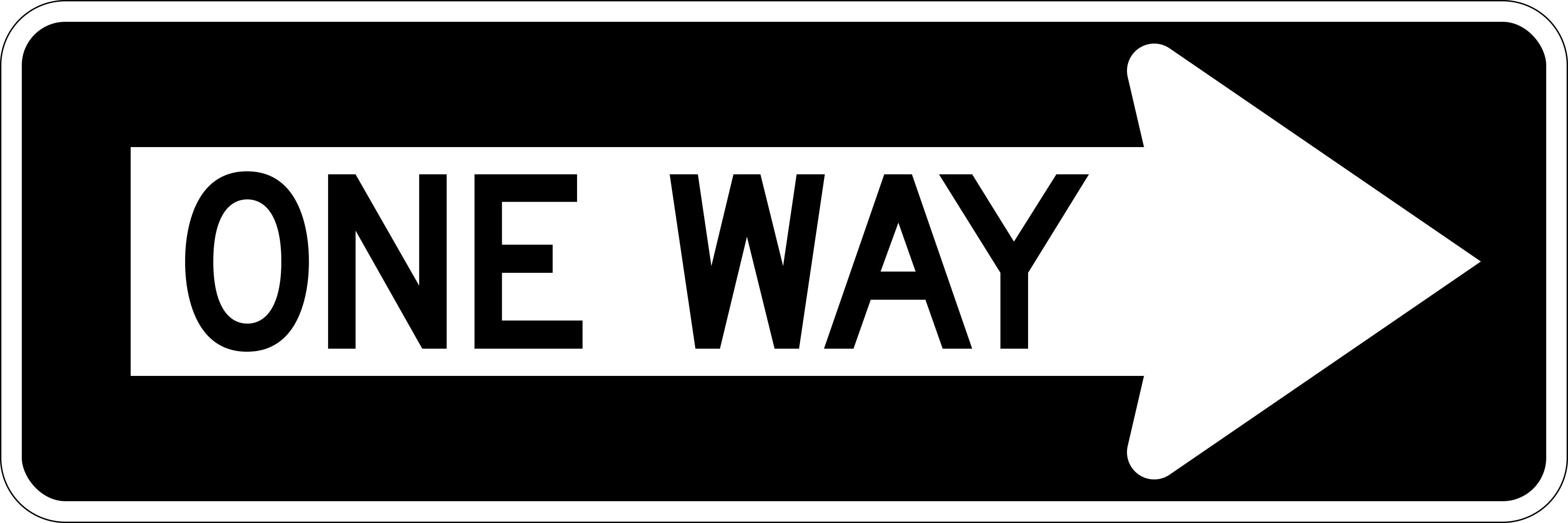
  7. 7. On a one-way street, what does the black-and-white arrow sign require?

    Black ONE WAY sign with arrow
    1. Travel only in the arrow's direction
    2. Turn toward the nearest side street
    3. Reserve the lane for buses
    4. Reverse direction at the next driveway
    Show answer

    Travel only in the arrow's direction. A ONE WAY sign controls the direction of travel on a one-way street or driveway. Full explanation in Test 7

  8. 8. How does stopping distance at 60 mph compare with 30 mph, according to the Connecticut manual?

    1. Over three times the distance, not twice
    2. Exactly twice
    3. About the same
    4. Half the distance
    Show answer

    Over three times the distance, not twice. Stopping at 60 mph does not take twice the distance it takes at 30 mph, as one might think, but over three times the distance. Full explanation in Test 8

  9. 9. What roadway arrangement follows a DIVIDED HIGHWAY BEGINS sign?

    Yellow sign with arrows splitting around a median
    1. U-turns are required at the median
    2. All traffic will share one undivided lane
    3. A median or divider splits the highway into two one-way roadways
    4. The road becomes a four-way intersection
    Show answer

    A median or divider splits the highway into two one-way roadways. DIVIDED HIGHWAY BEGINS announces that a median or divider will separate the highway into two roadways, with each roadway carrying one-way tr Full explanation in Test 9

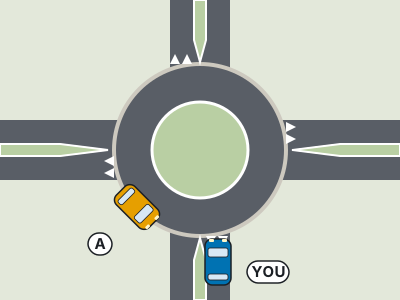
  10. 10. Before entering a roundabout, to whom must an entering driver yield?

    A single lane roundabout with a round center island and four entry roads, each with a yield line. Your car, blue, is on the south entry road at the yield line. Car A, orange, is already driving in the circle, to the left of your entry.
    1. No one when entering from the right
    2. Only traffic approaching from the left
    3. Vehicles waiting behind the entrance
    4. Traffic already circulating in the roundabout
    Show answer

    Traffic already circulating in the roundabout. Entering traffic yields to vehicles already circulating in the roundabout. Full explanation in Test 10

  11. 11. How should a driver treat a flashing red traffic light?

    1. As a flashing yellow signal requiring no stop
    2. As a green light when the intersection looks clear
    3. As a stop sign, stopping fully before proceeding when safe
    4. As a signal to reverse away from the intersection
    Show answer

    As a stop sign, stopping fully before proceeding when safe. A flashing red signal has the same meaning as a stop sign. Full explanation in Test 1

  12. 12. When may a driver cross a double yellow line to pass slow-moving traffic in Connecticut?

    1. Whenever the vehicle ahead is traveling below the posted limit
    2. When the pass is legal for that situation and there is enough sight distance to do it safely
    3. Only after driving on the shoulder first
    4. Whenever an oncoming vehicle is close enough to see
    Show answer

    When the pass is legal for that situation and there is enough sight distance to do it safely. Connecticut permits crossing a double yellow line to pass certain slow-moving traffic, including bicycles, but the permission is conditional Full explanation in Test 2

  13. 13. How should you respond to a pedestrian-crossing warning sign?

    Yellow sign with walking person
    1. Watch for people in your path and be prepared to slow or stop
    2. Accelerate so pedestrians have less time in the road
    3. Assume pedestrians must wait for every vehicle
    4. Use the sign as permission to park near the crossing
    Show answer

    Watch for people in your path and be prepared to slow or stop. A PEDESTRIAN CROSSING warning tells you that people may cross your path. Full explanation in Test 3

  14. 14. If the vehicle you are passing begins slowing or stopping, what must you do?

    1. Sound the horn and maintain speed
    2. Continue because the pass has started
    3. Move onto the shoulder to finish faster
    4. Yield to that vehicle
    Show answer

    Yield to that vehicle. The driver being overtaken retains the relevant protection even if that vehicle slows or stops. Full explanation in Test 4

  15. 15. A curved arrow appears before the roadway bends. What does the warning identify?

    Yellow curved-arrow sign
    1. A change in road direction or a curve ahead
    2. A lane reserved for turning at a signal
    3. A mandatory detour around construction
    4. A one-way road beginning at the sign
    Show answer

    A change in road direction or a curve ahead. A curved-arrow warning identifies a change in direction or a curve ahead. Full explanation in Test 5

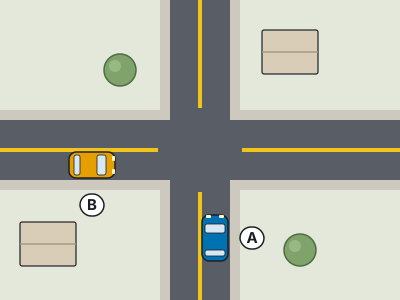
  16. 16. At an intersection without signs or signals, which approaching vehicle has priority?

    An intersection with no stop signs, yield signs or traffic signals. Car A, blue, approaches heading north. Car B, orange, approaches from the left heading east. Both will reach the intersection at about the same time.
    1. The vehicle approaching from the right
    2. The vehicle approaching from the left
    3. The vehicle traveling at the higher speed
    4. The vehicle with its turn signal on
    Show answer

    The vehicle approaching from the right. At an intersection with no stop sign, yield sign, or oncoming traffic signal, the driver must yield to vehicles coming from the right. Full explanation in Test 6

  17. 17. After stopping for an ice cream truck with its stop arm extended, how may you proceed past it in Connecticut?

    1. At a reasonable speed up to 5 mph, yielding to pedestrians going to or from the truck
    2. At the posted speed limit
    3. Only after the truck drives away
    4. At up to 25 mph with the horn sounding
    Show answer

    At a reasonable speed up to 5 mph, yielding to pedestrians going to or from the truck. After stopping, a driver may pass the ice cream truck at a reasonable speed, no faster than 5 mph, and must yield to any pedestrian crossing Full explanation in Test 7

  18. 18. What is the first response when the tires lose traction on wet pavement?

    1. Brake hard while turning toward the shoulder
    2. Ease your foot off the gas pedal
    3. Accelerate until the tires cut through the water
    4. Turn the steering wheel sharply back and forth
    Show answer

    Ease your foot off the gas pedal. During hydroplaning, the manual directs the driver to ease off the gas pedal first. Full explanation in Test 8

  19. 19. What road situation is identified by a five-sided pentagon sign?

    Yellow-green pentagon with two walking figures
    1. A school zone or school crossing
    2. A hospital entrance
    3. A recreational park entrance
    4. A pedestrian bridge only
    Show answer

    A school zone or school crossing. The five-sided pentagon marks school zones and warns about school crossings. Full explanation in Test 9

  20. 20. What does a dashed yellow center line mean?

    1. Traffic travels in the same direction only
    2. Passing is forbidden in both directions
    3. Passing is allowed when safe
    4. The lane is reserved for buses
    Show answer

    Passing is allowed when safe. Dashed yellow lines separate single lanes moving in opposite directions and indicate that passing is allowed. Full explanation in Test 10

  21. 21. What warning equipment makes an approaching emergency vehicle entitled to the right-of-way?

    1. A siren, air horn, or red or blue flashing light
    2. A vehicle color of white or silver
    3. A four-way flasher without an audible warning
    4. A parking light used on the shoulder
    Show answer

    A siren, air horn, or red or blue flashing light. Connecticut gives emergency vehicles priority when they are using a siren, air horn, or red or blue flashing light. Full explanation in Test 1

  22. 22. How should a driver pass a horseback rider on the roadway?

    1. Drive close to the rider to remain visible
    2. Sound the horn repeatedly so the rider moves aside
    3. Accelerate past before the animal can react
    4. Slow down and leave at least three feet while passing
    Show answer

    Slow down and leave at least three feet while passing. A person riding or driving an animal is a vulnerable user, and Connecticut requires drivers to allow three feet when passing. Full explanation in Test 2

  23. 23. What does the shape of an arrow on a turn or curve warning sign tell a driver?

    Yellow winding-arrow sign
    1. The exact speed limit for the roadway
    2. What to expect ahead
    3. Whether the road is reserved for buses
    4. Whether the next intersection has a traffic signal
    Show answer

    What to expect ahead. Warning signs placed before turns and curves use the arrow shape to show the kind of change a driver should anticipate ahead. Full explanation in Test 3

  24. 24. An emergency vehicle approaches while you are already in an intersection. What should you do first?

    1. Stop in the intersection immediately
    2. Back up to the previous stop line
    3. Drive through the intersection, then pull over
    4. Turn left and continue without stopping
    Show answer

    Drive through the intersection, then pull over. The emergency-vehicle rule requires a driver to pull to the right and stop, but the manual gives a specific instruction for a vehicle alread Full explanation in Test 4

  25. 25. When may a driver enter a signalized intersection during heavy traffic?

    1. Whenever the light is green, even if vehicles are stopped ahead
    2. Only when there is enough room to clear it without blocking traffic
    3. After stopping in the middle to wait for space
    4. When the driver can leave part of the vehicle in a crosswalk
    Show answer

    Only when there is enough room to clear it without blocking traffic. A green signal does not give permission to enter and then wait in a blocked intersection. Full explanation in Test 5

How this test works

Study the rules, then check the explanation

This page uses the prepared Connecticut question bank exactly as provided. Start the test, choose an answer, and read the explanation before moving on. Retakes serve the same 210 questions so you can work through the state set without losing your place.

Want a one-page summary to study or print? See the Connecticut DMV cheat sheet, with the most-missed rules from this same question bank.

Looking for another state? Go back to the DMV practice test hub. California remains on the established California DMV practice test page.

Are you a library or school? See the free DMV practice test partner resource for a copy ready listing and referral link.

How we write and check these questions

QualitySpace is expanding to Connecticut

We are a California-based independent insurance brokerage working on licensing in more states. We cannot help with Connecticut insurance yet. Leave your email and we will let you know when we can.