
Key points
You must drive on the right half of the roadway.
Source: Handbook p. 26
“You must drive on the right half of the roadway.”
Hawaii Driver's Manual, Handbook p. 26When moving slower than other traffic, drive in the extreme right lane.
Source: Handbook p. 26
“When moving slower than other traffic you should drive in the extreme right lane.”
Hawaii Driver's Manual, Handbook p. 26Do not drive on the left half within 100 feet of an intersection or railroad crossing.
Source: Handbook p. 26
“Approaching within 100 feet (30.5m) of or passing through an intersection or railroad crossing.”
Hawaii Driver's Manual, Handbook p. 26On marked lanes, stay entirely within your lane and change lanes only after checking that it is safe.
Source: Handbook p. 26
“Drive entirely within the marked lane and do not change lanes until you have checked that the change can be made safely.”
Hawaii Driver's Manual, Handbook p. 26Do not pass approaching a hill or curve without 700 to 1000 feet of clear distance ahead.
Source: Handbook p. 30
“On approaching a hill or curve where there is not 700 to 1000 feet (213m to 305m) clear distance ahead.”
Hawaii Driver's Manual, Handbook p. 30It is unlawful to speed up when you are being passed.
Source: Handbook p. 30
“Note: When you are being passed, it is unlawful to increase your speed.”
Hawaii Driver's Manual, Handbook p. 30Do not pass when a school bus on the same roadway has its flashing lights on.
Source: Handbook p. 31
“When there is a school bus on the same roadway when the flashing lights are operating.”
Hawaii Driver's Manual, Handbook p. 31The end of a no passing zone does not mean it is safe to pass; it only means you can see farther ahead.
Source: Handbook p. 31
“The end of a “no passing zone” does not mean it is safe to pass. It means there is increased visibility ahead.”
Hawaii Driver's Manual, Handbook p. 31
Numbers to know
| Number | What it means | Manual |
|---|---|---|
| 100 feet | no driving on the left half this close to an intersection or railroad crossing | Handbook p. 26 |
| 700 to 1000 feet | clear distance needed to pass near a hill or curve | Handbook p. 30 |
Recognize these signs
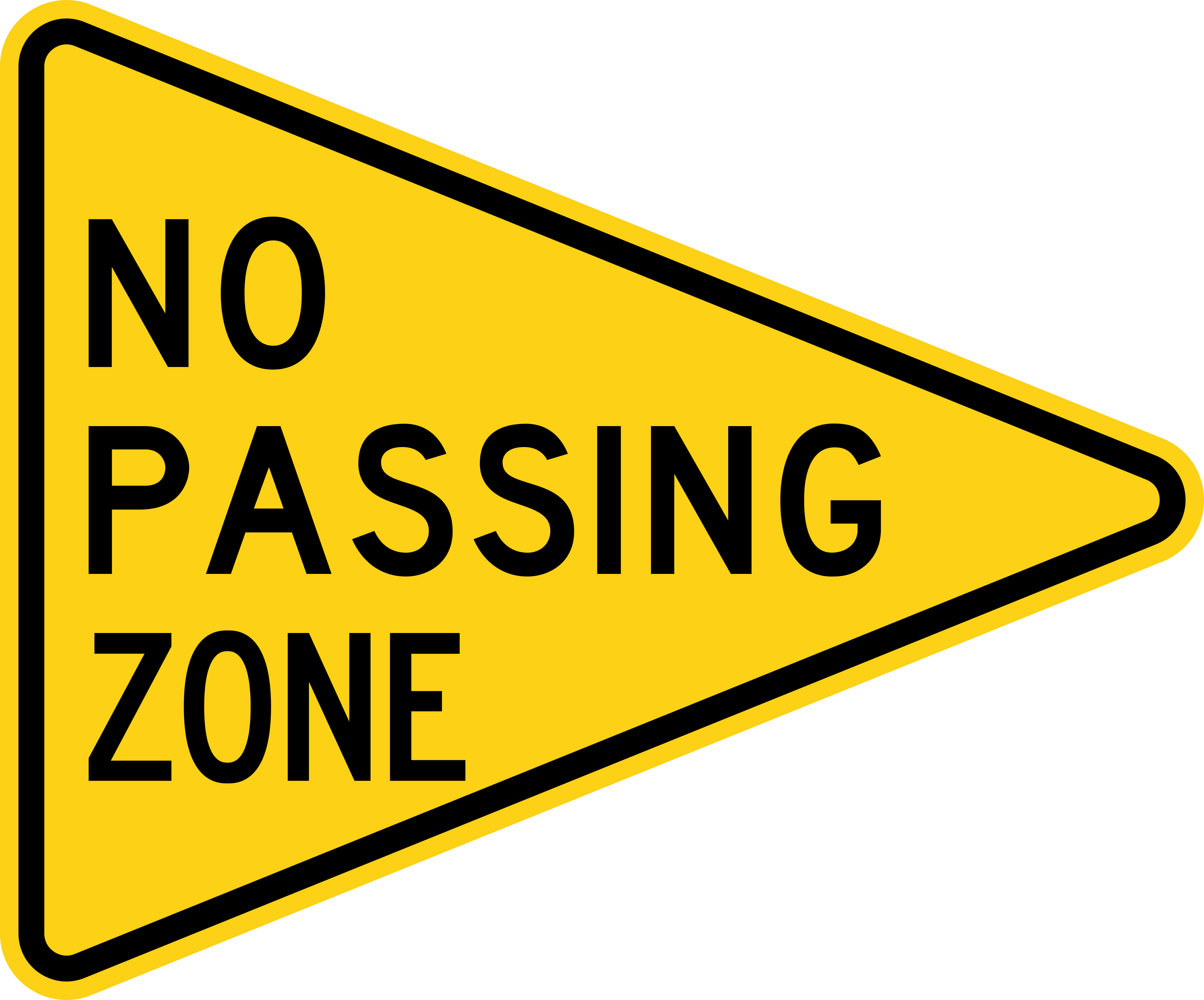
No passing zone
3 questions from the Hawaii practice test
1. When a driver enters a marked lane, what must happen before changing to another lane?
- Change lanes whenever the turn signal is on
- Check that the change can be made safely
- Move first, then check for vehicles
- Cross any lane line if the driver is in a hurry
Show answer
Check that the change can be made safely. On a roadway marked with traffic lanes, the driver must remain entirely within the marked lane and check that a lane change can be made safely before moving. A turn signal communicates an intention, but it does not make an unsafe gap safe. Checking after beginning the maneuver is too late, and urgency does not remove the lane rule. Use a repeatable cue: mirror check, blind-spot check, signal, then move only after the target lane is clear. Keep the vehicle centered until that sequence is complete.
2. When is passing prohibited near a hill or curve?
- When fewer than 700 to 1000 feet of clear distance is ahead
- Whenever the road has a broken white line
- Only when a vehicle is following closely
- When the road is straight for at least 100 feet
Show answer
When fewer than 700 to 1000 feet of clear distance is ahead. Hawaii identifies a hill or curve with less than 700 to 1000 feet of clear distance ahead as a no-passing situation. Limited sight distance can hide an opposing vehicle until there is no room to finish the maneuver. A broken white line and a following vehicle do not create the specific hill-or-curve restriction described here. As the road rises or bends, look for the required clear view and remain in lane when that view is insufficient.
3. What must a driver do before passing a school bus whose flashing lights are operating?
- Pass if the driver cannot see children
- Move onto the shoulder and pass slowly
- Wait, because passing the bus on the same roadway is prohibited
- Pass after sounding the horn twice
Show answer
Wait, because passing the bus on the same roadway is prohibited. The Hawaii manual lists an operating school bus warning system among the no-passing conditions. A driver must wait rather than use the shoulder, rely on a horn, or judge the rule by the absence of visible children. Moving onto the shoulder is still passing the bus, so it does not escape the prohibition. Treat the flashing lamps as the controlling cue, hold your position behind the bus, and continue only after the bus warning has ended and the roadway is safe.
Practice this topic
Lock it in with safe driving questions from the free Hawaii practice test. Every answer comes with a plain English explanation.
Source: the Hawaii Driver's Manual, Chapter V: Traffic Laws and Regulations. This lesson is a plain English summary, not the law itself; where it differs, the manual and the statute govern. Last checked 2026-09-27.