
Key points
You must signal every time, even when no other vehicles are in sight.
Source: Handbook p. 27
“You must signal every time, even when there are no other vehicles in sight.”
Hawaii Driver's Manual, Handbook p. 27Signal for at least 100 feet, about 5 car lengths, before you change lanes, turn or stop.
Source: Handbook p. 27
“Signals must be given for at least 100 feet (30.5m) before you change lanes, turn or stop. This is about five car lengths.”
Hawaii Driver's Manual, Handbook p. 27Use hand signals when your turn signals are not working.
Source: Handbook p. 27
“Hand signals must be used when the vehicle turn signals are not operating.”
Hawaii Driver's Manual, Handbook p. 27A signal does not give you the right to make the move; make sure it is safe first.
Source: Handbook p. 27
“Signaling does not give you the right to make the indicted maneuver;”
Hawaii Driver's Manual, Handbook p. 27Do not rest your foot on the brake pedal, because it gives a false stop signal.
Source: Handbook p. 27
“Do not rest your foot on the brake pedal when you are not braking to avoid giving following drivers a false stop lamp signal.”
Hawaii Driver's Manual, Handbook p. 27Stop at least 15 feet from the nearest rail when a signal warns of a train, a gate is down or a flagman signals.
Source: Handbook p. 27
“You must stop your vehicle not less than 15 feet (4.6m) from the nearest rail when: An installed electric or mechanical signal is giving warning of an approaching train; A crossing gate is lowered, or a flagman is signaling the approach of a train;”
Hawaii Driver's Manual, Handbook p. 27Also stop when a train within 1,500 feet sounds a warning.
Source: Handbook p. 27
“A train approaching within 1,500 feet (460m) gives audible warning of its approach;”
Hawaii Driver's Manual, Handbook p. 27Hazard warning signals warn other drivers that a vehicle is in a hazardous position, and should never be used while the vehicle is moving.
Source: Handbook p. 73
“Hazard warning signals (4-way flash) are intended to warn other drivers that a vehicle is in a hazardous position on the roadway. THIS SIGNAL SHOULD NEVER BE USED WHEN THE VEHICLE IS MOVING.”
Hawaii Driver's Manual, Handbook p. 73
Numbers to know
| Number | What it means | Manual |
|---|---|---|
| 100 feet | minimum signaling distance | Handbook p. 27 |
| 5 car lengths | rough length of the minimum signaling distance | Handbook p. 27 |
| 15 feet | minimum stopping distance from the nearest rail | Handbook p. 27 |
| 1,500 feet | distance at which a train's audible warning requires you to stop | Handbook p. 27 |
Recognize these signs
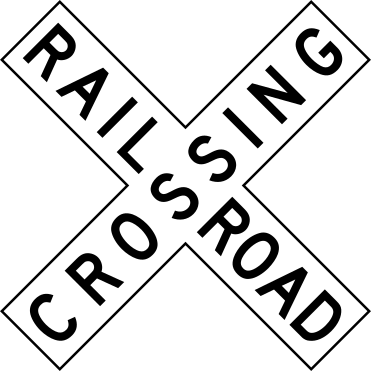
Railroad crossbuck
3 questions from the Hawaii practice test
1. How far before a turn or lane change must a driver generally signal?
- Only after beginning the maneuver
- At least 10 feet
- At least 100 feet
- Only when another vehicle is nearby
Show answer
At least 100 feet. Hawaii requires a turn signal for at least 100 feet before every turn or lane change. Signaling after the maneuver begins gives other road users too little time to understand the plan, and waiting for another vehicle is not the rule. The signal communicates intent but does not grant the right to move, so the driver must still check and yield as needed. Activate it early, maintain it through the maneuver, and confirm the path is clear before changing direction.
2. When should a driver use hazard warning signals according to the manual?
- Whenever the vehicle is moving in rain
- To warn others that a vehicle is in a hazardous position on the roadway
- To signal a routine lane change
- Whenever the driver wants priority in traffic
Show answer
To warn others that a vehicle is in a hazardous position on the roadway. Hazard warning signals are intended to warn other drivers that a vehicle is in a hazardous position on the roadway. The manual specifically says this signal should never be used while the vehicle is moving, so rain, a routine lane change, and a desire for priority are not proper reasons. A driver should first place the vehicle in a safe position when possible, then use the four-way flash to make the hazard visible. The key cue is the vehicle's dangerous position, not ordinary weather or a planned maneuver.
3. What does a turn signal communicate to other highway users?
- The driver's intention, but not a right to make the movement
- An automatic right-of-way over all nearby traffic
- That other drivers must stop immediately
- That the maneuver is safe without a check
Show answer
The driver's intention, but not a right to make the movement. A turn signal communicates an intended movement, but it does not give the driver the right to make that movement. The driver remains responsible for checking traffic and completing the turn or lane change safely without interfering with others. The automatic priority choice turns a warning into a privilege that Hawaii's rule does not grant. Other drivers are not required to stop immediately, and a signal never replaces a safety check. Signal in advance, observe the surrounding traffic, and proceed only after the space and path are clear.
Practice this topic
Lock it in with signals and markings questions from the free Hawaii practice test. Every answer comes with a plain English explanation.
Source: the Hawaii Driver's Manual, Chapter V: Traffic Laws and Regulations. This lesson is a plain English summary, not the law itself; where it differs, the manual and the statute govern. Last checked 2026-09-27.