
Test 4 of 10 · 20 questions · Free 2026
HI Permit Practice Test 4
Jump to the test ↓A fixed 20 question set from the Hawaii bank with answers and plain English explanations. The real HI exam is 30 questions, 80 percent to pass; take the full length version on the main practice page.
Question 1 of 20 · 0 right so far
All 20 questions in test 4
Every question below comes from the Hawaii question bank on this page. Open a question to see the correct answer and the explanation. Nothing here is hidden behind a signup.
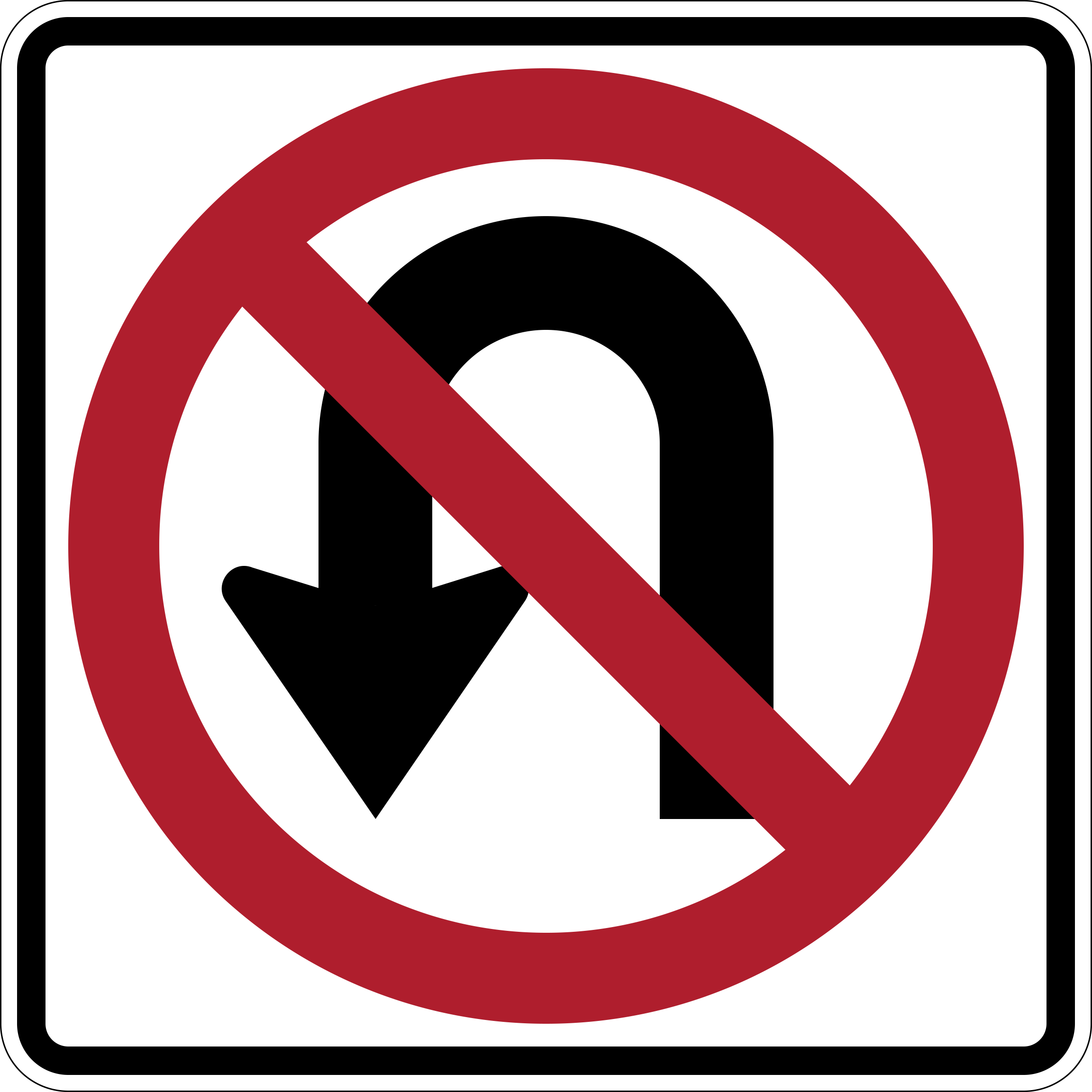
1. What maneuver is prohibited by the sign shown here?
- Driving straight through the controlled lane
- Making any left turn at the next intersection
- Passing a slower vehicle on a marked road
- Making a U-turn at that location
Show answer
Making a U-turn at that location. The crossed U-shaped arrow prohibits a U-turn at the location where the sign is posted. It does not automatically ban every left turn, ordinary passing, or straight travel. Drivers should read the symbol as a specific movement restriction and then choose a lawful route that continues forward or turns where permitted. Do not swing around simply because the roadway looks clear. The red prohibition mark is the cue to keep the vehicle pointed in its current direction until another legal opportunity is available.
Study this in the handbook: Traffic device types, warning, guide and work zone signs
2. What must a minor under 18 provide before entering Hawaii’s graduated licensing program?
- Consent from any adult neighbor
- Parental consent from each living parent or legal guardian, unless married or emancipated
- Only a school principal’s signature
- No consent when the applicant has passed the vision test
Show answer
Parental consent from each living parent or legal guardian, unless married or emancipated. A person younger than 18 must provide parental consent from each living parent or legal guardian unless the person is married or emancipated. One unrelated adult’s signature is not the stated substitute, and school approval does not replace legal consent. Passing a vision test addresses one examination but does not remove the family-consent condition. The practical document check is to identify every living parent or legal guardian whose consent is required and then check whether one of the listed exceptions applies before submitting the application.
Study this in the handbook: The instruction permit
3. How many passengers under age 18 may a Hawaii provisional licensee transport when the passenger is not a household member?
- Only one
- Two
- Three
- As many as fit with seat belts
Show answer
Only one. A Hawaii provisional license allows transport of only one person under age 18 who is not a household member. The limit is a number, not a capacity calculation based on available belts or seats. Two or three such passengers exceed the stated allowance. The household-member wording also matters, because it identifies the exception rather than giving every young passenger the same status. Before accepting riders, count the under-18 passengers who are outside the household and keep that number at one or below.
Study this in the handbook: The provisional license
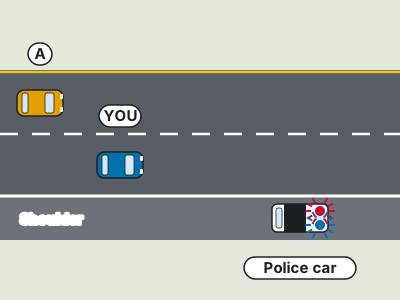
4. What should a driver do after approaching a stopped emergency vehicle with warning lights flashing?
- Maintain speed and pass in the nearest lane
- Stop beside the emergency vehicle to offer assistance
- Slow or stop as appropriate and move away when safe
- Follow directly behind it until traffic clears
Show answer
Slow or stop as appropriate and move away when safe. A stopped emergency vehicle with flashing lights creates a roadside hazard and needs a protected buffer. Slow down or stop according to the situation, then move away so an empty lane separates your vehicle from it whenever that can be done safely. Passing at unchanged speed ignores the danger. Stopping beside the vehicle or following behind it adds exposure and may obstruct responders. The useful driving cue is a lighted emergency vehicle ahead: reduce speed, create space, and keep the response area clear.
Study this in the handbook: Backing, entering traffic, lanes and parking
5. Which Hawaii vehicle occupants must wear seat belts, and what restraint rules apply to children?
- Only front seat occupants
- Only the driver
- All front and back seat occupants; children under 10 need a child restraint or booster unless at least 7 and over 4 feet 9 inches
- Only children
Show answer
All front and back seat occupants; children under 10 need a child restraint or booster unless at least 7 and over 4 feet 9 inches. Section 291-11.6 of the Hawaii Revised Statutes requires every front and back seat occupant to wear a seat belt, so limiting the rule to the driver, the front seat, or children is wrong. Children have added rules under section 291-11.5: under two in a rear-facing harnessed seat, two to under four in a harnessed seat, and four to under ten in a harnessed seat or booster. A child aged seven to under ten who is over four feet nine inches may use a correctly fitted lap and shoulder belt instead.
6. What does a steady yellow traffic light tell a driver about the next signal?
- The red light will be shown immediately afterward
- The signal will remain yellow until traffic clears
- The light grants priority to every turning vehicle
- The driver may enter after accelerating
Show answer
The red light will be shown immediately afterward. Yellow is the transition warning that red is about to appear. The driver should avoid entering the intersection during the yellow phase when stopping can be done safely. It is not an extended green, a promise that turning traffic has priority, or permission to accelerate into a conflict. Look at the distance to the stop line, brake smoothly when appropriate, and never enter after the red light is shown.
Study this in the handbook: Traffic signals and lane control signals
7. Where may bicyclists ride on sidewalks in Hawaii?
- Outside business districts, at 10 mph or less, yielding to pedestrians
- Anywhere, at any speed
- Only in business districts
- Nowhere, since sidewalks are for pedestrians only
Show answer
Outside business districts, at 10 mph or less, yielding to pedestrians. Bicycles are not allowed on sidewalks in business districts. In other areas, bicyclists may ride on sidewalks if they stay at 10 mph or less and always yield the right of way to pedestrians. The any speed choice ignores the 10 mph limit. Business districts are exactly where sidewalk riding is banned, and a total ban is also wrong because the manual allows it elsewhere.
Study this in the handbook: Trucks, motorcycles, bicycles and school buses
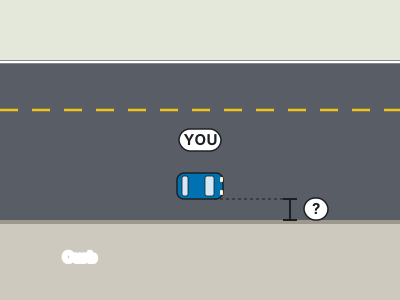
8. When parallel parked in Hawaii, how close must the curbside wheels be to the curb unless inside a marked stall?
- Within 24 inches
- Within 6 inches
- Within 12 inches
- At least 3 feet away
Show answer
Within 12 inches. Where angle parking is not clearly designated, a vehicle should be parallel to the curb and pointed with traffic. Its curbside wheels must be within 12 inches of the curb, unless the vehicle is completely within a marked parking stall. Six inches is narrower than Hawaii's stated allowance, while 24 inches and three feet leave the vehicle too far into the roadway. Align beside the curb before leaving the vehicle and check that the wheels are close enough to preserve room for moving traffic. The 12 inch measure is the practical parking check.
Study this in the handbook: Turn signals and railroad crossings
9. How early can you renew a Hawaii driver's license before it expires?
- Within six months before the expiration date
- Within 30 days before the expiration date
- Only on the expiration date itself
- Within two years before the expiration date
Show answer
Within six months before the expiration date. The manual says a Hawaii license can be renewed within six months before the expiration date, at any driver licensing office in the state. Thirty days is a narrower window than the manual gives, and waiting for the exact expiration date is not required. Two years is far outside the stated window. Renewing early matters because a Hawaii license is void after it expires.
Study this in the handbook: Documents, tests and renewal
10. You want to turn at the next intersection but realize you are not in the proper lane. What does the Hawaii manual tell you to do?
- Cut across lanes at the last moment
- Stop in your lane until a gap opens
- Continue on and make the turn elsewhere
- Turn from your current lane if no one is close
Show answer
Continue on and make the turn elsewhere. Hawaii's turns and curves procedures say to get into the proper lane for a turn well in advance, turning from the lane nearest the direction of the turn. If you are not in the proper lane when you want to turn, continue on and make the turn elsewhere. The manual warns against forcing your way into the proper lane or making abrupt last minute lane changes. Stopping in a travel lane to wait for a gap and turning across other lanes both create the conflicts this rule is meant to prevent. Missing one turn costs only a few minutes.
Study this in the handbook: Following distance, turns and freeways
11. What does this yellow warning sign announce?

- A divided highway begins ahead
- The divided highway ends ahead
- A one lane bridge is ahead
- A pedestrian safety island is ahead
Show answer
The divided highway ends ahead. The Hawaii manual pictures this sign among its warning signs and labels it Divided Highway Ends. The median that kept the two directions apart is ending, so the roadway ahead no longer has that divider. Warning signs warn you of dangers that exist or may be found on or near the road, and you should be prepared to take safe and proper action when you see them, such as staying in your lane and watching for vehicles approaching from the other direction. The Divided Highway sign looks similar but shows the median beginning instead.
Study this in the handbook: Traffic device types, warning, guide and work zone signs
12. What does Hawaii prohibit when a roadway has a posted minimum speed limit?
- Driving below the posted minimum
- Driving exactly at the posted maximum
- Changing lanes near an intersection
- Using the right lane on a highway
Show answer
Driving below the posted minimum. The speed rule works in both directions: the driver must not exceed the posted maximum and must not travel below the posted minimum. Therefore, driving too slowly can violate the posted requirement even when the driver is trying to be cautious. The maximum speed choice describes a separate upper boundary, while lane position and intersection changes are not the issue tested here. Watch for a minimum speed sign and avoid creating an unnecessary speed difference with surrounding traffic.
Study this in the handbook: Speed rules
13. How long must a Hawaii driver under 18 hold a provisional license before a class 3 license?
- 30 days
- One year
- Two years
- At least 6 months
Show answer
At least 6 months. If you are under age 18 you must operate on a provisional license for at least 6 months before being eligible for a class 3 driver's license, after first holding an instruction permit for 180 days. The provisional license limits late night driving to 11 p.m. to 5 a.m. only with a licensed parent or guardian, with exceptions for work and school, and limits passengers under 18.
Study this in the handbook: The instruction permit
14. How does Hawaii treat a driver's refusal to submit to a requested BAC test in the administrative process?
- It carries no administrative consequence
- It is treated like a test result of .08 percent or more
- It automatically restores full driving privileges
- It is treated like a result below .02 percent
Show answer
It is treated like a test result of .08 percent or more. The manual places refusal in the same administrative category as a BAC result of .08 percent or more. That means refusing is not a way to avoid the temporary permit process or related consequences. The no consequence option ignores Hawaii's implied consent framework, and a below .02 result is unrelated to a refusal. The practical cue is simple: a lawful request still matters when the driver declines, so refusal should be understood as its own triggering event.
Study this in the handbook: Alcohol, drugs and the law
15. Why should a driver look well ahead instead of watching only the vehicle immediately in front?
- To identify destinations without using signs
- To avoid checking mirrors or side areas
- To make following more closely comfortable
- To anticipate a developing chain reaction and preserve an alternate plan
Show answer
To anticipate a developing chain reaction and preserve an alternate plan. Hawaii's defensive-driving guidance says to look well ahead and anticipate a possible chain-reaction traffic situation. Seeing farther down the roadway gives a driver earlier notice of braking, congestion, or another developing hazard and leaves time to choose an alternate path. It does not replace mirror checks, and it is not a reason to follow closely. Keep your eyes moving, preserve space around the vehicle, and use the extra view to make a smooth decision before the hazard reaches you.
Study this in the handbook: Attitude, age and distraction
16. What does a flashing DON'T WALK or upraised palm signal mean to pedestrians already crossing?
- They must turn back immediately
- They must run into the nearest traffic lane
- They may continue to the nearest sidewalk, traffic island, or safety zone
- They may begin a new crossing from the curb
Show answer
They may continue to the nearest sidewalk, traffic island, or safety zone. A flashing DON'T WALK or upraised palm tells pedestrians not to start crossing, but those already in the roadway may continue to the nearest sidewalk, traffic island, or safety zone. The signal is designed to finish an existing crossing safely rather than force a sudden reversal. It does not authorize a new departure from the curb. Drivers should anticipate people completing the crossing, yield appropriate space, and avoid treating the flashing display as an empty crosswalk.
Study this in the handbook: Traffic signals and lane control signals
17. Which type of information is commonly shown by blue traffic signs?
- A warning that a hill or curve is ahead
- Guide and information about places or services
- A command to stop before a crosswalk
- A prohibition against entering a lane
Show answer
Guide and information about places or services. Blue is one of the colors used on guide and information signs. These signs help identify places and services or make a trip more comfortable, rather than imposing a stop or warning about a roadway hazard. A hill or curve warning belongs to the warning-sign category, while stop commands and lane prohibitions are regulatory instructions. The color does not excuse attention to the wording or symbol, because the specific message still directs where a service or location can be found. Treat blue as an information cue and continue following any separate regulatory signs.
Study this in the handbook: Sign colors, shapes and regulatory signs
18. On a freeway, which lane should remain open as much as possible for entering and leaving traffic?
- The far left lane
- The right lane
- The center lane only
- The shoulder
Show answer
The right lane. Freeway traffic should preserve the right lane for vehicles entering and leaving whenever possible. Through traffic generally belongs in the left or center lanes, while the right lane handles merging and exiting activity. Choosing the shoulder is unsafe and it is not a travel lane. Reserving the far left or center lane would interfere with the freeway's intended lane roles. If you are in the right lane, watch the entrance area and allow merging vehicles room rather than accelerating to close the gap.
Study this in the handbook: Following distance, turns and freeways
19. What is the purpose of a stop line at an intersection?
- It identifies a railroad track
- It marks the lane where passing is encouraged
- It shows where pedestrians must wait
- It marks the exact place to stop
Show answer
It marks the exact place to stop. A stop line is a solid white line painted across traffic lanes at an intersection or pedestrian crosswalk. It gives the driver a precise stopping point, keeping the vehicle behind the crossing area and preserving visibility for people and other traffic. It is not a passing guide, a pedestrian waiting boundary, or a railroad marking. When a signal or sign requires a stop, bring the front of the vehicle to the line without crossing it.
Study this in the handbook: Pedestrian safety
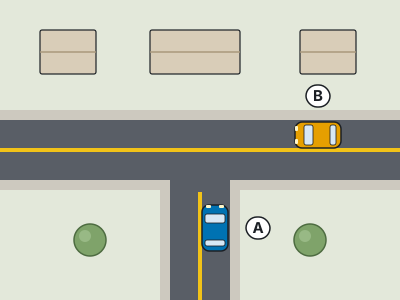
20. Your road meets a protected route at an intersection, and your approach has a YIELD sign. Which traffic must you yield to?
- Only vehicles approaching from your right
- No one, if you reach the intersection first
- Only vehicles that are signaling a turn
- All traffic on the protected route
Show answer
All traffic on the protected route. Hawaii's right of way diagrams show vehicles facing YIELD signs where their road meets a protected route, and the rule is to yield to all traffic on the protected route. A YIELD sign means other traffic has the right of way, so you approach ready to stop and stop whenever traffic with the right of way is present. Reaching the intersection first gives you no priority over the protected route, and the duty is not limited to vehicles from the right or to vehicles that are signaling. Slow early, check both directions, and enter only when the gap is clear.
Study this in the handbook: Right of way and roundabouts
QualitySpace is expanding to Hawaii
We are a California-based independent insurance brokerage working on licensing in more states. We cannot help with Hawaii insurance yet. Leave your email and we will let you know when we can.
Every question is written from the official Hawaii Driver's Manual. Need paper? Printable HI practice test with answer key.
Last verified 2026-10-05. How we check every question · Study all 216 as flashcards
Frequently asked questions
How many questions are on this Hawaii practice test?
This fixed set has 20 questions. It is test 4 of 10 from the 216 question Hawaii bank. The real HI exam asks 30 questions and you need 24 correct.
What is the passing score for the real Hawaii test?
No more than 6 errors on the 30-question written examination, i.e. 24 of 30 correct (published by Maui County; Honolulu does not publish a passing score) That figure comes from the official Hawaii source cited on the DMV facts page.
How does this fixed test relate to the full Hawaii bank?
Each numbered test is a fixed set of questions in a fixed order, so you can retake the same test later and compare. Every test mixes road signs and the other topics in about the same proportion as the full bank. Tests 1 to 10 together cover 200 of the 216 questions in the Hawaii bank, each once. The full practice page mixes the whole bank at random.
Last verified 2026-10-05. See the Hawaii DMV facts page for sourced state details.