
Test 7 of 10 · 20 questions · Free 2026
HI Permit Practice Test 7
Jump to the test ↓A fixed 20 question set from the Hawaii bank with answers and plain English explanations. The real HI exam is 30 questions, 80 percent to pass; take the full length version on the main practice page.
Question 1 of 20 · 0 right so far
All 20 questions in test 7
Every question below comes from the Hawaii question bank on this page. Open a question to see the correct answer and the explanation. Nothing here is hidden behind a signup.
1. Under Hawaii's no fault insurance law, what medical bill amount opens the door to a lawsuit for bodily injury?
- Medical bills over $500
- Any amount, since you can sue for injury at any time
- Medical bills over $5,000
- No amount, since no fault law bars every injury lawsuit
Show answer
Medical bills over $5,000. Hawaii lets you sue or be sued for property damage at any time, but not for bodily injury unless medical bills exceed $5,000, the injury causes lost use of a body part or function or permanent serious disfigurement, or the injury results in death. Five hundred dollars is far below the threshold. Suing at any time applies to property damage, not injury. Injury suits are limited, not banned outright.
Study this in the handbook: Crashes, reports and insurance
2. What is the minimum age for a Hawaii provisional license?
- 16 years
- 15 1/2 years
- 17 years
- 18 years
Show answer
16 years. The graduated licensing rules set 16 years as the minimum age for a provisional license. Fifteen and a half is the instruction-permit threshold, while 17 is associated with the minimum age for the later driver license. Waiting until 18 would skip the provisional phase rather than state its entry point. Keep the milestones separate: permit eligibility begins earlier, provisional eligibility begins at 16 after the required preparation, and the full license has its own age and holding conditions.
Study this in the handbook: The provisional license
3. If a vehicle begins to skid, what does the Hawaii manual recommend?

- Accelerate until the tires regain traction
- Apply the brakes sharply and turn hard
- Take immediate smooth corrective action
- Make a sudden steering change away from the skid
Show answer
Take immediate smooth corrective action. When a vehicle begins to skid, the manual calls for immediate smooth corrective action before control is lost. It later advises avoiding the brakes, easing off the accelerator, and steering in the direction the rear of the vehicle is skidding. Sharp braking, acceleration, or a sudden turn can increase the slide or produce an opposite skid. Keep the steering input firm but gentle, reduce the action that started the problem, and wait for the vehicle to respond. Smoothness is the key cue because abrupt inputs make a traction problem worse.
Study this in the handbook: Blowouts, brake failure, skids and fires
4. What roadway change does the pictured divided-highway warning announce?

- Vehicles may drive across the center island
- All traffic must make a U-turn at the next opening
- The highway is changing to a single narrow lane
- Opposing traffic will be separated by a median or divider
Show answer
Opposing traffic will be separated by a median or divider. The divided-highway symbol alerts the driver that opposing flows will be separated, so lane placement and the median become important. It does not invite a U-turn, promise a single lane, or authorize driving across an island. Maintain a lawful lane, follow the roadway around the divider, and look for any posted direction controls. A median is a separation feature, not an area to cross simply because a maneuver seems convenient.
Study this in the handbook: Traffic device types, warning, guide and work zone signs
5. Where does Hawaii require reduced speed limits under its traffic rules?
- Only on open rural highways
- On streets in residential or business areas
- Only when a vehicle carries passengers
- Only at intersections with a green signal
Show answer
On streets in residential or business areas. Hawaii lists streets in residential or business areas among the places where reduced speed limits are required. Those settings often contain driveways, turning traffic, people walking, and frequent access points, so the roadway environment calls for more caution. The rural-highway choice changes the listed location, while the passenger condition and green-signal condition are not part of the rule. Use storefronts, homes, parked cars, and nearby crossings as practical reminders to reduce speed and watch for conflicts before they develop.
Study this in the handbook: Speed rules
6. If two vehicles reach an intersection at the same time, which vehicle generally has priority?
- The vehicle that signals first
- The vehicle on the left
- The vehicle with the larger engine
- The vehicle on the right
Show answer
The vehicle on the right. When vehicles arrive simultaneously, Hawaii's general priority rule gives way to the vehicle on the right. Engine size does not create right of way, and using a turn signal communicates an intended movement without deciding who proceeds first. The vehicle on the left should wait and allow the right side vehicle to move. A good scan habit is to check both sides whenever arrival timing is close, then yield rather than accelerate to claim the space.
Study this in the handbook: Right of way and roundabouts
7. Which manual should an applicant consult for the extra motorcycle, motorscooter, or moped testing information?
- The county parking handbook
- The Commercial Driver's License Manual
- The Motorcycle Operator Manual
- The National Driver Register guide
Show answer
The Motorcycle Operator Manual. The Hawaii Driver's Manual directs motorcycle, motorscooter, and moped applicants to the Motorcycle Operator Manual for the category specific examination information. The commercial manual concerns larger commercial vehicle licensing, and the other choices do not describe the motorcycle testing source. This distinction matters because a class 1 or 2 applicant has a special knowledge test and an off street skills test. Match the reference book to the vehicle category before preparing for the exam.
Study this in the handbook: The provisional license
8. A driver under 21 in Hawaii has a blood alcohol content of .02 percent. What does the manual say?
- The driver is prohibited from operating a motor vehicle
- The driver is automatically treated as impaired under the adult range
- The driver may drive if a supervising adult is present
- The driver may drive if the trip is less than five miles
Show answer
The driver is prohibited from operating a motor vehicle. Hawaii uses a zero-tolerance rule for drivers under 21. A blood alcohol content of .02 percent or higher prohibits that driver from operating a motor vehicle, regardless of whether the driver feels normal or has an adult nearby. The adult impaired range is a separate rule and does not replace the under-21 threshold. The short-trip option also has no exception in the stated rule. Before driving, an under-21 driver must treat any reading at or above .02 percent as a stop signal, not as permission to make a limited trip.
Study this in the handbook: Alcohol, drugs and the law
9. A school bus is stopped on a highway with alternating red lamps flashing. Which traffic must stop?
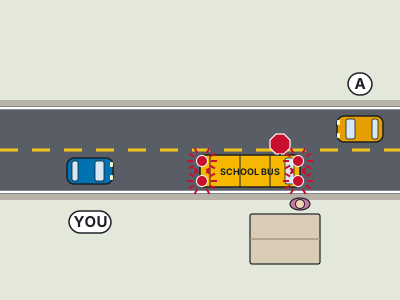
- Only vehicles directly behind the bus
- Only vehicles traveling toward the front of the bus
- Vehicles on the same highway in the bus lane and adjacent lanes
- No vehicle if the driver can see no children
Show answer
Vehicles on the same highway in the bus lane and adjacent lanes. The stopping duty reaches vehicles on the same highway in the lane occupied by the bus and every lane next to that lane. It is not limited to the car immediately behind the bus, and seeing no children does not cancel the requirement. Opposite direction traffic is excused only when it is traveling on a divided highway, which is a narrower condition than an ordinary two way road. Treat flashing alternating red lamps as a command to stop before reaching the bus and remain stopped until motion resumes or the lamps go out.
Study this in the handbook: Pedestrian safety
10. What does orange on a Hawaii traffic sign warn you about?
- Road work or an unusual condition near a work area
- A hospital, lodging or other driver service
- A maximum speed that applies at all times
- A route marker for a scenic destination
Show answer
Road work or an unusual condition near a work area. Orange is the color for warnings concerning road work. An orange sign may be rectangular or diamond shaped, and construction and maintenance signs notify drivers of unusual or potentially dangerous conditions in or near work areas. Services and destinations use guide colors, while a maximum speed is shown by a regulatory sign, and a route marker is guide information rather than a work warning. At an orange sign, reduce speed and watch for the devices the manual lists in work zones, such as barricades, drums, cones, flashing arrow panels and flagpersons.
Study this in the handbook: Sign colors, shapes and regulatory signs
11. What does a double solid white line mean for changing lanes?
- You may cross whenever traffic is light
- You must not cross it
- You must cross it before turning right
- It marks opposing traffic lanes
Show answer
You must not cross it. Double solid white lines prohibit movement from one lane to another. A light traffic condition does not cancel the marking, and the lines do not separate opposing directions because white lane lines divide traffic moving the same way. A driver approaching this marking should remain in the assigned lane and wait for a lawful opening beyond the restriction. The visual cue is the paired solid white barrier, which is stronger than a single dashed lane line.
Study this in the handbook: Pavement markings
12. When should a driver use hazard warning signals according to the manual?
- Whenever the vehicle is moving in rain
- To warn others that a vehicle is in a hazardous position on the roadway
- To signal a routine lane change
- Whenever the driver wants priority in traffic
Show answer
To warn others that a vehicle is in a hazardous position on the roadway. Hazard warning signals are intended to warn other drivers that a vehicle is in a hazardous position on the roadway. The manual specifically says this signal should never be used while the vehicle is moving, so rain, a routine lane change, and a desire for priority are not proper reasons. A driver should first place the vehicle in a safe position when possible, then use the four-way flash to make the hazard visible. The key cue is the vehicle's dangerous position, not ordinary weather or a planned maneuver.
Study this in the handbook: Turn signals and railroad crossings
13. The registered owner of a Hawaii vehicle moves to a new address. What must the owner do?
- Notify the county agency by telephone within 10 days
- Report the new address at the next registration renewal
- Notify the county agency in writing within 30 days after the change
- Do nothing unless the vehicle is sold
Show answer
Notify the county agency in writing within 30 days after the change. When a registered owner's address changes, the owner must notify the appropriate county agency within thirty days after the change, in writing, giving the old and new addresses along with the license number, make and vehicle identification number. A telephone call within 10 days is not the stated method or time. Waiting for the next renewal or doing nothing misses the 30 day deadline. Renewal notices are mailed to the last recorded address, so the record needs to be current.
Study this in the handbook: Vehicle equipment, inspection and registration
14. You must stop at least 15 feet from the nearest rail when a train gives an audible warning while approaching within what distance?
- 1,500 feet
- 500 feet
- 1,000 feet
- 3,000 feet
Show answer
1,500 feet. Hawaii requires a stop not less than 15 feet from the nearest rail when a train approaching within 1,500 feet gives an audible warning. The stop is also required when a signal is warning, a gate is lowered, a flagman signals, or a visible train is close enough to be a hazard. Five hundred and 1,000 feet are shorter than the stated distance, and 3,000 feet is not in the rule. A horn from a train in that range is a command to stop.
Study this in the handbook: Turn signals and railroad crossings
15. At an intersection, what special right of way applies to a funeral procession?
- Other drivers must yield to the procession
- The procession must yield to all cross traffic
- Only the lead vehicle receives priority
- The procession has priority only with a police escort
Show answer
Other drivers must yield to the procession. Hawaii recognizes a funeral procession as a group that receives special treatment at intersections. Other drivers must yield rather than cut between vehicles or treat each member as an unrelated arrival. Limiting priority to the lead car would break up the procession, and the manual does not make a police escort the condition in this rule. A useful visual cue is a connected line of vehicles moving together: wait for the entire procession to clear before proceeding.
Study this in the handbook: Backing, entering traffic, lanes and parking
16. What testing is required for a Hawaii class 2 motorcycle license?
- A written test but no skills test
- Only the standard class 3 road test
- A vision screening with no motorcycle testing
- A special knowledge test and an off street skills test
Show answer
A special knowledge test and an off street skills test. A class 2 motorcycle applicant must pass both a special knowledge test and an off-street skills test. The manual pairs these two tests for the motorcycle class, and the off-street setting means the skills check happens away from regular traffic on the highway. The ordinary class 3 road test does not replace those category specific requirements. Choosing only a written exam leaves out the practical evaluation, and a vision screening alone is plainly incomplete. The manual directs applicants to the Motorcycle Operator Manual for the additional details.
Study this in the handbook: The provisional license
17. After a tire blowout, when should the driver apply the brakes lightly?
- Immediately, before steering
- Never, because braking is permanently unsafe
- Only after reaching the next freeway exit
- After slowing gradually to a very low speed
Show answer
After slowing gradually to a very low speed. The sequence after a blowout is gradual deceleration without the brakes, followed by light braking once the vehicle is moving very slowly. Immediate braking can turn the tire failure into an uncontrollable skid, and the manual says to pull off the road into a safe area once the vehicle is moving slowly, not to drive on to an exit. The manual does not ban braking forever; it delays gentle braking until direction and speed are stabilized. Remember the order as hold, coast down, brake lightly, then pull into a safe area.
Study this in the handbook: Blowouts, brake failure, skids and fires
18. What movement is required when a green arrow is lighted for a traffic lane?
- Choose any direction after yielding
- Move only in the direction shown by the arrow
- Travel straight regardless of the arrow
- Change to a lane with a red signal
Show answer
Move only in the direction shown by the arrow. A green arrow permits movement but limits that movement to the direction indicated by the arrow. It is not a general green light that allows a driver to select any path through the intersection. The choice allowing any direction overlooks the lane-specific control, while going straight regardless of the arrow can conflict with cross traffic or the intended turn. Moving into a lane showing red is also prohibited. Read the arrow before entering the intersection and follow its direction through the controlled area, even when another route appears open.
Study this in the handbook: Traffic signals and lane control signals
19. At about what speed may partial hydroplaning begin?
- 15 miles per hour
- 25 miles per hour
- 65 miles per hour
- 35 miles per hour
Show answer
35 miles per hour. The manual places the possible beginning of partial hydroplaning at 35 miles per hour, with the extent increasing as speed and standing water increase. The lower figures understate the point identified in the text, while 65 miles per hour ignores that loss of contact can develop earlier. Hydroplaning removes braking, steering, and acceleration control, so reduce speed before water accumulates. Check tire tread and inflation too, since worn or underinflated tires can hydroplane at lower speeds.
Study this in the handbook: Rain, fog and night driving
20. What rule does Hawaii apply to an opened alcoholic beverage container in a vehicle on a public road?
- It may be stored anywhere if the driver has not been drinking
- It may not be stored in the area normally occupied by the driver or passengers
- It may be stored in the back seat
- It may be held by a passenger who is 21 or older
Show answer
It may not be stored in the area normally occupied by the driver or passengers. Storing an opened alcoholic beverage container in the area of a vehicle normally occupied by the driver or passengers is prohibited on any public road. Whether the driver has been drinking does not matter. The back seat is part of the passenger area, so it is not a lawful place for an opened container. A passenger's age creates no exception, and consuming or possessing alcohol on a public highway is itself against the law.
Study this in the handbook: Alcohol, drugs and the law
QualitySpace is expanding to Hawaii
We are a California-based independent insurance brokerage working on licensing in more states. We cannot help with Hawaii insurance yet. Leave your email and we will let you know when we can.
Every question is written from the official Hawaii Driver's Manual. Need paper? Printable HI practice test with answer key.
Last verified 2026-10-05. How we check every question · Study all 216 as flashcards
Frequently asked questions
How many questions are on this Hawaii practice test?
This fixed set has 20 questions. It is test 7 of 10 from the 216 question Hawaii bank. The real HI exam asks 30 questions and you need 24 correct.
What is the passing score for the real Hawaii test?
No more than 6 errors on the 30-question written examination, i.e. 24 of 30 correct (published by Maui County; Honolulu does not publish a passing score) That figure comes from the official Hawaii source cited on the DMV facts page.
How does this fixed test relate to the full Hawaii bank?
Each numbered test is a fixed set of questions in a fixed order, so you can retake the same test later and compare. Every test mixes road signs and the other topics in about the same proportion as the full bank. Tests 1 to 10 together cover 200 of the 216 questions in the Hawaii bank, each once. The full practice page mixes the whole bank at random.
Last verified 2026-10-05. See the Hawaii DMV facts page for sourced state details.