
Test 9 of 10 · 20 questions · Free 2026
HI Permit Practice Test 9
Jump to the test ↓A fixed 20 question set from the Hawaii bank with answers and plain English explanations. The real HI exam is 30 questions, 80 percent to pass; take the full length version on the main practice page.
Question 1 of 20 · 0 right so far
All 20 questions in test 9
Every question below comes from the Hawaii question bank on this page. Open a question to see the correct answer and the explanation. Nothing here is hidden behind a signup.
1. Which Hawaii vehicles display a license plate on the rear only?
- Passenger cars
- Motorcycles, trailers and semitrailers
- Pickup trucks
- All vehicles registered in Hawaii
Show answer
Motorcycles, trailers and semitrailers. Hawaii requires motorcycles, trailers and semitrailers to display a license plate on the rear. All other vehicles, including passenger cars and pickup trucks, must display plates on both the front and the rear. That is why the choice covering all Hawaii vehicles is wrong. A car driven with only a rear plate does not meet the rule, and neither does a pickup truck. The rear only rule is limited to those three vehicle types.
Study this in the handbook: Vehicle equipment, inspection and registration
2. The vehicle you provide for a Hawaii road test must have which documents?
- A current registration, a current safety inspection certificate and an insurance identification card
- Only a current registration
- The certificate of title and a bill of sale
- Only an insurance identification card
Show answer
A current registration, a current safety inspection certificate and an insurance identification card. For the road test you must provide a vehicle in safe operating condition with a current registration, a current safety inspection certificate and an insurance identification card. Registration alone or an insurance card alone leaves out required items. The title and bill of sale are ownership papers and are not what the test requires. All vehicle safety defects must also be corrected before the test, and a licensed driver must bring you to the station.
Study this in the handbook: Documents, tests and renewal
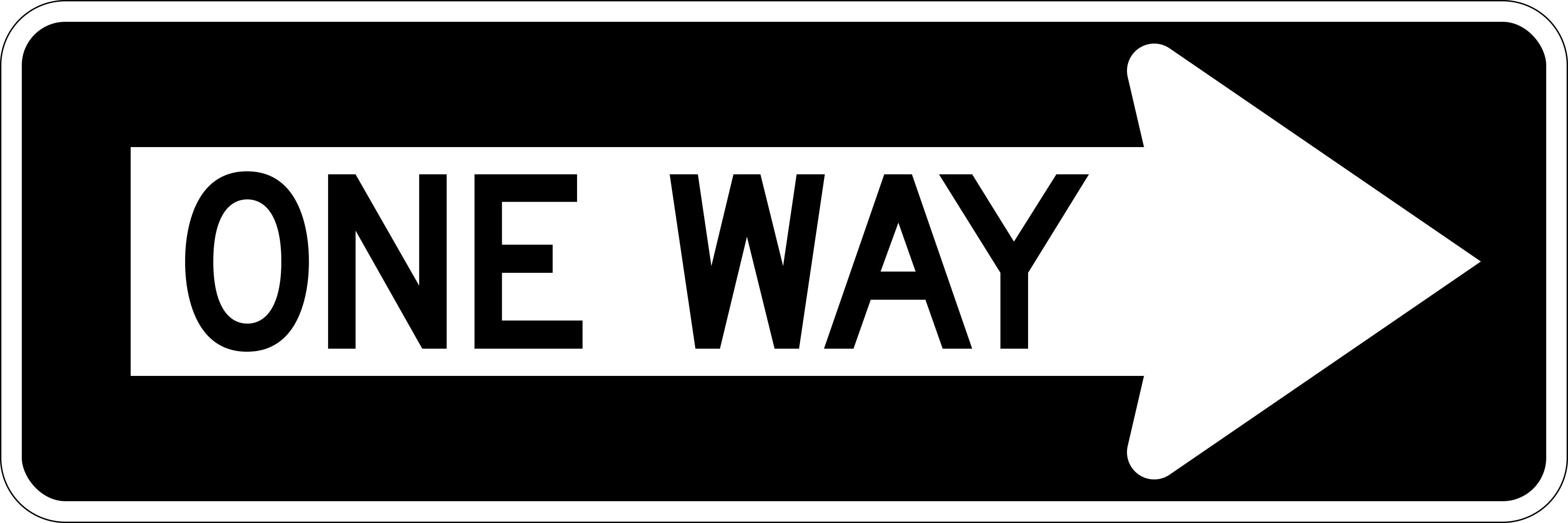
3. What does the arrow on this ONE WAY sign tell the driver?
- Turn in that direction only after stopping at a red light
- Travel on the street only in the arrow’s direction
- Use the right lane only for passing
- Expect two-way traffic around the next corner
Show answer
Travel on the street only in the arrow’s direction. The arrow identifies the only direction of travel permitted on the one-way street. Hawaii’s roadway rule says drivers must follow the direction shown by posted traffic signs. The sign does not create a special right-on-red rule, assign a passing lane, or predict two-way traffic. Before entering, compare the arrow with your intended path; once on the street, keep moving in that direction and watch for lane-use instructions. A wrong-way entry is dangerous because opposing traffic may not expect a vehicle to appear.
Study this in the handbook: Driving on the right and passing laws
4. May a Hawaii applicant take the category 3 driver performance test in an autocycle?
- Yes, any registered vehicle may be used
- Yes, as long as it has a current safety inspection
- No, even though a category 3 license allows driving one, an autocycle cannot be used for the test
- Only if the applicant already holds a class 2 motorcycle license
Show answer
No, even though a category 3 license allows driving one, an autocycle cannot be used for the test. Hawaii lets a category 3 license holder drive an autocycle, but the manual says an autocycle may not be used for the category 3 performance test. Registration and a current safety inspection are required for the test vehicle, yet they do not make an autocycle acceptable. Holding a class 2 motorcycle license does not create an exception. Bring a regular vehicle in safe operating condition for the test.
Study this in the handbook: Documents, tests and renewal
5. Where does Hawaii law make it illegal to consume or possess an alcoholic beverage?
- Only inside a moving vehicle
- On any public highway or any public sidewalk
- Only within 1,000 feet of a school
- Only on highways, never on sidewalks
Show answer
On any public highway or any public sidewalk. Hawaii law makes it illegal to consume or possess any alcoholic beverage on any public highway or any public sidewalk. The rule is not limited to a moving vehicle; it covers the public highway and sidewalk themselves. No school distance appears in the rule. Sidewalks are named expressly, so the highways only choice is wrong. Opened containers also may not be stored where the driver or passengers sit.
Study this in the handbook: Alcohol, drugs and the law
6. What is the purpose of a guide and information sign?
- To require a complete stop at every intersection
- To impose a criminal penalty for speeding
- To warn that a railroad train is approaching
- To help a driver find a route or make the trip more comfortable
Show answer
To help a driver find a route or make the trip more comfortable. Guide and information signs provide navigation help or useful trip information. They do not impose a speed penalty, warn specifically of an approaching train, or command a stop at every intersection. Those functions belong to regulatory or warning devices. When reading a sign, first identify whether it gives direction and services, describes danger, or orders an action. A route arrow, destination, or facility symbol should be read as assistance with the trip, not as a new traffic command.
Study this in the handbook: Pavement markings
7. How long must a Hawaii driver convicted of certain vehicle offenses maintain an SR-22?
- One year
- 30 days
- Three years from the conviction date
- For life
Show answer
Three years from the conviction date. Under Hawaii's Motor Vehicle Safety Responsibility Law, a driver convicted of certain offenses involving vehicles must file and maintain proof of financial responsibility for three years from the conviction date, by filing evidence of insurance on Form SR-22. The penalty for not complying is suspension of the driver's license. One year and 30 days are far too short, and the requirement is not lifelong. Keep this separate from the SR-21, which is the evidence of insurance filed after a crash involving death, injury or property damage over $3,000.
Study this in the handbook: Crashes, reports and insurance
8. When is passing prohibited near a hill or curve?
- When fewer than 700 to 1000 feet of clear distance is ahead
- Whenever the road has a broken white line
- Only when a vehicle is following closely
- When the road is straight for at least 100 feet
Show answer
When fewer than 700 to 1000 feet of clear distance is ahead. Hawaii identifies a hill or curve with less than 700 to 1000 feet of clear distance ahead as a no-passing situation. Limited sight distance can hide an opposing vehicle until there is no room to finish the maneuver. A broken white line and a following vehicle do not create the specific hill-or-curve restriction described here. As the road rises or bends, look for the required clear view and remain in lane when that view is insufficient.
Study this in the handbook: Driving on the right and passing laws
9. A crash causes injury or at least $3,000 in property damage. What reporting duty applies?
- Report it only to the vehicle manufacturer
- Report it only if another driver requests it
- Wait until the next business day
- Report it to police immediately by the quickest means of communication
Show answer
Report it to police immediately by the quickest means of communication. Hawaii requires immediate police reporting when a traffic crash causes any personal injury, death, or property damage of $3,000 or more. Waiting for the next business day risks violating the reporting duty, and a request from another driver is not the trigger. The manufacturer is not the required first report. After securing the scene, use the quickest available communication to contact police, and do not leave the scene without identifying yourself and rendering assistance to anyone injured.
Study this in the handbook: Crashes, reports and insurance
10. What does a double solid white line between lanes mean?
- Lane movement is prohibited across the line
- A lane change is required immediately
- The line may be crossed whenever traffic is slow
- The line separates opposing directions of traffic
Show answer
Lane movement is prohibited across the line. Double solid white lines separate lanes moving in the same direction while prohibiting movement from one lane to the other. Slow traffic does not make crossing lawful, and the marking does not separate opposing directions, which is the role of yellow centerlines. It also does not order an immediate lane change. Keep the vehicle on its side of the marking and wait for a permitted lane arrangement. Seeing two solid white lines should trigger a firm no crossing response.
Study this in the handbook: Pavement markings
11. What does the Hawaii manual say about the legal requirement to wear a bicycle helmet?
- It may not be legally required, but wearing one is a good idea
- It is legally mandatory for every bicyclist
- It is required only for riders older than 40
- It is required only when riding faster than 15 MPH
Show answer
It may not be legally required, but wearing one is a good idea. The manual recommends a helmet every time a person rides, while acknowledging that wearing one may not be legally required. That distinction separates a strong safety recommendation from a universal legal mandate. The age and speed conditions in the other choices are not the manual’s explanation. Serious head injuries can occur even on a short or slow ride, so the concrete habit is to put on the helmet before moving the bicycle, regardless of distance, pace, or the rider’s age.
Study this in the handbook: Trucks, motorcycles, bicycles and school buses
12. In the listed Honolulu office schedule, during what hours are written tests administered?
- 9:00 a.m. to 5:00 p.m.
- 7:00 a.m. to noon
- 8:00 a.m. to 3:30 p.m.
- No written tests are offered
Show answer
8:00 a.m. to 3:30 p.m.. The manual lists Honolulu written testing from 8:00 a.m. to 3:30 p.m. That schedule is specific to the Honolulu listing, so it should not be generalized to every county, whose posted hours may differ. The earlier opening, later closing, and no testing choices do not match the printed office information. Treat the time as a planning detail, then verify the current county listing before traveling because the introduction warns that information can change between printings.
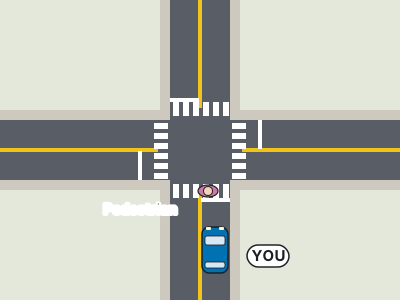
13. At a marked crosswalk, what right of way does Hawaii give a pedestrian who is crossing?
- Priority belongs to the faster traveler
- The pedestrian must yield to every vehicle
- The vehicle that arrives first has priority
- The pedestrian has the right of way
Show answer
The pedestrian has the right of way. Crosswalk lines show pedestrians where to safely cross, and Hawaii's manual tells drivers they must stop for pedestrians in crosswalks. The driver gives way to the person on foot instead of relying on arrival order or speed. A pedestrian does not lose that protection simply because a vehicle reached the area first, and the choice saying the pedestrian yields to every vehicle reverses the rule. A useful road cue is to scan the full crossing before moving, including someone who has just stepped into the marked area.
Study this in the handbook: Pedestrian safety
14. What should a driver do before backing a vehicle?
- Rely only on the rear-view mirrors
- Visually check the area behind the vehicle
- Accelerate quickly to shorten the maneuver
- Back first, then look for children
Show answer
Visually check the area behind the vehicle. Before backing, the driver should visually check the area to the rear and then turn around to look behind the vehicle. Hawaii's manual warns that the view in rear-view mirrors is too small to rely on for this purpose. Accelerating quickly reduces the time to react, and looking for children only after movement begins is especially dangerous in residential areas. Back slowly, use an outside guide when the rear cannot be seen, and watch the front clearance if turning. The essential cue is a direct look before the vehicle starts moving backward.
Study this in the handbook: Backing, entering traffic, lanes and parking
15. What do double solid yellow centerlines permit you to do in Hawaii?
- Cross only to make a U-turn at any location
- Cross to pass whenever no oncoming vehicle is visible
- Cross only for a left turn into or from an alley, private road, or driveway
- Use the lines as a lane for slow traffic
Show answer
Cross only for a left turn into or from an alley, private road, or driveway. Double solid yellow lines mark the center where passing is prohibited in both directions. Hawaii permits crossing them only to make a left turn into or from an alley, private road or driveway. A clear view of opposing traffic does not create a passing exception. The U-turn choice is broader than the manual's stated permission, and the centerline is never a travel lane for slow vehicles. Before crossing, check the turn is lawful and safe, signal, and yield as required. Treat the paired solid lines as a strong no-passing cue.
Study this in the handbook: Pavement markings
16. During Hawaii’s provisional-license nighttime hours, what passenger condition applies even when the driver is traveling under an exception?
- The driver may carry two people under 18 without any supervisor
- The driver may transport any number of passengers under 18
- The driver may transport only household members and no one else
- The driver may not transport more than one person under 18 unless accompanied by a parent or guardian
Show answer
The driver may not transport more than one person under 18 unless accompanied by a parent or guardian. The nighttime passenger condition limits the driver to no more than one person under 18 unless a parent or guardian is accompanying the driver. That condition is easy to miss because the employment and school-authorized travel exceptions concern the reason for driving, not unlimited passenger capacity. The choices allowing any number or two unsupervised young passengers expand the rule beyond its stated limit. Before leaving late, check both the trip purpose and the age and number of passengers, then verify whether the parent or guardian exception applies.
Study this in the handbook: The provisional license
17. When the pictured warning shows a lane ending, what should the driver do?

- Remain beside the other lane until the pavement ends
- Check traffic and merge smoothly before the lane disappears
- Use the shoulder as a new through lane
- Pass vehicles by crossing into opposing traffic
Show answer
Check traffic and merge smoothly before the lane disappears. The narrowing-lane symbol gives advance notice that the available roadway will change. Signal, check the adjacent lane, and merge when a safe opening exists instead of waiting until the last few feet. Staying beside another vehicle can close the needed gap. The shoulder is not automatically a travel lane, and opposing traffic is never a routine escape route. Early mirror checks and a gradual movement make the lane reduction easier for everyone to manage.
Study this in the handbook: Traffic device types, warning, guide and work zone signs
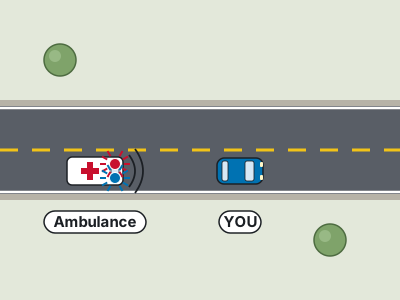
18. When an emergency vehicle is approaching with its warning signal, what is the driver's immediate duty?
- Continue at the same speed until it passes
- Follow it closely through the intersection
- Provide a clear path and stop
- Turn toward the emergency vehicle to make room
Show answer
Provide a clear path and stop. A siren, bell, horn, or flashing red or blue lamp from an approaching emergency vehicle requires the driver to create a clear path and stop. Reduce speed, identify where the vehicle is coming from, and move out of its path without panic braking. Following it, maintaining speed, or turning toward it can obstruct the response route. Keep watching until the emergency vehicle has passed and the roadway is safe to use again.
Study this in the handbook: Emergency vehicles
19. At what speed in heavy rain may tires lose all contact with the pavement, according to the Hawaii manual?
- 20 miles per hour
- 100 miles per hour
- Tires never fully lose contact
- 55 miles per hour
Show answer
55 miles per hour. Hawaii's manual explains that up to about 35 miles per hour, tires with good tread wipe the road surface the way a windshield wiper clears glass. Partial hydroplaning may start at 35 miles per hour, the extent grows with speed and the amount of water, and at 55 miles per hour in a heavy rain the tires may lose all contact with the pavement. At that point you cannot brake, accelerate or turn. Prevent it by keeping good tread depth and proper tire pressure and by reducing speed, since hydroplaning occurs most often at higher speeds.
Study this in the handbook: Rain, fog and night driving
20. What must a driver do when facing double solid white lane lines?
- Do not cross them
- Cross whenever the adjacent lane is faster
- Cross only to pass a motorcycle
- Cross briefly before every intersection
Show answer
Do not cross them. Double solid white lines indicate that lane-to-lane movement is prohibited, so a driver must not cross them. The marking controls traffic moving in the same direction and is stronger than a single dashed white line, which may be crossed safely. Choosing the faster adjacent lane, passing a motorcycle, or crossing before an intersection creates exceptions that the manual does not provide. Treat the double line as a firm boundary and remain in the authorized lane until the roadway marking permits a legal movement. Looking for a broken line ahead is the useful visual cue before planning a lane change.
Study this in the handbook: Pavement markings
QualitySpace is expanding to Hawaii
We are a California-based independent insurance brokerage working on licensing in more states. We cannot help with Hawaii insurance yet. Leave your email and we will let you know when we can.
Every question is written from the official Hawaii Driver's Manual. Need paper? Printable HI practice test with answer key.
Last verified 2026-10-05. How we check every question · Study all 216 as flashcards
Frequently asked questions
How many questions are on this Hawaii practice test?
This fixed set has 20 questions. It is test 9 of 10 from the 216 question Hawaii bank. The real HI exam asks 30 questions and you need 24 correct.
What is the passing score for the real Hawaii test?
No more than 6 errors on the 30-question written examination, i.e. 24 of 30 correct (published by Maui County; Honolulu does not publish a passing score) That figure comes from the official Hawaii source cited on the DMV facts page.
How does this fixed test relate to the full Hawaii bank?
Each numbered test is a fixed set of questions in a fixed order, so you can retake the same test later and compare. Every test mixes road signs and the other topics in about the same proportion as the full bank. Tests 1 to 10 together cover 200 of the 216 questions in the Hawaii bank, each once. The full practice page mixes the whole bank at random.
Last verified 2026-10-05. See the Hawaii DMV facts page for sourced state details.