
Test 1 of 10 · 20 questions · Free 2026
HI Permit Practice Test 1
Jump to the test ↓A fixed 20 question set from the Hawaii bank with answers and plain English explanations. The real HI exam is 30 questions, 80 percent to pass; take the full length version on the main practice page.
Question 1 of 20 · 0 right so far
All 20 questions in test 1
Every question below comes from the Hawaii question bank on this page. Open a question to see the correct answer and the explanation. Nothing here is hidden behind a signup.
1. What must a driver do when a steady yellow X lane-control signal is displayed?
- Enter the lane and maintain speed
- Move out because the lane will be used for opposite-direction traffic
- Use the lane for passing only
- Stop in the lane and wait for a red X
Show answer
Move out because the lane will be used for opposite-direction traffic. A yellow X warns that the lane is being changed for traffic moving in the opposite direction, so the driver must move out of that lane. It is not permission to enter, pass, or remain there until a red X appears. The manual gives a limited exception when the yellow X is flashing: the lane may be used only while preparing for a left turn. Read the display over your lane, signal, and leave it before opposing traffic is released.
Study this in the handbook: Traffic signals and lane control signals
2. According to the Hawaii manual, a driver with a blood alcohol content of more than .05 percent but less than .08 percent may be considered what?
- Under the influence of alcohol
- Completely unaffected by alcohol
- Sober once the driver drinks black coffee
- Impaired
Show answer
Impaired. The manual says a driver may be considered impaired when the blood alcohol content is more than .05 percent but less than .08 percent. Under the influence is the category for .08 percent or more, so it does not fit this range. A driver in this range is not unaffected, since the manual calls it impaired. Black coffee does not sober anyone up; only time lets the liver burn up the alcohol.
Study this in the handbook: Alcohol, drugs and the law
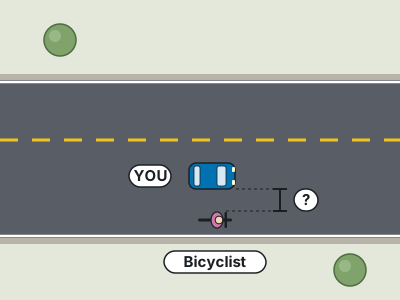
3. How much space should a motorist maintain when passing a bicyclist?
- No fixed space if the bicyclist is in a bike lane
- At least 6 inches until the front wheel clears
- One foot only when traffic is present
- At least 3 feet until safely past
Show answer
At least 3 feet until safely past. Motorists should keep at least three feet between the vehicle and bicyclist until the pass is safely completed. The smaller measurements do not provide the manual's buffer, and a bike lane does not erase the need for care or a safe separation. Watch for a bicyclist who may move around an obstacle or prepare for a turn, and avoid passing before an immediate right turn. The useful habit is to leave the three foot cushion for the entire pass, not just while the front bumper goes by.
Study this in the handbook: Trucks, motorcycles, bicycles and school buses
4. What minimum following distance should a driver allow behind a motorcycle?
- At least two seconds
- At least one second
- At least five feet
- The same distance used behind a parked car
Show answer
At least two seconds. The motorcycle guidance calls for at least a two second following distance. That space gives the rider room to maneuver or stop and gives the driver more time to judge a narrow vehicle's speed and position. One second and five feet are smaller or differently measured cushions, while a parked car is not a moving comparison. Increase the gap when visibility, pavement, or traffic makes reactions harder. The simple road habit is to count two seconds after the motorcycle passes a fixed object before your vehicle reaches it.
Study this in the handbook: Trucks, motorcycles, bicycles and school buses
5. What does a yellow arrow mean for the traffic lane it controls?
- The same as a green arrow, with movement required in its direction
- The same as a yellow light for that lane
- The same as a red arrow, with no movement permitted
- A warning that the lane is reserved for buses
Show answer
The same as a yellow light for that lane. A yellow arrow carries the same meaning as a circular yellow light, but its instruction applies to the indicated traffic lane. It warns that the signal is changing, so entering the intersection or beginning a turn requires caution and judgment. The green-arrow option is wrong because green permits movement only in the arrow direction, while yellow is the transition warning. Look at the arrow's lane, assess whether stopping can be done safely, and do not treat the display as permission to accelerate through the intersection.
Study this in the handbook: Traffic signals and lane control signals
6. Which vehicle is included in Hawaii's manual definition of an emergency vehicle?
- A tow truck with no designated warning system
- Any private car carrying a first-aid kit
- A delivery van using its hazard lights in traffic
- A county ambulance properly equipped with warning equipment
Show answer
A county ambulance properly equipped with warning equipment. The manual includes county ambulances among emergency vehicles when they are properly equipped with a blue or red flashing light and a warning sound system. Carrying medical supplies or switching on ordinary hazard lamps does not give every private or delivery vehicle that status. A tow truck also needs the required designation and equipment to fit the definition. When the recognized warning signals appear, make space and follow the emergency-vehicle rules promptly.
Study this in the handbook: Emergency vehicles
7. What is the first response when you hear or see an emergency vehicle warning?
- Follow the emergency vehicle closely
- Continue at the same speed until it is visible
- Stop in the nearest intersection
- Reduce speed and determine its location and direction
Show answer
Reduce speed and determine its location and direction. An emergency warning requires calm, deliberate action. First reduce speed, then determine where the vehicle is coming from and where it is going before moving out of its path. Continuing unchanged delays the response, while stopping in an intersection can block both the emergency vehicle and other traffic. Following it closely is unsafe and interferes with its route. Use the sound and flashing lamps as cues, search around you, and create a clear path as soon as it is safe.
Study this in the handbook: Backing, entering traffic, lanes and parking
8. What does this five-sided warning sign indicate?

- A school crossing or school zone
- An adult pedestrian-only crosswalk
- A public park entrance
- A roadwork crew ahead
Show answer
A school crossing or school zone. The five-sided school sign can mean either School Crossing or School Zone. It calls for heightened attention to children and a reduced speed when the manual’s stated conditions apply. The sign does not identify an adult-only crosswalk, a park entrance, or roadwork. Treat the area as active even when no child is currently in the lane: scan sidewalks, driveways, and the road edge, and be ready to stop. The pentagon shape is the recognition cue that distinguishes this school warning from ordinary diamond warnings.
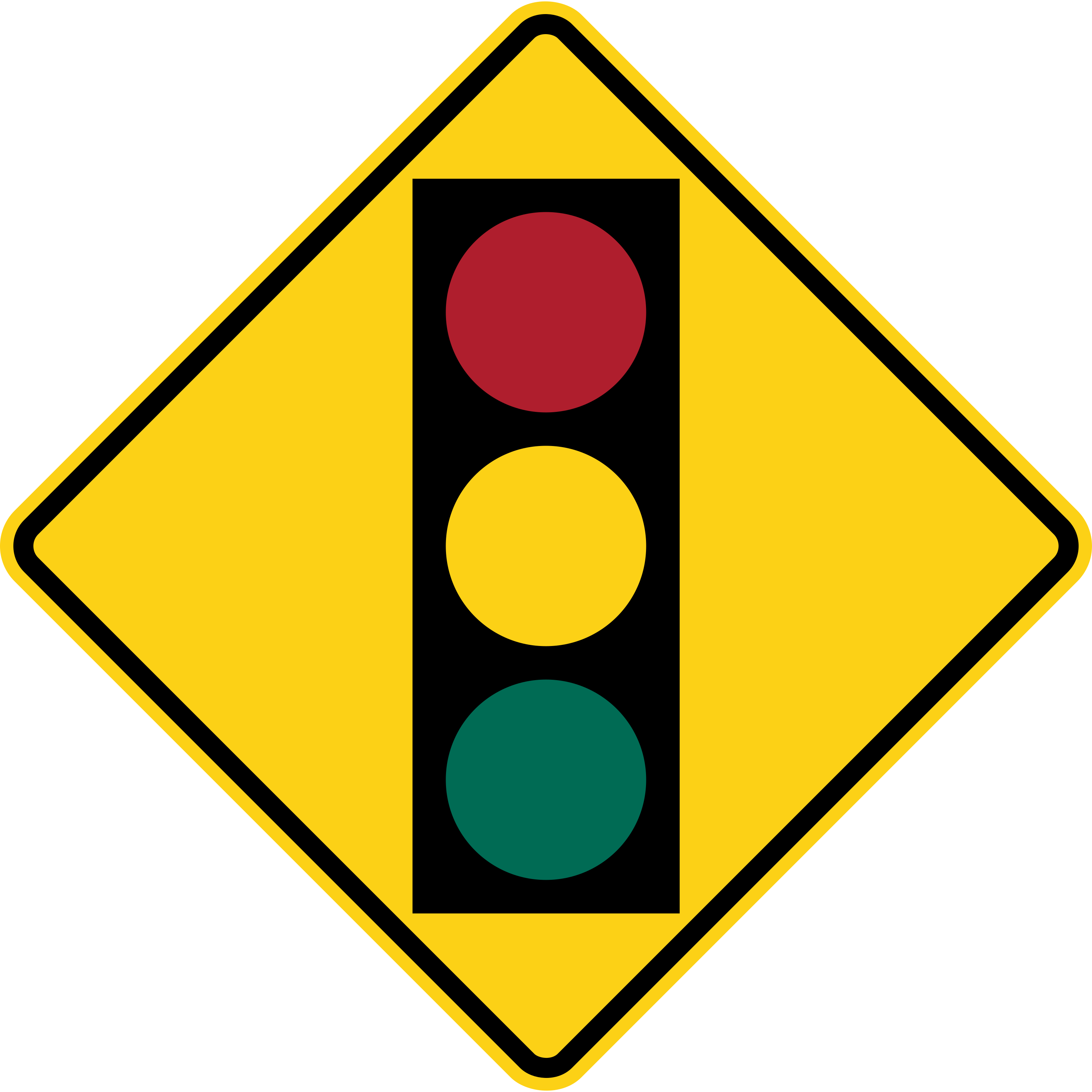
9. What should a driver prepare for after seeing this traffic signal warning sign?
- A police checkpoint ahead
- A broken streetlight that requires a detour
- A traffic signal ahead
- A railroad crossing with no signal
Show answer
A traffic signal ahead. This warning sign announces a traffic signal ahead. It does not mean a streetlight is broken, identify a police checkpoint, or substitute for a railroad warning. Warning devices point to hazardous or changing conditions, so the driver should reduce speed enough to read the upcoming signal and respond smoothly. Scan for pedestrians and vehicles near the intersection, cover the brake if needed, and obey the signal when reached. The signal symbol itself is the cue to expect controlled traffic movement soon.
Study this in the handbook: Pavement markings
10. What must every occupant do while a Hawaii minor is driving under the graduated licensing program?
- Carry proof of employment
- Sit in the back seat
- Keep a window partially open
- Use a safety belt or child restraint
Show answer
Use a safety belt or child restraint. The program requires every occupant to use a safety belt or child restraint. Seat location, an open window, and employment paperwork do not provide the restraint protection required by the rule. This applies during the learner’s supervised practice as well as later graduated-license driving, so the driver should not wait until a road test or nighttime trip to enforce it. Make the restraint check part of the start-of-trip routine: inspect every seating position, secure children in the proper restraint, and then begin driving.
Study this in the handbook: The instruction permit
11. What vehicles does a Hawaii Category 3 license cover?
- Cars and light trucks of 18,000 pounds GVWR or less and buses carrying 15 or fewer occupants
- Motorcycles only
- Trucks over 18,001 pounds
- Any vehicle up to 26,000 pounds
Show answer
Cars and light trucks of 18,000 pounds GVWR or less and buses carrying 15 or fewer occupants. The Category 3 driver's license covers cars and lightweight trucks of 18,000 pounds GVWR or less and buses designed to carry 15 or fewer occupants, and its road test asks you to start the vehicle, drive through a business district, parallel park, show proper signaling, turning, starting and stopping, and move off on a slight grade without rolling backwards. Single vehicles of 18,001 to 26,000 pounds need a higher class, and 26,001 pounds or more needs a commercial class.
Study this in the handbook: Documents, tests and renewal
12. A Hawaii instruction permit holder is driving a passenger vehicle during the daytime. Who must accompany the holder?
- A parent of any age, even without a driver license
- Any passenger who has held a license for at least six months
- A licensed driver at least 21 years old who is licensed for that type of vehicle
- No one, if the permit holder has passed the written test
Show answer
A licensed driver at least 21 years old who is licensed for that type of vehicle. An instruction permit allows driving only while supervised by a licensed driver who is at least 21 and qualified for that vehicle type. In vehicles other than motorcycles, that licensed driver must sit in the right front seat, giving the permit holder immediate supervision. Passing the written test does not remove the accompaniment rule. A parent who cannot legally drive the vehicle cannot satisfy it, and a recently licensed passenger has no special authority merely from being a passenger. Check both age and vehicle-class qualification before moving the car. Between 11:00 p.m. and 5:00 a.m., a permit holder under 18 must be accompanied by a parent or guardian.
Study this in the handbook: The instruction permit
13. What must a Hawaii permit holder complete before applying for a provisional license?
- Hold the permit for 30 days
- Hold a valid instruction permit for 180 days
- Hold the permit until the applicant turns 18
- Hold the permit for one calendar year
Show answer
Hold a valid instruction permit for 180 days. Hawaii requires a valid instruction permit to be held for 180 days before the provisional-license application. Thirty days is too short, and the program does not replace the measured period with an eighteenth birthday or a full calendar year. The distinction matters because 180 days is a specific minimum that can be reached before a year has passed. A learner planning the next stage should count the required days from valid permit status and confirm that other program conditions are also complete before applying.
Study this in the handbook: The instruction permit
14. When entering a Hawaii roundabout, what must you do?
- Drive clockwise around the central island
- Enter first because circulating traffic must stop for you
- Yield to traffic already circulating and travel counterclockwise
- Stop inside the circle until every approach is empty
Show answer
Yield to traffic already circulating and travel counterclockwise. A roundabout is a one-way circular intersection. Entering traffic yields to vehicles already circulating, keeps to the right of the central island and proceeds counterclockwise. Circulating traffic does not have to stop for an entering vehicle, so that choice would reverse the priority. Clockwise travel is the wrong direction, and stopping in the circle disrupts movement and can create a collision risk. Slow before entry, look left for circulating vehicles and yield to pedestrians and bicyclists. Use the right turn signal when leaving, and make another circuit if you miss your exit.
Study this in the handbook: Backing, entering traffic, lanes and parking
15. Which condition specifically calls for a reduced speed limit under Hawaii’s traffic rules?
- A green light with no pedestrians nearby
- An empty rural highway with clear weather
- A School Crossing location where children are present
- A road with no posted signs or pavement markings
Show answer
A School Crossing location where children are present. The manual identifies streets near schools and playgrounds, along with School Crossing locations when children are present, as places requiring reduced speed. Clear weather or light traffic does not erase that special condition. A green signal controls movement at an intersection, but it does not create an exception around a school crossing. When the sign and children are present together, treat the area as an active hazard zone: slow before reaching it, watch the edges, and be ready to stop for someone entering the crossing.
Study this in the handbook: Speed rules
16. You bring a vehicle registered in another state to Hawaii in your own name. What is the longest period a Hawaii permit (temporary registration) can cover?
- Twelve months
- 30 days
- 90 days
- Two years
Show answer
Twelve months. A vehicle registered in another state may get a Hawaii permit, or temporary registration, that lets it be driven up to its out of state expiration date. Under no circumstances will the permit exceed a twelve month period. Thirty and 90 days are shorter than that cap, and two years is longer than any permit allowed. When the permit expires, the owner must register the vehicle with the county where they reside, unless they are a member of the U.S. Armed Forces.
Study this in the handbook: Vehicle equipment, inspection and registration
17. How fast is the human collision inside a car compared with the car's own collision, according to the Hawaii manual?
- Both take about one second
- The person stops first, in one second
- The car stops in 1/10 of a second, the unbelted person in only 1/100 of a second
- They take the same time
Show answer
The car stops in 1/10 of a second, the unbelted person in only 1/100 of a second. In the car's collision it takes 1/10 of a second to stop as the front end crushes and absorbs force, but in the human collision an unbelted occupant slams into the dashboard and windshield and stops in only 1/100 of a second. Belted occupants are fastened to the car's framework and ride down the crash with it, which is why belts prevent the human collision.
Study this in the handbook: Seat belts and children
18. Under current Hawaii law, how must a driver restrain a child who is 4 years old but not yet 10?
- In a harnessed child restraint or booster seat, unless the child is at least 7 and over 4 feet 9 inches in a lap and shoulder belt
- In a rear-facing seat only, until the child turns 10
- With an adult lap belt alone, at any height
- No special restraint once the child turns 4
Show answer
In a harnessed child restraint or booster seat, unless the child is at least 7 and over 4 feet 9 inches in a lap and shoulder belt. Hawaii Revised Statutes section 291-11.5 now covers children under ten. A child from age four up to ten must ride in a harnessed child passenger restraint or a booster seat. The only relief is for a child who is at least seven and taller than four feet nine inches, who may use a lap and shoulder belt that fits correctly. Rear-facing seats are required only under age two, and a lap belt alone never satisfies the rule. The older handbook figure of under four and under eight no longer reflects the statute.
19. How should you treat a single solid white lane line?
- Cross it freely whenever the adjacent lane looks empty
- Cross it only in unusual circumstances and with great care
- Treat it as the centerline separating opposing traffic
- Stop immediately on top of the line
Show answer
Cross it only in unusual circumstances and with great care. White lane lines separate traffic moving in the same direction. A single solid white line signals that changing lanes is hazardous, so Hawaii allows crossing it only in unusual circumstances and then only with great care. An empty-looking adjacent lane is not enough to make routine crossing appropriate. It is not an opposing-traffic centerline, and stopping on the paint is not the rule. Check mirrors and blind spots, signal when changing lanes, and use a dashed white line when a normal lane change is available. The solid line should prompt caution, not automatic movement.
Study this in the handbook: Pavement markings
20. According to the Hawaii manual, which crash danger does a seat belt help prevent?
- It guarantees that no crash injuries will occur
- It helps prevent occupants from being thrown from the vehicle
- It lets passengers ride safely on a seat back
- It removes the need for child safety seats
Show answer
It helps prevent occupants from being thrown from the vehicle. The manual identifies preventing an occupant from being thrown from the vehicle as a major safety function of a seat belt. Ejection greatly increases the chance of death, and the belt also helps keep a person from striking the vehicle interior or another occupant. It cannot guarantee that injuries will never occur, and it does not make an unsafe seat position acceptable. Child safety seats remain necessary for children too small for regular belts. Fasten the lap and shoulder belt before moving, then make sure every passenger is restrained.
Study this in the handbook: Seat belts and children
QualitySpace is expanding to Hawaii
We are a California-based independent insurance brokerage working on licensing in more states. We cannot help with Hawaii insurance yet. Leave your email and we will let you know when we can.
Every question is written from the official Hawaii Driver's Manual. Need paper? Printable HI practice test with answer key.
Last verified 2026-10-05. How we check every question · Study all 216 as flashcards
Frequently asked questions
How many questions are on this Hawaii practice test?
This fixed set has 20 questions. It is test 1 of 10 from the 216 question Hawaii bank. The real HI exam asks 30 questions and you need 24 correct.
What is the passing score for the real Hawaii test?
No more than 6 errors on the 30-question written examination, i.e. 24 of 30 correct (published by Maui County; Honolulu does not publish a passing score) That figure comes from the official Hawaii source cited on the DMV facts page.
How does this fixed test relate to the full Hawaii bank?
Each numbered test is a fixed set of questions in a fixed order, so you can retake the same test later and compare. Every test mixes road signs and the other topics in about the same proportion as the full bank. Tests 1 to 10 together cover 200 of the 216 questions in the Hawaii bank, each once. The full practice page mixes the whole bank at random.
Last verified 2026-10-05. See the Hawaii DMV facts page for sourced state details.