
Test 2 of 10 · 20 questions · Free 2026
HI Permit Practice Test 2
Jump to the test ↓A fixed 20 question set from the Hawaii bank with answers and plain English explanations. The real HI exam is 30 questions, 80 percent to pass; take the full length version on the main practice page.
Question 1 of 20 · 0 right so far

All 20 questions in test 2
Every question below comes from the Hawaii question bank on this page. Open a question to see the correct answer and the explanation. Nothing here is hidden behind a signup.
1. After this HILL warning sign the road drops down a steep grade. According to the Hawaii manual, when should you downshift for engine braking?
- Before starting the downgrade
- Halfway down, once the vehicle has gained speed
- Only after the brakes begin to fade
- At the bottom of the hill
Show answer
Before starting the downgrade. Hawaii's manual says downshifting is a proper way to get extra braking effect from the engine when going down a steep grade, and that the downshift should be made before starting the downgrade because it is more difficult to downshift at higher speeds. Waiting until halfway down or until the brakes feel weak means trying to shift when speed is already high, and shifting at the bottom gives no help on the slope. Treat the HILL sign as the cue to select the lower gear early, which also helps avoid prolonged brake use.
2. What must a Hawaii permit holder do before operating on a highway with an instruction permit?
- Wait until age 16 even if the permit was properly issued
- Drive alone only during daylight hours
- Carry a school identification card instead of a supervising driver
- Drive only when accompanied by a licensed driver at least 21 years old
Show answer
Drive only when accompanied by a licensed driver at least 21 years old. The permit is a supervised learning authorization, not an unrestricted license. The manual requires a licensed driver at least 21 years old to accompany the permit holder on any highway. Daylight does not create a solo-driving exception, and a school card cannot perform the supervising role. The age 16 option skips the actual condition because a properly issued permit may be used before that birthday. The practical cue is simple: before starting, identify the qualified adult who will be riding with the learner and confirm that the adult is licensed for that vehicle.
Study this in the handbook: The instruction permit
3. When may a Hawaii provisional licensee drive between 11:00 p.m. and 5:00 a.m. under the ordinary nighttime rule?
- When accompanied by a licensed parent or guardian
- Whenever the licensee has no passengers
- Whenever the road is dry and well lit
- Only after holding the provisional license for six months
Show answer
When accompanied by a licensed parent or guardian. The ordinary nighttime permission requires accompaniment by a licensed parent or guardian. Empty seats, good weather, and street lighting do not create a general solo-driving exception. Six months is a separate holding period tied to applying for a driver license, not a blanket authorization for nighttime driving before that period ends. A provisional driver should check the clock first, then identify the required licensed family supervisor. Employment and school-authorized travel are listed separately as exceptions, so they should not be silently assumed here.
Study this in the handbook: The provisional license
4. For a driver who is 21 or older, at what BAC level does Hawaii consider the driver under the influence of alcohol?
- 0.05 percent
- 0.02 percent
- 0.08 percent
- 0.10 percent
Show answer
0.08 percent. Hawaii's alcohol chapter says that when a test shows alcohol in the driver's blood, a content of .08 percent or more means the driver may be considered under the influence of alcohol. The .02 figure belongs to the under 21 Zero Tolerance rule, so importing it into an adult question is a category error. A reading above .05 but below .08 is described as impaired, a separate category, and .10 is higher than the stated trigger. Keep the age condition attached to the number: adult .08, under 21 .02.
Study this in the handbook: Alcohol, drugs and the law
5. After a Hawaii crash with death, injury or over $3,000 damage, what must a driver file?
- Nothing if insured
- A report to police and insurer, and evidence of insurance on Form SR-21
- Only a police report
- A bond of $10,000
Show answer
A report to police and insurer, and evidence of insurance on Form SR-21. The Motor Vehicle Safety Responsibility Law covers all drivers in crashes resulting in death, injury or property damage in excess of $3,000, who must report the crash to the police and their insurance company and file evidence of insurance on Form SR-21. Drivers convicted of certain offenses must file and maintain proof of financial responsibility for three years on Form SR-22, or the license is suspended.
Study this in the handbook: Crashes, reports and insurance
6. What sequence does the Hawaii manual recommend for an accelerator that sticks open?
- Shift into park immediately while traveling at full speed
- Quickly depress and release the pedal, turn off the ignition, brake, and pull off safely
- Pump the accelerator repeatedly and continue toward the destination
- Turn the steering wheel sharply before touching the brake
Show answer
Quickly depress and release the pedal, turn off the ignition, brake, and pull off safely. A stuck accelerator can keep the vehicle moving or accelerating after your foot leaves the pedal. The manual calls for a quick full depression and release of the accelerator, then turning the ignition off carefully, applying the brakes and pulling into a safe area. Shifting into park is not a step the manual lists for this emergency. Repeated pumping leaves the problem active, and a sharp steering movement adds an avoidable hazard. Turn the ignition only far enough to stop the engine, since engaging the steering lock would create another emergency.
Study this in the handbook: Blowouts, brake failure, skids and fires
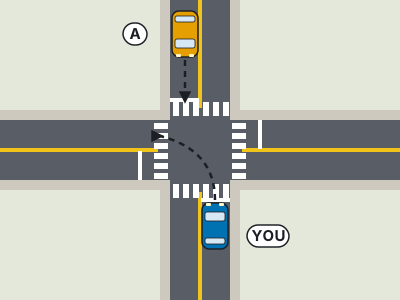
7. Before turning left at an intersection, which traffic must you yield to?
- Vehicles already stopped on a side street behind you
- Only vehicles approaching from behind
- No traffic, because the turn signal grants priority
- Oncoming traffic close enough to create a hazard
Show answer
Oncoming traffic close enough to create a hazard. A left turn crosses the path of opposing traffic, so the turning driver must yield to oncoming vehicles that are close enough to be a hazard. Signaling communicates an intention but does not grant the right-of-way. Traffic behind you is not the principal conflict described by this rule, and stopped vehicles on a side street do not cancel the duty to check the opposing lane. Wait for a safe opening, keep pedestrians in view, and complete the turn without forcing an approaching driver to brake or swerve. The practical cue is the distance and speed of the oncoming vehicle.
Study this in the handbook: Right of way and roundabouts
8. What does a green arrow above a reversible lane permit?
- Using that lane in the direction controlled by the arrow
- Entering the lane only to park temporarily
- Driving against the displayed direction until the next exit
- Crossing the lane without checking for other traffic
Show answer
Using that lane in the direction controlled by the arrow. Lane control signals assign a direction to a lane that may change use during the day. A green arrow tells you that the lane is available for travel in its displayed direction. The parking choice misunderstands a moving traffic lane, while driving against the arrow defeats the purpose of the signal. A green arrow also does not erase ordinary duties such as checking traffic before moving across a line. Read the signal directly above your lane, then follow only the direction it controls. A red X means that lane must not be used.
Study this in the handbook: Traffic signals and lane control signals
9. What do warning traffic control devices tell a driver?
- That a federal facility is nearby
- That a hazardous condition or possible hazard may be present
- That a mandatory speed penalty has ended
- That the driver has permission to ignore lane markings
Show answer
That a hazardous condition or possible hazard may be present. Warning devices communicate risk rather than issuing the direct commands associated with regulatory devices or the route information supplied by guide signs. They can alert a driver to a hazardous condition or the possibility of one, so the response should include attention and appropriate caution. A nearby federal facility, a finished penalty, or permission to disregard markings is not what this category means. When a warning sign appears, scan farther ahead, adjust speed if needed, and prepare for the condition described.
Study this in the handbook: Pavement markings
10. What does a turn signal communicate to other highway users?
- The driver's intention, but not a right to make the movement
- An automatic right-of-way over all nearby traffic
- That other drivers must stop immediately
- That the maneuver is safe without a check
Show answer
The driver's intention, but not a right to make the movement. A turn signal communicates an intended movement, but it does not give the driver the right to make that movement. The driver remains responsible for checking traffic and completing the turn or lane change safely without interfering with others. The automatic priority choice turns a warning into a privilege that Hawaii's rule does not grant. Other drivers are not required to stop immediately, and a signal never replaces a safety check. Signal in advance, observe the surrounding traffic, and proceed only after the space and path are clear.
Study this in the handbook: Turn signals and railroad crossings
11. What does the color yellow usually indicate on a traffic sign?
- A route or location guide
- A required stop at every intersection
- A warning of hazardous or dangerous conditions
- A prohibition against every action
Show answer
A warning of hazardous or dangerous conditions. Yellow is the manual's warning color for hazardous or dangerous conditions, and it almost always appears on a diamond-shaped sign. It does not automatically require a full stop, identify a route, or prohibit every action. A driver seeing yellow should look for the hazard described by the sign and adjust speed or position before reaching it. The color is an early attention cue, while the symbol or wording supplies the particular warning.
Study this in the handbook: Sign colors, shapes and regulatory signs
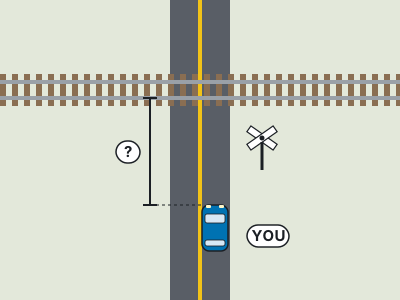
12. When a railroad crossing requires a stop, how far from the nearest rail must you stop?
- Not less than 30 feet
- Exactly 5 feet
- Not less than 15 feet
- With the front tires on the nearest rail
Show answer
Not less than 15 feet. A required railroad crossing stop must be made not less than 15 feet from the nearest rail. The rule applies when a crossing signal warns of an approaching train, a gate is lowered, a flagman gives a warning, or the train is close enough to be a hazard. Five feet is too close for a safe buffer, while 30 feet adds a distance the manual does not specify. Stopping on the rail places the vehicle directly in the train's path. The cue is to identify the nearest rail first, then stop with the full vehicle behind the 15 foot minimum.
Study this in the handbook: Turn signals and railroad crossings
13. What is the age cutoff in Hawaii's law against leaving a child unattended in a motor vehicle for five minutes or longer?
- It covers only children under six
- It covers only children under four
- It covers children under twelve
- It covers children under nine years of age
Show answer
It covers children under nine years of age. Hawaii law prohibits the driver or any adult passenger from leaving a child under nine years of age unattended in a motor vehicle for five minutes or longer. Limiting the rule to children under six or under four is too narrow, because the law reaches every child under nine. Twelve is above the stated age. Unattended children face heat exposure and injury, including when the car is stolen or when the emergency brake, power windows or trunk release are used by accident.
Study this in the handbook: Seat belts and children
14. Until when can an expired Hawaii license still be renewed, instead of applying as if for an original license?
- Within 90 days after the expiration date
- Within 30 days after the expiration date
- Within five years after the expiration date
- Within a year after the expiration date
Show answer
Within a year after the expiration date. Hawaii allows an expired license to be renewed within a year after the expiration date. After that renewal period, the driver must follow the procedure for an original license. Ninety days and 30 days are shorter than the stated period, and five years is much longer. Remember that this is only a renewal window; the license is void and cannot be used for driving once it expires.
Study this in the handbook: Documents, tests and renewal
15. Your Hawaii driver's license expired yesterday. May you keep driving while you arrange to renew it?
- No, the license is void after the expiration date and there is no grace period
- Yes, there is a 90 day grace period
- Yes, as long as a licensed driver rides with you
- Yes, but only to and from work
Show answer
No, the license is void after the expiration date and there is no grace period. Every Hawaii driver's license is void after its expiration date, and the manual states plainly that there is no grace period. That rules out a 90 day grace period. Having a licensed driver in the car does not revive an expired license, because that arrangement belongs to instruction permits. There is no work commute exception either. You may still renew within a year after expiration, but you may not drive until you do.
Study this in the handbook: Documents, tests and renewal
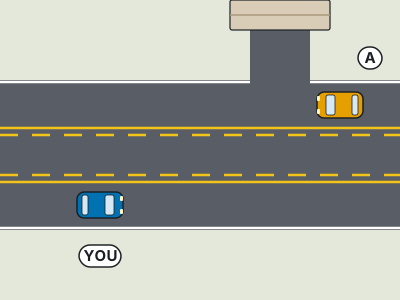
16. What is a two-way left-turn channelization lane used for?
- Driving straight through when the regular lane is crowded
- Passing slower traffic in either direction
- Left-turn maneuvers only
- Parking while waiting for a gap
Show answer
Left-turn maneuvers only. The center lane formed by a yellow solid line and a dashed line may be used by traffic from either direction for left turn maneuvers only. The manual says the lane must never be used for passing, and it is not a shortcut for straight travel or a place to park. Enter it when preparing for a lawful left turn, stay alert for vehicles from the opposite direction that may be using the same lane, and leave it for the intended turn. The paired solid and dashed yellow lines are the cue that this center lane has a single purpose.
Study this in the handbook: Pedestrian safety
17. Up to what speed can a belted occupant survive a crash, according to the Hawaii manual?
- Up to 60 miles per hour with lap and shoulder belts
- Up to 20 mph
- Up to 100 mph
- Belts make no difference
Show answer
Up to 60 miles per hour with lap and shoulder belts. You can survive a crash at speeds up to 60 miles per hour if using lap and shoulder belts, while an unbelted person can be killed at speeds as low as 12 mph. Belts keep you from being thrown from the car, where the chance of death is many times greater, and from striking the windshield and interior. In a crash the car stops in a tenth of a second and an unbelted body in a hundredth.
Study this in the handbook: Seat belts and children
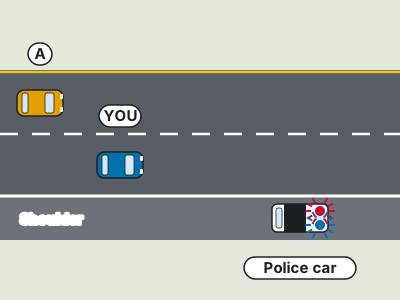
18. What should you do when approaching a stopped emergency vehicle with its lights flashing?
- Keep the same speed because the vehicle is stationary
- Slow down or stop as appropriate and create a separating lane if safe
- Pass on the shoulder without reducing speed
- Stop directly beside it and block the next lane
Show answer
Slow down or stop as appropriate and create a separating lane if safe. A stopped emergency vehicle with flashing lights remains a roadside hazard and needs a protected space. Slow or stop as conditions require, then move away so an empty lane separates your vehicle from the emergency vehicle whenever that movement is possible and safe. Speeding past, using the shoulder carelessly, or stopping beside the vehicle leaves responders exposed and may create another collision. Scan early so the lane change is gradual rather than abrupt.
Study this in the handbook: Emergency vehicles
19. What must a driver do before passing a school bus whose flashing lights are operating?
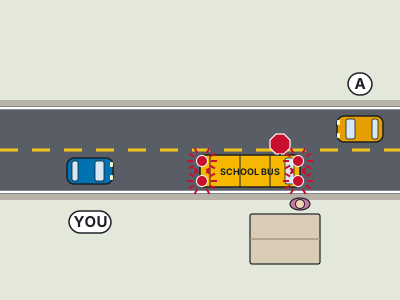
- Pass if the driver cannot see children
- Move onto the shoulder and pass slowly
- Wait, because passing the bus on the same roadway is prohibited
- Pass after sounding the horn twice
Show answer
Wait, because passing the bus on the same roadway is prohibited. The Hawaii manual lists an operating school bus warning system among the no-passing conditions. A driver must wait rather than use the shoulder, rely on a horn, or judge the rule by the absence of visible children. Moving onto the shoulder is still passing the bus, so it does not escape the prohibition. Treat the flashing lamps as the controlling cue, hold your position behind the bus, and continue only after the bus warning has ended and the roadway is safe.
Study this in the handbook: Driving on the right and passing laws
20. What should a driver do after seeing a yellow diamond warning sign?

- Ignore the sign unless a police officer is present
- Treat the sign as permission to keep the same speed
- Stop in the lane regardless of traffic
- Prepare to take safe and proper action
Show answer
Prepare to take safe and proper action. Hawaii says warning signs identify dangers on or near the road and that drivers should be prepared to take safe and proper action. That means reading the symbol, checking the roadway, and adjusting speed or position as the hazard requires. The sign does not guarantee that the current speed is safe, and it does not demand an automatic stop in every circumstance. Waiting for an officer or ignoring the sign removes the driver's responsibility. A yellow diamond is a cue to look ahead early and make a controlled response before reaching the condition.
Study this in the handbook: Traffic device types, warning, guide and work zone signs
QualitySpace is expanding to Hawaii
We are a California-based independent insurance brokerage working on licensing in more states. We cannot help with Hawaii insurance yet. Leave your email and we will let you know when we can.
Every question is written from the official Hawaii Driver's Manual. Need paper? Printable HI practice test with answer key.
Last verified 2026-10-05. How we check every question · Study all 216 as flashcards
Frequently asked questions
How many questions are on this Hawaii practice test?
This fixed set has 20 questions. It is test 2 of 10 from the 216 question Hawaii bank. The real HI exam asks 30 questions and you need 24 correct.
What is the passing score for the real Hawaii test?
No more than 6 errors on the 30-question written examination, i.e. 24 of 30 correct (published by Maui County; Honolulu does not publish a passing score) That figure comes from the official Hawaii source cited on the DMV facts page.
How does this fixed test relate to the full Hawaii bank?
Each numbered test is a fixed set of questions in a fixed order, so you can retake the same test later and compare. Every test mixes road signs and the other topics in about the same proportion as the full bank. Tests 1 to 10 together cover 200 of the 216 questions in the Hawaii bank, each once. The full practice page mixes the whole bank at random.
Last verified 2026-10-05. See the Hawaii DMV facts page for sourced state details.