
Test 6 of 10 · 20 questions · Free 2026
HI Permit Practice Test 6
Jump to the test ↓A fixed 20 question set from the Hawaii bank with answers and plain English explanations. The real HI exam is 30 questions, 80 percent to pass; take the full length version on the main practice page.
Question 1 of 20 · 0 right so far
All 20 questions in test 6
Every question below comes from the Hawaii question bank on this page. Open a question to see the correct answer and the explanation. Nothing here is hidden behind a signup.
1. A person with a white cane or a guide dog is in the roadway ahead. When must you stop?
- Always, regardless of the traffic signal or traffic situation
- Only when your signal is red
- Only when the person is in a marked crosswalk
- Only if the person raises the cane toward traffic
Show answer
Always, regardless of the traffic signal or traffic situation. Hawaii drivers must stop for all blind persons in the roadway, identified by a white cane or a guide dog, regardless of the traffic signal indication or traffic situation. A green light for you does not remove the duty, so the red signal choice is wrong. The rule is not limited to marked crosswalks. No special gesture with the cane is required before you stop.
Study this in the handbook: Pedestrian safety
2. You are driving in fog. If you cannot see at least how far ahead should you pull completely off the pavement and stop?
- One car length, about 20 feet
- 100 feet
- 500 feet
- Two car lengths, about 40 feet
Show answer
Two car lengths, about 40 feet. The manual says that if you are unable to see at least two car lengths, 40 feet, in fog you should pull completely off the pavement, stop, and turn on the hazard warning signals. One car length is less visibility than the stated trigger. One hundred and 500 feet are not the figures used. Before reaching that point, sharply reduce speed and use low beam headlamps rather than high beams.
Study this in the handbook: Rain, fog and night driving
3. When you stop in traffic behind another vehicle, how far back does the Hawaii manual say you should stop?
- Close enough to its bumper that no one can cut in
- Far enough back to see where its rear tires rest on the road
- Exactly one car length, regardless of the situation
- As close as possible to save space in the lane
Show answer
Far enough back to see where its rear tires rest on the road. The Hawaii manual says that when stopping in traffic, you should stop far enough behind the vehicle ahead so that you can see the point where its rear tires rest on the road. That space allows room to go around the vehicle should it not be able to proceed, for example if it stalls. Creeping up to the bumper to block others or to save space removes that escape room, and a fixed car length is not the measure the manual gives. Use the visible tires as your check every time you stop in a line.
4. What does the color red indicate on a Hawaii traffic sign?
- A required action is shown on a rectangular sign
- A route or service is identified
- A hazardous condition is warned of
- An action is prohibited
Show answer
An action is prohibited. On Hawaii traffic signs, red indicates that an action is prohibited. The color may appear on signs of various shapes, so the rule is about the meaning of red rather than one particular outline. Green, blue, and brown are used on guide and information signs, black and white show a required action, yellow warns of hazardous conditions, and orange concerns road work. When red appears, read the words or symbol to learn which movement or activity is barred, because the color itself tells you the message is a prohibition rather than a warning or a direction.
Study this in the handbook: Sign colors, shapes and regulatory signs
5. What hazard does this yellow pedestrian symbol warn the driver to expect?

- A pedestrian crossing
- A zone where pedestrians are forbidden
- A sidewalk repair area only
- A lane reserved for bicycles
Show answer
A pedestrian crossing. The pedestrian symbol warns that a pedestrian crossing is ahead. It does not ban pedestrians, limit the message to sidewalk repairs, or identify a bicycle lane. Hawaii’s warning-sign guidance calls for safe and proper action when a hazard may be present, and the driver must be especially ready to see people entering from either side. Slow before the crossing, scan the full roadway, and yield when a pedestrian is crossing. The walking figure is the cue to search for people, not merely pavement markings.
Study this in the handbook: Pedestrian safety
6. Where may a Hawaii driver go in person to renew a driver's license?
- Only to the county office that first issued the license
- At any driver licensing office in Hawaii
- Only to the State Motor Vehicle Safety Office
- Only to a police station in the driver's home county
Show answer
At any driver licensing office in Hawaii. Hawaii lets a driver renew at any driver licensing office in the state, so the renewal is not tied to the county office that first issued the card. The State Motor Vehicle Safety Office handles program coordination rather than serving as the only renewal counter, and a police station is not a licensing office. Plan the visit around the renewal window: a license can be renewed within six months before it expires, and a vision test must be passed before the renewal is completed.
Study this in the handbook: Documents, tests and renewal
7. What does Hawaii prohibit when a person drives a motor vehicle under the influence of intoxicants?
- Renewing a license without an appointment
- Driving only on rural roads after dark
- Driving a motor vehicle while under the influence
- Operating a moped with a class 1 license
Show answer
Driving a motor vehicle while under the influence. Hawaii prohibits driving a motor vehicle while under the influence of intoxicants. The rule addresses the driver's condition, not the type of road, the time of day, or the licensing appointment process. A class 1 license concerns moped operation and does not create an exception to the intoxicant rule. Keep the wording tied to the act of driving, because the prohibition applies before a crash or other dangerous result occurs. A useful study cue is that impairment itself is the trigger, so do not wait for unsafe weaving or a collision before recognizing the violation.
Study this in the handbook: Alcohol, drugs and the law
8. What does the crossed right-turn arrow prohibit?
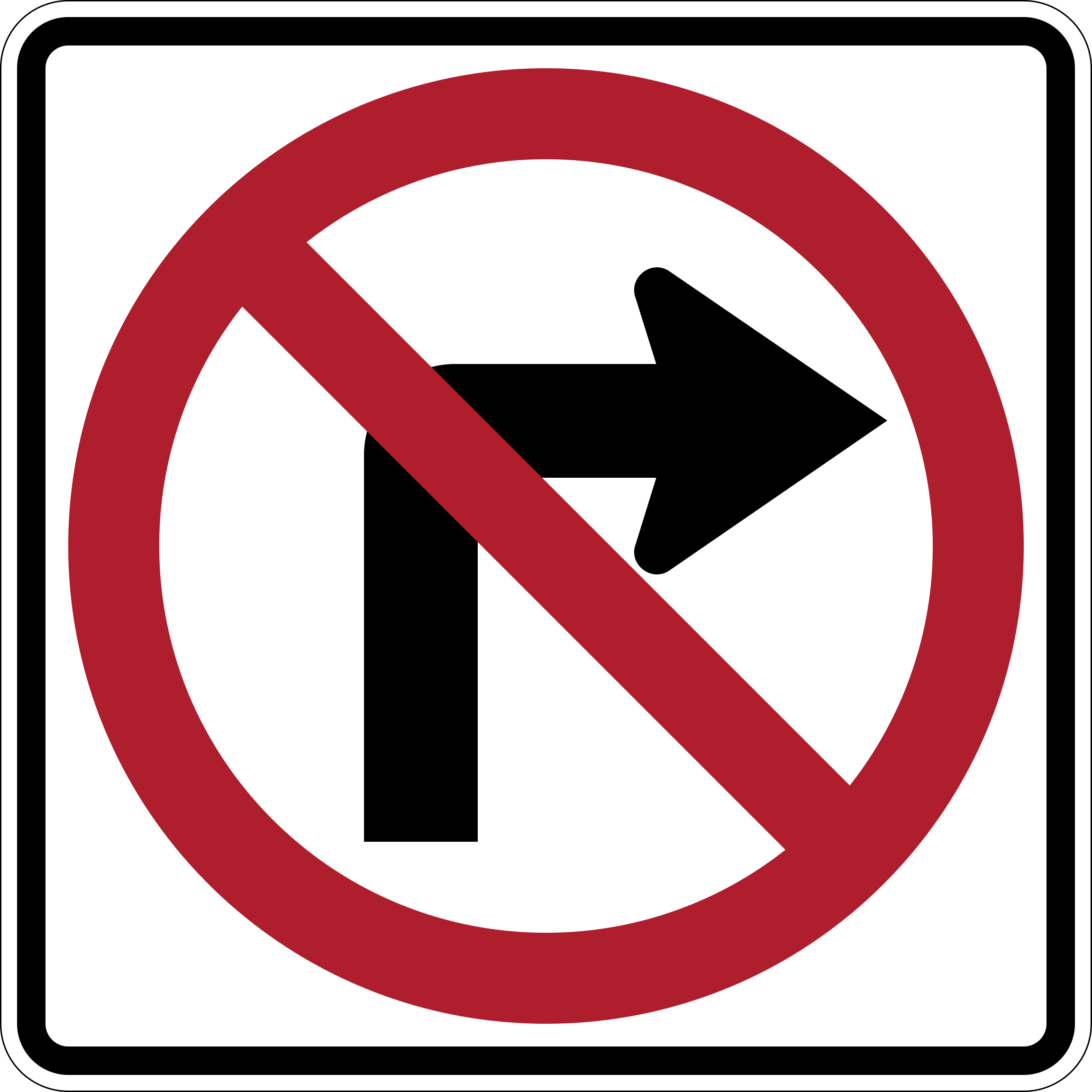
- Turning right at the signed location
- Driving straight through the intersection
- Parking on the right side of the street
- Turning left from a separate permitted lane
Show answer
Turning right at the signed location. The crossed right-turn arrow prohibits the right turn shown by the symbol. It does not prohibit straight travel, ordinary parking on the right, or a left turn that has its own permission and safe path. The red marking is the important visual cue because Hawaii uses red to show that an action is prohibited. Slow early enough to choose another route, and do not turn simply because no vehicle is approaching. The restriction applies at the signed location even when the maneuver seems convenient.
Study this in the handbook: Traffic device types, warning, guide and work zone signs
9. Where does Hawaii require reduced speed limits according to the manual?
- On every road after sunset
- Only on rural highways
- Only in parking lots
- On streets near schools and playgrounds
Show answer
On streets near schools and playgrounds. The manual identifies streets near schools and playgrounds as places where reduced speed limits are required. The rule is location based, not limited to rural highways, parking lots, or nighttime driving. Sunset alone does not activate this particular requirement. The strongest cue is the surrounding land use: when children may be entering, crossing, or playing near the roadway, expect a reduced posting and prepare to slow before reaching the activity area.
Study this in the handbook: Speed rules
10. Why should a driver avoid talking on a cell phone while driving, even with hands-free equipment?
- The phone always disables the headlights
- Hands-free equipment blocks the brake pedal
- The conversation diverts attention from driving
- A call makes every road surface slippery
Show answer
The conversation diverts attention from driving. The manual describes cell phone conversation as distracting because attention is directed toward the conversation instead of driving. It says hands-free equipment does not remove that mental distraction and can make a driver less likely to notice a dangerous situation. The brake pedal and headlights are unrelated mechanical claims, and a call does not change the road surface. If a call is necessary, pull to the side of the road in a safe place and remain stopped until finished. The practical cue is attention: if the conversation competes with scanning traffic, stop before continuing it.
Study this in the handbook: Attitude, age and distraction
11. When a tire blows out while you are driving, what should you do first?
- Apply the brakes firmly to stop as quickly as possible
- Accelerate to restore tire stability
- Turn sharply toward the nearest shoulder
- Grip the steering wheel and keep the vehicle in its lane
Show answer
Grip the steering wheel and keep the vehicle in its lane. A blowout can pull the vehicle sharply, so the first priority is steady control of the steering wheel and lane. Firm braking can make the vehicle uncontrollable, and a sudden shoulder turn can create a second loss of control. Acceleration does not repair the failed tire or reduce the danger. Hold the wheel firmly, ease the vehicle down gradually, and wait until it is moving very slowly before braking lightly and leaving the roadway. The practical cue is to stabilize direction before trying to stop.
Study this in the handbook: Blowouts, brake failure, skids and fires
12. After stopping at a red light, when may a driver turn right in Hawaii?
- When no sign prohibits it and the driver yields to pedestrians and vehicles
- Automatically, without checking traffic
- Only after a green arrow appears
- Only if the turn is made from a one-way street
Show answer
When no sign prohibits it and the driver yields to pedestrians and vehicles. Hawaii allows a right turn after a red-light stop unless a sign prohibits the movement, but the turning driver must yield to all pedestrians and vehicles. The maneuver is not automatic, and a green arrow is not required for this general permission. The one-way-street condition belongs to the separate left-on-red exception. Stop first, inspect the crosswalk and conflicting traffic, and turn only after those road users have been given priority.
Study this in the handbook: Traffic signals and lane control signals
13. What will sober up a person after alcohol has entered the blood?
- Only time, as the liver burns up the alcohol
- Drinking black coffee
- Taking a cold shower
- Eating a large meal
Show answer
Only time, as the liver burns up the alcohol. Once alcohol enters your blood there is nothing you can do to lessen its effect. Black coffee, food or a cold shower might wake you up, but they will not sober you up. The liver burns up the alcohol and the body eliminates it through the kidneys and lungs, and that process takes time. Eating before drinking can slow how fast alcohol affects you, but a meal afterward does not undo it.
Study this in the handbook: Alcohol, drugs and the law
14. According to the Hawaii manual, what is the most a fine can be for each violation of the motor vehicle insurance law?
- $500
- $1,000
- $5,000
- $10,000
Show answer
$5,000. Each violation of Hawaii's motor vehicle insurance law is a separate offense subject to a fine not to exceed $5,000 or thirty days imprisonment, license suspension, forfeiture of the registration certificate, or any combination of these. Five hundred dollars and $1,000 are below the stated maximum, and $1,000 is the figure the manual gives for the school bus law. Ten thousand dollars is above the maximum and is the per person amount of basic personal injury protection benefits.
Study this in the handbook: Crashes, reports and insurance
15. For a Hawaii instruction permit holder, where must the supervising licensed driver sit in a passenger vehicle?
- Outside the vehicle at the curb
- In the rear seat behind the learner
- In any seat, provided the supervisor can see the road
- In the right front seat
Show answer
In the right front seat. For vehicles except motorcycles, Hawaii places the qualified supervising driver in the right front seat. That location lets the supervisor observe the learner and respond during practice. Sitting behind the learner does not meet the stated placement, and visibility from another seat cannot substitute for the required position. A person standing outside the car is not supervising the operation from within the vehicle. Before practice begins, confirm the supervisor’s age, license class, and seat location together, because satisfying only one of those conditions is not enough.
Study this in the handbook: The instruction permit
16. For Hawaii auto policies issued or renewed on or after January 1, 2026, what minimum liability limits apply?
- $25,000, $50,000 and $25,000
- $40,000 per person, $80,000 per accident for bodily injury, and $20,000 property damage, plus $10,000 PIP
- $100,000 combined
- $5,000 per person
Show answer
$40,000 per person, $80,000 per accident for bodily injury, and $20,000 property damage, plus $10,000 PIP. For new and renewed Hawaii policies effective on or after January 1, 2026, minimum liability limits are $40,000 per person and $80,000 per accident for bodily injury, and $20,000 for property damage. Personal injury protection remains at least $10,000. Liability coverage pays for harm to others; coverage for damage to your own vehicle is separate. Keep the per-person, per-accident, and property-damage categories separate when checking the policy, because the limits apply to different kinds of loss.
17. When the first drops of rain make the road slick, what following distance should a driver allow?
- At least twice the normal following distance
- Exactly the normal following distance
- Half the normal following distance
- No following distance if headlights are on
Show answer
At least twice the normal following distance. The first rain can leave oil and water on the pavement, making the surface especially slippery. The manual pairs reduced speed and extra caution with at least twice the normal following distance. Keeping the ordinary gap does not account for the changed stopping conditions, and shortening it makes a sudden stop more dangerous. Headlights improve visibility to others but do not restore tire grip. When rain begins, lift off the pace, enlarge the gap, and expect the road to be slick before it looks flooded.
Study this in the handbook: Rain, fog and night driving
18. Why should a driver avoid entering an intersection during a yellow light?
- Yellow means cross traffic has already stopped forever
- The signal is about to change to red
- The vehicle loses steering control at every yellow light
- Yellow authorizes only left turns
Show answer
The signal is about to change to red. The practical reason for caution is the timing of the signal: yellow is followed immediately by red. Entering late can leave the vehicle in conflict with traffic receiving the next indication, so the approach should be judged early and stopped safely when possible. The other choices add claims the signal does not make. Watch the stop line and intersection space, and do not treat a brief yellow display as special permission for a particular turn.
Study this in the handbook: Traffic signals and lane control signals
19. How often must an ordinary passenger vehicle driven on Hawaii public highways pass a Periodic Motor Vehicle Inspection?
- Every six months
- At least once a year
- Every two years
- Only when the vehicle is sold
Show answer
At least once a year. Hawaii requires an official Periodic Motor Vehicle Inspection, also called a safety inspection, at least once a year for motor vehicles on public highways. Every six months is the schedule for ambulances, not ordinary cars. Two years is the gap allowed only for a new vehicle after its initial inspection when first sold. Inspection is not tied to selling the car, and a current certificate is needed before a vehicle can be registered.
Study this in the handbook: Vehicle equipment, inspection and registration
20. You meet an oncoming vehicle on a narrow Hawaii road. How much of the main traveled portion must you allow it?
- At least one quarter
- Whatever space is left after your own lane
- At least one half
- None, because the first vehicle to arrive has priority
Show answer
At least one half. On narrow roads you must allow vehicles going in the opposite direction at least one half of the main traveled portion of the road. One quarter is less than the rule requires. Taking what you want and leaving the rest ignores the stated share. Arriving first does not give priority on a narrow road; both drivers must share it and pass each other on the right.
Study this in the handbook: Driving on the right and passing laws
QualitySpace is expanding to Hawaii
We are a California-based independent insurance brokerage working on licensing in more states. We cannot help with Hawaii insurance yet. Leave your email and we will let you know when we can.
Every question is written from the official Hawaii Driver's Manual. Need paper? Printable HI practice test with answer key.
Last verified 2026-10-05. How we check every question · Study all 216 as flashcards
Frequently asked questions
How many questions are on this Hawaii practice test?
This fixed set has 20 questions. It is test 6 of 10 from the 216 question Hawaii bank. The real HI exam asks 30 questions and you need 24 correct.
What is the passing score for the real Hawaii test?
No more than 6 errors on the 30-question written examination, i.e. 24 of 30 correct (published by Maui County; Honolulu does not publish a passing score) That figure comes from the official Hawaii source cited on the DMV facts page.
How does this fixed test relate to the full Hawaii bank?
Each numbered test is a fixed set of questions in a fixed order, so you can retake the same test later and compare. Every test mixes road signs and the other topics in about the same proportion as the full bank. Tests 1 to 10 together cover 200 of the 216 questions in the Hawaii bank, each once. The full practice page mixes the whole bank at random.
Last verified 2026-10-05. See the Hawaii DMV facts page for sourced state details.