
Test 12 of 25 · 20 questions · Free 2026
HI Permit Practice Test 12
Jump to the test ↓A fixed 20 question set from the Hawaii bank with answers and plain English explanations. The real HI exam is 30 questions, 80 percent to pass; take the full length version on the main practice page.
Question 1 of 20 · 0 right so far
All 20 questions in test 12
Every question below comes from the Hawaii question bank on this page. Open a question to see the correct answer and the explanation. Nothing here is hidden behind a signup.
1. You see the orange triangle on a slow-moving vehicle ahead. What should you do?
- Pass before the vehicle reaches a curve
- Flash your lights and wait for a signal
- Keep your speed and sound your horn
- Reduce speed and approach with caution
Show answer
Reduce speed and approach with caution. The manual says to reduce speed and approach cautiously when you see the emblem. The vehicle may be wide, may turn into a field or driveway without much warning, and may not have brake lights or turn signals that a car driver expects. A quick pass before a curve is especially risky because you cannot see what is coming. Drop your speed first, confirm the passing zone and the oncoming lane, then go around with room to spare.
Study this in the handbook: Driving on the right and passing laws
2. What standard governs steering wheel condition in Hawaii vehicle equipment checks?
- It may shimmy slightly at highway speed without any repair being needed
- It should turn smoothly from full right to full left and back
- It needs power assistance fitted and working at all times to pass
- It may pull gently to one side on level roads and still be acceptable
Show answer
It should turn smoothly from full right to full left and back. Sound steering in Hawaii turns smoothly and easily from the maximum right position to the maximum left position and back again. A shimmy signals worn parts rather than acceptable character. Pulling to one side points to alignment or tire trouble that needs repair. Power assistance is not the test; plenty of sound systems steer without it, and assisted systems must still sweep cleanly. During a pre drive check, turn lock to lock while parked. Any grind, catch or shake earns a mechanic visit before highway driving.
Study this in the handbook: Vehicle equipment, inspection and registration
3. Where does the manual tell drivers to be especially watchful for children?
- Only on freeways and divided highways
- Only in parking lots and loading zones
- Near bridges, tunnels, and freeway ramps
- Near schools, parks, playgrounds, and homes
Show answer
Near schools, parks, playgrounds, and homes. Drivers should be especially watchful for children near schools, parks, playgrounds and in residential areas, and stop upon the signal of any school crossing guard. Children in those places cross between parked cars, chase objects into the street, and judge gaps poorly compared with adults. Freeways and divided highways are closed to pedestrians, parking lots and loading zones call for care but are not the places named, and bridges, tunnels and ramps carry fast traffic where children are not expected on foot. Slow down where children gather and be ready to stop.
Study this in the handbook: Pedestrian safety
4. What program must a Hawaii class 3 applicant under age 18 complete?
- A graduated licensing program
- A commercial driver training program
- A motorcycle off-street skills program
- A second vision screening program
Show answer
A graduated licensing program. The Hawaii licensing chapter says an applicant under age 18 must complete a graduated licensing program. That requirement is tied to the class 3 path and is separate from commercial training, motorcycle skills testing, or another vision screening. The graduated licensing program is the program the manual requires. The other choices belong to different license activities or add a test not stated in this passage. The age condition matters: the manual describes the graduated program for the under-18 applicant rather than presenting it as the same requirement for every class 3 driver.
Study this in the handbook: The provisional license
5. Why does the manual say a very slow pace is acceptable after a blowout?
- Because the punctured tire reseals as it cools down
- Because steering improves with speed
- The rim escapes damage at very slow speed
- Because the suspension absorbs the flat
Show answer
The rim escapes damage at very slow speed. After a blowout you reduce speed gradually without the brakes, and the manual notes you can drive for some distance with a blown-out tire at a very slow speed without causing damage to the wheel rim. That is why the gentle final phase works: at crawling speed the rim can carry the car briefly to a safe pull-off. The tire does not reseal, steering does not improve with speed on a flat, and the suspension is not the reason. Crawl, pull off, then deal with the wheel.
Study this in the handbook: Blowouts, brake failure, skids and fires
6. What does the manual say about stopping on a Hawaii freeway?
- Stop in the right lane whenever you feel tired
- Never stop unless it is absolutely unavoidable
- Stop every two hours to rest
- Stop on the median to check a map
Show answer
Never stop unless it is absolutely unavoidable. The manual's freeway rules include never stopping on the freeway unless it is absolutely unavoidable. A stopped car in a high-speed lane is a rear-end hazard, and the manual adds that you should not slow down unnecessarily for the same reason. Fatigue stops belong at a rest area or off the freeway, scheduled breaks belong off the roadway, and the median is no place to pause for directions. If a stop becomes unavoidable, get entirely off the roadway as far from traffic as you can.
Study this in the handbook: Following distance, turns and freeways
7. May you park within an intersection in Hawaii if you stay in the car?
- Yes, as long as you stay behind the wheel with the engine running the whole time
- Yes, if no other car is waiting to turn through the intersection
- Yes, for up to five minutes while you load or unload passengers
- No, you may not park within or so close to it that you interfere with traffic
Show answer
No, you may not park within or so close to it that you interfere with traffic. Hawaii bars parking within or so close to an intersection that your vehicle interferes with traffic. There is no fixed number of feet in this rule; the question is whether the car narrows the turning path or blocks the view across the corner. Staying in the driver's seat, leaving the engine on or choosing a quiet moment does not make the position legal. Leave the corners clear so turning drivers can see and stay in their lane.
Study this in the handbook: Speed rules
8. A Hawaii driver refuses a requested alcohol test. What can the refusal do to the driver's license?
- Nothing, unless the driver is convicted of DUI
- Suspend it for 30 days in every case, with no hearing
- Revoke it for one, two, or four years based on priors
- Revoke it only if the driver is under 21
Show answer
Revoke it for one, two, or four years based on priors. Refusing a test can lead to revocation for one year, two years or four years, depending on the driver's prior alcohol enforcement contacts. The refusal is handled through the administrative process, so a criminal conviction is not required for the license action. A 30-day permit is the temporary document described for a test at .08 or higher or a refusal, not the length of the revocation. The number of prior contacts is the fact that sets the term, so do not assume a first refusal means a fixed one-year loss.
Study this in the handbook: Alcohol, drugs and the law
9. When can a small amount of alcohol affect a driver more rapidly?
- After the driver has eaten a full meal
- After the driver has drunk water first
- When the driver's stomach is empty
- After the driver waits an hour to eat
Show answer
When the driver's stomach is empty. A small amount of alcohol affects a person more rapidly on an empty stomach than after a meal. Food slows the rate at which alcohol reaches the blood, but it does not make drinking safe or remove the alcohol's effects. A full meal reverses the comparison in the manual. Water and waiting to eat do not provide the meal condition the passage identifies. The important contrast is whether food was recently eaten, not the beverage used to chase the drink or the amount of time before the next meal. Empty stomach means faster effect in this rule.
Study this in the handbook: Alcohol, drugs and the law
10. How does the Hawaii manual classify a bicycle using the roadway?
- A vehicle with the same rights and duties as other vehicles
- A toy that belongs on a sidewalk
- A pedestrian that must yield to cars
- A slow vehicle that must pull over for traffic
Show answer
A vehicle with the same rights and duties as other vehicles. Bicycles are legally vehicles, and riders have the same rights and responsibilities as other drivers. That means a bicycle can use the travel lane where it must, must obey signals and signs, and is entitled to the space a vehicle needs. Calling it a toy or a pedestrian misreads the law and invites unsafe passes. A slow-moving bicycle should still be given room; it is not required to leave the road at every corner. Pass with at least three feet and expect the rider to move around obstacles.
Study this in the handbook: Trucks, motorcycles, bicycles and school buses
11. What does the manual expect from a properly working set of windshield wipers?
- They clean the windshield evenly, without leaving streaks
- They polish the glass to a mirror shine
- They sweep only the driver's side of the glass
- They run only on the high speed setting
Show answer
They clean the windshield evenly, without leaving streaks. The windshield wipers should clean the windshield evenly, without leaving streaks. Streaking means worn or damaged blades, and a smeared windshield in rain or glare can hide a pedestrian until it is too late. Polishing to a shine, one-sided sweeps and a high-speed-only mechanism are not the standard the manual sets. Check the blades when you check the washer reservoir, and replace them at the first sign of streaking, skipping or cracking.
Study this in the handbook: Vehicle equipment, inspection and registration
12. What does a red circle with a diagonal slash on a traffic sign mean?
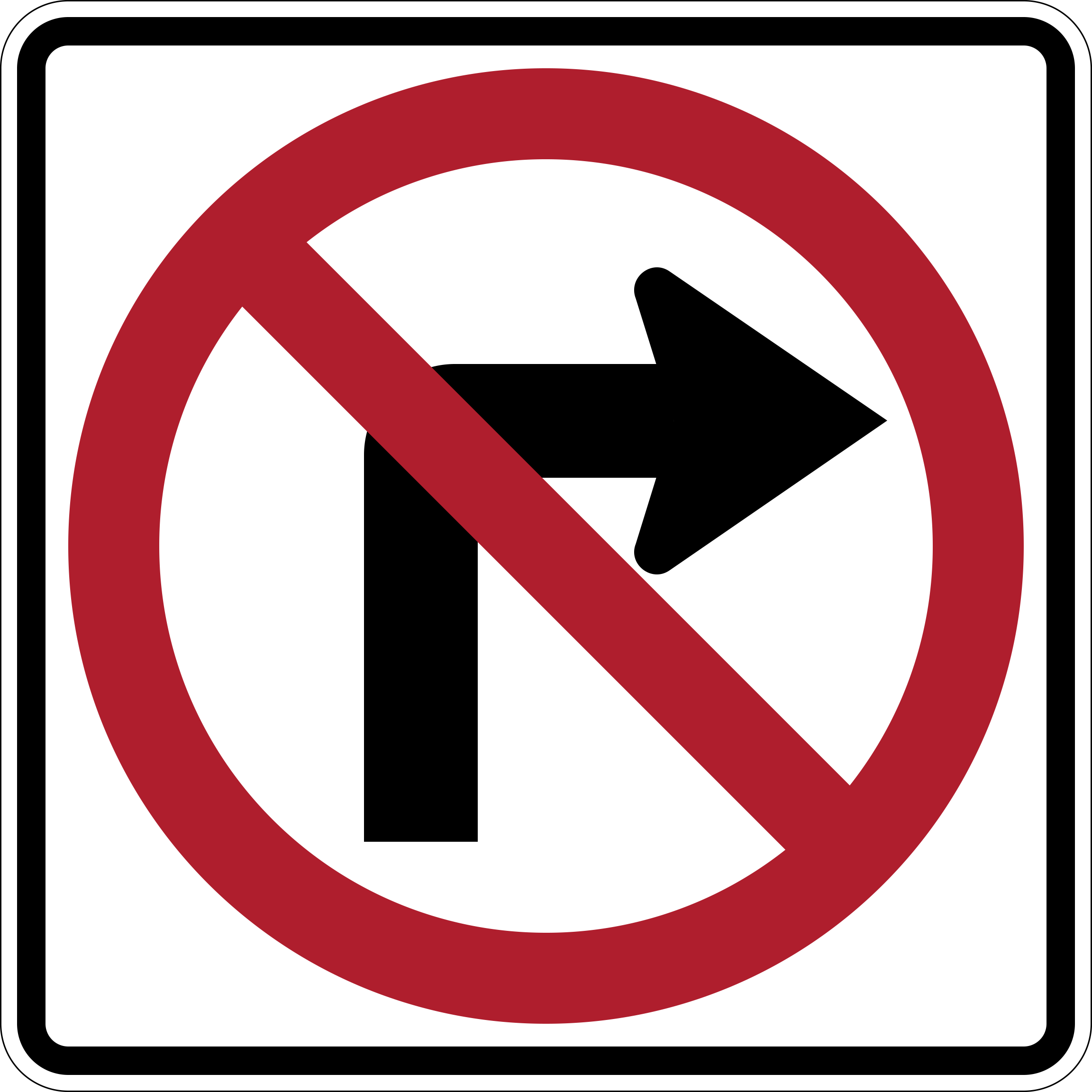
- A hazard may exist, but no action is required
- The pictured movement is recommended in the next lane
- The pictured movement or activity is prohibited
- The sign provides directions to a public facility
Show answer
The pictured movement or activity is prohibited. A red circle, especially one with a diagonal bar, marks an exclusion or prohibition. The symbol inside identifies the movement or activity that is not allowed, such as a prohibited turn. It is not a recommendation, a general hazard warning or a facility guide. Pay attention to both the slash and the underlying symbol, because the symbol tells you exactly what is restricted. Slow down early enough to choose a legal path, and do not treat an empty roadway as permission to ignore the displayed prohibition.
Study this in the handbook: Traffic device types, warning, guide and work zone signs
13. What does the Hawaii manual warn that large fast-moving vehicles generate?
- A steadying pull that keeps smaller cars centered
- A cushion of air that makes passing safer
- A brief loss of grip only when pavement is wet
- Wind gusts strong enough to change a smaller vehicle's direction
Show answer
Wind gusts strong enough to change a smaller vehicle's direction. Large fast-moving vehicles generate wind gusts strong enough to change the direction of smaller vehicles. The air movement can affect a car while it approaches or passes a truck or bus, so the smaller vehicle's driver must be ready for a steering correction. A steadying pull and a cushion of air turn the airflow into protection, but the manual describes a destabilizing force. Limiting the effect to wet pavement is incorrect because the passage does not add that condition. The wind-gust description states the warning directly: a large vehicle's slipstream can move a smaller one.
14. You see red lane marking reflectors in your lane at night. What do they mean?
- You are going the wrong direction in the traffic lane
- The lane is closed for road work ahead
- You are approaching a railroad crossing
- The lane is reserved for emergency vehicles
Show answer
You are going the wrong direction in the traffic lane. Red lane marking reflectors mean you are going the wrong direction in the traffic lane. The reflectors face the driver who has entered against the flow, giving a night warning that headlights alone may not provide in time. A work closure is shown with barricades, drums and arrow panels rather than red lane reflectors. A railroad crossing is marked with a large X and two Rs on the pavement, and emergency use does not turn a lane into a wrong way entry. Stop safely, turn around where it is lawful, and re enter with the flow.
Study this in the handbook: Rain, fog and night driving
15. You are driving in the morning and see school children waiting along the roadway. What should that tell you?
- A crossing guard is on duty at the next corner
- A school bus is in the area, so stay alert
- The children will stay on the sidewalk until noon
- You may pass the waiting group at normal speed
Show answer
A school bus is in the area, so stay alert. School children waiting along the roadway in the morning indicate that a school bus is in the area. Drivers travelling when buses make their runs should be on the alert, because a waiting child may dart in front of traffic without judging speed or distance well. A guard at the next corner does not follow from children waiting at the roadside. No rule keeps the children on the sidewalk until noon, and passing at normal speed without added care ignores the warning the group provides. Slow your approach, scan both sides, and expect sudden movement.
Study this in the handbook: Pedestrian safety
16. On a one-way street with two or more marked lanes, what does the manual allow?
- The manual allows passing on the right.
- The manual allows passing on the shoulder.
- The manual allows passing against traffic.
- The manual allows passing only at intersections.
Show answer
The manual allows passing on the right.. On a one-way street with two or more lanes marked for traffic, Hawaii allows passing to the right of another vehicle. The permission does not move the maneuver onto the shoulder, authorize driving against the posted direction, or create a special intersection rule. Use the marked lane, follow the one-way signs, and make the lane change safely. The study cue is the combination of one-way traffic and at least two marked lanes, which gives a right-side passing lane.
Study this in the handbook: Driving on the right and passing laws
17. What do brake or stop lamps tell other drivers?
- That you intend to turn
- That your high beams are on
- That you are slowing or stopping
- That you are backing up
Show answer
That you are slowing or stopping. Brake or stop lamps warn other drivers that you are slowing or stopping, and the manual says to check these lamps frequently to make sure they operate when the brakes are applied. Turn signals carry the turning message, high beams are a headlamp state, and backup lamps, not brake lamps, announce reversing. A dead brake lamp hides your deceleration from the driver behind, which is how rear-end crashes start. Have someone press the pedal while you walk behind the car and confirm both lamps light.
18. The passing car beside you appears to be slowing to duck back in behind you. What does the manual say to do?
- Hold your speed exactly where it is right now
- Accelerate to let the passer return behind you
- Slow down further to be courteous to the passer
- Honk until the driver speeds up again
Show answer
Accelerate to let the passer return behind you. If the passing vehicle appears to be slowing in an attempt to return to the lane behind your vehicle, the manual says to accelerate your vehicle to allow the passing vehicle to return to the lane in back of you. It also warns, in either case, to be certain of the other driver's intentions before you change speed. Holding speed closes the gap the passer needs, slowing further traps the car beside oncoming traffic, and honking does not solve the geometry. A brief acceleration opens the door behind you.
Study this in the handbook: Blowouts, brake failure, skids and fires
19. You doubt you can comfortably cope with the conditions ahead on a planned drive. What does the manual say?
- Drive slowly and see how conditions develop
- Postpone or cancel the trip
- Wait for darkness to reduce traffic
- Take a faster route to shorten exposure
Show answer
Postpone or cancel the trip. The route plan should consider traffic, road, weather and light conditions and allow sufficient time, and the manual's closing rule is that if you are doubtful whether you can comfortably cope with any undesirable conditions, postpone or cancel the trip. Driving slowly into conditions you already distrust, waiting for darkness or racing a shorter route all accept a risk the manual tells you to decline. The trip is optional; the risk is not worth taking when your own judgment says no.
20. Where does the manual say is the safest place for a pet in the car?
- A carrier
- The driver's lap
- Loose on the back seat
- The open cargo bed
Show answer
A carrier. Pets can be distracting and should not ride in the driver's lap, and the manual names a carrier as the safest place. A lap pet can dart under the pedals, block your view or become a projectile in a crash. An animal loose on the back seat can still leap forward at the worst moment, and an open cargo bed offers no restraint at all. Load the carrier, secure it, and give both yourself and the animal a stable, predictable ride.
Study this in the handbook: Attitude, age and distraction
Every question is written from the official Hawaii Driver's Manual. Need paper? Printable HI practice test with answer key.
Last verified 2026-10-05. How we check every question · Study all 500 as flashcards
Frequently asked questions
How many questions are on this Hawaii practice test?
This fixed set has 20 questions. It is test 12 of 25 from the 500 question Hawaii bank. The real HI exam asks 30 questions and you need 24 correct.
What is the passing score for the real Hawaii test?
No more than 6 errors on the 30-question written examination, i.e. 24 of 30 correct (published by Maui County; Honolulu does not publish a passing score) That figure comes from the official Hawaii source cited on the DMV facts page.
How does this fixed test relate to the full Hawaii bank?
Each numbered test is a fixed set of questions in a fixed order, so you can retake the same test later and compare. Every test mixes road signs and the other topics in about the same proportion as the full bank. Tests 1 to 25 together cover every question in the Hawaii bank once. The full practice page mixes the whole bank at random.
Last verified 2026-10-05. See the Hawaii DMV facts page for sourced state details.