
Test 6 of 10 · 20 questions · Free 2026
RI Permit Practice Test 6
Jump to the test ↓A fixed 20 question set from the Rhode Island bank with answers and plain English explanations.
Question 1 of 20 · 0 right so far
All 20 questions in test 6
Every question below comes from the Rhode Island question bank on this page. Open a question to see the correct answer and the explanation. Nothing here is hidden behind a signup.
1. How much is the highway safety assessment that Rhode Island law charges a person found in violation of the chemical test refusal statute?
- $500
- $150
- $300
- $86
Show answer
$500. Rhode Island General Laws section 31-27-2.1 requires anyone found in violation of the chemical test refusal statute to pay a highway safety assessment of $500, in addition to any other fines. The $150 assessment in the manual belongs to the under 18 driving while impaired table, and the $300 figure appears in the 18 to 21 driving while impaired table for a second violation. The $86 amount is a fee in the adult DUI table, not the refusal assessment. Refusing a test does not avoid these costs; it adds its own penalty package.
Study this in the handbook: Refusal and DUI penalties
2. When stopping at a Rhode Island intersection, how long should you completely stop before proceeding with caution?
- At least one second
- Until the vehicle behind you honks
- A minimum of three seconds
- Exactly ten seconds
Show answer
A minimum of three seconds. Rhode Island guidance calls for a complete stop that lasts at least three seconds. That pause gives you time to look left, look right, look left again, and then move only after checking for hazards. One second is too brief to perform that scan reliably. Waiting for a horn is not a traffic rule and could encourage another driver to pressure you into moving. Ten seconds is not required unless traffic conditions make a longer wait prudent. Use the three-second pause as a deliberate intersection routine, especially where pedestrians, cyclists, or vehicles may be hidden by parked cars.
Study this in the handbook: Stopping, turning and passing
3. How should a driver respond to a flashing red traffic signal in Rhode Island?
- Slow down and continue without stopping
- Make a full stop, yield to traffic on both sides, then proceed when safe
- Treat it as a flashing yellow signal
- Stop only if a pedestrian is waiting
Show answer
Make a full stop, yield to traffic on both sides, then proceed when safe. A flashing red signal has the same stopping meaning as a stop sign. The driver must stop completely, yield to vehicles on the right and left, and proceed only after the intersection is safe. Treating it as flashing yellow would remove the required stop. Waiting for a pedestrian is not enough, because cross traffic also has priority. See flashing red, stop first and check both directions.
Study this in the handbook: Traffic lights and roundabouts
4. What area does this five-sided school symbol warn drivers about?

- A school crossing or school zone where extra caution is needed
- A public park where pedestrians never cross
- An adult-only crosswalk near a hospital
- A railroad platform with no roadway crossing
Show answer
A school crossing or school zone where extra caution is needed. The five-sided school symbol marks a school crossing or school area. Drivers should reduce speed as appropriate, watch closely, and expect children near the roadway. It is not a park, hospital, or railroad-platform designation. Children can move quickly and may not check for traffic, so the sign should trigger an active scan of sidewalks, crossings, and the road edge before continuing.
5. According to the Rhode Island manual, how does a hands-free phone compare with a hand-held phone for crash risk?
- Research indicates no difference in risk between the two
- Hands-free is more dangerous
- Hands-free is far safer
- Hand-held is safer because the driver looks at the road
Show answer
Research indicates no difference in risk between the two. Some drivers choose a headset that removes the need to hold the phone. While a hands-free device may at first appear less distracting, the manual reports that research indicates no differences in risk between the two modes, because the conversation itself takes the driver's attention. Dialing adds the extra hazard of a hand off the wheel and eyes on the keypad. The safest choice is to let calls wait.
Study this in the handbook: Distractions, drowsy driving and road rage
6. Who must wear a certified helmet when riding a bicycle on a Rhode Island public highway or bike path?
- Only riders under 10
- Every rider of any age
- Any rider or passenger 15 years of age or younger
- Only passengers, not riders
Show answer
Any rider or passenger 15 years of age or younger. Any person fifteen years of age or younger riding a bicycle, or riding as a passenger on a bicycle, on a public highway, bicycle path or other public right of way must wear a certified bicycle helmet. Adults are not covered by the law, and the rule applies to riders and passengers alike, not passengers only. Drivers should expect these young riders on the road, since bicycles have a legal right to use the roadway.
Study this in the handbook: Pedestrians, school buses and bicyclists
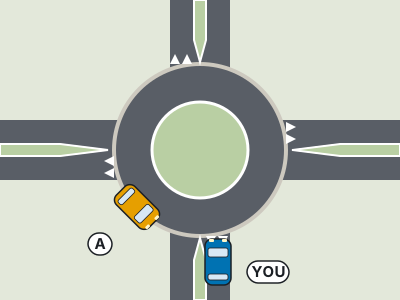
7. When entering a single-lane Rhode Island roundabout, what must you do before merging?
- Stop in the center island
- Yield to vehicles already in the roundabout and wait for a safe gap
- Enter immediately because circulating traffic yields
- Travel clockwise around the circle
Show answer
Yield to vehicles already in the roundabout and wait for a safe gap. Entering traffic must yield to vehicles already circulating in the roundabout. Wait for an adequate gap, then merge into the flow in a counterclockwise direction. Stopping in the center is not part of normal roundabout operation, and circulating vehicles do not yield to an entering vehicle. Clockwise travel is the wrong direction for this roadway design. The safest cue is to slow to the posted speed, look for a usable opening, and join the circle without forcing another driver to brake. Continue through the roundabout and exit to the right when you reach your street.
Study this in the handbook: Traffic lights and roundabouts
8. When an emergency vehicle approaches in Rhode Island, what should a driver do before re-entering traffic?
- Follow immediately behind it to move through traffic faster
- Pull right, stop, wait for it to pass, then signal and check before proceeding
- Stop in the left lane and leave the vehicle unattended
- Continue straight because emergency vehicles always change lanes
Show answer
Pull right, stop, wait for it to pass, then signal and check before proceeding. The manual says to give emergency vehicles the right-of-way by pulling to the right, stopping, and waiting for them to pass. Before returning to the traffic flow, activate the turn signal and glance over your shoulder to check for another emergency vehicle. Following the emergency vehicle is unsafe and not authorized, while stopping in the left lane does not create the prescribed clearance. Make the re-entry deliberate rather than immediate.
Study this in the handbook: Licenses, insurance, phones and other laws
9. Before entering a Rhode Island roundabout, what sign should a motorist look for?
- A red octagon requiring an immediate U-turn
- A blue rectangle showing a fuel pump
- A yellow diamond warning sign with an arrow and circle pattern
- A white circle marking a parking zone
Show answer
A yellow diamond warning sign with an arrow and circle pattern. The manual directs motorists approaching a roundabout to observe a yellow diamond warning sign showing an arrow with a circle pattern and two or more arrows pointing away from the circle. The sign warns about the roundabout and its exits. The blue, red, and white options describe unrelated colors or invented meanings. Use the yellow diamond as the advance cue, then slow, yield, and enter only when a safe gap is available.
Study this in the handbook: Stop signs, roundabout signs and work zones
10. Why should a driver avoid taking the right-of-way for granted?
- Another driver may fail to yield, and giving way can prevent a collision
- The law never assigns right-of-way at intersections
- Yielding automatically causes a traffic violation
- The driver with priority must always stop first
Show answer
Another driver may fail to yield, and giving way can prevent a collision. Having legal priority does not guarantee that another road user understands or obeys the rule. The manual advises yielding when necessary because the other driver may not grant the right-of-way, and that caution can save a life. This does not mean intersection law disappears or that yielding is itself unlawful. It means defensive driving takes priority over proving a legal point. Scan for a conflicting vehicle, reduce speed, and give space when the other person’s behavior is uncertain.
Study this in the handbook: Licenses, insurance, phones and other laws
11. What does Rhode Island's Basic Speed Law promote?
- A fixed speed that never changes with weather
- The highest speed a vehicle can reach on a clear road
- A speed that is safe for pedestrians, road conditions, and other traffic
- The same pace for every road user
Show answer
A speed that is safe for pedestrians, road conditions, and other traffic. The Basic Speed Law promotes a speed that remains safe for pedestrians, the road surface, and surrounding traffic. It therefore rejects the idea that a driver should chase the vehicle's maximum capability or hold one fixed pace through changing weather. The choice “The same pace for every road user” also ignores that different road users and conditions create different hazards. Keep the posted limit in view, but reduce speed whenever visibility, traction, traffic density, or pedestrian activity makes the listed maximum unsuitable.
Study this in the handbook: Licenses, insurance, phones and other laws
12. What should a driver do when facing a steady yellow traffic light?
- Accelerate so the vehicle enters before the light turns red
- Slow down and proceed cautiously if stopping cannot be done safely, then clear the intersection
- Stop in the middle of the intersection until green returns
- Treat it exactly like a flashing red signal
Show answer
Slow down and proceed cautiously if stopping cannot be done safely, then clear the intersection. A steady yellow warns that red is next. The driver should slow and use caution, stopping when that can be done safely. If a stop cannot be made safely, the vehicle should clear the intersection rather than freeze in the travel path. Accelerating to beat the signal turns a warning into a risky race. A flashing red has a different command, requiring a full stop and a yield. Watch the signal change and choose a safe, controlled exit from the intersection.
Study this in the handbook: Traffic lights and roundabouts
13. How long must a Rhode Island driver hold a Limited Provisional License before moving to a Full Operator's License?
- At least 6 months
- At least 24 months
- At least 18 months
- At least 12 months
Show answer
At least 12 months. The Full Operator's License requires holding the Limited Provisional License for at least twelve months, being at least 17 years and 6 months old, and having no moving violation or safety belt conviction in the previous six months. Six months is the minimum holding period for the instructional permit, not the provisional license. Eighteen and twenty-four months are longer than the rule. Keeping the stages separate helps: six months on the permit, then twelve months on the provisional license.
Study this in the handbook: The three levels of Rhode Island's graduated license
14. Rhode Island's seat belt law is a primary law for all ages. What does that mean for drivers?
- Only drivers under 18 can be ticketed for belts
- A belt ticket can be written only after another violation
- Belts are required only on highways
- You can be pulled over if anyone in the vehicle is unbuckled
Show answer
You can be pulled over if anyone in the vehicle is unbuckled. A primary law lets police stop a vehicle for the belt violation alone. Rhode Island's seat belt use law is primary for all ages, so you can be pulled over if anyone in the vehicle is unbuckled. The choice limiting it to drivers under 18 is wrong because it covers every age. A belt ticket does not depend on another violation being seen first. The law covers operation on the roadways, streets, and highways of the state, not highways only.
Study this in the handbook: Seat belts, child seats and headlights
15. What upcoming control does this STOP sign warning tell the driver to anticipate?

- A stop sign ahead, requiring preparation to stop
- The end of a priority roadway with no stop control
- A no-stopping zone beginning immediately at the warning sign
- A yield sign that replaces all stop signs ahead
Show answer
A stop sign ahead, requiring preparation to stop. This warning sign indicates that a STOP sign is ahead. The driver should reduce speed as needed, locate the stopping point, and be ready to make a complete stop when reaching the control. It does not announce the end of priority, prohibit stopping at the warning sign itself, or replace the stop control with a yield. The small stop symbol is the advance notice to prepare.
16. What minimum suspension does the Rhode Island manual state for refusing to take a chemical test?
- Until the driver turns 21
- Thirty days
- One year
- Six months
Show answer
Six months. A person who refuses a chemical test faces a license suspension of at least six months. The thirty-day option is too short, while one year is not the minimum stated by the manual. The age-based choice belongs to particular offense tables and is not the general refusal rule. When the question asks for the minimum, choose the lower boundary rather than importing a longer period from a later refusal or a different alcohol offense.
Study this in the handbook: Alcohol, BAC limits and implied consent
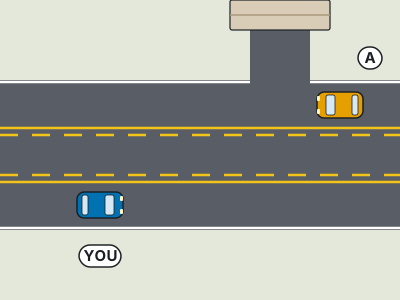
17. When may a driver enter Rhode Island’s shared center left-turn lane?
- To pass a slow vehicle straight through
- Whenever the regular lane is congested
- When intending to turn within 100 feet
- To travel several blocks before turning
Show answer
When intending to turn within 100 feet. The shared center lane is reserved for turning movements. A motorist intending to turn may enter it only when the turn will occur within 100 feet. Using the lane to pass, avoid congestion, or travel several blocks changes a short preparation space into an improper travel lane. Watch for the solid and broken yellow boundaries, arrows, and signs that identify its restricted purpose. The practical cue is destination timing: enter only when your left turn is close enough to occur within the stated distance.
Study this in the handbook: Turn signals and roadway markings
18. Which color and sign group identifies a construction or work-zone warning in the Rhode Island manual?
- The white organ-donor notice group
- The blue hospital guide sign group
- The green freeway-direction group
- The orange construction sign group
Show answer
The orange construction sign group. The warning-sign panel includes construction and road-work signs, and orange is the visual cue associated with work zones. Those signs alert drivers to changing conditions, workers, equipment, or altered paths. Blue signs in the manual identify services such as hospitals, while green signs provide route guidance. White organ-donor notices are not roadway warnings. On approach to an orange work-zone sign, reduce speed, scan for flagpersons and lane shifts, and follow temporary directions. Color helps you anticipate the kind of response before reading the symbol or wording.
Study this in the handbook: Speed limits and freeway driving
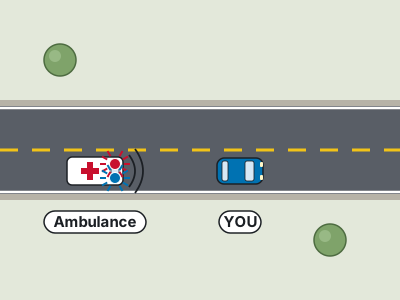
19. What must a driver do when an emergency vehicle approaches with warning lights and siren?
- Follow the emergency vehicle closely after it passes
- Keep moving at the same speed to avoid blocking traffic
- Stop in the center of the nearest intersection
- Pull to the right, stop, and wait for it to pass
Show answer
Pull to the right, stop, and wait for it to pass. Rhode Island tells drivers to give emergency vehicles the right-of-way at all times: pull over to the right, stop, and wait for the vehicle to pass. Before re-entering traffic, activate the turn signal and glance over your shoulder to make sure another emergency vehicle is not coming. Maintaining speed or stopping in the middle of an intersection can obstruct the emergency response. Following closely is also wrong, because the manual says to always drive 500 feet behind emergency vehicles.
Study this in the handbook: After a collision and when stopped by police
20. When approaching a horse being ridden on a public highway, what must a driver do?
- Accelerate past before the horse can react
- Reduce speed and avoid sounding the horn or making loud noises
- Sound the horn repeatedly to warn the rider
- Drive close to the horse so it stays at the edge
Show answer
Reduce speed and avoid sounding the horn or making loud noises. A horse can react unpredictably to noise or a sudden approach. Rhode Island law specifically requires the motorist to reduce speed and refrain from sounding a horn or causing other loud noises near a horse on a public highway. Accelerating or crowding the animal increases the chance of startling it and creating a collision. Ease off the accelerator early, leave generous side room, and pass quietly only when the path is clear.
Study this in the handbook: Licenses, insurance, phones and other laws
QualitySpace is expanding to Rhode Island
We are a California-based independent insurance brokerage working on licensing in more states. We cannot help with Rhode Island insurance yet. Leave your email and we will let you know when we can.
Every question is written from the official Rhode Island Driver's Manual. Need paper? Printable RI practice test with answer key.
Last verified 2026-10-05. How we check every question · Study all 200 as flashcards
Frequently asked questions
How many questions are on this Rhode Island practice test?
This fixed set has 20 questions. It is test 6 of 10 from the 200 question Rhode Island bank.
How does this fixed test relate to the full Rhode Island bank?
Each numbered test is a fixed set of questions in a fixed order, so you can retake the same test later and compare. Every test mixes road signs and the other topics in about the same proportion as the full bank. Tests 1 to 10 together cover every question in the Rhode Island bank once. The full practice page mixes the whole bank at random.
Last verified 2026-10-05. See the Rhode Island DMV facts page for sourced state details.
Return to the full Rhode Island practice test · Study road signs