
Test 9 of 10 · 20 questions · Free 2026
RI Permit Practice Test 9
Jump to the test ↓A fixed 20 question set from the Rhode Island bank with answers and plain English explanations.
Question 1 of 20 · 0 right so far
All 20 questions in test 9
Every question below comes from the Rhode Island question bank on this page. Open a question to see the correct answer and the explanation. Nothing here is hidden behind a signup.
1. Under Rhode Island's texting law, which use of a wireless handset is prohibited while operating a motor vehicle?
- Calling emergency services during an actual emergency
- Using a phone only after parking in a legal space
- Composing, reading, or sending a text message
- Listening to a passenger's spoken directions
Show answer
Composing, reading, or sending a text message. The manual states that, regardless of age, a driver may not use a wireless handset to compose, read, or send a text message while operating a motor vehicle. The parking choice describes a stopped situation but does not state the prohibited conduct, and emergency calling is not the listed texting activity. Spoken directions from a passenger are not handset texting. Remember the three covered actions: compose, read, and send.
Study this in the handbook: Licenses, insurance, phones and other laws
2. At this STOP sign, where should the vehicle stop before yielding?
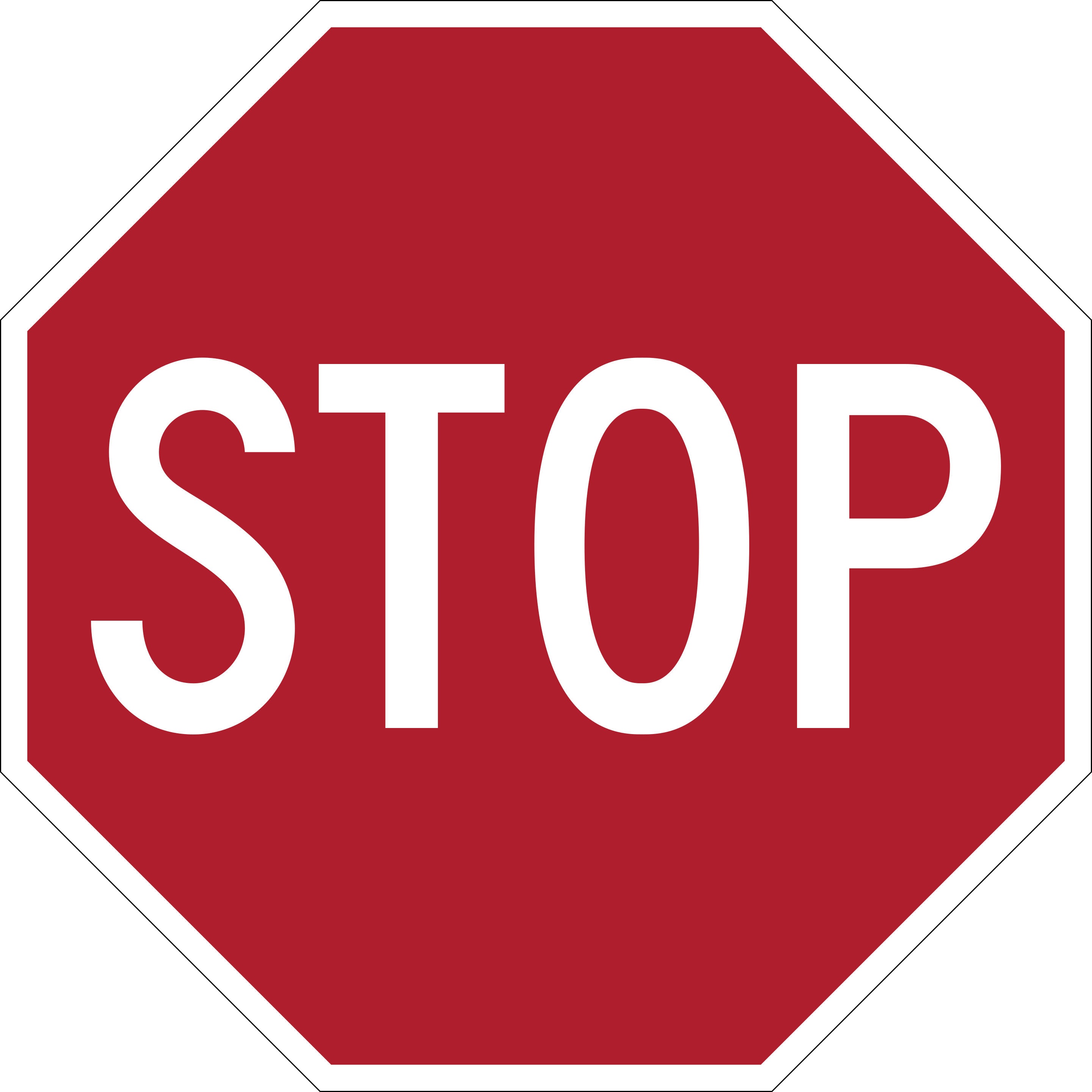
- After entering the intersection, if cross traffic is present
- Before the crosswalk or stop line, then yield before proceeding
- Only beside the signpost when another car approaches
- At the next driveway beyond the intersection
Show answer
Before the crosswalk or stop line, then yield before proceeding. Rhode Island law requires every driver approaching a STOP sign to stop before entering the crosswalk on the near side of the intersection, or at a clearly marked stop line when there is no crosswalk. After stopping, yield to traffic before moving into the intersection. Stopping beside the signpost, inside the intersection, or beyond it puts the vehicle too far forward and past the point the law names. Use the crosswalk or stop line as the visual cue, then scan for people and vehicles before proceeding.
Study this in the handbook: Stopping, turning and passing
3. Your Rhode Island license is suspended. When does the suspension period begin to run?
- Only after your license has been surrendered or forwarded to the DMV
- On the date the court mails the notice
- On the date of the violation
- After you complete a driver course
Show answer
Only after your license has been surrendered or forwarded to the DMV. A suspended driver must turn in the license in person to the Operator Control Section, or the Accident Section if the order results from a collision. The suspension period does not begin until the license has been surrendered or forwarded to the DMV, and failing to comply affects reinstatement. The violation date and the notice date do not start the clock. During the suspension you cannot legally drive in Rhode Island or any other state for any reason.
Study this in the handbook: The three levels of Rhode Island's graduated license
4. A Rhode Island limited provisional license holder is driving without supervision. During which period is that unsupervised driving permitted?
- Only from 6:00 AM to 10:00 PM
- From 5:00 AM to 1:00 AM
- Only from sunrise to sunset
- At any hour if the vehicle has a safety belt
Show answer
From 5:00 AM to 1:00 AM. The manual permits unsupervised driving from 5:00 AM through 1:00 AM, with additional allowances for travel to or from work and certain volunteer emergency organizations. That means the restricted overnight interval is 1:00 AM to 5:00 AM. The sunrise-to-sunset choice is too narrow because the rule uses clock times, and a safety belt does not erase the time restriction. Read the schedule as daytime and evening driving bounded by those two stated times.
Study this in the handbook: The three levels of Rhode Island's graduated license
5. Smoke is coming from beneath your vehicle's hood. What should you do first?
- Pull off immediately, switch off the ignition, and move away
- Open the hood while remaining in the traffic lane
- Drive until the engine cools completely
- Pour water over the engine before leaving the vehicle
Show answer
Pull off immediately, switch off the ignition, and move away. For smoke under the hood, the manual puts personal safety first: pull immediately off the road, turn the ignition off, and move away from the vehicle. Calling 911 comes next, while attempting to extinguish the fire is discouraged unless a fire extinguisher is available. Opening the hood in traffic leaves the driver exposed. The useful cue is smoke under the hood means stop, shut down, and create distance.
Study this in the handbook: Skids, brake failure, blowouts and other emergencies
6. Which adjustment helps prevent hydroplaning on a wet Rhode Island road?
- Brake hard whenever the roadway begins to shine
- Increase speed so water passes beneath the tires faster
- Reduce speed and keep tires inflated to the manufacturer's recommendation
- Steer toward areas where water has pooled
Show answer
Reduce speed and keep tires inflated to the manufacturer's recommendation. Hydroplaning begins when the front tires lose contact with a wet road, taking away steering capability. The manual recommends maintaining the manufacturer’s tire pressure, reducing speed, and being cautious in rain. Increasing speed works against those precautions, while pooled water is an area to avoid. Braking hard can also disturb control. Watch for standing water and ease off the accelerator before reaching it.
Study this in the handbook: Stopping, turning and passing
7. When entering a Rhode Island roundabout, to whom must a driver yield?
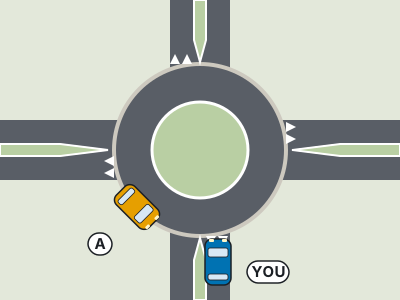
- Only vehicles approaching from the left
- Vehicles waiting behind the driver at the entrance
- Vehicles already traveling in the roundabout
- No vehicles when the entry lane is single lane
Show answer
Vehicles already traveling in the roundabout. At a roundabout entrance, the entering driver yields to vehicles already circulating. The manual describes waiting for a gap and then merging into the counterclockwise flow, so an empty entry lane alone does not establish priority. Traffic behind the entrant is not the controlling concern, and the rule does not limit yielding to vehicles from one side. Slow to the posted speed, scan the circle, and enter only after the circulating lane gives you a safe opening.
Study this in the handbook: Traffic lights and roundabouts
8. When passing a bicyclist, how much clearance should a motorist allow whenever possible?
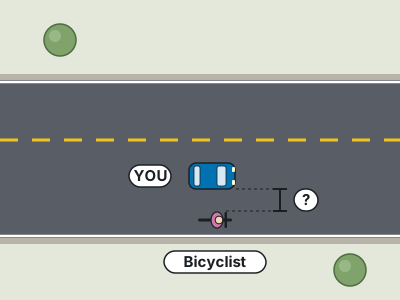
- No clearance if the bicycle is near the curb
- Less than one foot if the motorist sounds the horn
- Exactly two feet in every roadway condition
- As much as possible, generally three to five feet
Show answer
As much as possible, generally three to five feet. A bicyclist is vulnerable to potholes, puddles, debris, and sudden movement, so passing space must account for more than the bicycle’s current position. The manual recommends as much clearance as possible, giving three to five feet as a practical range, and says the driver should be prepared to stop suddenly. A horn does not make a close pass safe, and a curb does not remove the bicyclist’s need for room. Slow down, leave space, and wait when necessary.
Study this in the handbook: Pedestrians, school buses and bicyclists
9. What do solid yellow lines separating opposing traffic generally prohibit?
- Passing other vehicles across the solid lines
- Changing lanes in the same direction whenever safe
- Driving below the posted speed limit
- Turning into a legal driveway
Show answer
Passing other vehicles across the solid lines. Solid yellow lines separate traffic moving in opposite directions and prohibit motorists from passing other vehicles across those lines. The manual notes limited exceptions, such as a legal turn or avoiding an object in the road, but ordinary passing is not allowed. Same-direction lane changes are governed by white lines, and a speed limit does not determine the meaning of a centerline. A legal driveway turn can be an exception, yet it does not make passing permissible. See solid yellow and think opposing traffic plus no passing.
Study this in the handbook: Turn signals and roadway markings
10. An adult in Rhode Island refuses a chemical test for the third time within ten years. What license suspension does the law set?
- 1 to 2 years
- 6 months to 1 year
- 2 to 5 years
- 30 to 180 days
Show answer
2 to 5 years. Rhode Island's refusal statute counts prior violations over a ten year period. A third or subsequent refusal within ten years is a misdemeanor with up to one year in prison, an $800 to $1,000 fine, at least 100 hours of community restitution, and a license suspension of two to five years. Six months to one year is the first refusal suspension, and one to two years is the second refusal suspension. Thirty to 180 days is the suspension for a first DUI at a BAC of 0.08% to 0.1%, not a refusal.
11. A 19-year-old in Rhode Island is convicted of a first Driving While Impaired offense with a BAC of 0.04%. What does the table list?
- 30 to 180 day suspension and a $100 to $300 fine
- 6 to 12 month suspension and a $150 assessment
- 1 to 3 month suspension, a fine of up to $250, 30 hours of community service
- Suspension until age 21
Show answer
1 to 3 month suspension, a fine of up to $250, 30 hours of community service. For drivers 18 to 21 with a BAC of 0.02% to 0.08%, the first violation brings a 1 to 3 month license suspension, a fine of up to $250, and 30 hours of community service, plus a special course and treatment. The 6 to 12 month suspension with a $150 assessment is the under 18 first offense. The 30 to 180 day suspension with a $100 to $300 fine is the adult first DUI at 0.08% to 0.1%. Suspension until age 21 is an under 18 repeat penalty.
Study this in the handbook: Refusal and DUI penalties
12. How should you respond to a traffic signal that flashes red?
- A slow roll without stopping if the road looks clear
- A full stop followed by yielding to traffic on both sides
- Immediate acceleration through the intersection
- A stop only when another signal is green
Show answer
A full stop followed by yielding to traffic on both sides. A flashing red signal must be treated like a stop sign. Make a full stop, then yield the right-of-way to vehicles on your right and left before proceeding. A slow roll fails to satisfy the stopping requirement, and accelerating through removes the time needed to see cross traffic or pedestrians. The other signal color does not change the duty created by the flashing red indication. Use the same routine as a stop sign: stop completely, look both ways, yield, and go only when safe.
Study this in the handbook: Traffic lights and roundabouts
13. What traffic controls does a Rhode Island roundabout use instead of stop signs or traffic signals?
- Stop signs at every entrance and exit
- Only flashing red lights and railroad gates
- Yield signs, directional signs, and pavement markings
- No signs or markings because circulating traffic has priority
Show answer
Yield signs, directional signs, and pavement markings. Rhode Island's manual explains that a roundabout does not use stop signs or traffic signals as its control method. Instead, yield signs, directional signs, and pavement markings guide traffic through the intersection. The claim that no guidance is needed is especially unsafe because entering drivers must yield and choose the proper path. Approach slowly, follow the posted direction, and obey the yield instruction before merging into circulating traffic.
Study this in the handbook: Traffic lights and roundabouts
14. When must Rhode Island drivers turn on their headlights?
- Whenever the vehicle is stopped at a traffic signal
- Only between midnight and dawn on roads without streetlights
- Only when another driver flashes headlights first
- From sunset to sunrise, when visibility is under 500 feet, and when wipers are in use
Show answer
From sunset to sunrise, when visibility is under 500 feet, and when wipers are in use. Rhode Island requires headlights from sunset to sunrise, whenever the driver cannot see 500 feet ahead, and when windshield wipers are being used because of rain, sleet, snow, or similar conditions. The rule is not limited to dark rural roads or to a response to another driver. Turning headlights on while stopped at a signal is not the trigger described here. Remember the three cues: nighttime, limited visibility, or wipers operating because weather is affecting the drive.
Study this in the handbook: Seat belts, child seats and headlights
15. Which document must be shown for a Rhode Island road test vehicle's insurance requirement?
- A vehicle sales advertisement
- A utility bill in the vehicle owner's name
- A school transcript for the permit holder
- A current Rhode Island insurance identification card
Show answer
A current Rhode Island insurance identification card. The road test checklist requires proof of valid Rhode Island insurance, and it identifies an insurance card as acceptable evidence. A utility bill may establish an address in another setting, but it does not prove that the test vehicle is insured. A school transcript and a sales advertisement provide no insurance certification. Before the appointment, confirm that the vehicle owner is listed on the card and bring the original or an accepted photocopy so the examiner can verify the vehicle requirement.
16. What should a driver do when a school bus has flashing red lights on a public highway?
- Stop from either direction and remain stopped until the red lights end
- Pass if traveling toward the front of the bus
- Stop only when the bus is on the driver's side
- Continue if no children are visible
Show answer
Stop from either direction and remain stopped until the red lights end. Flashing red school bus lights require approaching motorists from either direction to make a full stop and stay stopped until the lights no longer flash. The rule applies on public highways, and the presence or absence of visible children does not cancel it. Passing from the front or stopping only for the nearer direction creates the exact danger the rule addresses. A divided highway has a separate exception when the bus is opposite the vehicle, so drivers should first identify whether the roadway is divided before relying on that exception.
Study this in the handbook: Pedestrians, school buses and bicyclists
17. How far from a crosswalk at an intersection must a Rhode Island driver avoid parking?
- Within 20 feet
- Within 5 feet
- Within 50 feet
- Only directly on the painted stripes
Show answer
Within 20 feet. Rhode Island's parking restrictions include the space within twenty feet of a crosswalk at an intersection. The prohibition is broader than the painted stripes themselves, so parking five feet away still blocks the protected approach and is not allowed. Fifty feet is a different distance used elsewhere in the parking list, including railroad crossings. Before leaving a vehicle, scan beyond the exact markings and measure the nearby curb features that create a statutory buffer.
Study this in the handbook: Where you may not park or stop
18. Which roadway change does this Rhode Island warning sign announce?

- A traffic signal is ahead
- The road narrows from the right
- A school crossing is ahead
- The highway is entering a divided section
Show answer
The road narrows from the right. The warning-sign panel identifies a road narrowing from the right as an upcoming roadway change. Drivers should anticipate less usable space, scan for vehicles beside them, and adjust position smoothly rather than waiting until the pavement pinches. A traffic signal, school crossing, and divided highway each have separate warning labels in the same panel. Treat the narrowing as advance information, not as a command to stop or an instruction to turn. Reducing speed early gives you time to read the roadway and cooperate with nearby traffic.
19. Besides suspension and fines, which treatment-related consequence can appear after a Rhode Island chemical test refusal?
- A mandatory vehicle repainting inspection
- Alcohol or drug treatment
- A permanent ban on public transportation
- A required motorcycle skills examination
Show answer
Alcohol or drug treatment. The refusal penalties include alcohol or drug treatment, along with a special course on driving while intoxicated in the adult table. None of the vehicle repainting, transit, or motorcycle-testing choices appears as a refusal consequence. The manual also identifies community service and assessments, so treatment is one part of a broader penalty package rather than a replacement for the suspension. Look for the substance-related response when the question asks about treatment.
Study this in the handbook: Alcohol, BAC limits and implied consent
20. At a Rhode Island four-way stop, two vehicles arrive at the same time. Which vehicle should go first?
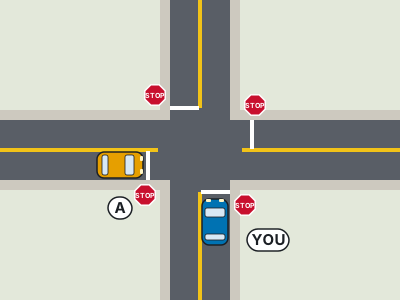
- The vehicle that sounds its horn first
- The vehicle on the other driver’s left
- The vehicle with the larger engine
- The vehicle on the other driver’s right
Show answer
The vehicle on the other driver’s right. When two vehicles reach a four-way stop at the same time, the driver must yield the right-of-way to the vehicle on the right. The rule is based on position, not engine size, vehicle type, or who uses the horn. A vehicle that arrived earlier has priority over vehicles arriving later, but that is a different timing situation. Make a full stop first, identify which vehicle is to your right, and allow that vehicle to proceed. Keep watching for pedestrians and for drivers who may misunderstand the order.
Study this in the handbook: Stopping, turning and passing
QualitySpace is expanding to Rhode Island
We are a California-based independent insurance brokerage working on licensing in more states. We cannot help with Rhode Island insurance yet. Leave your email and we will let you know when we can.
Every question is written from the official Rhode Island Driver's Manual. Need paper? Printable RI practice test with answer key.
Last verified 2026-10-05. How we check every question · Study all 200 as flashcards
Frequently asked questions
How many questions are on this Rhode Island practice test?
This fixed set has 20 questions. It is test 9 of 10 from the 200 question Rhode Island bank.
How does this fixed test relate to the full Rhode Island bank?
Each numbered test is a fixed set of questions in a fixed order, so you can retake the same test later and compare. Every test mixes road signs and the other topics in about the same proportion as the full bank. Tests 1 to 10 together cover every question in the Rhode Island bank once. The full practice page mixes the whole bank at random.
Last verified 2026-10-05. See the Rhode Island DMV facts page for sourced state details.
Return to the full Rhode Island practice test · Study road signs