
Test 10 of 10 · 20 questions · Free 2026
RI Permit Practice Test 10
Jump to the test ↓A fixed 20 question set from the Rhode Island bank with answers and plain English explanations.
Question 1 of 20 · 0 right so far
All 20 questions in test 10
Every question below comes from the Rhode Island question bank on this page. Open a question to see the correct answer and the explanation. Nothing here is hidden behind a signup.
1. What is the first level in Rhode Island's graduated licensing system?
- Limited Provisional License
- Limited Instructional Permit
- Full Operator's License
- Commercial Driver's License
Show answer
Limited Instructional Permit. Rhode Island describes three graduated levels in sequence: limited instructional permit, limited provisional license, and full operator's license. The first level is the Limited Instructional Permit, which lets a new driver practice with qualified supervision. The provisional license comes after the permit and required experience, while the full operator's license is the final level. A commercial license is a different license type, not the opening step for this graduated system. Remember the progression as practice, provisional driving, then full licensing.
Study this in the handbook: The three levels of Rhode Island's graduated license
2. After holding a Rhode Island Limited Instructional Permit for the required period and passing the road test, what comes next?
- A second classroom permit
- A Full Operator's License immediately
- A motorcycle-only permit
- A Limited Provisional License
Show answer
A Limited Provisional License. The next graduated stage is the Limited Provisional License. Reaching it requires more than simply possessing a permit: the applicant must satisfy the holding period, testing, driving-history, and supervised-experience conditions described in the manual. A full operator's license is the later Level Three stage, not the immediate next step. The motorcycle-only option is unrelated, and a second classroom permit is not part of the sequence. Think of the road test as the gateway from supervised permit practice to provisional privileges.
3. A Rhode Island driver under 18 is convicted of a first DUI with a BAC of 0.08% or above. What suspension does the table list?
- 6 to 18 months
- 2 to 5 years
- 3 to 12 months
- 1 to 3 months
Show answer
6 to 18 months. The under 18 DUI table, for a BAC of 0.08% or above, lists a 6 to 18 month license suspension, a $500 highway safety assessment, and 10 to 60 hours of community service for a first violation, along with a special course and alcohol or drug education or treatment. A second or later violation brings a suspension until age 21 and up to 1 year of incarceration and/or a $500 fine. One to three months is the 18 to 21 impaired driving first offense. Two to five years is the third refusal suspension, and three to twelve months does not appear for this row.
Study this in the handbook: Refusal and DUI penalties
4. According to Rhode Island's alcohol laws, what birthday marks the legal drinking age?
- The 18th birthday
- The 19th birthday
- The 21st birthday
- The 25th birthday
Show answer
The 21st birthday. Rhode Island's manual uses the twenty-first birthday as the dividing point in its underage alcohol provisions. That age matters when reading the separate DWI and DUI categories, but it does not mean a driver should use age alone to judge whether driving is safe. The 18th and 19th birthdays do not end the under-21 rules, while 25 has no role in the cited provision. When studying the table, pair the age boundary with the BAC range instead of treating the number as a permission to drive after drinking.
Study this in the handbook: Alcohol, BAC limits and implied consent
5. What does the Rhode Island manual list as the first-offense penalty for failing to stop for a school bus with flashing red lights?
- A fine of up to $1,000 and a 1 year suspension
- A $75 fine with no suspension
- A fine of up to $300 and/or suspension up to 30 days
- A warning for the first offense
Show answer
A fine of up to $300 and/or suspension up to 30 days. A first violation of the school bus stop law brings a fine of up to $300 and/or a license suspension of up to 30 days, and penalties increase for later violations. The rule to stop and remain stopped until the red lights stop flashing applies on public highways, private roads, and parking lots. The $1,000 figure is the manual's amount for failing to yield to a blind or low vision pedestrian, not the school bus penalty. A flat $75 fine understates the penalty, and the manual lists no warning for a first violation.
Study this in the handbook: Pedestrians, school buses and bicyclists
6. A Rhode Island teen with a Limited Instructional Permit wants to practice with an older cousin. Which cousin qualifies as a supervising driver?
- A 21-year-old who has been licensed for five years
- A 20-year-old who has been licensed for four years
- A 19-year-old who holds a full operator's license
- A 25-year-old who got a license six months ago
Show answer
A 21-year-old who has been licensed for five years. Rhode Island sets two tests for a supervising driver: at least 21 years old and licensed to drive for at least five years. Only the 21-year-old with five years of licensed driving meets both. The 20-year-old and the 19-year-old fail the age test even with a valid license. The 25-year-old is old enough but has only six months of experience, far short of five years. The supervising driver must sit beside the permit holder and is legally responsible for any driving violation the permit holder commits.
Study this in the handbook: The three levels of Rhode Island's graduated license
7. What is the first action in the IPDE defensive driving system?
- Predict only what the nearest driver will do
- Execute a steering maneuver immediately
- Decide on a route without scanning
- Identify hazards in the driving scene
Show answer
Identify hazards in the driving scene. IPDE begins with Identify, meaning the driver locates hazards by getting the big picture. Prediction, decision, and execution follow in that order. Steering immediately skips observation, and focusing only on the nearest driver is too narrow for the system’s broad scan. The sequence is a practical mental checklist: identify what is present, predict possible conflicts, decide on a response, then execute it. Beginning with a wide view gives the driver time to recognize a developing problem before a sudden maneuver becomes necessary.
Study this in the handbook: Following distance, trucks and motorcycles
8. When must a driver dim high beams while following another vehicle?
- When following at 200 feet or less
- Only after the other driver signals a complaint
- At 50 feet or less
- Only when the vehicle ahead is stopped
Show answer
When following at 200 feet or less. The manual’s 500/200 rule says high beams should be dimmed when following another vehicle at a distance of 200 feet or less. This prevents glare from distracting or blinding the driver ahead. Waiting for a complaint or for the other vehicle to stop abandons the preventive purpose of the rule, while 50 feet is a much shorter threshold. The study cue is directional: 500 feet concerns an approaching vehicle, and 200 feet concerns a vehicle being followed. Both numbers require timely beam control at night.
Study this in the handbook: Seat belts, child seats and headlights
9. How can a driver guard against hydroplaning on a wet roadway?
- Use cruise control to maintain a steady pace
- Reduce speed and avoid areas where water pools
- Make a sharp steering correction toward the shoulder
- Brake hard while keeping the accelerator pressed
Show answer
Reduce speed and avoid areas where water pools. Hydroplaning begins when the front tires lose contact with a wet road and steering capability disappears. The manual recommends keeping tire pressure at the manufacturer's standard, reducing speed, driving carefully in rain, and avoiding pooled water. Cruise control is unsafe in this setting because a loss of tire contact can make the vehicle accelerate. A sharp steering correction or hard braking can also upset the vehicle. The useful cue is prevention before the tires float: slow down early, maintain the tires, and choose a path away from standing water.
Study this in the handbook: Stopping, turning and passing
10. Where signs are posted, how far from a fire station driveway must a Rhode Island driver stay when parking on the opposite side of the street?
- 20 feet
- 75 feet
- 30 feet
- 100 feet
Show answer
75 feet. Rhode Island bars parking within 20 feet of the driveway of a fire station and, across the street, within 75 feet of the driveway where signs are posted. The 75 foot zone applies only where signs are posted. Twenty feet is the same side distance, 30 feet is the traffic control distance, and 100 feet is not a listed number. Also never park at a curb cut or ramp for people with disabilities.
Study this in the handbook: Where you may not park or stop
11. At a red octagonal STOP sign, where must the driver stop before proceeding?
- Past the crosswalk so the front wheels reach the next lane
- Only after entering the intersection far enough to see cross traffic
- At the center of the intersection
- Before entering the crosswalk on the near side of the intersection
Show answer
Before entering the crosswalk on the near side of the intersection. The stop requirement applies before entering the near-side crosswalk. If there is no crosswalk, the driver uses a marked stop line, or the nearest point where approaching traffic can be seen before entering the intersection. Stopping in the middle or beyond the crosswalk places the vehicle where pedestrians and cross traffic may already be moving. Approach slowly, stop at the required location, look both ways, and proceed only after yielding.
Study this in the handbook: Stop signs, roundabout signs and work zones
12. What do broken white lines between lanes generally allow a driver to do?
- Pass other vehicles and change lanes when safe
- Cross only during an emergency
- Pass only on the shoulder
- Change lanes only after stopping completely
Show answer
Pass other vehicles and change lanes when safe. Broken white lines separate traffic moving in the same direction and indicate that a lane change is generally permitted when traffic conditions make it safe. They do not authorize using the shoulder, and a driver does not need to stop before moving across the line. A solid white line carries more restriction, especially near a carpool, restricted, breakdown, or parking area. Scan mirrors and the blind spot before taking advantage of an available lane change.
Study this in the handbook: Turn signals and roadway markings
13. Before receiving a Rhode Island Level 2 limited provisional license, how much supervised driving must a permit holder complete, and how much must be at night?
- 25 hours, including 10 hours at night
- 40 hours, including 5 hours after sunset
- 60 hours, including 20 hours at night
- 50 hours, including 10 hours at night
Show answer
50 hours, including 10 hours at night. The Level 2 application requires fifty hours of supervised driving with a qualified supervising driver, and ten of those hours must be completed at night. The forty-hour option understates the total, while the sixty-hour option adds a requirement the manual does not give. Think of the requirement as a 50 and 10 pairing, then remember that the permit holder must also satisfy the separate permit, road-test, and application conditions before moving to Level 2.
Study this in the handbook: The three levels of Rhode Island's graduated license
14. When must a Rhode Island driver turn on headlights during the day?
- Only when driving on an interstate highway
- Whenever visibility is reduced or the windshield wipers are in use
- Only after another driver flashes headlights
- Whenever the temperature falls below freezing
Show answer
Whenever visibility is reduced or the windshield wipers are in use. Rhode Island requires headlights when a driver cannot see 500 feet ahead and whenever wipers are operating because of rain, sleet, or snow. Low beams are appropriate in those conditions, since high beams can reflect from precipitation and reduce what the driver can see. The interstate-only choice narrows a rule that applies to any roadway. A practical cue is simple: if weather turns the wipers on, turn the headlights on too.
Study this in the handbook: Seat belts, child seats and headlights
15. What does the divided-highway-begins sign warn you to expect?

- A no-passing zone starts at the sign
- The roadway will become a single lane
- Traffic directions will separate around a median
- A traffic signal is about to change
Show answer
Traffic directions will separate around a median. A divided-highway-begins sign warns that opposing traffic will be separated by a median or similar barrier. Stay on the proper side of that separation and follow the lane markings as the roadway divides. A single-lane reduction is a narrowing condition, not a divided highway beginning. A no-passing restriction is shown by its own regulatory or warning sign, and a signal-change warning concerns an intersection. The useful visual cue is the arrows splitting apart, which represents traffic directions taking separate paths.
Study this in the handbook: Pedestrians, school buses and bicyclists
16. What speed limits does the manual list for residential areas and most highways?
- 45 mph in residential areas and 55 mph on every highway
- 15 mph in residential areas and 35 to 45 mph on most highways
- 35 mph in residential areas and 70 to 80 mph on most highways
- 25 mph in residential areas and 50 to 65 mph on most highways
Show answer
25 mph in residential areas and 50 to 65 mph on most highways. The manual’s highway guidance lists 25 miles per hour in residential areas and 50 to 65 miles per hour on most highways. Those figures describe the listed limits, not permission to ignore posted signs or conditions. The Basic Speed Law still requires a speed suited to weather, traffic, pedestrians, and the road surface. Check the sign for the specific segment, then slow below the maximum when conditions make that necessary.
Study this in the handbook: Licenses, insurance, phones and other laws
17. What condition is identified by the skidding-car warning sign?

- A road is reserved for racing
- A vehicle inspection station is ahead
- The pavement may be slippery when wet
- The lane is ending at a bridge
Show answer
The pavement may be slippery when wet. The skidding car symbol, labeled Slippery When Wet in the manual's warning sign panel, warns that the roadway may lose traction when wet. Reduce speed before reaching the slick area, leave extra room, and use gentle steering and braking. The inspection choice concerns vehicle equipment and is not represented by a warning symbol. Racing is not a roadway message, and a lane ending at a bridge would use a different road shape warning. The manual adds that oil, rubber, dirt and water make roads especially slippery when it first starts to rain.
Study this in the handbook: Stopping, turning and passing
18. What is the safest first response to a tire blowout?
- Accelerate so the tire can clear the roadway quickly
- Brake hard and turn sharply toward the shoulder
- Hold the steering wheel firmly, ease off the accelerator, and avoid braking at first
- Shift into reverse while the vehicle is still moving
Show answer
Hold the steering wheel firmly, ease off the accelerator, and avoid braking at first. For a blowout or flat tire, the manual reminds you the tire is already a total loss, so your task is to drive to safety. Grip the steering wheel firmly with both hands and ease up on the accelerator to slow the vehicle. Do not brake, because braking can cause the vehicle to swerve; let it slow gradually. Accelerating, braking hard while turning sharply, or shifting into reverse all work against control. Once you have control, check traffic, drive off the roadway slowly while braking gently, and turn on your hazard flashers.
Study this in the handbook: Skids, brake failure, blowouts and other emergencies
19. When a school bus has flashing red lights, when may approaching motorists continue?
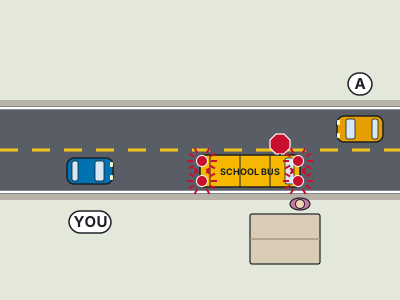
- As soon as no children are visible near the roadway
- After the bus's red lights no longer flash, unless the bus is opposite them on a divided highway
- After slowing to 10 mph on any road
- Immediately when traveling toward the bus from the opposite direction
Show answer
After the bus's red lights no longer flash, unless the bus is opposite them on a divided highway. Flashing red lights on a school bus require traffic approaching from either direction to make a full stop and remain stopped. The restriction applies on public highways, private roads, and parking lots. The divided-highway exception applies when the bus is opposite your vehicle and a real separation, such as a barrier, grass, guardrail, trees, or water, divides the directions. A clear view of children or a reduced speed does not replace the required stop. Identify the roadway separation before proceeding.
Study this in the handbook: Pedestrians, school buses and bicyclists
20. How far before a turn should a driver give the required signal?
- At least 100 feet before making the turn
- Only after beginning to turn the steering wheel
- Exactly 25 feet before every turn
- Only when another vehicle is directly behind
Show answer
At least 100 feet before making the turn. Rhode Island requires a driver to signal at least 100 feet before making a turn, and a signal is also required when driving out of a parking space. Signaling early gives drivers behind time to understand your plan and adjust their speed or position. Waiting until the steering wheel moves can leave no useful warning, while 25 feet is shorter than the stated minimum. Do not make signaling dependent on seeing a vehicle behind you. Use the cue of the upcoming maneuver and signal with enough distance to communicate it.
Study this in the handbook: Turn signals and roadway markings
QualitySpace is expanding to Rhode Island
We are a California-based independent insurance brokerage working on licensing in more states. We cannot help with Rhode Island insurance yet. Leave your email and we will let you know when we can.
Every question is written from the official Rhode Island Driver's Manual. Need paper? Printable RI practice test with answer key.
Last verified 2026-10-05. How we check every question · Study all 200 as flashcards
Frequently asked questions
How many questions are on this Rhode Island practice test?
This fixed set has 20 questions. It is test 10 of 10 from the 200 question Rhode Island bank.
How does this fixed test relate to the full Rhode Island bank?
Each numbered test is a fixed set of questions in a fixed order, so you can retake the same test later and compare. Every test mixes road signs and the other topics in about the same proportion as the full bank. Tests 1 to 10 together cover every question in the Rhode Island bank once. The full practice page mixes the whole bank at random.
Last verified 2026-10-05. See the Rhode Island DMV facts page for sourced state details.
Return to the full Rhode Island practice test · Study road signs