
Test 7 of 10 · 20 questions · Free 2026
RI Permit Practice Test 7
Jump to the test ↓A fixed 20 question set from the Rhode Island bank with answers and plain English explanations.
Question 1 of 20 · 0 right so far

All 20 questions in test 7
Every question below comes from the Rhode Island question bank on this page. Open a question to see the correct answer and the explanation. Nothing here is hidden behind a signup.
1. What condition does this pedestrian crossing sign tell a driver to anticipate?
- People may cross ahead, so be prepared to yield
- Pedestrians are prohibited from entering the roadway
- Sidewalk repairs have closed the crossing permanently
- Only bicycles may use the marked crossing
Show answer
People may cross ahead, so be prepared to yield. A pedestrian crossing warning tells drivers to expect people crossing the roadway ahead. Drivers should slow where needed, remain alert, and yield when a pedestrian has the right-of-way. The sign does not ban pedestrians, announce permanent sidewalk repairs, or convert the crossing into a bicycle-only facility. Look beyond the sign for people near the curb, in the crosswalk, or between parked vehicles.
Study this in the handbook: Turn signals and roadway markings
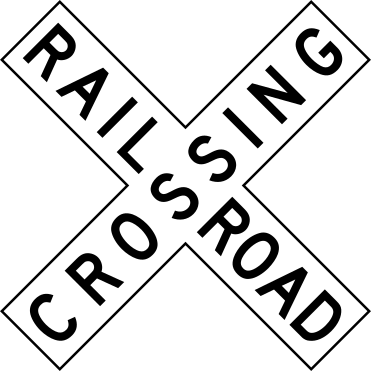
2. What does the RAILROAD CROSSING sign identify at the tracks?
- A pedestrian-only path that vehicles may not cross
- A hospital entrance where horns are prohibited
- A temporary construction detour around the tracks
- The crossing itself, where a driver must yield to trains
Show answer
The crossing itself, where a driver must yield to trains. The crossbuck marks the railroad crossing itself. A driver approaching it must look and listen for trains and yield when a train is present or approaching. The symbol is not a hospital, construction, or pedestrian-only marker. Do not treat an apparently quiet track as automatically clear. Railroad equipment has priority, and the safest approach leaves room to stop before the rails.
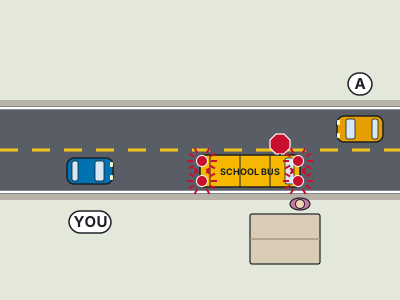
3. A school bus displays flashing red lights. What must an approaching Rhode Island motorist do?
- Continue unless the bus is in a marked school zone
- Pass slowly if no children are visible
- Stop only when approaching from behind the bus
- Stop fully and remain stopped until the red lights stop flashing
Show answer
Stop fully and remain stopped until the red lights stop flashing. Flashing red bus lights require a full stop for motorists coming from either direction, and the vehicle must stay stopped until the red lights no longer flash. The rule also covers public highways, private roads, and parking lots. Passing because children are not visible ignores the signal. The divided-highway exception applies only when the bus is opposite the vehicle on a separated roadway.
Study this in the handbook: Pedestrians, school buses and bicyclists
4. Besides suspension, fines, and assessments, what other consequence can follow a Rhode Island chemical test refusal?
- Public community service and drunk driving school or alcohol treatment referral
- A vehicle repainting inspection and motorcycle test
- A permanent ban on public transportation
- Only a written warning with no program requirement
Show answer
Public community service and drunk driving school or alcohol treatment referral. The refusal rule includes public community service and drunk driving school or a referral to an alcohol treatment program, in addition to the license suspension, fine, and highway safety assessment. The vehicle and motorcycle choices describe unrelated requirements, while a permanent transit ban is not a listed driving penalty. Read the consequence as a package rather than isolating the suspension. The treatment or education component is the clue that separates refusal penalties from ordinary paperwork violations.
Study this in the handbook: Alcohol, BAC limits and implied consent
5. Which item is listed among the Rhode Island manual’s warning signs?
- Hospital
- Yield Sign Ahead
- R.I. Route
- Food
Show answer
Yield Sign Ahead. The warning-sign group includes advance notices such as Yield Sign Ahead, Traffic Signal Ahead, Stop Sign Ahead, and Railroad Crossing Ahead. Hospital, Food, and R.I. Route appear in the manual’s guide-sign material, so they identify services or routes rather than the warning group. Use the sign’s message and placement to anticipate a roadway condition before reaching it. A sign that says Yield Sign Ahead tells the driver to prepare for the upcoming yield control, not to treat the warning itself as the final intersection command.
6. Which item is shown among Rhode Island’s guide signs?
- Road Narrows
- No U-Turn
- Freeway Direction
- Pedestrian Crossing
Show answer
Freeway Direction. Freeway Direction is listed in the manual’s guide-sign group. Guide signs help drivers navigate by identifying routes, exits, destinations, services, or distances. No U-Turn is a regulatory control, while Road Narrows and Pedestrian Crossing are warning information. Those categories require different driving responses, so recognizing the group is useful when reading an unfamiliar sign. A practical cue is purpose: guide signs answer where to go or what facility is available; they do not primarily command a maneuver or announce an approaching hazard.
7. Which of these does the Rhode Island manual give as an example of aggressive driving?
- Following too closely
- Signaling before every turn
- Keeping a four second gap
- Yielding to pedestrians
Show answer
Following too closely. Aggressive driving occurs when a driver operates a vehicle in a pushy or bold manner. The manual's examples are exceeding the speed limit, following too closely, failing to obey traffic controls, and making improper turns and maneuvers. Signaling, keeping a safe gap and yielding are the opposite. Road rage is the extreme case, where a driver acts out anger toward another road user, and the manual advises staying out of it rather than responding.
Study this in the handbook: Distractions, drowsy driving and road rage
8. When may a driver turn right at a steady red light in Rhode Island?
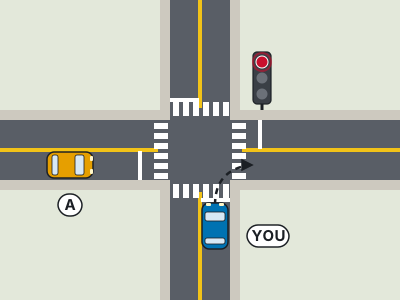
- After a complete stop and yielding, unless a sign prohibits the turn
- Whenever the driver slows and sees no vehicle nearby
- Only after the signal has been red for one minute
- Before stopping if the right lane is clear
Show answer
After a complete stop and yielding, unless a sign prohibits the turn. A right turn on red is allowed only after a complete stop and after yielding to pedestrians and other vehicles, unless a posted sign prohibits that turn. Merely slowing is not enough, and a clear-looking lane does not remove the duty to stop and yield. There is no one-minute waiting period. Check the sign, stop before the crosswalk or stop line, scan all approaches, and turn only when the movement is safe. The memory cue is stop, yield, then turn when permitted.
Study this in the handbook: Traffic lights and roundabouts
9. Before completing a left turn at an intersection, which road user must you always yield to?
- Only vehicles that are behind you
- Pedestrians in the street
- No one if your turn signal is on
- A parked vehicle at the curb
Show answer
Pedestrians in the street. The manual specifically directs drivers making a left turn to yield the right-of-way to pedestrians in the street. A signal announces your intention but does not give you priority over someone crossing or walking through the turning path. Vehicles behind you are not the only concern, and a parked vehicle does not automatically receive right-of-way. Before turning, wait until the way is clear, keep the vehicle controlled, and scan the crosswalk and roadway for people. The practical cue is to finish the pedestrian check before beginning the steering movement.
Study this in the handbook: Pedestrians, school buses and bicyclists
10. If an accelerator pedal sticks to the floor, what should the driver do while moving toward safety?
- Pump the accelerator until the engine stops
- Shift to reverse and accelerate
- Turn off the ignition before steering
- Shift to neutral while applying the brake
Show answer
Shift to neutral while applying the brake. For a stuck accelerator or an engine racing out of control, the manual first suggests kicking the side of the pedal once to try to jar it free. If that fails, shift the car to NEUTRAL at the same time you apply the brake; the engine will race, but power is removed from the drive wheels. Then choose an escape path to an open zone off the roadway, keep braking, follow that path off the road, and turn off the ignition once you are off the roadway. Shifting to reverse and pumping the accelerator are not part of this procedure.
Study this in the handbook: Skids, brake failure, blowouts and other emergencies
11. How long is a Rhode Island Limited Instructional Permit valid?
- Six months
- Three years
- One year or until age 18, whichever is longer
- Until the road test is passed, with no limit
Show answer
One year or until age 18, whichever is longer. The Limited Instructional Permit is valid for one year or until the holder reaches age 18, whichever is longer. If the permit expires before the road test is passed, the applicant must take the computerized test again or be recertified by CCRI and obtain a new permit. The permit does not last indefinitely, and six months is not the validity period.
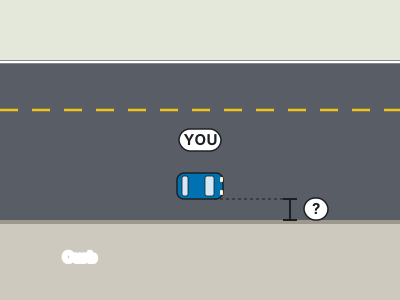
12. On a two-lane Rhode Island road, how close must a parked vehicle's right wheels be to the right side or curb?
- A maximum of three feet
- A maximum of twelve inches
- At least six feet
- Any distance if hazard lights are on
Show answer
A maximum of twelve inches. Unless another law prohibits parking, the manual says a vehicle on a two-lane road must place its right wheels no more than twelve inches from the right side or curb. Three feet leaves unnecessary clearance and can interfere with moving traffic. Six feet is even farther away, while hazard lights do not authorize an improper parking position. After stopping, check the curb alignment, leave room for traffic, and verify that no separate restriction such as a hydrant, crosswalk, or intersection applies.
Study this in the handbook: Where you may not park or stop
13. How are speeding fines treated in Rhode Island designated construction areas?
- They are waived when workers are not visible
- They are doubled twenty-four hours a day
- They are cut in half during daylight
- They apply only to commercial vehicles
Show answer
They are doubled twenty-four hours a day. Speeding tickets issued inside designated construction areas carry doubled fines twenty-four hours a day. The rule is tied to the work-zone location, not to whether a driver can see workers at that moment, so the choice “They are waived when workers are not visible” is unsafe. There is no daylight discount, and the provision is not limited to commercial vehicles. Slow down to the posted construction speed, watch for changing lane patterns, and treat orange signs as an immediate cue that ordinary speeding consequences have increased.
Study this in the handbook: Speed limits and freeway driving
14. How does the Rhode Island three second rule measure following distance?
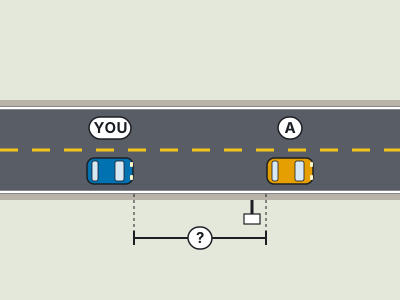
- Use the speedometer to hold a fixed number of feet
- Measure three car lengths with a tape measure
- Wait until the vehicle ahead changes lanes
- Count until your vehicle reaches a fixed point passed by the vehicle ahead
Show answer
Count until your vehicle reaches a fixed point passed by the vehicle ahead. The three second method uses a fixed roadside reference. When the vehicle ahead passes a sign, pole, tree, overpass, or pavement line, the following driver starts counting. Reaching that same point before the count ends means the gap is too short, so the driver should drop back and count again. Car lengths and fixed feet change meaning as speed changes, and a lane change is not a reliable measurement event. The cue is point, count, compare: select a landmark and let time, rather than guesswork, set the cushion.
Study this in the handbook: Following distance, trucks and motorcycles
15. What is the recommended sequence for controlling a vehicle that begins to skid?
- Press the accelerator and steer sharply away from the skid
- Release the gas, avoid the brake, let the vehicle slow, and steer where you want to go
- Lock the brakes while turning toward the shoulder
- Shift to park and hold the wheel straight
Show answer
Release the gas, avoid the brake, let the vehicle slow, and steer where you want to go. During a skid, abrupt pedal or steering inputs can make the vehicle harder to control. The manual’s sequence is to let off the gas, keep the foot away from the brake and clutch, allow gradual slowing, and turn in the direction you want the vehicle to go. That response differs from locking the brakes, adding power, or making a sharp opposite turn. Keep steering corrections measured and be ready to work left and right until the vehicle settles.
Study this in the handbook: Skids, brake failure, blowouts and other emergencies
16. What does a flashing yellow traffic signal tell motorists to do?
- Accelerate before cross traffic arrives
- Stop until the signal becomes solid green
- Proceed with caution
- Ignore the signal as a malfunction
Show answer
Proceed with caution. A flashing yellow signal allows movement but calls for caution. It is not a command to stop like flashing red, and it is not permission to accelerate or disregard the intersection. The driver should reduce risk by scanning for vehicles and pedestrians, adjusting speed, and proceeding only when the path is safe. The compact study cue is yellow means caution, while red means stop. That distinction matters because treating the flashing yellow as a malfunction or as a green light can lead to a conflict with crossing traffic.
17. What traffic direction does a Rhode Island roundabout use around its center island?
- Either direction, depending on the exit
- Clockwise
- Counterclockwise
- Straight through the center island
Show answer
Counterclockwise. A Rhode Island roundabout directs traffic counterclockwise around a center island. The circular design uses yield signs, directional signs, and pavement markings instead of stop signs or traffic signals to organize movement. Clockwise travel would oppose the pattern described in the manual, while the center island is not a travel lane. As you approach, slow to the posted speed, yield at entry, and follow the circulating path until reaching the intended exit.
Study this in the handbook: Traffic lights and roundabouts
18. An adult Rhode Island driver is convicted of a first DUI with a BAC between 0.08% and 0.1%. What license suspension and fine does the table list?
- 1 to 2 year suspension and $400 fine
- Suspension until age 21 and $250 fine
- 3 to 18 month suspension and $500 fine
- 30 to 180 day suspension and $100 to $300 fine
Show answer
30 to 180 day suspension and $100 to $300 fine. For drivers 21 or older with a BAC of 0.08% to 0.1%, a first violation is a misdemeanor with up to 1 year in prison, a 30 to 180 day license suspension, a $100 to $300 fine, and a $500 highway safety assessment. The 3 to 18 month suspension with a $500 fine is the first offense at 0.15% or above. A 1 to 2 year suspension with a $400 fine is a second offense. Suspension until age 21 applies only to younger drivers.
Study this in the handbook: Refusal and DUI penalties
19. A Rhode Island permit holder runs a stop sign during a practice drive. What does the manual say about the supervising driver?
- The supervising driver is legally responsible for any driving violation the permit holder commits
- Only the vehicle owner can be cited
- The supervising driver bears no responsibility for the permit holder's driving
- Only the permit holder's parent can be held responsible
Show answer
The supervising driver is legally responsible for any driving violation the permit holder commits. The licensed supervising driver must sit beside the permit holder at all times, be ready to take control in an emergency, and is legally responsible for any driving violation the permit holder may commit. That makes the choice saying the supervisor bears no responsibility wrong. The rule is written about the supervising driver, not the vehicle owner or a parent who is not in the car. A supervisor who is distracted or asleep cannot meet that duty, which is why the manual also says to be ready to take control.
Study this in the handbook: The three levels of Rhode Island's graduated license
20. How long must a Rhode Island teen hold a Limited Instructional Permit before taking the DMV road test?
- At least 30 days
- At least 90 days
- At least six months
- At least one full year
Show answer
At least six months. The permit must be held for at least six months before a Rhode Island DMV road test. Thirty days is the wait after a failed road test, not the permit holding period, and 90 days is not a Rhode Island GDL figure. One year is roughly how long the permit stays valid, not the minimum holding time. If the permit expires before the road test is passed, the applicant must retake the computerized test or be recertified by CCRI and get a new permit.
Study this in the handbook: The three levels of Rhode Island's graduated license
QualitySpace is expanding to Rhode Island
We are a California-based independent insurance brokerage working on licensing in more states. We cannot help with Rhode Island insurance yet. Leave your email and we will let you know when we can.
Every question is written from the official Rhode Island Driver's Manual. Need paper? Printable RI practice test with answer key.
Last verified 2026-10-05. How we check every question · Study all 200 as flashcards
Frequently asked questions
How many questions are on this Rhode Island practice test?
This fixed set has 20 questions. It is test 7 of 10 from the 200 question Rhode Island bank.
How does this fixed test relate to the full Rhode Island bank?
Each numbered test is a fixed set of questions in a fixed order, so you can retake the same test later and compare. Every test mixes road signs and the other topics in about the same proportion as the full bank. Tests 1 to 10 together cover every question in the Rhode Island bank once. The full practice page mixes the whole bank at random.
Last verified 2026-10-05. See the Rhode Island DMV facts page for sourced state details.
Return to the full Rhode Island practice test · Study road signs