
Test 4 of 10 · 20 questions · Free 2026
RI Permit Practice Test 4
Jump to the test ↓A fixed 20 question set from the Rhode Island bank with answers and plain English explanations.
Question 1 of 20 · 0 right so far
All 20 questions in test 4
Every question below comes from the Rhode Island question bank on this page. Open a question to see the correct answer and the explanation. Nothing here is hidden behind a signup.
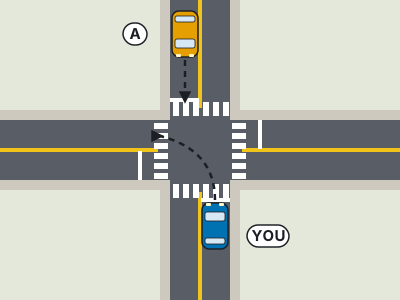
1. Before turning left at an intersection, which road user must the driver yield to?
- Only pedestrians already standing in a marked crosswalk
- Only vehicles larger than the turning vehicle
- Oncoming traffic, including an oncoming bicyclist
- No one, because a left turn has priority over straight traffic
Show answer
Oncoming traffic, including an oncoming bicyclist. A left turn crosses the path of people traveling toward the intersection. The manual specifically says the turning driver must yield to oncoming bicyclists just as to an oncoming motorist. Vehicle size is irrelevant, and the duty is not limited to pedestrians in a painted crosswalk. A left-turn signal does not create priority over straight traffic. Before moving across the opposing path, check for both motor vehicles and bicycles, then wait until the approach is clear.
Study this in the handbook: Pedestrians, school buses and bicyclists
2. At a Rhode Island four-way stop, two vehicles arrive at the same time. Which driver yields?
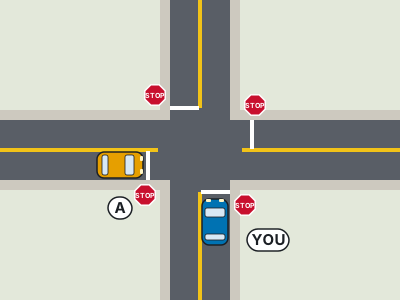
- The driver on the left yields to the vehicle on the right
- The driver on the right yields to the vehicle on the left
- The vehicle with the larger engine has priority
- Both drivers proceed together
Show answer
The driver on the left yields to the vehicle on the right. At a four-way stop, arrival order normally settles priority, but equal arrival creates a special tie rule. The vehicle on the left must yield to the vehicle on its right. The choice “The driver on the right yields to the vehicle on the left” reverses that relationship and would give priority to the wrong approach. A larger engine has no bearing on right-of-way, and moving together would create a conflict in the intersection. Make a complete stop first, identify which vehicle is to your right, and let that vehicle proceed before entering.
Study this in the handbook: Right of way at intersections, rotaries and driveways
3. Which condition requires Rhode Island drivers to turn on their vehicle headlights?
- Driving at noon on a clear, dry day
- Driving only on a divided highway
- Carrying a passenger in daylight
- Using windshield wipers
Show answer
Using windshield wipers. Rhode Island requires headlights from sunset to sunrise, any time you cannot see 500 feet ahead, when it is raining or snowing, and any time the windshield wipers are on. Clear, dry midday driving meets none of those conditions, and the rule has no special trigger for divided highways or for carrying a passenger. A practical cue is simple: if the wipers are operating, the headlights must be operating too, even when the rain seems light and the road ahead looks visible.
Study this in the handbook: Licenses, insurance, phones and other laws
4. What is the minimum license suspension in Rhode Island for refusing a chemical test?
- 30 days
- One year
- Two years
- Six months
Show answer
Six months. The Rhode Island manual states that if you refuse to take a chemical test, your license will be suspended for a minimum of six months. Refusal also brings a fine, a highway safety assessment, public community service, and drunk driving school or referral to an alcohol treatment program. The adult penalty table lists six months to one year for a first refusal, so one year is the top of that range rather than the minimum. Two years appears only for repeat violations, and 30 days is not a refusal figure at all.
Study this in the handbook: Alcohol, BAC limits and implied consent
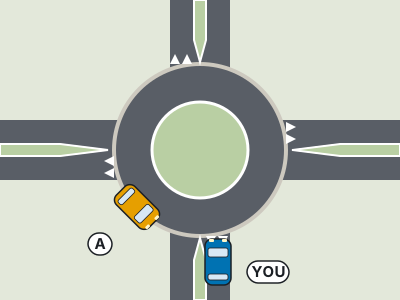
5. Before entering a roundabout, what should a motorist do after approaching the entrance?
- Enter immediately because entering traffic has priority
- Slow to the posted speed, yield to traffic already inside, and wait for a safe gap
- Stop inside the circle until every exit is empty
- Pass circulating vehicles on the left before merging
Show answer
Slow to the posted speed, yield to traffic already inside, and wait for a safe gap. Entry traffic must yield to vehicles already circulating. The driver should slow to the posted speed, find an adequate safe gap, and merge counterclockwise without forcing a circulating vehicle to brake. Entering immediately reverses the priority, and stopping inside the circle is prohibited unless there is an emergency. Passing inside the roundabout adds an unnecessary conflict. Approach with eyes on the circulating lane, choose the gap before entering, and maintain the planned path to the exit.
Study this in the handbook: Traffic lights and roundabouts
6. If an aggressive driver continues to hassle or follow you, where should you drive for help?
- Home, so the driver learns your address
- A deserted shoulder where the driver cannot see you
- The nearest police station or a busy place
- A faster lane where you can race away
Show answer
The nearest police station or a busy place. A driver who continues to hassle or follow you should be met with distance and public visibility, not a confrontation. The manual recommends driving to the nearest police station or busy place to get help. Going home reveals a private location, while a deserted shoulder removes witnesses and assistance. Keep doors locked, avoid eye contact, and do not make sudden braking or swerving moves while you choose a safe destination.
Study this in the handbook: Distractions, drowsy driving and road rage
7. In Rhode Island, when must a collision additionally be reported to the police?
- Only when a vehicle must be towed
- When property damage is over $100
- Only when a driver is under 18
- When it involves personal injury or property damage over $1,000
Show answer
When it involves personal injury or property damage over $1,000. The manual says any collision involving personal injury or property damage in excess of $1,000 must additionally be reported to the police. A tow is not the test, and the rule does not depend on a driver's age. The $100 figure is far below the reporting threshold. If you hit an unattended vehicle or property, you must also leave your name and address in writing, securely attached, and report the collision to the nearest state or local police.
Study this in the handbook: After a collision and when stopped by police
8. A 19-year-old Rhode Island driver, alone, knowingly carries an unopened case of beer in the trunk (not for work). What may the DMV do?
- Nothing, because the containers are unopened
- Suspend the license for not more than 30 days
- Revoke the license for 5 years
- Issue a $50 fine only
Show answer
Suspend the license for not more than 30 days. Rhode Island law says a driver under 21 who operates a vehicle, unless accompanied by a parent or legal guardian, and knowingly has alcoholic beverages in any form, opened or unopened, anywhere in the vehicle, faces a license suspension of not more than 30 days. Unopened containers are expressly covered, so a choice that exempts them fails. The narrow exception is for ages 16 to 21 transporting unopened alcohol in the course of their employment. Five year revocation and a $50 fine are not the listed penalty.
Study this in the handbook: Refusal and DUI penalties
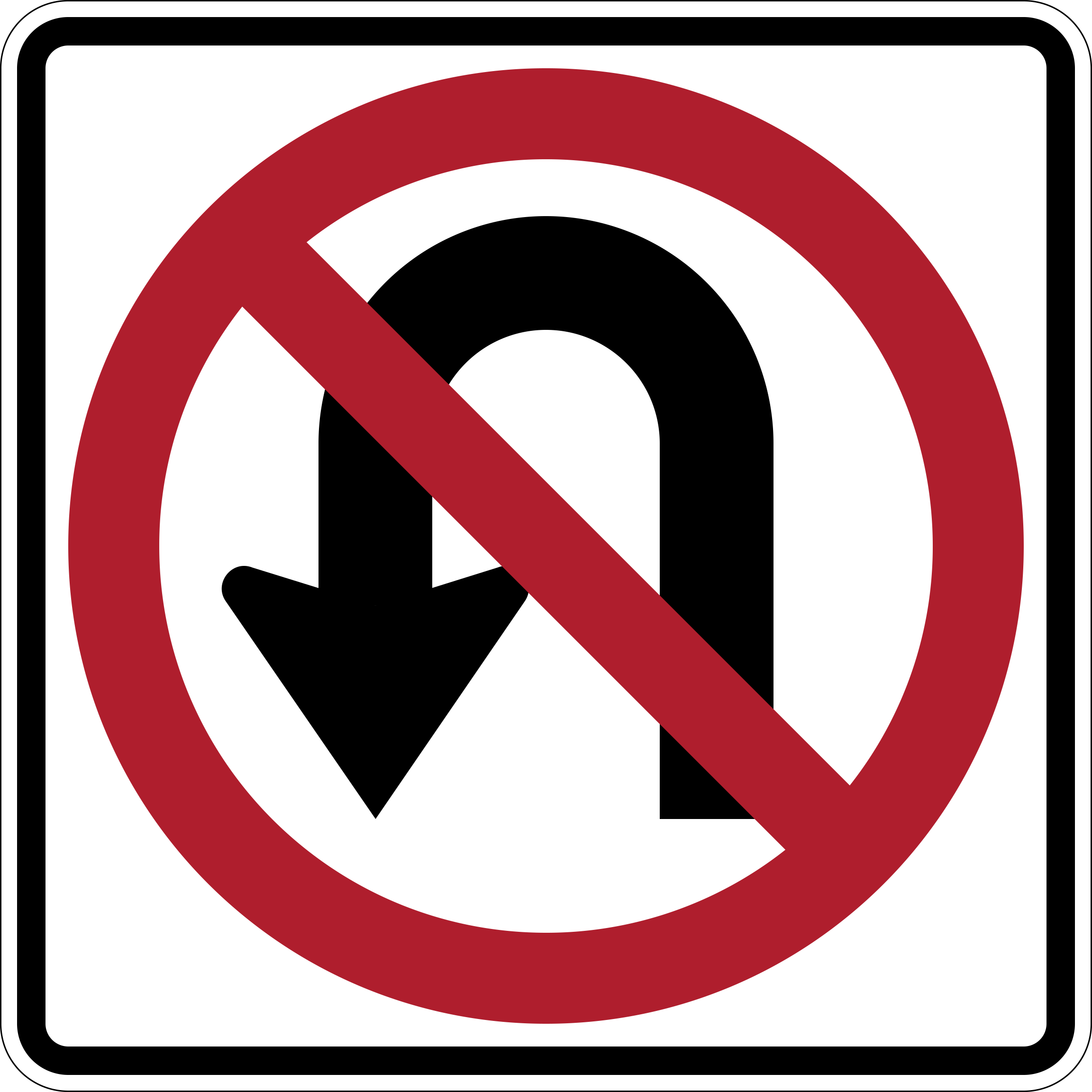
9. Which maneuver is prohibited by this sign?
- Turning into a driveway on the right
- Changing from one lane to another
- Making a U-turn
- Stopping at a marked intersection
Show answer
Making a U-turn. The crossed U-shaped arrow identifies a prohibition on U-turns at that location. It does not ban ordinary lane changes, right turns into driveways, or stopping where another sign or signal requires a stop. A driver should read the symbol literally: the barred maneuver is turning the vehicle around. If a route is missed, continue to a lawful place where a turnabout is permitted.
10. What does a crossroad warning sign tell a driver to anticipate?

- A hospital entrance with emergency vehicles
- An intersection where traffic may cross from both sides
- A road closed to all turning movements
- A one-way lane that must be used for passing
Show answer
An intersection where traffic may cross from both sides. A crossroad warning indicates an intersection ahead, with traffic potentially entering from either side. Reduce speed, watch for vehicles and pedestrians, and be prepared to yield according to the traffic control present. A hospital entrance is a guide or service location, not the meaning of the plus-shaped roadway symbol. A prohibition on turns requires a regulatory sign, and a passing lane does not describe crossing traffic. Use the intersecting arms as the cue that another road will meet yours ahead.
11. What following-distance rule does the manual give as an easy way to judge a safe gap?
- One car length at every speed
- The three-second-following-distance rule
- A half-second gap in light traffic
- Exactly ten feet behind the vehicle ahead
Show answer
The three-second-following-distance rule. The manual uses a three second following distance as a practical way to judge space behind another vehicle. It is not a fixed number of feet because the required distance grows with speed. Wet or slippery pavement calls for additional seconds, and a motorcycle deserves extra room as well. Choose a fixed object, count the time between the vehicle ahead passing it and your vehicle reaching it, and increase the gap when conditions deteriorate.
Study this in the handbook: Licenses, insurance, phones and other laws
12. Which source does the Rhode Island manual identify for up-to-date changes in laws, fees, and procedures?
- The DMV or Rhode Island General Laws websites
- A vehicle owner's manual
- A newspaper classified advertisement
- A roadway construction cone
Show answer
The DMV or Rhode Island General Laws websites. The manual points readers to dmv.ri.gov or rilin.state.ri.us when they need current information about laws, fees, or procedures. A vehicle owner's manual covers operation and maintenance, not state licensing rules. Classified advertisements and roadway equipment have no authority to update DMV requirements. This distinction is useful because the handbook itself warns that listed fees may be subject to surcharges or statutory changes. Verify time-sensitive details before relying on a printed page.
13. How far behind an emergency vehicle does the Rhode Island manual advise a driver to remain?
- At least 500 feet
- At least 50 feet
- Exactly 100 feet
- No distance is advised after the vehicle passes
Show answer
At least 500 feet. Rhode Island's highway safety list tells drivers to give emergency vehicles the right of way at all times, pull over to the right and stop until they pass, and then signal and check over the shoulder for another emergency vehicle before re-entering traffic. The same item says to always drive 500 feet behind emergency vehicles. Fifty feet is the manual's distance for staying behind a large truck so its driver can see you, and 100 feet is the turn signal distance. Let the gap open to at least 500 feet before continuing.
Study this in the handbook: After a collision and when stopped by police
14. A Rhode Island sign says NO RIGHT TURN ON RED. What does that sign require?
- Use the shoulder to turn around
- Turn right after slowing without stopping
- Turn right only if a vehicle behind you signals
- Do not make a right turn during the red signal
Show answer
Do not make a right turn during the red signal. Rhode Island drivers may normally turn right at a red light after a full stop, but not when a no turn on red sign is posted. The sign removes that permission, so you remain stopped and wait for a signal that allows the movement. A slow roll is not a full stop, and a following vehicle's signal never changes the restriction. Using the shoulder to get around the light is not a lawful option. Look for the posted restriction before turning, then wait for a green indication or another lawful instruction.
Study this in the handbook: Licenses, insurance, phones and other laws
15. If a solid yellow line is on your side and a broken yellow line is on the other side, who may pass?
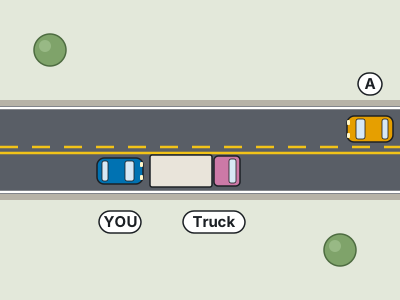
- The driver beside the broken line may pass with care
- Both directions may pass without checking
- The driver beside the solid line may pass freely
- Neither direction may ever cross for a legal turn
Show answer
The driver beside the broken line may pass with care. With solid and broken yellow lines together, the restriction applies according to which line is beside the driver. A motorist next to the solid line should not pass or cross it, except for listed emergencies or lawful movements. The motorist next to the broken line may pass another vehicle with care. Both directions therefore do not have equal permission. Read the pavement from your seat, verify that the broken line is on your side, and check sight distance and oncoming traffic before beginning any pass.
Study this in the handbook: Turn signals and roadway markings
16. What should a Rhode Island driver do before changing lanes?
- Rely only on the horn without signaling
- Move first and signal after entering the new lane
- Use the turn signal before changing lanes
- Signal only when another vehicle is beside the car
Show answer
Use the turn signal before changing lanes. Rhode Island’s highway guidance says drivers should use turn signals before changing lanes. Signaling after the vehicle has moved gives nearby traffic no useful advance notice, and a horn cannot communicate the intended lateral movement as clearly. Waiting until another vehicle is beside the car also removes valuable warning time. Check mirrors and the blind spot, signal early enough for others to understand the plan, and change lanes only after the space is clear. Turn the signal off once the maneuver is complete.
17. Which sign in the Rhode Island manual identifies a roadway exit?
- Exit Ahead
- No Passing Zone
- Slippery When Wet
- Stop Sign Ahead
Show answer
Exit Ahead. Exit Ahead is listed with the manual’s guide signs, which provide navigation information before or along a route. No Passing Zone, Slippery When Wet, and Stop Sign Ahead belong to warning or regulatory information and describe restrictions or hazards rather than a destination decision. When you see an exit guide sign, plan your lane position early and avoid a sudden crossing of traffic. The study cue is the sign’s purpose: guide signs help you navigate, while warning signs prepare you for conditions and regulatory signs direct lawful conduct.
18. A Rhode Island permit holder has logged 60 supervised hours and passed the road test, but was convicted of a seat belt infraction four months ago. What blocks the Limited Provisional License?
- Nothing, because seat belt infractions are not moving violations
- The applicant must repeat the 33 hour driver education class
- The applicant must be free of moving violations and seat belt infractions for the previous six months
- The applicant must wait until age 18 for any license
Show answer
The applicant must be free of moving violations and seat belt infractions for the previous six months. To get a Limited Provisional License, the applicant must not have been convicted of a moving violation or a safety belt infraction during the previous six months. A conviction four months ago falls inside that window, so the license must wait. Seat belt infractions are named separately in the rule, which is why the idea that they do not count is wrong. Nothing in the manual requires repeating the 33 hour course for this, and the provisional license exists precisely for drivers under 18.
Study this in the handbook: The three levels of Rhode Island's graduated license
19. What minimum vision, with corrective lenses if you normally wear them, does Rhode Island require for a Limited Instructional Permit?
- 20/70
- 20/100
- 20/20
- 20/40
Show answer
20/40. Every permit applicant takes a vision test, and the vision must be at least 20/40 with corrected lenses. Anyone who normally wears glasses or contact lenses to see at a distance must wear them for the test. The 20/20 choice describes perfect vision, which is not required. The 20/70 and 20/100 choices describe weaker vision than the Rhode Island minimum, so they would not qualify an applicant for the permit.
Study this in the handbook: The three levels of Rhode Island's graduated license
20. What speed does the Rhode Island manual list for residential areas?
- 35 miles per hour
- 25 miles per hour
- 45 miles per hour
- 55 miles per hour
Show answer
25 miles per hour. The highway safety section lists 25 miles per hour for residential areas. The higher choices are not the residential figure given in this summary, even though highways may have substantially different limits. A posted sign and current law still control the road you are actually using, and the Basic Speed Law requires a lower speed when weather, traffic, or surface conditions demand it. Treat 25 mph as the listed residential reference, not permission to ignore a lower posting or unsafe conditions.
Study this in the handbook: Speed limits and freeway driving
QualitySpace is expanding to Rhode Island
We are a California-based independent insurance brokerage working on licensing in more states. We cannot help with Rhode Island insurance yet. Leave your email and we will let you know when we can.
Every question is written from the official Rhode Island Driver's Manual. Need paper? Printable RI practice test with answer key.
Last verified 2026-10-05. How we check every question · Study all 200 as flashcards
Frequently asked questions
How many questions are on this Rhode Island practice test?
This fixed set has 20 questions. It is test 4 of 10 from the 200 question Rhode Island bank.
How does this fixed test relate to the full Rhode Island bank?
Each numbered test is a fixed set of questions in a fixed order, so you can retake the same test later and compare. Every test mixes road signs and the other topics in about the same proportion as the full bank. Tests 1 to 10 together cover every question in the Rhode Island bank once. The full practice page mixes the whole bank at random.
Last verified 2026-10-05. See the Rhode Island DMV facts page for sourced state details.
Return to the full Rhode Island practice test · Study road signs