
Test 6 of 25 · 20 questions · Free 2026
WA Permit Practice Test 6
Jump to the test ↓A fixed 20 question set from the Washington bank with answers and plain English explanations. The real WA exam is 40 questions, 80 percent to pass; take the full length version on the main practice page.
Question 1 of 20 · 0 right so far
All 20 questions in test 6
Every question below comes from the Washington question bank on this page. Open a question to see the correct answer and the explanation. Nothing here is hidden behind a signup.
1. How close to a railroad crossing may you park in Washington?
- No closer than 15 feet
- No closer than 20 feet
- No closer than 50 feet
- No closer than 100 feet
Show answer
No closer than 50 feet. Washington bans parking on railroad tracks and within 50 feet of a railroad crossing. Fifteen feet is the hydrant rule and also the nearest point a driver may stop before a flashing crossing, a different situation. Twenty feet is the pedestrian safety zone rule, and 100 feet is not the stated distance. The guide puts both rules in the same list of places where a driver may not park.
Study this in the handbook: Parking rules and hills
2. When driving at night, how should you adjust your following distance?
- Reduce it because headlights improve visibility
- Keep exactly one vehicle length in every condition
- Increase it
- Follow more closely so you can use the vehicle ahead as a guide
Show answer
Increase it. Night driving limits what you can see and how quickly you can identify a hazard, so the guide advises increasing following distance. Extra space gives you more time to react within the area illuminated by your headlights. Following closely reduces that time and can hide hazards behind the vehicle ahead. A fixed one length rule ignores changing speed and visibility. Keep your headlights appropriate, scan beyond the beam for shadows, and leave a larger cushion whenever darkness or an unfamiliar road reduces your view.
Study this in the handbook: Night driving, slippery roads, skids and hydroplaning
3. Why do variable speed limit signs display changing speed limits?
- To distribute the flow of traffic
- To show the average speed drivers have chosen
- To replace enforceable limits with suggested speeds
- To mark the speed of the slowest vehicle nearby
Show answer
To distribute the flow of traffic. Variable speed limit signs change the posted limit to help distribute traffic flow. Their purpose is not to report the average speed of drivers or the speed of a nearby vehicle. Washington distinguishes these digital limits from speed warning signs, which recommend a speed change for a hazard or road condition. Read a changing limit as traffic control information rather than treating it as a report of what other drivers are doing.
Study this in the handbook: Traffic signs
4. When must a Washington driver yield to a transit bus?
- Never, buses yield to cars
- Only at bus stops with a red curb
- Only when the bus is stopped
- When a bus traveling in the same direction has signaled and is pulling back onto the roadway
Show answer
When a bus traveling in the same direction has signaled and is pulling back onto the roadway. Yield to any transit vehicle traveling in the same direction as you that has signaled and is pulling back onto the roadway. The duty is triggered by two facts together: the bus is heading your way and has signaled that it is pulling back into traffic. Slow and let the bus back in rather than accelerating to pass it. Neither a red curb nor a bus simply sitting at a stop is the condition the guide names; the signal and the return to the roadway are.
Study this in the handbook: Pedestrians, school buses and transit buses
5. What is the best way to reduce the risk of hydroplaning on a wet road?
- Slow down
- Increase speed to cross the water quickly
- Brake hard whenever water covers the roadway
- Turn the steering wheel rapidly to find traction
Show answer
Slow down. Hydroplaning occurs when water builds between the tires and road, reducing traction and making the vehicle feel as if it is floating. The guide identifies slowing down on a wet road as the best prevention. Speeding increases the chance that the tires will lose contact, while hard braking and rapid steering can worsen instability. Watch for standing water, reduce speed before reaching it, and keep your movements smooth. If the vehicle does begin to hydroplane, avoid jerking the wheel and wait calmly for traction to return.
Study this in the handbook: Night driving, slippery roads, skids and hydroplaning
6. What marks a Washington agricultural vehicle designed to go 25 mph or less?
- A flashing blue light
- A red flag on the left side
- A white square
- A triangle sign or emblem on the back
Show answer
A triangle sign or emblem on the back. Agricultural and farm vehicles designed to go 25 mph or less carry a triangle sign or emblem on the back. When you see the slow moving vehicle emblem, be patient, slow down and give plenty of space. If you need to pass and there are two lanes in your direction, move over one full lane. If there is only one lane in each direction, look for oncoming traffic and proceed carefully, leaving at least 3 feet between the widest part of your vehicle and the farm vehicle.
Study this in the handbook: Large vehicles, motorcycles, bicycles and farm vehicles
7. Before turning, what check does the Washington guide specifically recommend for nearby bicyclists or pedestrians?
- Rely only on the rearview mirror
- Check the side mirrors and look over your shoulder
- Sound the horn and turn without looking behind
- Check behind only after the turn is complete
Show answer
Check the side mirrors and look over your shoulder. A turn can cross the path of someone beside or behind the vehicle, so the guide calls for side-mirror checks and an over-shoulder check before turning. A rearview mirror alone leaves side areas unexamined. A horn is not a substitute for seeing a bicyclist or pedestrian, and checking after the turn comes too late to prevent a conflict. Build the mirror and shoulder scan into the turn routine before steering across the adjacent path.
Study this in the handbook: Large vehicles, motorcycles, bicycles and farm vehicles
8. What do Washington recreation signs identify?
- Only emergency hospitals
- Only route speed limits
- Only temporary lane closures
- Local attractions such as hiking trails, picnic spaces, and skiing areas
Show answer
Local attractions such as hiking trails, picnic spaces, and skiing areas. Recreation signs identify local attractions, with hiking trails, picnic spaces, and skiing areas listed as examples. They are different from service signs, which point to facilities such as hospitals, and from work-zone signs, which warn about roadway operations. A recreation sign helps with trip planning, but it does not change the speed limit or authorize a lane maneuver. Continue watching the roadway while following its direction.
Study this in the handbook: Traffic signs
9. After stopping at a red light, when may you turn right?
- Whenever the light has been red for at least five seconds
- When no no-turn-on-red sign applies and there is room to enter traffic
- Without stopping if the cross street appears empty
- Only after the driver behind you honks
Show answer
When no no-turn-on-red sign applies and there is room to enter traffic. A right turn on red requires a complete stop first. You may then turn only if there is no no turn on red sign and there is plenty of room to enter traffic safely. The five second idea invents a timer that Washington does not use, and an empty looking cross street does not remove the stop requirement. Check for pedestrians, bicyclists, and approaching vehicles before turning. The reliable sequence is stop, check the restriction, yield, and turn only with adequate space.
Study this in the handbook: Traffic signals and rules of the road
10. After the first six months with a Washington intermediate license, how many passengers under 20 who are not immediate family may ride along?
- None
- No more than three
- No more than one
- No more than five
Show answer
No more than three. From six months until age 18 or one year, whichever comes first, an intermediate driver may carry no more than three passengers under 20 who are not immediate family. None is the rule only for the first six months. A one passenger cap is not the Washington rule, and five exceeds the cap. After one year of safe driving with no crash or traffic offense, the passenger limits no longer apply.
Study this in the handbook: Instruction permits and the intermediate license
11. An adult 18 or older in Washington chooses to practice on a permit before the skills exam. How experienced must the supervising driver be?
- 3 or more years of experience
- Any licensed driver age 18 or older
- 5 or more years of experience
- 10 or more years of experience
Show answer
5 or more years of experience. One of the four ways an adult can get a first Washington license is to pass the knowledge exam, get a permit, practice with a licensed driver who has 5 or more years of experience, and then pass the skills exam. Three years is the rule for supervising a teen's logged hours. Any licensed 18-year-old would not meet the standard, and ten years exceeds it. Adults may also transfer a license or take a course with an exam waiver.
Study this in the handbook: Instruction permits and the intermediate license
12. A Washington teen who skips driver training passes the knowledge exam at 15 and a half. When may the teen take the skills exam?
- Not until age 18
- At age 16
- At age 16 and a half
- Six months after getting the permit
Show answer
Not until age 18. Without a driver training course, a teen can take the knowledge exam at 15 and a half and get a permit, but must wait until 18 to take the skills exam and get a license. Age 16 with six months on the permit is the path for teens who complete an approved traffic safety course. Sixteen and a half is not a Washington threshold. The permit lasts one year and can be renewed for a fee.
Study this in the handbook: Instruction permits and the intermediate license
13. A Washington driver is convicted of DUI. Within what range can the driving privilege be suspended?
- 90 days to 4 years
- 7 days to 30 days
- 90 days to 730 days only for refusals
- Exactly one year every time
Show answer
90 days to 4 years. A DUI conviction can bring a suspension of 90 days to 4 years, along with a probationary license, an ignition interlock device, proof of financial responsibility, an alcohol assessment, and retesting. The 90 to 730 day range is for refusing a test, not for a conviction. Seven to 30 days is far too short, and the length is not a fixed year. Alcohol and drug offenses stay on the driving record for life.
Study this in the handbook: License exams, renewal and losing your license
14. How far from the nearest rail should a driver stop when a railroad crossing signal is flashing?
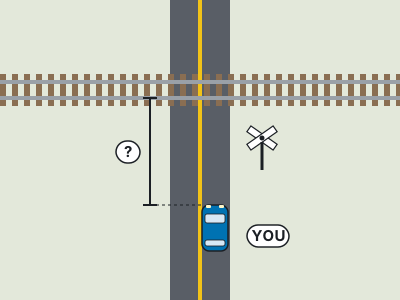
- Exactly 75 feet
- Between 1 and 5 feet
- At least 100 feet and no closer
- Between 15 and 50 feet
Show answer
Between 15 and 50 feet. When a railroad crossing signal is flashing, a driver must stop between 15 and 50 feet from the nearest rail. The shorter distances leave too little room if a train enters the crossing, while 75 or 100 feet are not the guide’s stated range. The same stopping distance applies when a gate is lowering, a flagger signals, a train creates an immediate hazard, or a warning horn sounds. Stop before the tracks, wait for the warning to end, and never drive around a lowered gate.
Study this in the handbook: Railroad crossings, emergency vehicles and emergency zones
15. Which trip is an exception allowing a Washington intermediate license holder to drive at any hour with passengers?
- Agricultural purposes
- A late restaurant visit
- A recreational movie trip
- A shopping trip across town
Show answer
Agricultural purposes. Agricultural purposes are one named exception to the intermediate-license time and passenger restrictions. The guide does not extend that exception to ordinary recreation, dining, or shopping, even when a parent knows about the trip. The purpose of the journey matters, not simply the driver's desire to travel late. Before relying on an exception, compare the actual trip with the limited agricultural activity described in the manual.
Study this in the handbook: Instruction permits and the intermediate license
16. How often does the Washington guide suggest stopping during a long trip?
- Every 300 miles or 5 hours
- About every 100 miles or 2 hours
- Only when the fuel tank is low
- Every 25 miles
Show answer
About every 100 miles or 2 hours. Planning breaks helps you stay alert on long drives. The Washington guide suggests stopping about every 100 miles or 2 hours, walking around, getting fresh air and drinking water. It also recommends getting adequate sleep before the trip, since most people need 7 to 9 hours, and bringing a travel companion who can share the driving. Waiting until you need fuel could mean driving far longer than two hours while fatigue builds.
Study this in the handbook: Alcohol, cannabis, medicine and fatigue
17. If vehicle trouble prevents you from getting completely off the road, where should you stop?
- Just over a hill where approaching drivers cannot see you
- Where other drivers have a clear view of your vehicle
- Around a curve so traffic can pass on the straightaway
- In the nearest travel lane with no warning lights
Show answer
Where other drivers have a clear view of your vehicle. When a disabled vehicle cannot be moved away from traffic, visibility becomes the priority. Stop where approaching drivers have a clear view of the vehicle, and avoid a position just over a hill or around a curve. Those hidden locations give other drivers less time to react and increase the chance of a secondary collision. The manual also advises using emergency flashers and headlights, then placing flares behind the vehicle when available. Remember the cue: if you cannot get fully off the road, choose a visible stopping place and warn traffic.
Study this in the handbook: Breakdowns, collisions and power lines
18. What does Selective Service registration through Washington licensing mean?
- Automatic enlistment in the military
- A background check for the license
- Registration to vote
- A person assigned male at birth between ages 18 and 25 becomes eligible to be drafted in a national emergency
Show answer
A person assigned male at birth between ages 18 and 25 becomes eligible to be drafted in a national emergency. The guide's glossary explains that Selective Service registration makes a person assigned male at birth between ages 18 and 25 eligible to be drafted in the military in case of a national emergency. Washington lets applicants register with the United States Selective Service System when applying for a license or ID card; that sign up is not enlistment and not a background check. Voter registration is a separate option offered at licensing offices.
19. What does the Washington guide say about snow tires and chains?
- They are never required in Washington
- Chains may only be used on the rear wheels
- Use snow tires or chains when it is required, and chains or studded tires improve winter traction
- They are only for trucks
Show answer
Use snow tires or chains when it is required, and chains or studded tires improve winter traction. Snowy roads require a larger following distance and dramatically reduced speed, and the guide says to use snow tires or chains when required. During winter months you can improve traction by adding chains or changing to studded tires. Avoid icy roads when possible; if you must drive on them, slow down and leave extra space. On cold, wet days shady spots can be icy, and overpasses and other bridges can have icy spots even when the rest of the road does not.
Study this in the handbook: Night driving, slippery roads, skids and hydroplaning
20. In Washington, may you cross a solid yellow line on your side to enter a shared center lane marked with left-turn arrows?
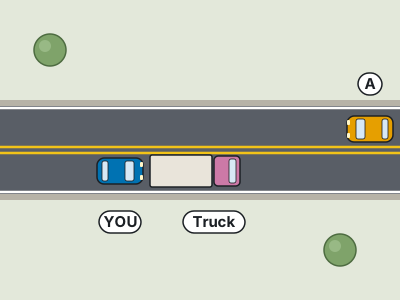
- Only to pass a slow vehicle in the center lane
- No, a solid yellow line can never be crossed for any purpose
- Yes, to enter the shared turn lane
- Only if the center lane is marked for through travel
Show answer
Yes, to enter the shared turn lane. Washington permits crossing the solid yellow line on your side to enter a shared center turn lane. Look for its left-turn arrows and remain aware of vehicles approaching from the other direction because they may also use that lane. This is different from crossing a solid yellow line to pass another vehicle. The shared lane is for the indicated turning movements, so permission to enter it does not make it an extra passing or through lane.
Study this in the handbook: Road markings, lanes and school zones
Every question is written from the official Washington State Driver Guide. Need paper? Printable WA practice test with answer key.
Last verified 2026-10-05. How we check every question · Study all 500 as flashcards
Frequently asked questions
How many questions are on this Washington practice test?
This fixed set has 20 questions. It is test 6 of 25 from the 500 question Washington bank. The real WA exam asks 40 questions and you need 32 correct.
What is the passing score for the real Washington test?
32 out of 40 correct answers (80%) That figure comes from the official Washington source cited on the DMV facts page.
How does this fixed test relate to the full Washington bank?
Each numbered test is a fixed set of questions in a fixed order, so you can retake the same test later and compare. Every test mixes road signs and the other topics in about the same proportion as the full bank. Tests 1 to 25 together cover every question in the Washington bank once. The full practice page mixes the whole bank at random.
Last verified 2026-10-05. See the Washington DMV facts page for sourced state details.
Return to the full Washington practice test · Study road signs