
Key points
Trains always have the right of way and can take up to a mile to stop.
Source: PDF page 40
“Trains ALWAYS have the right-of-way. They are heavy and cannot stop quickly even if they are traveling at low speeds. It can take up to a mile for a train to come to a full stop.”
Washington Driver Guide (plain-text version), PDF page 40Stop between 15 and 50 feet from the nearest rail when the signal flashes, the gate is lowering or down, or a flagger signals stop.
Source: PDF page 40
“Stop between 15 and 50 feet away from the nearest rail of a crossing when: The signal is flashing. The crossing gate is lowering or already down. A flagger is giving a signal to stop.”
Washington Driver Guide (plain-text version), PDF page 40Never stop on the tracks; if your vehicle gets stuck at a crossing, get everyone out immediately.
Source: PDF page 40
“Do not stop on the tracks. If your vehicle gets stuck at a crossing, get everyone out immediately.”
Washington Driver Guide (plain-text version), PDF page 40To report a problem at a crossing, call the number on the blue and white Emergency Notification System sign and give the crossing ID.
Source: PDF page 40
“call the number on the blue and white Emergency Notification System sign. Give the crossing ID number to the dispatcher.”
Washington Driver Guide (plain-text version), PDF page 40As soon as you see or hear an emergency vehicle's signals, pull to the right side of the road and stop.
Source: PDF page 41
“As soon as you see or hear the signals, immediately pull your vehicle to the right side of the road and stop.”
Washington Driver Guide (plain-text version), PDF page 41After it passes, signal and reenter traffic in the order you were traveling before.
Source: PDF page 41
“Wait until the emergency vehicle has passed before signaling and reentering traffic. You should reenter traffic in the order you were traveling before.”
Washington Driver Guide (plain-text version), PDF page 41As soon as you see a roadside response vehicle with flashing lights, move over into a farther lane or slow to at least 10 mph below the posted limit.
Source: PDF page 55
“As soon as you see a roadside response vehicle with flashing lights, you must either: Move over into a farther lane. Slow down to at least 10 mph below the posted speed limit.”
Washington Driver Guide (plain-text version), PDF page 55Never drive faster than 50 mph in an emergency zone.
Source: PDF page 55
“Never drive faster than 50 mph in an emergency zone.”
Washington Driver Guide (plain-text version), PDF page 55
Numbers to know
| Number | What it means | Manual |
|---|---|---|
| 15 to 50 feet | where to stop from the nearest rail | PDF page 40 |
| 911 | number to call if there is no Emergency Notification System sign | PDF page 40 |
| 10 mph below | how far below the posted limit to slow if you do not move over | PDF page 55 |
| 50 mph | maximum speed in an emergency zone | PDF page 55 |
Recognize these signs

Railroad crossing ahead 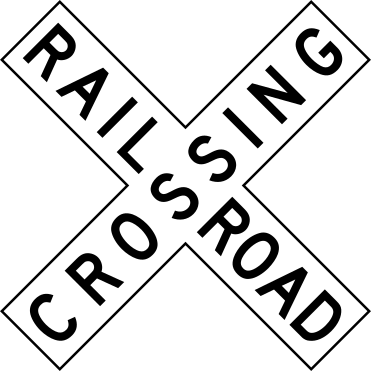
Railroad crossbuck
3 questions from the Washington practice test
1. How far from the nearest rail should a driver stop when a railroad crossing signal is flashing?
- Exactly 75 feet
- Between 1 and 5 feet
- At least 100 feet and no closer
- Between 15 and 50 feet
Show answer
Between 15 and 50 feet. When a railroad crossing signal is flashing, a driver must stop between 15 and 50 feet from the nearest rail. The shorter distances leave too little room if a train enters the crossing, while 75 or 100 feet are not the guide’s stated range. The same stopping distance applies when a gate is lowering, a flagger signals, a train creates an immediate hazard, or a warning horn sounds. Stop before the tracks, wait for the warning to end, and never drive around a lowered gate.
2. What is required when approaching a railroad crossing with flashing red lights?
- Cross quickly before the train reaches the crossing
- Stop and stay outside the gates, because a train is approaching
- Stop only if a gate is lowered
- Drive around the warning lights if the track looks clear
Show answer
Stop and stay outside the gates, because a train is approaching. Flashing red lights at a railroad crossing mean a train is approaching, so the driver must stop and stay outside of the gates. Trains always have the right-of-way, and the guide warns that a train can take up to a mile to come to a full stop. When the lights flash and bells ring, you must stop whether the gate is down or not, and you must never drive around the gate. Crossing quickly or driving around the warning equipment risks a collision. Go only after the red lights stop flashing and all other warning signs deactivate.
3. After pulling right for an emergency vehicle, how should you reenter traffic?
- Wait until it passes, then reenter in the order you were traveling
- Back into the lane before signaling
- Reenter immediately behind the emergency vehicle
- Use the left lane first regardless of traffic
Show answer
Wait until it passes, then reenter in the order you were traveling. After yielding to an emergency vehicle, wait until it has passed before signaling and reentering traffic. Return in the order you were traveling, which avoids cutting across vehicles that stopped with you or creating a new conflict. Following the emergency vehicle closely can interfere with its route, and backing into traffic is unpredictable. The left lane is not automatically the correct reentry path. Pull right, stop, watch the entire scene, and resume only after the emergency movement is complete and a safe gap is available.
Practice this topic
Lock it in with emergencies questions from the free Washington practice test. Every answer comes with a plain English explanation.
Source: the Washington Driver Guide (plain-text version), Chapter 4: Roads. This lesson is a plain English summary, not the law itself; where it differs, the manual and the statute govern. Last checked 2026-09-27.