
Key points
Yellow lines separate traffic in opposite directions; white lines separate lanes going the same way.
Source: PDF page 51
“Yellow lines separate traffic in opposite directions. White lines separate traffic lanes moving in the same direction.”
Washington Driver Guide (plain-text version), PDF page 51A dashed yellow center line on a two lane road means you may pass when safe.
Source: PDF page 52
“A dashed yellow line shows the center of a two-way, two-lane road. If it’s safe, you may use the oncoming lane to pass another vehicle.”
Washington Driver Guide (plain-text version), PDF page 52Double solid yellow center lines mean no passing in either direction.
Source: PDF page 52
“You are not allowed to pass, in either direction, on roads with double yellow lines.”
Washington Driver Guide (plain-text version), PDF page 52With a solid and a dashed yellow line, you may pass only if the dashed line is on your side.
Source: PDF page 52
“You’re not allowed to pass when the solid yellow line is on your side of the road. If the dashed line is on your side of the road, you may pass if it’s safe to do so.”
Washington Driver Guide (plain-text version), PDF page 52Double solid white lines are a barrier, and crossing them is illegal.
Source: PDF page 52
“Double solid white lines are a barrier between lanes. It’s illegal to cross double white lines.”
Washington Driver Guide (plain-text version), PDF page 52A shared center lane must not be used for passing, and you should not travel more than 300 feet in it.
Source: PDF page 52
“These lanes must not be used for passing. You shouldn’t travel farther than 300 feet in a center lane.”
Washington Driver Guide (plain-text version), PDF page 52It is illegal to drive within, over or across medians.
Source: PDF page 52
“It’s illegal to drive within, over, or across medians.”
Washington Driver Guide (plain-text version), PDF page 52On a reversible lane, a red X means you cannot use it.
Source: PDF page 53
“A green arrow means you can use the lane, and, a red X means you can’t.”
Washington Driver Guide (plain-text version), PDF page 53The school zone speed limit is 20 mph.
Source: PDF page 54
“The school zone speed limit is 20 mph because higher speeds increase the risk of fatal crashes.”
Washington Driver Guide (plain-text version), PDF page 54Always reduce your speed in a work zone, even when no workers are present.
Source: PDF page 55
“Always reduce your speed in a work zone, even if there are no workers.”
Washington Driver Guide (plain-text version), PDF page 55
Numbers to know
| Number | What it means | Manual |
|---|---|---|
| 300 feet | most you should travel in a shared center lane | PDF page 52 |
| 20 mph | school zone speed limit | PDF page 54 |
| 18 inches | width of solid yellow median markings | PDF page 52 |
Recognize these signs

School crossing 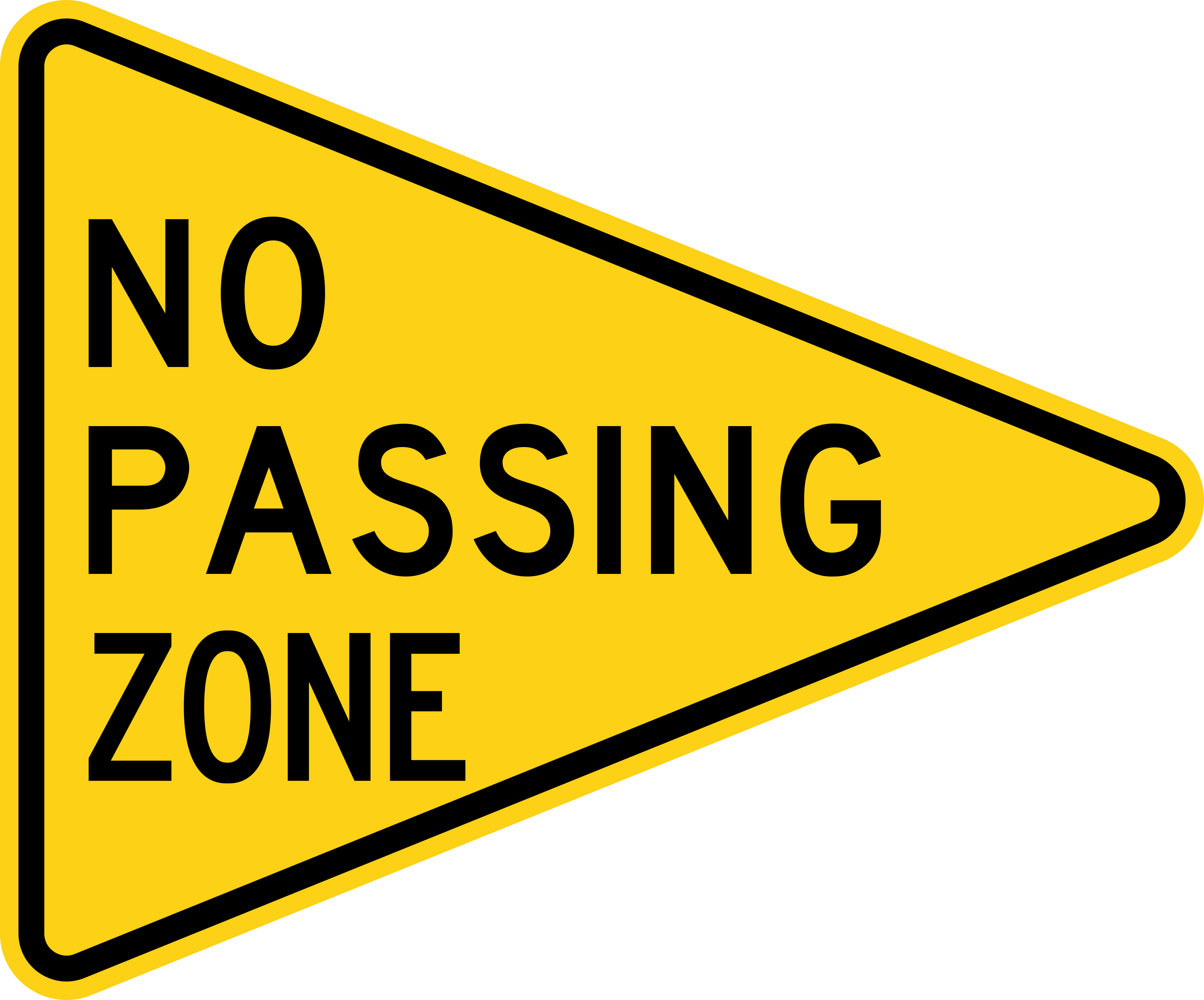
No passing zone
3 questions from the Washington practice test
1. What does a double solid yellow centerline indicate on a two-way roadway?
- The line marks a bicycle lane
- Passing is required in both directions
- The road has one-way traffic only
- Passing is not allowed
Show answer
Passing is not allowed. The guide uses double solid yellow centerlines to show the middle of a two-way road and says drivers are not allowed to pass there. The wrong alternative reverses the restriction, while the one-way and bicycle-lane choices identify different roadway arrangements. Yellow separates traffic moving in opposite directions, which is a useful visual cue before applying the passing rule. Keep the vehicle in its lane and wait for markings or signs that lawfully permit a maneuver. Do not cross the double solid line merely because the road ahead looks clear.
2. What does a dashed yellow line at the center of a two-way, two-lane road indicate?
- Traffic travels in the same direction on both sides
- The lane is reserved for left turns
- Passing is forbidden in both directions
- You may use the oncoming lane to pass when safe
Show answer
You may use the oncoming lane to pass when safe. A dashed yellow centerline separates opposing traffic while permitting a driver to enter the oncoming lane for a pass when the view, traffic, and roadway conditions make that maneuver safe. It does not mean both lanes flow the same way, which is associated with white lane lines. A blanket no-passing rule is shown by solid or double solid yellow markings, not a dashed line alone. A reserved center turn lane uses arrows and different lane guidance. Before crossing, scan ahead and behind, signal, and be certain the pass will not surprise approaching traffic.
3. What does a double solid white line between lanes indicate?
- You may change lanes whenever you signal
- It is a barrier that you may not cross
- It separates traffic traveling in opposite directions
- It marks a lane where stopping is required
Show answer
It is a barrier that you may not cross. Double solid white lines separate lanes moving in the same direction but form a barrier that drivers may not cross. A turn signal does not authorize crossing the pair. Opposing traffic is separated by yellow lines, not double white lines, and the markings do not themselves require a stop. The practical cue is the repeated solid white boundary: remain on your side unless roadway instructions provide a different legal path. Plan lane changes before reaching the double line.
Practice this topic
Lock it in with signals and markings questions from the free Washington practice test. Every answer comes with a plain English explanation.
Source: the Washington Driver Guide (plain-text version), Chapter 4: Roads. This lesson is a plain English summary, not the law itself; where it differs, the manual and the statute govern. Last checked 2026-09-27.