
Key points
Check for signs and colored curb markings that limit parking.
Source: PDF page 56
“Check for signs prohibiting or limiting parking. Colored curb markings can indicate parking restrictions.”
Washington Driver Guide (plain-text version), PDF page 56Do not park on a crosswalk, sidewalk or bicycle lane, or within an intersection.
Source: PDF page 56
“Do not park: In an intersection. On a crosswalk, sidewalk, or bicycle lane.”
Washington Driver Guide (plain-text version), PDF page 56Do not park within 30 feet of a traffic signal, stop sign or yield sign, or within 5 feet of a driveway.
Source: PDF page 56
“Within 30 feet of a traffic signal, stop sign, or yield sign. Within 5 feet of a driveway, alley, or private road.”
Washington Driver Guide (plain-text version), PDF page 56Do not park within 75 feet of a fire station driveway on the opposite side of the street.
Source: PDF page 56
“Within 75 feet of a fire station driveway on the opposite side of the street.”
Washington Driver Guide (plain-text version), PDF page 56Do not park within 50 feet of a railroad crossing.
Source: PDF page 56
“Within 50 feet of a railroad crossing.”
Washington Driver Guide (plain-text version), PDF page 56Do not park more than 12 inches from the curb or facing oncoming traffic.
Source: PDF page 56
“Facing oncoming traffic. More than 12 inches from the curb.”
Washington Driver Guide (plain-text version), PDF page 56The white stripes next to a disabled parking space are an access aisle that must be kept clear.
Source: PDF page 58
“The white stripes next to a reserved space, called an access aisle, must be kept clear.”
Washington Driver Guide (plain-text version), PDF page 58It is a crime to leave a child under 12 unattended in a parked vehicle, or under 16 with the motor running.
Source: PDF page 57
“It’s a crime to leave a child under the age of 16 unattended in a parked vehicle while the motor is running. It’s a crime to leave a child under the age of 12 unattended in a parked vehicle.”
Washington Driver Guide (plain-text version), PDF page 57Facing downhill, turn your wheel toward the curb.
Source: PDF page 58
“Facing down the hill Turn your steering wheel toward the curb until the front of your front tire touches the curb.”
Washington Driver Guide (plain-text version), PDF page 58
Numbers to know
| Number | What it means | Manual |
|---|---|---|
| 30 feet | no parking distance from a signal, stop sign or yield sign | PDF page 56 |
| 5 feet | no parking distance from a driveway, alley or private road | PDF page 56 |
| 75 feet | no parking distance from a fire station driveway across the street | PDF page 56 |
| 20 feet | no parking distance from pedestrian safety zones | PDF page 56 |
| 50 feet | no parking distance from a railroad crossing | PDF page 56 |
| 15 feet | no parking distance from a fire hydrant | PDF page 56 |
| 12 inches | farthest you may park from the curb | PDF page 56 |
| Under 12, or under 16 with motor running | children who may not be left unattended in a parked vehicle | PDF page 57 |
Recognize these signs
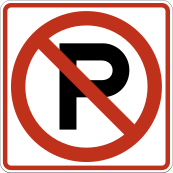
No parking 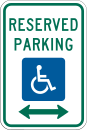
Disabled parking
3 questions from the Washington practice test
1. Before leaving a Washington vehicle parked, what should the driver check?
- Signs and colored curb markings
- Whether another car is double parked
- The vehicle's radio volume
- Only the distance from the nearest gas station
Show answer
Signs and colored curb markings. Washington makes the driver responsible for choosing a legal, nonhazardous parking place. The guide directs drivers to check signs that prohibit or limit parking and to notice colored curb markings. Another vehicle's illegal double parking does not make a space legal, and gas stations or radio volume have no bearing on the parking restriction. Before opening the door, scan the curb and nearby signs so the space itself does not create a hazard.
2. Which location is specifically listed as a place where Washington drivers must not park?
- In a designated parking space
- Beside a legal curb during permitted hours
- On a private driveway with permission
- On a crosswalk, sidewalk, or bicycle lane
Show answer
On a crosswalk, sidewalk, or bicycle lane. The Washington guide expressly prohibits parking on a crosswalk, sidewalk, or bicycle lane. Those areas serve people walking or riding and must remain available rather than becoming storage space for a vehicle. A designated space or a permitted curb may be lawful when all posted conditions are met, and private permission does not turn a public crossing into a parking place. Before stopping, identify the surface and its markings, not just an open gap.
3. What are the white stripes next to a Washington disabled parking space, and what is the rule for them?
- Overflow parking for compact cars
- A loading zone for deliveries
- An access aisle that must be kept clear
- A motorcycle space
Show answer
An access aisle that must be kept clear. The white stripes next to a reserved space are called an access aisle and must be kept clear. You can be fined for parking in a reserved stall without displaying the required placard and for blocking the access aisle. A placard should not hang from the mirror while you drive. These reserved spots are meant for vehicles with disabled parking plates or a disabled parking placard, and a person whose disability limits walking may apply for temporary or permanent privileges.
Practice this topic
Lock it in with parking questions from the free Washington practice test. Every answer comes with a plain English explanation.
Source: the Washington Driver Guide (plain-text version), Chapter 4: Roads. This lesson is a plain English summary, not the law itself; where it differs, the manual and the statute govern. Last checked 2026-09-27.