
Test 10 of 25 · 20 questions · Free 2026
WA Permit Practice Test 10
Jump to the test ↓A fixed 20 question set from the Washington bank with answers and plain English explanations. The real WA exam is 40 questions, 80 percent to pass; take the full length version on the main practice page.
Question 1 of 20 · 0 right so far
All 20 questions in test 10
Every question below comes from the Washington question bank on this page. Open a question to see the correct answer and the explanation. Nothing here is hidden behind a signup.
1. How early may a Washington driver renew a license before it expires?
- Up to 30 days before
- Up to 90 days before
- Only after it expires
- Up to one year before
Show answer
Up to one year before. Washington drivers can renew up to one year before the license expires, online through License Express or at a licensing office. Thirty and 90 days are shorter than the Washington window. Waiting until after expiration can add a fee, and a license 8 or more years expired requires retaking both the knowledge and skills tests. Renewing early avoids both problems, and the expiration date is printed near the bottom of the license.
Study this in the handbook: License exams, renewal and losing your license
2. What does a One Way sign identify?
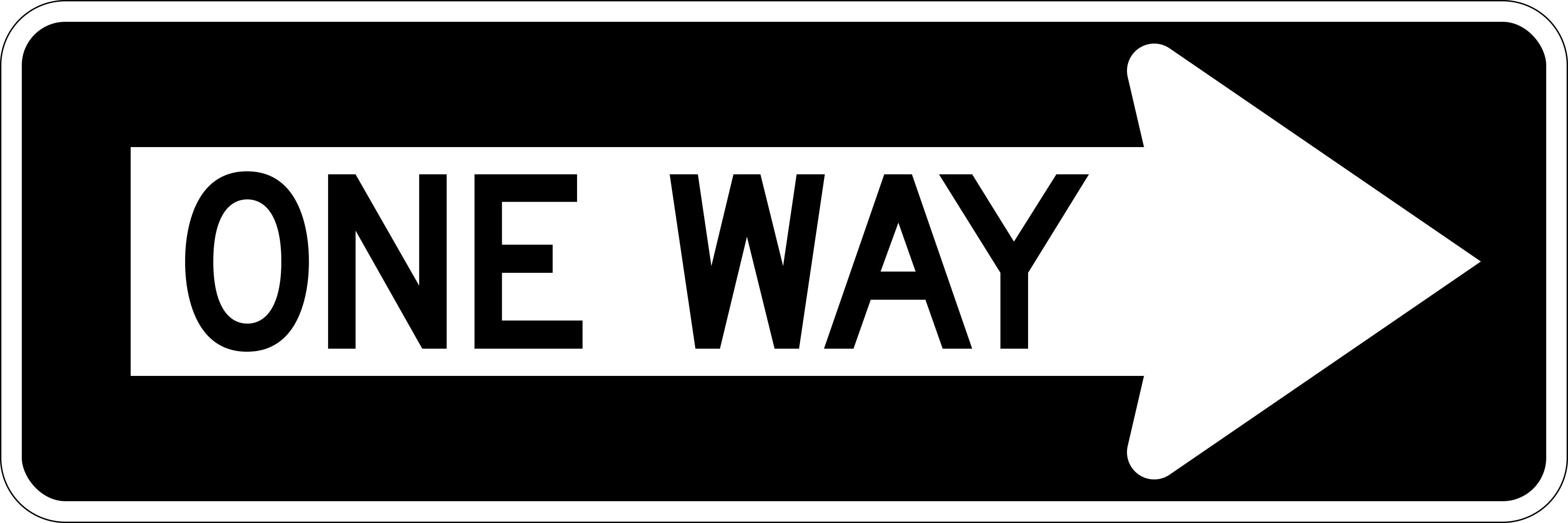
- Only buses may use the road
- Passing is required in the arrow's direction
- The road has two opposing travel lanes
- Traffic flows only in the direction of the arrow
Show answer
Traffic flows only in the direction of the arrow. A One Way sign identifies the permitted flow of traffic, which is only the direction shown by its arrow. It does not authorize passing, describe a two way road, or reserve the street for buses. The guide also warns never to drive the wrong way on a one way street. Follow the arrow when entering or continuing along the street, and pay attention to other signs that govern turns or lane use. The arrow is the key visual cue.
Study this in the handbook: Traffic signs
3. How does the Washington guide say to report road rage in progress?
- File a report at a licensing office
- Post it on social media
- Call 911 immediately
- Follow the driver to get the plate
Show answer
Call 911 immediately. Report in progress road rage incidents immediately by calling 911. Reducing road rage and aggressive driving is described as critical to the mission of the Washington State Patrol, whose troopers watch for aggressive driving. If you feel followed or harassed, the guide says to drive to an area with other people and open businesses, avoid aggressive honking or gestures, and call the police if necessary.
Study this in the handbook: Distracted driving, emotions and road rage
4. What is required when approaching a railroad crossing with flashing red lights?
- Cross quickly before the train reaches the crossing
- Stop and stay outside the gates, because a train is approaching
- Stop only if a gate is lowered
- Drive around the warning lights if the track looks clear
Show answer
Stop and stay outside the gates, because a train is approaching. Flashing red lights at a railroad crossing mean a train is approaching, so the driver must stop and stay outside of the gates. Trains always have the right-of-way, and the guide warns that a train can take up to a mile to come to a full stop. When the lights flash and bells ring, you must stop whether the gate is down or not, and you must never drive around the gate. Crossing quickly or driving around the warning equipment risks a collision. Go only after the red lights stop flashing and all other warning signs deactivate.
Study this in the handbook: Railroad crossings, emergency vehicles and emergency zones
5. How far behind a disabled vehicle should a Washington driver place emergency flares?
- 200 to 300 feet behind the vehicle
- 50 feet
- 1,000 feet
- 10 to 20 feet
Show answer
200 to 300 feet behind the vehicle. If your vehicle has trouble, get it off the road and away from traffic, turn on the emergency flashers and headlights, and warn other road users by placing emergency flares 200 to 300 feet behind the vehicle. Without flares, stand somewhere safe and wave traffic around. Lift the hood or tie a white cloth to the antenna, mirror or door handle to signal an emergency.
Study this in the handbook: Breakdowns, collisions and power lines
6. What does Washington's Clean Car Law require?
- All vehicles must be electric by 2030
- Vehicles made in 2009 and later must meet strict clean air standards before they can be registered, licensed, or sold
- Vehicles older than 2009 cannot be driven
- Emissions tests every year
Show answer
Vehicles made in 2009 and later must meet strict clean air standards before they can be registered, licensed, or sold. Washington's Clean Car Law requires vehicles made in 2009 and later to meet strict clean air standards before they can be registered, licensed, or sold in the state. The guide ties the standard to the moment a vehicle is registered, licensed, or sold, and it does not describe yearly emissions tests. Choosing efficient routes, carpooling and recycling vehicles through a disposal center support the same goal of cleaner air across the state.
7. You are driving alone and start to feel tired. What does the Washington guide tell you to do?
- Open the window and turn up the radio
- Drink coffee and keep driving to your destination
- Pull off the road and take a 20 minute nap
- Speed up to finish the trip sooner
Show answer
Pull off the road and take a 20 minute nap. Drowsy driving slows reaction time and can lead to falling asleep at the wheel. The Washington guide says that if you are traveling alone and start to feel tired, you should pull off the road and take a 20 minute nap, because stopping to sleep is better than risking a crash. If another driver is with you, take turns. The guide lists warning signs such as heavy eyelids, drifting from your lane and missing exits, and any of them is a signal to pull over and rest.
Study this in the handbook: Alcohol, cannabis, medicine and fatigue
8. Under Washington's distracted driving law, who may hold a cell phone or tablet while driving?
- Drivers age 21 and older
- No driver, regardless of age or experience
- Drivers stopped briefly in moving traffic
- Drivers with five years of experience
Show answer
No driver, regardless of age or experience. Washington prohibits holding any electronic device while driving, including cell phones, tablets and gaming devices. The guide stresses that the law applies to all drivers, regardless of age or experience, not only teens with permits or intermediate licenses. Hands free use is allowed, but notifications and screens can still pull your attention away. Put the phone away and silence it before you start moving so you are not tempted to pick it up.
Study this in the handbook: Distracted driving, emotions and road rage
9. What speed limit applies in a Washington school zone when the school zone limit is in effect?
- 20 mph
- 15 mph
- 25 mph
- 35 mph
Show answer
20 mph. The guide states that the school zone speed limit is 20 mph because higher speeds increase the risk of fatal crashes. The other numbers may appear on ordinary roads, but they do not match the school zone figure stated here. Signs can clarify when the limit applies, and school activity may continue after regular class hours. The practical cue is to slow before entering the marked area and watch carefully for children near the school or playground. A driver should not wait for a child to appear before reducing speed and attention.
Study this in the handbook: Road markings, lanes and school zones
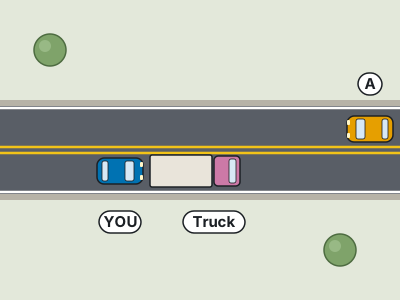
10. What does a double solid yellow centerline indicate on a two-way roadway?
- The line marks a bicycle lane
- Passing is required in both directions
- The road has one-way traffic only
- Passing is not allowed
Show answer
Passing is not allowed. The guide uses double solid yellow centerlines to show the middle of a two-way road and says drivers are not allowed to pass there. The wrong alternative reverses the restriction, while the one-way and bicycle-lane choices identify different roadway arrangements. Yellow separates traffic moving in opposite directions, which is a useful visual cue before applying the passing rule. Keep the vehicle in its lane and wait for markings or signs that lawfully permit a maneuver. Do not cross the double solid line merely because the road ahead looks clear.
Study this in the handbook: Road markings, lanes and school zones
11. Before leaving a Washington vehicle parked, what should the driver check?
- Signs and colored curb markings
- Whether another car is double parked
- The vehicle's radio volume
- Only the distance from the nearest gas station
Show answer
Signs and colored curb markings. Washington makes the driver responsible for choosing a legal, nonhazardous parking place. The guide directs drivers to check signs that prohibit or limit parking and to notice colored curb markings. Another vehicle's illegal double parking does not make a space legal, and gas stations or radio volume have no bearing on the parking restriction. Before opening the door, scan the curb and nearby signs so the space itself does not create a hazard.
Study this in the handbook: Parking rules and hills
12. What is the lowest BAC threshold for Washington's separate under-21 consuming-alcohol driving offense?
- 0.00% only
- 0.02%
- 0.05%
- 0.08%
Show answer
0.02%. For drivers under 21, the guide attaches the same potential consequences an adult faces at 0.08% to a BAC of only 0.02%. Never treat a lower reading as permission to drive after drinking. The minors summary in the guide lists the under 21 figure as a BAC of 0.02% or more, which is the lowest number among these answers that the guide actually names. The 0.08% figure is the adult threshold for drivers 21 and older, so it does not describe this under 21 rule.
Study this in the handbook: License exams, renewal and losing your license
13. After passing Washington's knowledge exam, how long does an applicant have to complete the skills exam?
- One year
- Five years
- Two years
- Until the permit expires, regardless of time
Show answer
Two years. Passing the knowledge exam starts a two-year window for completing the Driving Skills Exam. The one-year choice confuses this window with the instruction permit's validity period, which is a separate rule. Five years is longer than the guide allows, and an applicant cannot simply ignore the two-year limit because a permit may still be available. A useful calendar cue is to record the knowledge-exam date and plan the skills appointment before its second anniversary.
Study this in the handbook: License exams, renewal and losing your license
14. What does Washington's implied consent law mean when an officer suspects a driver is under the influence?
- The driver may choose testing only after a conviction
- The driver agrees to a roadside search of every passenger
- The driver must surrender the vehicle before testing
- The driver agrees to be tested for alcohol or drugs
Show answer
The driver agrees to be tested for alcohol or drugs. Washington treats driving as agreement to an alcohol or drug test when an officer suspects impairment. This is a testing obligation, not an automatic finding that the driver is guilty. The choice about surrendering the vehicle adds a consequence that the quoted rule does not state, and passenger searches are unrelated. A useful roadside cue is the phrase implied consent: operating on Washington roads carries this advance agreement. Refusing a test can create separate loss of driving privilege, so a driver should not assume refusal avoids every consequence.
Study this in the handbook: DUI limits, implied consent and open containers
15. When may a Washington child move from a booster seat to a regular seat belt under the guide's age and size chart?
- At age 4 regardless of belt fit
- As soon as the child weighs 40 pounds
- When the lap and shoulder belts fit properly, typically between ages 8 and 12
- At age 6 even if the shoulder belt crosses the neck
Show answer
When the lap and shoulder belts fit properly, typically between ages 8 and 12. Children age four and older should remain in a car or booster seat until the vehicle lap and shoulder belts fit properly. The guide describes that transition as typically occurring between ages eight and twelve, and its size chart lists four years to 4 feet 9 inches for the booster stage. Age alone does not make a poorly fitting belt safe. A belt should sit correctly across the lap and shoulder, not the stomach or neck. Check fit in the actual vehicle every trip rather than relying on a birthday or weight alone.
Study this in the handbook: Seat belts, child seats, steering and braking
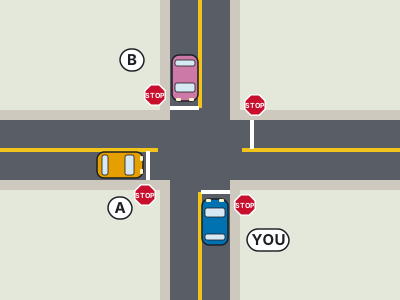
16. At a four-way stop, which vehicle has priority when one arrives before the others?
- The largest vehicle
- The vehicle closest to the center line
- The first vehicle to arrive
- The vehicle with the brightest headlights
Show answer
The first vehicle to arrive. At a four-way stop, the first vehicle to arrive is the first to go. If another vehicle arrives second, it follows second, subject to the normal yielding rules. Vehicle size, lane position, and headlight brightness do not create right-of-way. A tie is handled separately by yielding to the vehicle on the right, and a left-turning vehicle must yield to traffic going straight or turning right. Make the full stop, establish arrival order, and move only after checking for people in the crosswalk and other hazards.
Study this in the handbook: Intersections, turns and roundabouts
17. A school bus stops with red lights flashing on a road with three lanes and a median between the directions. You are driving toward it from the other side. Must you stop?
- Yes, every vehicle in both directions must stop
- No, traffic on the opposite side does not need to stop here
- Only if the bus driver waves you to stop
- Only when you can see children near the bus
Show answer
No, traffic on the opposite side does not need to stop here. On a multilane road, drivers behind the bus must stop when its red lights flash and its stop sign extends. Drivers coming from the other direction do not need to stop when the road has three or more lanes and a median or barrier separates the two sides, which is the road described here. On a plain two lane road, everyone stops in both directions. The bus driver does not wave traffic through, and you should not wait to see children before deciding. Keep watching for kids anyway, because they can still be near the road.
Study this in the handbook: Pedestrians, school buses and transit buses
18. How many supervised practice hours does Washington require for a teen driver?
- 40 hours of daylight and 10 hours of night driving
- 100 hours of daylight
- 20 hours total
- 10 hours of daylight and 40 at night
Show answer
40 hours of daylight and 10 hours of night driving. Washington requires a teen seeking a first license to complete at least 40 hours of day driving and 10 hours of night driving with a licensed driver who has 3 or more years of experience, and a parent, guardian, or responsible adult must attest to the hours. Parent orientation classes offered by driver training courses further explain the requirement. The other choices shrink the total, inflate the daylight hours, or reverse the day and night numbers.
Study this in the handbook: Instruction permits and the intermediate license
19. If the dashed yellow line is on your side of a solid-and-dashed yellow pair, when may you pass?
- Never, because any yellow line forbids passing
- Only after another driver waves you through
- Whenever you are behind a truck
- When it is safe to do so
Show answer
When it is safe to do so. A solid yellow line beside a dashed yellow line gives different instructions to each direction. When the dashed line is on your side, the guide allows passing if the maneuver is safe. The statement that every yellow line forbids passing overlooks the dashed marking. A wave from another driver cannot replace the driver’s own visibility and judgment, and being behind a truck does not create permission. Check sight distance, traffic, and hazards before crossing the dashed line.
Study this in the handbook: Road markings, lanes and school zones
20. From how far away must a vehicle's red brake lights be clearly visible under the Washington driver guide?
- 100 feet
- 25 feet
- 500 feet
- 1,000 feet
Show answer
100 feet. The Washington guide says brake lights are red and must be clearly visible from 100 feet away. Brake lights warn the person behind you that you are slowing and about to stop, so a burned out or dirty lamp takes away that warning. Check the lights regularly and replace bulbs when the dashboard shows a lamp out symbol. If the brake lights fail while you are driving, the guide tells you to use the stop hand signal until the problem is repaired.
Study this in the handbook: Headlights, brake lights, tires and signals
QualitySpace is expanding to Washington
We are a California-based independent insurance brokerage working on licensing in more states. We cannot help with Washington insurance yet. Leave your email and we will let you know when we can.
Every question is written from the official Washington State Driver Guide. Need paper? Printable WA practice test with answer key.
Last verified 2026-10-05. How we check every question · Study all 500 as flashcards
Frequently asked questions
How many questions are on this Washington practice test?
This fixed set has 20 questions. It is test 10 of 25 from the 500 question Washington bank. The real WA exam asks 40 questions and you need 32 correct.
What is the passing score for the real Washington test?
32 out of 40 correct answers (80%) That figure comes from the official Washington source cited on the DMV facts page.
How does this fixed test relate to the full Washington bank?
Each numbered test is a fixed set of questions in a fixed order, so you can retake the same test later and compare. Every test mixes road signs and the other topics in about the same proportion as the full bank. Tests 1 to 25 together cover every question in the Washington bank once. The full practice page mixes the whole bank at random.
Last verified 2026-10-05. See the Washington DMV facts page for sourced state details.
Return to the full Washington practice test · Study road signs