
Test 13 of 25 · 20 questions · Free 2026
WA Permit Practice Test 13
Jump to the test ↓A fixed 20 question set from the Washington bank with answers and plain English explanations. The real WA exam is 40 questions, 80 percent to pass; take the full length version on the main practice page.
Question 1 of 20 · 0 right so far
All 20 questions in test 13
Every question below comes from the Washington question bank on this page. Open a question to see the correct answer and the explanation. Nothing here is hidden behind a signup.
1. On long, steep grades in Washington, where should you expect slow large vehicles?
- Only behind snow removal equipment
- In the left lane moving with fast traffic
- In the right lane traveling slowly
- Stopped on every shoulder pullout
Show answer
In the right lane traveling slowly. Large vehicles travel slowly when going up or down steep roads. Be prepared to encounter slow vehicles in the right lane. When following a large vehicle, adjust your following distance so you have a wide view of the roadway ahead. When traveling up or down steep roads, large vehicles travel slowly. Grade slowness applies broadly, not only near snow equipment. The guide says to expect slow vehicles in the right lane on steep roads.
Study this in the handbook: Pedestrians, school buses and transit buses
2. You need to stop on a busy Washington road. What should you do?
- Keep moving until you can safely pull over
- Block one lane while checking your phone
- Reverse to the last side street you passed
- Stop in the travel lane with flashers on
Show answer
Keep moving until you can safely pull over. Avoid blocking travel lanes. If you need to stop, keep moving until you can safely pull over. The guide also says not to drive in reverse on the road, even if you miss a turn or exit. Phone use during a lane blockage compounds the hazard. Reversing on the road is discouraged and unsafe. Flashers do not excuse blocking a live travel lane.
Study this in the handbook: Large vehicles, motorcycles, bicycles and farm vehicles
3. At a red freeway ramp meter in Washington, where do you stop?
- On the freeway shoulder past the meter
- Beside the meter pole off the pavement
- At the white stop line on the ramp
- Halfway down the ramp near merging traffic
Show answer
At the white stop line on the ramp. Ramp meters work like regular traffic signals. When the light is red, stop at the white stop line; when the signal turns green, continue along the on-ramp. Rolling halfway down the ramp or waiting on the freeway shoulder skips the stop line the meter controls. Treating the meter as an ordinary red light keeps the routine familiar: full stop at the line, then on green continue along the on-ramp.
Study this in the handbook: Traffic signals and rules of the road
4. In Washington sign colors, what does orange warn about?
- Guide information for destinations
- Motorist services on the next exit
- Public recreation and historic areas
- Construction and maintenance work
Show answer
Construction and maintenance work. Orange signs warn of construction and maintenance. Red indicates prohibited or restricted actions; yellow warns of general and unexpected road conditions. Fluorescent yellow green warns of school, pedestrian, and bicycling activity. Green provides guide or directional information, blue provides motorist services guidance, and brown identifies recreation, cultural, and historical areas. Red = Prohibitive or restricted action Orange = Construction and maintenance warning Yellow = General and unexpected road conditions warning.
Study this in the handbook: Traffic signals and rules of the road
5. You have no flares after a breakdown in Washington. What visible signal can mark the emergency?
- Leave one door wide open into the traffic side
- Drape a dark jacket over the trunk lid
- Lift the hood or tie a white cloth to the antenna, mirror, or door handle
- Turn on only the parking lights and wait inside silently
Show answer
Lift the hood or tie a white cloth to the antenna, mirror, or door handle. Lift the hood or tie a white cloth to the antenna, side mirror, or door handle to signal an emergency. Turn on emergency flashers and headlights. If you have no flares or other warning device, stand somewhere safe and wave traffic around your vehicle. A door open into traffic can be struck and blocks the passing lane. The manual specifies a white cloth on the antenna, side mirror, or door handle, or raising the hood.
Study this in the handbook: Breakdowns, collisions and power lines
6. Where must Washington license plates be displayed, and in what condition?
- Rear only, washed at each renewal
- Front only when a bracket is installed
- Either end, as long as one plate stays readable
- Clearly on the front and rear, kept clean and easy to read
Show answer
Clearly on the front and rear, kept clean and easy to read. Washington license plates must be clearly displayed on the front and rear of the vehicle, kept clean, and easy to read. A frame must not cover or obstruct the letters, numbers, or tabs. License plates must be clearly displayed on the front and rear of motor vehicles registered in Washington. They must be clean and easy to read. Rear only drops the required front plate.
7. Where must Washington proof of liability insurance be kept while driving?
- With you or in your vehicle, carried whenever you drive
- At home with the vehicle title papers
- Only at a vehicle licensing office when registration is renewed
- Only during the first year of registration
Show answer
With you or in your vehicle, carried whenever you drive. Carry proof of liability insurance with you or inside the vehicle on each trip, showing coverage of at least $25,000 for bodily injury or death of one person, $50,000 for two or more persons in one collision, and $10,000 for property damage in one collision. Keeping proof only at home or only at a licensing office leaves it unavailable during a stop or after a crash. Proof kept with the driver or inside the vehicle can be shown where the duty applies.
8. Both headlights fail suddenly on a dark Washington road. What lights and move come next?
- Keep driving on parking lights to the next town
- Use hazards, turn signals, or fog lights if available and pull off the road promptly
- Follow the taillights ahead at the same speed
- Flash the dead lights by switching them repeatedly
Show answer
Use hazards, turn signals, or fog lights if available and pull off the road promptly. Put on your hazard warning lights, turn signals, or fog lights, if you have them. Pull off the road as soon as possible. Use available hazard lights, turn signals, or fog lights, and pull off the road as soon as possible. The guide directs you to pull off the road as soon as possible, rather than follow another vehicle at the same speed.
Study this in the handbook: Breakdowns, collisions and power lines
9. Why does Washington tell parked drivers to lock the car door?
- Locking folds the mirrors in on most models
- Locking allows the parking brake to hold tighter
- Locking turns off daytime running lights fully
- Locking prevents theft and keeps unwanted intruders out of the vehicle
Show answer
Locking prevents theft and keeps unwanted intruders out of the vehicle. Locking your door prevents theft and protects your vehicle against unwanted intruders. The guide heads this parking step: take your keys and lock your door. Folding mirrors, holding the parking brake tighter, and turning off daytime running lights are not the reason the guide gives for locking. The stated reason for locking is to prevent theft and unwanted intruders. When you leave the vehicle parked, take your keys with you and lock the door.
Study this in the handbook: Parking rules and hills
10. What should decisions about an older Washington driver's ability not rest on by itself?
- Age alone
- Changes in vision
- Slower reflexes
- Physical fitness changes
Show answer
Age alone. Decisions about driving ability should not be based on age alone. Changes in vision, physical fitness, reflexes, attention, and ability to react quickly can affect safe driving and should be assessed. Decisions about your driving ability shouldn’t be based on age alone. Vision changes are a legitimate safety factor worth assessing. Reflex changes affect reaction ability and deserve honest review. Fitness changes can influence safe driving and belong in the assessment.
11. You stopped for a Washington school bus with flashing red lights. When may you go again?
- As soon as the last child steps onto the sidewalk
- After the lights stop flashing, the sign is retracted, and the metal arm returns to the front bumper
- After waiting ten seconds with your foot on the brake
- When the bus driver turns off the engine
Show answer
After the lights stop flashing, the sign is retracted, and the metal arm returns to the front bumper. Three signals must all reset before traffic moves again around a school bus: the red lights stop flashing, the stop sign retracts, and the metal arm returns to the front bumper of the bus. A child stepping onto a sidewalk does not guarantee another child is not about to dart back, which is why watching for children continues even after the lights quit. Counting ten seconds or watching the engine substitutes your guess for the bus equipment. Wait for the full reset, then proceed slowly with your eyes still scanning.
Study this in the handbook: Pedestrians, school buses and transit buses
12. How should the shoulder belt be worn according to the Washington guide?
- Behind your back for comfort
- Under your arm so it feels looser
- Snug across the shoulder and chest, not crossing the neck or face
- Loose across the stomach below the lap belt
Show answer
Snug across the shoulder and chest, not crossing the neck or face. Wear the shoulder belt snugly across the shoulder and chest, not across the neck or face. Never place it behind your back or under your arm. The lap belt should fit snugly over the hips below the stomach. Check that the belt is not twisted and that the cross-body strap lies across the middle of the shoulder. Your seat belt should go across the middle of your chest.
Study this in the handbook: Seat belts, child seats, steering and braking
13. How do Washington drivers who are deaf or hard of hearing often adjust for missed sounds?
- By keeping one window open at all times
- By relying more on vision and staying more alert
- By using hazard lights whenever traffic is heavy
- By driving only on familiar streets near home
Show answer
By relying more on vision and staying more alert. Horns, sirens, and screeching tires can warn of danger. Hearing problems can develop slowly and be difficult to detect. Drivers who are deaf or hard of hearing can often adjust by relying more on vision and staying more alert. Are deaf or hard of hearing can often adjust by learning to rely more on vision and staying more alert. The adjustment described is relying more on vision and staying more alert, not keeping a window open.
Study this in the handbook: Alcohol, cannabis, medicine and fatigue
14. How much lane width is a motorcyclist entitled to use?
- Only the right third of a wide lane
- Half a lane, shared with one small car
- The same lane width as all other vehicles
- Only lanes marked for motorcycles
Show answer
The same lane width as all other vehicles. A motorcycle may look small inside a lane, yet the rider holds the same lane width as every other vehicle. Riders shift position inside that space constantly to see and be seen and to dodge gravel, seams, potholes, and manhole covers that a car would shrug off. Because the full width belongs to the rider, sliding your car alongside within the lane, even a wide one, steals the escape room those position changes need. Leave extra following room too, and allow even more when rain makes surfaces slick for two wheels.
Study this in the handbook: Large vehicles, motorcycles, bicycles and farm vehicles
15. You are leaving a parallel space in Washington. When may you pull forward into traffic?
- When your front door clears the rear bumper of the vehicle parked ahead of you
- As soon as your front bumper passes your own door handle
- Only after the vehicle behind you leaves first
- When half your car length fits beside the lead car
Show answer
When your front door clears the rear bumper of the vehicle parked ahead of you. Check traffic, signal, and move forward slowly while steering into the lane. Make sure your front bumper will clear the vehicle ahead; otherwise, reverse and adjust your steering. Move into the closest traffic lane when your front door clears the rear bumper of the vehicle ahead. Move forward into the closest lane of traffic when your front door clears the rear bumper of the vehicle parked ahead of you.
Study this in the handbook: Parking rules and hills
16. What advantage do free-flow left turns give at a Washington diverging diamond?
- Passing slow trucks on the left shoulder
- Right turns across two lanes at once
- Left turns onto the freeway without stopping for oncoming traffic
- U-turns anywhere along the overpass
Show answer
Left turns onto the freeway without stopping for oncoming traffic. A diverging diamond crosses traffic to the other side of the roadway so left turns onto and off freeway ramps run more efficiently. Its main advantage is free-flow left turns: you turn left onto the freeway without stopping or yielding to oncoming traffic, because the design removes conflicts with opposing vehicles. Signs and pavement markings guide the lane shift, and after the overpass or underpass you cross back to the right side. The layout does not invite shoulder passing or double lane right turns.
Study this in the handbook: Intersections, turns and roundabouts
17. Your Washington dashboard shows a lamp out symbol. What maintenance does that warning call for?
- Add engine oil soon
- Replace the bulbs
- Rotate the tires at once
- Refill the washer fluid
Show answer
Replace the bulbs. A lamp-out symbol means it is time to replace the bulbs. The guide says to keep all lights clean, bright, aimed correctly, and working properly. Make sure all lights are clean, bright, pointing the right direction, and operating properly. If your dashboard shows a “lamp out” symbol, it’s time to replace the bulbs. The guide says the lamp-out symbol calls for replacing bulbs, not adding oil.
Study this in the handbook: Headlights, brake lights, tires and signals
18. The pictured Washington sign means a driver should be ready for what?
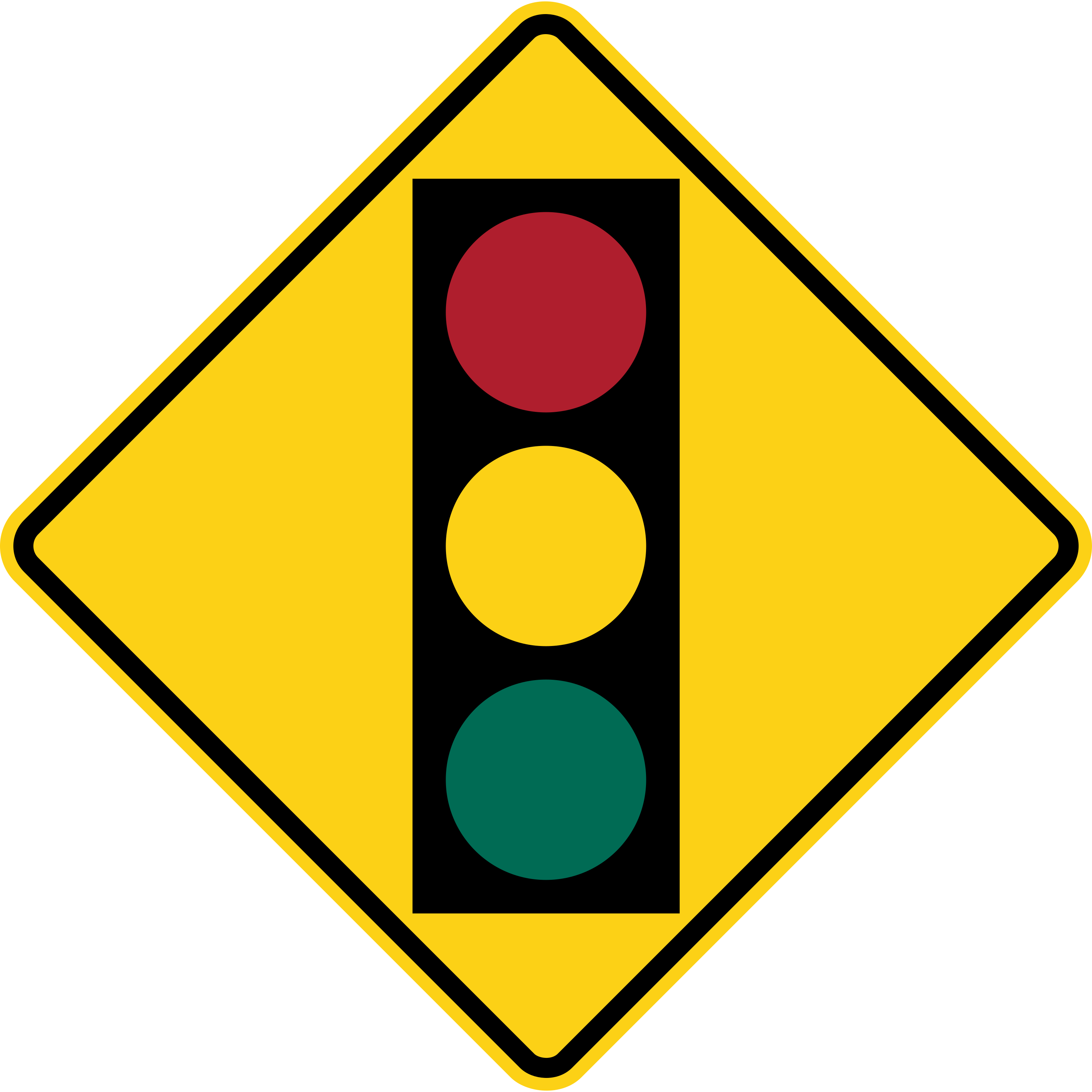
- A railroad crossing with two tracks
- A traffic signal ahead
- A stop sign hidden by foliage
- A flashing school beacon only
Show answer
A traffic signal ahead. This sign warns of a traffic signal ahead. Shown is a yellow diamond sign with a traffic light symbol. In the guide list, yellow means a general and unexpected road conditions warning. Two railroad tracks, a foliage hidden stop sign, and a flashing school beacon only are separate messages that this signal symbol does not carry. Traffic signs tell you about traffic rules, hazards, and roadway directions.
Study this in the handbook: Traffic signs
19. Why does a Washington license application ask whether the applicant is a twin?
- Twins must carry a special license class
- Twin applicants receive a fee discount
- The registry assigns twins matching plate numbers
- The state twin registry connects twins who want to join research studies
Show answer
The state twin registry connects twins who want to join research studies. The Washington State Twin Registry is for twins interested in research studies. Universities might contact people who identify themselves as twins when applying for a license. When you apply for your license, you’ll be asked if you are a twin. The Washington State Twin Registry is for twins interested in participating in research studies. The guide explains the twin question as a way to connect interested twins with research studies.
Study this in the handbook: License exams, renewal and losing your license
20. When does a cross traffic alert mainly warn a Washington driver?
- While cruising at freeway speed in the center lane
- While backing out of a parking space with traffic approaching from the side
- While waiting at a red light facing uphill
- While passing a slow truck on a two lane road
Show answer
While backing out of a parking space with traffic approaching from the side. Cross traffic alert warns about traffic approaching from the side, such as when backing out of a parking space. It helps reduce collision risk when visibility is limited. It assists the driver and does not replace checking the surroundings. Warns drivers of approaching traffic from the side, such as when backing out of parking spaces. Backing out with traffic approaching from the side is the example given in the guide.
QualitySpace is expanding to Washington
We are a California-based independent insurance brokerage working on licensing in more states. We cannot help with Washington insurance yet. Leave your email and we will let you know when we can.
Every question is written from the official Washington State Driver Guide. Need paper? Printable WA practice test with answer key.
Last verified 2026-10-05. How we check every question · Study all 500 as flashcards
Frequently asked questions
How many questions are on this Washington practice test?
This fixed set has 20 questions. It is test 13 of 25 from the 500 question Washington bank. The real WA exam asks 40 questions and you need 32 correct.
What is the passing score for the real Washington test?
32 out of 40 correct answers (80%) That figure comes from the official Washington source cited on the DMV facts page.
How does this fixed test relate to the full Washington bank?
Each numbered test is a fixed set of questions in a fixed order, so you can retake the same test later and compare. Every test mixes road signs and the other topics in about the same proportion as the full bank. Tests 1 to 25 together cover every question in the Washington bank once. The full practice page mixes the whole bank at random.
Last verified 2026-10-05. See the Washington DMV facts page for sourced state details.
Return to the full Washington practice test · Study road signs