
Test 2 of 25 · 20 questions · Free 2026
WA Permit Practice Test 2
Jump to the test ↓A fixed 20 question set from the Washington bank with answers and plain English explanations. The real WA exam is 40 questions, 80 percent to pass; take the full length version on the main practice page.
Question 1 of 20 · 0 right so far
All 20 questions in test 2
Every question below comes from the Washington question bank on this page. Open a question to see the correct answer and the explanation. Nothing here is hidden behind a signup.
1. How long do alcohol and drug related offenses stay on a Washington driving record?
- Three years
- Five years
- For life
- Until age 21
Show answer
For life. Washington keeps alcohol and drug related offenses on the driving record for life. Three and five years understate the Washington record rule, which has no expiration date for these offenses. Age 21 matters for the lower BAC and THC limits, but an offense does not drop off at 21. A DUI arrest brings loss of license, heavy fines, criminal penalties, jail and higher insurance rates.
Study this in the handbook: License exams, renewal and losing your license
2. A Washington license has been expired for 8 years. What must the driver do?
- Pay only the regular renewal fee
- Retake the skills and knowledge tests
- Take only a vision screening
- Wait one year before renewing
Show answer
Retake the skills and knowledge tests. If a license is 8 or more years expired, the driver must retake the skills and knowledge tests. A shorter lapse may only add a fee to the renewal. A vision screening alone does not cover this case, and there is no one-year waiting period. Renewing up to one year before the expiration date, which is printed near the bottom of the license, avoids both the extra fee and the retesting.
Study this in the handbook: License exams, renewal and losing your license
3. For a Washington driver age 21 or older, what active THC concentration is described as a DUI threshold?
- Any amount measured in a vehicle's fuel system
- More than 1 nanogram per milliliter of blood
- Exactly 0 nanograms per milliliter of blood
- More than 5 nanograms per milliliter of blood
Show answer
More than 5 nanograms per milliliter of blood. For drivers 21 and older, the guide identifies more than 5 nanograms of active THC per milliliter of blood as a DUI threshold. The one-nanogram choice lowers the stated adult figure, while zero nanograms is not the adult standard in this passage. The fuel-system option changes the sample entirely, since the rule concerns THC in blood. Remember the measurement, the substance, and the driver's age as one combined test condition.
Study this in the handbook: License exams, renewal and losing your license
4. How should the head restraint be set to protect you from whiplash?
- Even with your ears
- Level with the base of your neck
- As low as it will go
- Removed for better rear visibility
Show answer
Even with your ears. Whiplash is a neck injury from the head being thrown during a crash. The Washington guide says to protect yourself by making sure the headrest is even with your ears, which puts it behind the head where it can stop that motion. A restraint set at the neck or pushed all the way down sits too low to do that job, and removing it takes away the protection entirely. The guide says to make these adjustments any time you drive after someone else.
Study this in the handbook: Headlights, brake lights, tires and signals
5. What should you do when a traffic signal is not working?
- Wait for a police officer before moving under any circumstance
- Continue through because the signal gives no instruction
- Treat the intersection like a four way stop and yield to traffic on your right
- Use the intersection as though you have a green light
Show answer
Treat the intersection like a four way stop and yield to traffic on your right. A dark or malfunctioning signal does not give any driver priority. Washington tells you to make a complete stop, then yield to traffic approaching from your right and proceed cautiously when it is safe. The green light choice would turn a missing control into permission to enter, which is exactly the risk this rule prevents. Scan every approach, including bicycles and pedestrians, before moving. The key cue is four way stop behavior: stop first, then resolve right of way rather than guessing what the signal intended.
Study this in the handbook: Traffic signals and rules of the road
6. What calming technique does the Washington guide suggest for a driver who feels angry or stressed?
- Count slowly from 1 to 20, or backwards from 100 by three
- Drive faster to get home sooner
- Turn the music up loud
- Honk to release tension
Show answer
Count slowly from 1 to 20, or backwards from 100 by three. The guide suggests breathing exercises you can do while parked and counting slowly from 1 to 20, or backwards from 100 by three, concentrating only on the numbers to quiet everything else. Emotional awareness encourages patience and respect for other road users. Allow plenty of time for the trip, and if another driver is harassing you, call the police rather than engaging.
Study this in the handbook: Distracted driving, emotions and road rage
7. After a collision in Washington, what does the guide say a driver should do first regarding the scene?
- Leave immediately if the vehicles can still move
- Drive several miles away before calling anyone
- Do not drive away; move the vehicle near the site when possible
- Wait for another driver to decide whether to stop
Show answer
Do not drive away; move the vehicle near the site when possible. The guide says not to drive away after a collision. If possible, move the vehicle to the side of the road while keeping it near the collision site, and call 911 if anyone is injured or killed. Leaving immediately can prevent assistance, information exchange, and required reporting. Driving far away before calling makes the scene harder for responders to locate, and another driver's decision does not remove your responsibility. Protect people from traffic, use warning devices when available, and follow the next reporting steps once immediate danger is addressed.
Study this in the handbook: Breakdowns, collisions and power lines
8. Which location is specifically listed as a place where Washington drivers must not park?
- In a designated parking space
- Beside a legal curb during permitted hours
- On a private driveway with permission
- On a crosswalk, sidewalk, or bicycle lane
Show answer
On a crosswalk, sidewalk, or bicycle lane. The Washington guide expressly prohibits parking on a crosswalk, sidewalk, or bicycle lane. Those areas serve people walking or riding and must remain available rather than becoming storage space for a vehicle. A designated space or a permitted curb may be lawful when all posted conditions are met, and private permission does not turn a public crossing into a parking place. Before stopping, identify the surface and its markings, not just an open gap.
Study this in the handbook: Parking rules and hills
9. What minimum property damage liability coverage must a Washington driver carry?
- $10,000 per collision
- $5,000 per collision
- $25,000 per collision
- $50,000 per collision
Show answer
$10,000 per collision. Washington requires liability insurance of at least $25,000 for injury or death of one person, $50,000 for two or more people in one collision, and $10,000 for damage to the property of others. The $25,000 and $50,000 amounts are the bodily injury limits, not the property damage limit. Five thousand dollars is below the state minimum. Drivers must keep proof of insurance with them or in the vehicle.
10. What minimum bodily injury coverage does Washington require for one person injured or killed in a collision?
- $10,000
- $25,000
- $15,000
- $50,000
Show answer
$25,000. The Washington minimum is $25,000 for bodily injury or death of one person, $50,000 when two or more people are hurt or killed in one collision, and $10,000 for property damage. So $50,000 is the per collision figure for multiple people and $10,000 is the property figure. Fifteen thousand dollars is below the Washington minimum. Proof of this insurance must be carried in the vehicle.
11. How far may you travel in a Washington shared center turn lane?
- No farther than 50 feet
- No farther than 150 feet
- Up to a quarter mile
- No farther than 300 feet
Show answer
No farther than 300 feet. Washington says you should not travel farther than 300 feet in a shared center lane, and the lane must never be used for passing. It is reserved for left turns in either direction, or U-turns where allowed, so oncoming drivers may use it at the same time. Fifty and 150 feet are shorter than the Washington figure, and a quarter mile is far beyond the rule.
Study this in the handbook: Road markings, lanes and school zones
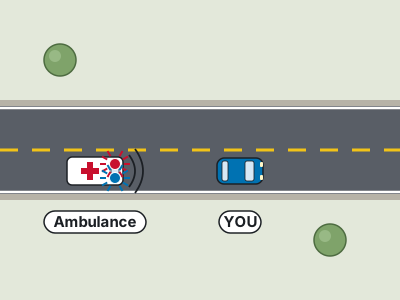
12. When a Washington fire truck, ambulance, or police car uses lights or sirens, what should other drivers do first?
- Pull right and stop
- Race ahead to the next intersection
- Stop in the left lane
- Follow the emergency vehicle closely
Show answer
Pull right and stop. Emergency vehicles using lights or sirens have priority, so the immediate response is to move to the right side of the road and stop. Racing ahead creates another conflict, and stopping in the left lane may block the emergency path. Following closely is unsafe and does not yield the roadway. After the vehicle passes, wait before signaling and reentering traffic, then return in the order you were traveling.
Study this in the handbook: Large vehicles, motorcycles, bicycles and farm vehicles
13. What is the proper response to a steady yellow traffic light before entering an intersection?
- Treat it as an unrestricted green
- Accelerate beyond the posted limit
- Slow down and prepare to stop
- Reverse immediately without checking traffic
Show answer
Slow down and prepare to stop. A steady yellow light means the signal is changing to red, so the guide tells drivers to slow down and prepare to stop. A driver already in the intersection should continue through at the posted speed, but a driver approaching should not accelerate beyond the limit to clear the intersection. Treating yellow as an unrestricted green encourages the wrong decision, and reversing creates another hazard. Look ahead early, ease off the accelerator, and stop if doing so is safe. The light is a transition warning, not an invitation to race.
Study this in the handbook: Traffic signals and rules of the road
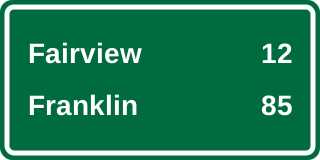
14. What do Washington destination signs show?
- Only the location of disabled parking
- Directions and distances to locations such as cities, airports, or state lines
- Only warnings about slippery pavement
- Only construction worker instructions
Show answer
Directions and distances to locations such as cities, airports, or state lines. Destination signs help drivers navigate by showing directions and distances to places such as cities, airports, and state lines. The guide also includes national parks, historical areas, and museums among possible destinations. These signs support route planning but do not replace regulatory signs, hazard warnings, or work-zone directions. Read the destination information early so lane changes can be made safely and without a last-second maneuver.
Study this in the handbook: Traffic signs
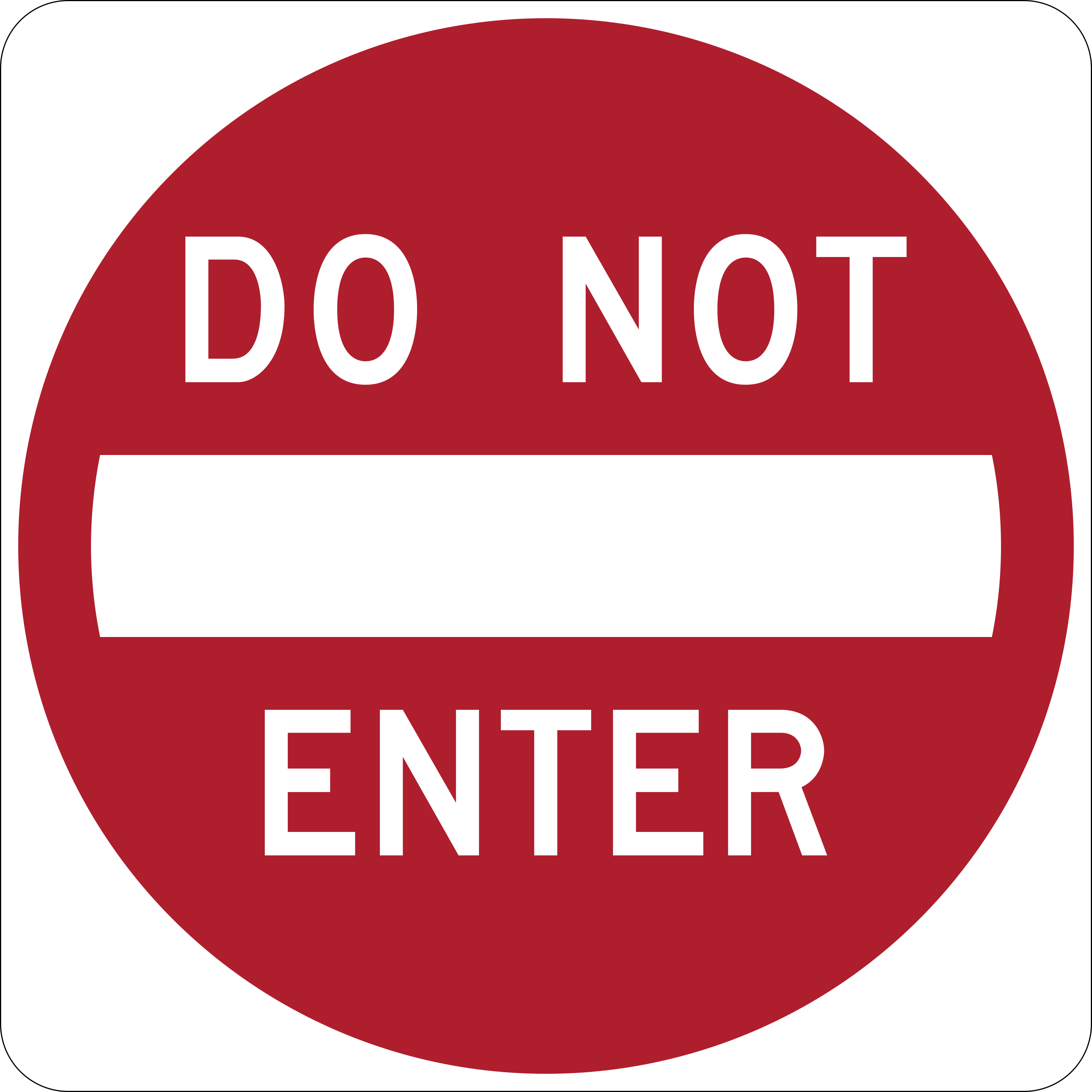
15. A square sign with a white horizontal line inside a circle means what?
- The street is reserved for buses
- You cannot enter the street from that direction
- The lane ends ahead
- Traffic must turn left
Show answer
You cannot enter the street from that direction. Washington describes this square symbol as a directional entry restriction. The white horizontal line inside the circle means a driver cannot enter the street from the direction facing the sign. It is not a lane ending notice, a bus reservation, or a turn instruction. Treat the sign as a prohibition on entering, then find a lawful route from the correct direction. The visual cue is the horizontal white bar inside the circle, rather than an arrow or lane diagram.
Study this in the handbook: Traffic signs
16. What does the Washington guide say about corrective lenses?
- Wear them only for the vision test
- Wear them only on the freeway
- Always wear them when driving and avoid dark or tinted lenses at night
- Tinted lenses are best at night
Show answer
Always wear them when driving and avoid dark or tinted lenses at night. If you are required to wear corrective lenses, always wear them when driving and avoid using dark or tinted corrective lenses at night. Seeing well covers peripheral vision, judging distance and speed, and night vision. The guide warns that a driver who cannot see clearly will have trouble identifying traffic hazards and responding to problems. Have your eyes checked regularly.
17. A parked vehicle's motor is running. Under Washington law, leaving a child of what age alone in it is a crime?
- Under 6
- Under 16
- Under 10
- Under 21
Show answer
Under 16. Washington has two age limits for leaving children in parked vehicles. It is a crime to leave a child under 12 unattended in any parked vehicle, and the limit rises to under 16 when the motor is running. When you park, make sure adults, children and animals exit properly, then take your keys and lock the door to prevent theft and intruders.
Study this in the handbook: Parking rules and hills
18. In a Washington highway construction or maintenance work zone, what must motorists, pedestrians, and bicyclists do?
- Yield only to pedestrians crossing at a marked crosswalk
- Continue without yielding if the posted speed limit has not changed
- Stop only for service vehicles displaying blue lights
- Yield to highway construction personnel, flashing-yellow-light vehicles, or work-zone equipment
Show answer
Yield to highway construction personnel, flashing-yellow-light vehicles, or work-zone equipment. In a highway construction or maintenance work zone, motorists, pedestrians, and bicyclists must yield to construction personnel, vehicles with flashing yellow lights, and equipment inside the work zone. A posted speed limit does not remove that duty, and the rule is broader than stopping for service vehicles or marked-crosswalk users. Watch for workers, equipment, and flashing yellow lights whenever work-zone signs are present. Reduce risk by yielding promptly and following the temporary traffic controls around the active work area.
Study this in the handbook: Traffic signs
19. What must you do before entering an intersection when a cross street is blocked from view?
- Edge forward slowly until you can see crossing traffic
- Accelerate through before another vehicle appears
- Turn around and use the shoulder
- Rely on the vehicle ahead without checking
Show answer
Edge forward slowly until you can see crossing traffic. If the stop line leaves the cross street hidden, Washington guidance says to edge forward slowly until you can see. This lets crossing drivers see the front of your vehicle and gives them a chance to slow or warn you. Accelerating, using the shoulder, or following another vehicle’s judgment removes your own view. The cue is blocked sightline: stop first, creep only as needed, and enter after confirming the path is clear.
Study this in the handbook: Intersections, turns and roundabouts
20. Which Washington office helps a new driver obtain a driver license or identification card?
- A vehicle licensing office only
- A county assessor's office
- A private insurance office
- A driver licensing office
Show answer
A driver licensing office. Washington separates driver services from vehicle registration services. A driver licensing office handles a driver license or identification card, while a vehicle licensing office helps with vehicle licensing and registration. The vehicle office choice confuses the two destinations and could send an applicant to the wrong counter. Before visiting, match the request to the office named for that service. This distinction is especially useful when a person needs a new credential rather than tabs or registration paperwork.
QualitySpace is expanding to Washington
We are a California-based independent insurance brokerage working on licensing in more states. We cannot help with Washington insurance yet. Leave your email and we will let you know when we can.
Every question is written from the official Washington State Driver Guide. Need paper? Printable WA practice test with answer key.
Last verified 2026-10-05. How we check every question · Study all 500 as flashcards
Frequently asked questions
How many questions are on this Washington practice test?
This fixed set has 20 questions. It is test 2 of 25 from the 500 question Washington bank. The real WA exam asks 40 questions and you need 32 correct.
What is the passing score for the real Washington test?
32 out of 40 correct answers (80%) That figure comes from the official Washington source cited on the DMV facts page.
How does this fixed test relate to the full Washington bank?
Each numbered test is a fixed set of questions in a fixed order, so you can retake the same test later and compare. Every test mixes road signs and the other topics in about the same proportion as the full bank. Tests 1 to 25 together cover every question in the Washington bank once. The full practice page mixes the whole bank at random.
Last verified 2026-10-05. See the Washington DMV facts page for sourced state details.
Return to the full Washington practice test · Study road signs