
Test 7 of 25 · 20 questions · Free 2026
WA Permit Practice Test 7
Jump to the test ↓A fixed 20 question set from the Washington bank with answers and plain English explanations. The real WA exam is 40 questions, 80 percent to pass; take the full length version on the main practice page.
Question 1 of 20 · 0 right so far
All 20 questions in test 7
Every question below comes from the Washington question bank on this page. Open a question to see the correct answer and the explanation. Nothing here is hidden behind a signup.
1. What does the guide say drivers are responsible for knowing about Washington signs?
- Only signs pictured in the guide
- Only signs on interstate highways
- All signs, including city and county signs
- Only signs with a speed number
Show answer
All signs, including city and county signs. The guide lists some Washington State signs but makes clear that the list is not complete. Drivers remain responsible for knowing signs used by cities and counties as well as statewide signs. Limiting attention to pictures in one guide, interstate routes, or speed-number signs would leave important controls unread. Keep scanning for local signs and interpret their shapes, colors, symbols, and words before proceeding.
Study this in the handbook: Traffic signs
2. What should you do immediately after seeing a Wrong Way sign facing you?
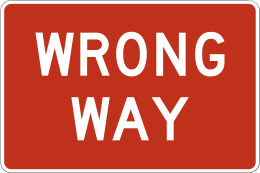
- Continue until the next exit
- Move to the left lane and speed up
- Stop and turn around immediately
- Stop only if another car appears
Show answer
Stop and turn around immediately. A Wrong Way sign warns that the vehicle is traveling against the intended direction and that a head on collision is possible. The guide says to stop and turn around immediately. Continuing to the next exit leaves you exposed to opposing traffic. Changing lanes or speeding up increases the danger. The practical cue is the sign itself: treat it as an urgent direction error, not a routine route marker.
Study this in the handbook: Traffic signs
3. What features of a traffic sign give clues to the type of information it provides?
- Only the driver's vehicle color
- The age of the pavement
- The posted fuel price
- Its shape, color, symbols, and words
Show answer
Its shape, color, symbols, and words. Traffic signs communicate rules, hazards, directions, and services. Their shape and color provide an early classification, while the symbols and words identify the message more precisely. A sign’s appearance does not depend on the driver’s vehicle, fuel prices, or pavement age. Scan the whole sign before acting, because a color may suggest a category but the wording or symbol supplies the instruction that applies at that location.
Study this in the handbook: Traffic signals and rules of the road
4. When driving behind a bicyclist in Washington, how much space should a driver leave?
- Less than 1 foot to discourage wobbling
- Exactly 10 feet in every situation
- At least 3 feet
- No space if the bicycle is near the curb
Show answer
At least 3 feet. Washington tells drivers to leave at least 3 feet of space when driving behind a bicyclist. Bicyclists may legally use the full lane and ride where they are most visible, so a rider near the curb is not a reason to close the gap. Less than a foot is plainly unsafe, and a fixed ten feet is not the stated minimum. Stay back, wait until passing is safe, and remember that passing has its own rules in the guide, including the same 3 foot buffer.
Study this in the handbook: Large vehicles, motorcycles, bicycles and farm vehicles
5. How far does a loaded truck at 55 mph need to stop, according to the Washington guide?
- About 100 feet
- About 450 feet, even with properly adjusted brakes
- About 200 feet
- About 1,000 feet
Show answer
About 450 feet, even with properly adjusted brakes. It takes a loaded truck with properly adjusted brakes, traveling at 55 mph, 450 feet to come to a complete stop. Cutting in front of a truck without enough space is dangerous for everyone. When merging ahead of a large vehicle, wait until you can see both of its headlights in your rearview mirror, then keep pace with traffic so the truck does not have to brake hard.
Study this in the handbook: Large vehicles, motorcycles, bicycles and farm vehicles
6. How should you respond to a flashing yellow traffic light?
- Stop and remain stopped until a solid green appears
- Slow down and proceed as you would at a yield sign
- Accelerate because cross traffic must stop
- Treat it as a red arrow
Show answer
Slow down and proceed as you would at a yield sign. A flashing yellow light has the same meaning as a yield sign. Slow down, treat the intersection as uncontrolled, and proceed only when you have the right of way. A complete stop is not automatically required, although you must stop if traffic or a person in your path makes that necessary. The green assumption reverses the rule by claiming priority over cross traffic. Reduce speed early, scan every approach, and resolve who may proceed before entering.
Study this in the handbook: Traffic signals and rules of the road
7. When entering a roundabout, who must yield?
- Approaching vehicles must yield to traffic already in the roundabout
- The largest vehicle always has priority
- Traffic already circulating must stop for every entering vehicle
- Vehicles entering from the left have priority
Show answer
Approaching vehicles must yield to traffic already in the roundabout. At a roundabout, approaching vehicles yield to traffic already circulating. Slow down, look left, and wait for a safe opening before entering. Once inside, follow your lane and continue counterclockwise toward the chosen exit. Making circulating traffic stop would defeat the roundabout’s continuous flow, and vehicle size does not determine priority. The strongest visual cue is traffic already moving around the center island. Yield before entry, then watch for pedestrians and bicyclists at the crosswalk as you enter and exit.
Study this in the handbook: Intersections, turns and roundabouts
8. What is the Washington response when a roadside response vehicle displays flashing lights?
- Move over into a farther lane or slow at least 10 mph below the limit
- Pass without changing speed
- Drive no faster than 70 mph
- Stop in the lane beside the vehicle
Show answer
Move over into a farther lane or slow at least 10 mph below the limit. An emergency zone requires drivers to create a safer buffer around a roadside response vehicle. Move over into a farther lane when possible. If that cannot be done safely, slow to 10 mph or more under the posted speed limit, and never exceed 50 mph in the emergency zone. Stopping in the adjacent lane can expose both vehicles to a collision, while passing at the same speed leaves too little protection. Identify the flashing lights early, check for an open lane, and reduce speed before reaching the scene.
Study this in the handbook: Railroad crossings, emergency vehicles and emergency zones
9. At a four-way stop, two vehicles arrive at approximately the same time. Who goes first?
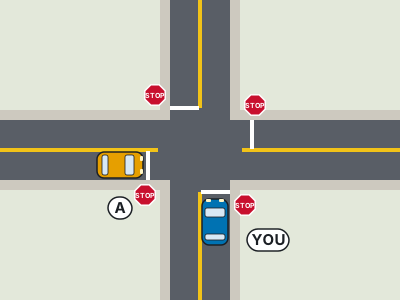
- The vehicle that signals first
- The vehicle on the left
- The vehicle traveling faster
- The vehicle on the right
Show answer
The vehicle on the right. When two vehicles reach a four-way stop at approximately the same time, the driver on the left yields to the vehicle on the right. Arrival order still controls when one vehicle clearly got there first, so this rule applies to the tie condition described. Speed does not decide the sequence, and a turn signal communicates an intention rather than granting priority. Make a complete stop, identify who arrived first, and then use the right-side rule if timing is close. Continue watching for pedestrians and cyclists while the vehicles move.
Study this in the handbook: Intersections, turns and roundabouts
10. What does the Washington guide mean by polydrug use?
- Taking a drug more than once a day
- Using only prescription drugs
- Mixing or taking more than one type of drug, which can produce effects greater than any drug on its own
- Drinking on an empty stomach
Show answer
Mixing or taking more than one type of drug, which can produce effects greater than any drug on its own. Polydrug use is the mixing or taking of more than one type of drug. Mixing alcohol, cannabis or other drugs can produce effects greater than any drug on its own, and the category includes alcohol, cannabis, illegal drugs, prescription drugs, over the counter medicines and other substances such as inhalants. Read medicine warnings or ask a pharmacist before combining anything with alcohol.
Study this in the handbook: Alcohol, cannabis, medicine and fatigue
11. During the first six months with a Washington intermediate license, who may ride as a passenger under age 20?
- Up to three friends
- One friend if the driver is 17
- Anyone, as long as all wear seat belts
- Only immediate family members
Show answer
Only immediate family members. For the first six months after the intermediate license is issued, the driver may carry no passengers under 20 except immediate family members. After six months the rule loosens to no more than three passengers under 20, still excluding family from the count, so up to three friends describes the later stage. Being 17 does not create an exception, and seat belt use does not change the passenger limit.
Study this in the handbook: Instruction permits and the intermediate license
12. You think another driver is following and harassing you. Where does the Washington guide tell you to go?
- To an area with other people and open businesses
- Straight home so you are safe
- To a quiet side road to pull over and talk
- Onto the freeway at high speed to lose them
Show answer
To an area with other people and open businesses. If you are the target of road rage, the Washington guide says to distance yourself physically and mentally, avoid speeding, honking or gestures, and keep your eyes on the road. If you feel you are being followed or harassed, drive to an area where there are other people and open businesses, and call the police if necessary. Do not try to settle the conflict yourself, and do not speed away, because that turns you into an aggressive driver too.
Study this in the handbook: Distracted driving, emotions and road rage
13. Glare from oncoming headlights bothers you at night. How does the Washington guide suggest you avoid it?
- Look directly at the oncoming headlights until they pass
- Watch the right edge of the road and use it as a steering guide
- Switch on your high beams to balance the glare
- Wear dark tinted glasses after sunset
Show answer
Watch the right edge of the road and use it as a steering guide. Staring into oncoming headlights can leave you briefly unable to see. The Washington guide tells drivers bothered by glare to watch the right edge of the road and use it as a steering guide until the vehicle passes. Turning on your high beams would blind the other driver, and the guide specifically warns against dark or tinted corrective lenses at night. Slowing down and increasing following distance also help when night vision is a problem.
14. While driving with an intermediate license, when may a Washington driver use a phone?
- Only to report an emergency
- Whenever the phone is hands-free
- Only between midnight and 5 a.m.
- Whenever a passenger makes the call
Show answer
Only to report an emergency. Washington intermediate license laws restrict cell phones and wireless communication devices even when hands-free technology is available. The guide gives one exception: the driver can use the phone to report an emergency. Hands-free operation, a passenger’s request, or a particular time window does not create a general permission to use the device. Treat the emergency exception narrowly and keep the phone inactive during ordinary driving.
Study this in the handbook: Instruction permits and the intermediate license
15. What speed range is a roundabout designed for?
- 15 to 25 mph
- 5 to 10 mph
- 30 to 40 mph
- 45 to 55 mph
Show answer
15 to 25 mph. Washington roundabouts are designed for speeds between 15 and 25 mph. That range supports controlled entry, visibility, and safe interaction with vehicles, pedestrians, and bicyclists. Five to 10 mph is unnecessarily slow as a general design range, while 30 mph or more leaves less time to yield and respond. The cue is to slow before entering, choose a lane, yield to circulating traffic, and stay in that lane until exiting.
Study this in the handbook: Intersections, turns and roundabouts
16. If a driver is not enrolled in driver training, when can the driver take the knowledge exam?
- At age 14
- After turning 15 and one-half
- After turning 18
- Only after turning 16
Show answer
After turning 15 and one-half. Applicants who are not enrolling in a driver training course can take the Washington knowledge exam after turning 15 and one-half. Age 14 is too early, and waiting until 16 or 18 is not required for this exam. The separate skills exam and license have different timing rules. Remember the distinction: the knowledge exam can begin at 15 and one-half without training, but a person must wait until 18 for the skills exam and license under this path.
Study this in the handbook: Instruction permits and the intermediate license
17. After getting a Washington traffic ticket, how long do you have to follow the instructions on the back to avoid a suspension?
- 5 days
- 30 days
- 15 days
- 60 days
Show answer
15 days. The instructions on the back of a ticket must be followed within 15 days, or the driving privilege can be suspended. Driving on that suspended license can lead to losing the vehicle or being arrested. Five days is the deadline for a vehicle report of sale, and 30 and 60 days are not the ticket deadline. Signing the ticket is not an admission of guilt, and refusing to sign can lead to arrest.
Study this in the handbook: Breakdowns, collisions and power lines
18. If no officer files a report after a Washington collision, how soon must the driver file a collision report form?
- Within 24 hours
- Within 4 days
- Within 10 days
- Within 30 days
Show answer
Within 4 days. State law requires a driver to file a collision report form within 4 days of a crash if a law enforcement officer does not file one. Twenty-four hours is too short, 10 days is the address change deadline, and 30 days is not the stated period. Drivers should also exchange names, contact details, license numbers and insurance information, and photograph the damage.
Study this in the handbook: Breakdowns, collisions and power lines
19. How does Washington treat fines for passing a stopped school bus?
- They are waived for a first offense
- They are the same as a parking ticket
- They are cut in half if no children are present
- They are doubled
Show answer
They are doubled. Washington doubles fines for anyone who passes a stopped school bus. The rule has no first offense waiver, and the guide treats it as passing a stopped bus, not as a parking matter. Seeing no children does not reduce the fine, because the lights and sign signal that children are near and getting on or off the bus. Drivers traveling in the same direction must stop when the red lights flash and the stop paddle is out.
Study this in the handbook: Pedestrians, school buses and transit buses
20. How close to a fire hydrant may you park in Washington?
- No closer than 5 feet
- No closer than 10 feet
- No closer than 20 feet
- No closer than 15 feet
Show answer
No closer than 15 feet. Parking within 15 feet of a fire hydrant is prohibited in Washington. Five feet is the driveway and alley rule, and 20 feet is the distance from a pedestrian safety zone. Ten feet is shorter than the Washington rule. The same no parking list also covers railroad tracks, construction zones, and double parking. Painted curbs can add limits: white allows only short stops, and yellow or red marks a loading zone or another restriction.
Study this in the handbook: Parking rules and hills
QualitySpace is expanding to Washington
We are a California-based independent insurance brokerage working on licensing in more states. We cannot help with Washington insurance yet. Leave your email and we will let you know when we can.
Every question is written from the official Washington State Driver Guide. Need paper? Printable WA practice test with answer key.
Last verified 2026-10-05. How we check every question · Study all 500 as flashcards
Frequently asked questions
How many questions are on this Washington practice test?
This fixed set has 20 questions. It is test 7 of 25 from the 500 question Washington bank. The real WA exam asks 40 questions and you need 32 correct.
What is the passing score for the real Washington test?
32 out of 40 correct answers (80%) That figure comes from the official Washington source cited on the DMV facts page.
How does this fixed test relate to the full Washington bank?
Each numbered test is a fixed set of questions in a fixed order, so you can retake the same test later and compare. Every test mixes road signs and the other topics in about the same proportion as the full bank. Tests 1 to 25 together cover every question in the Washington bank once. The full practice page mixes the whole bank at random.
Last verified 2026-10-05. See the Washington DMV facts page for sourced state details.
Return to the full Washington practice test · Study road signs