
Test 8 of 25 · 20 questions · Free 2026
WA Permit Practice Test 8
Jump to the test ↓A fixed 20 question set from the Washington bank with answers and plain English explanations. The real WA exam is 40 questions, 80 percent to pass; take the full length version on the main practice page.
Question 1 of 20 · 0 right so far
All 20 questions in test 8
Every question below comes from the Washington question bank on this page. Open a question to see the correct answer and the explanation. Nothing here is hidden behind a signup.
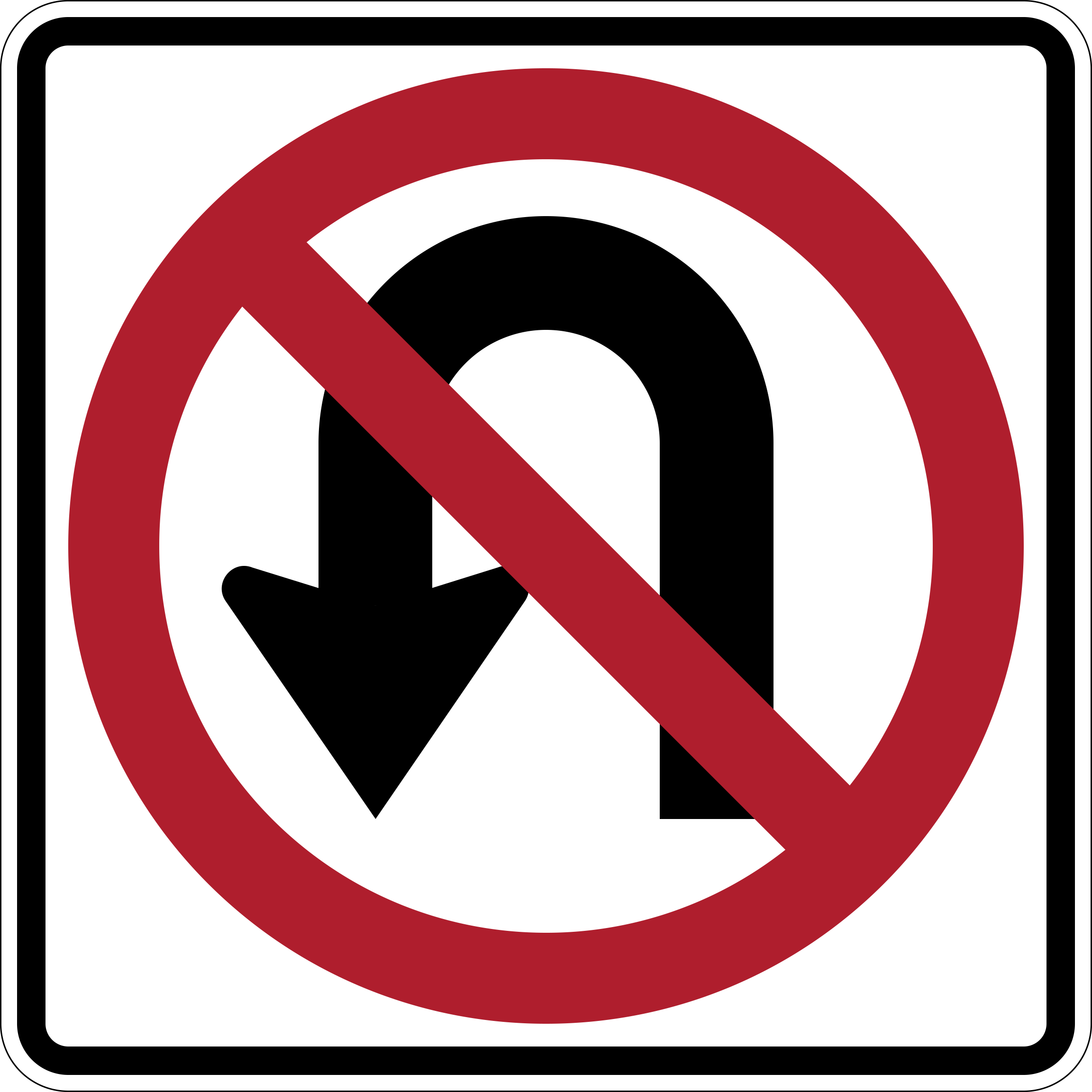
1. A red circle and slash over a U-turn symbol indicates what?
- U-turns are required
- Left turns are the only prohibited movement
- U-turns are not allowed
- The lane is reserved for passing
Show answer
U-turns are not allowed. Washington uses a red circle with a red slash over a symbol to prohibit the pictured action. When that symbol shows a U-turn, the restriction applies to U-turns at that location. It does not automatically ban left turns, require a U-turn, or create a passing lane. Read the movement under the slash, then obey that specific restriction while following any other lane or intersection controls. The crossed U-shaped arrow is the cue that distinguishes this sign.
Study this in the handbook: Traffic signs
2. What lane does a Washington Keep Right sign tell you to use when you are not passing?
- The far left lane
- The shoulder
- The right lane
- Any lane closed by a merge sign
Show answer
The right lane. The Keep Right sign reminds drivers to stay in the right lane unless they are passing another vehicle. That is a lane positioning rule, not permission to drive on the shoulder or to occupy the far left lane without a passing reason. A merge sign may impose a separate instruction, but it does not erase the keep right reminder. When traveling normally on a multilane road, use the right lane and move left only for a lawful pass.
Study this in the handbook: Traffic signs
3. Until what age must a Washington child ride in a rear-facing car seat?
- Up to age 2
- Up to age 1
- Up to age 4
- Up to age 8
Show answer
Up to age 2. Children up to age 2 must ride rear facing. From 2 to 4 they ride in a seat with a rear or forward facing harness, and from 4 they use a car or booster seat until the adult belt fits, typically between ages 8 and 12 or at 4 feet 9 inches. Age 1 is too early, and 4 and 8 describe later stages. Children under 13 should never ride in the front seat.
Study this in the handbook: Seat belts, child seats, steering and braking
4. What is the maximum speed allowed in a Washington emergency zone?
- Posted speed limit plus 10 mph
- 35 mph in every emergency zone
- 50 mph
- No maximum if the driver changes lanes
Show answer
50 mph. A driver in a Washington emergency zone must never drive faster than 50 mph. That ceiling applies even when the posted limit is higher, so adding 10 mph is not permitted. A universal 35 mph rule is also not stated, and changing lanes does not remove the speed restriction. When flashing lights identify a roadside response vehicle, reduce speed early and create space for workers rather than treating the zone like ordinary traffic.
Study this in the handbook: Railroad crossings, emergency vehicles and emergency zones
5. When may a Washington driver drive in a bicycle lane?
- Only when turning or crossing it to park near the curb
- To pass slow traffic on the right
- Whenever no bicyclist is in sight
- During rush hour to reduce congestion
Show answer
Only when turning or crossing it to park near the curb. Bicycle lanes are reserved for riders. The Washington guide allows drivers to use them only when turning or when crossing the lane to park near the curb. Using the lane to pass on the right, to save time in rush hour, or simply because it looks empty is not allowed, since a rider may appear quickly. After you park, look carefully in all directions for a bicyclist before you open your door.
Study this in the handbook: Large vehicles, motorcycles, bicycles and farm vehicles
6. What should a driver do for roadside workers in a Washington emergency zone?
- Stop beside the response vehicle and wait in the travel lane
- Create a safe space as soon as possible
- Use the shoulder as a regular passing lane
- Accelerate through the zone before workers can react
Show answer
Create a safe space as soon as possible. Drivers should create a safe space for roadside workers as soon as possible when an emergency zone is active. The travel-lane choice leaves the vehicle beside people who need protection, while using the shoulder as a routine passing lane creates another conflict. Accelerating reduces reaction time and increases the danger. Look for flares, signs, or flashing lights, then slow down, make room, and stay alert for workers and response equipment.
Study this in the handbook: Railroad crossings, emergency vehicles and emergency zones
7. Who is allowed in the vehicle with the examiner during Washington's Driving Skills Exam?
- The applicant and three driving coaches
- The applicant and the examiner only
- Any family member and the examiner
- Every applicant waiting for a test
Show answer
The applicant and the examiner only. During the Driving Skills Exam, Washington limits the vehicle to the applicant and the examiner, with stated exceptions for service animals and sign language interpreters. Three coaches, a family member, or a group of waiting applicants are not listed as ordinary occupants. This rule keeps the evaluation focused and avoids adding passengers who could distract the driver or interfere with the examiner's observations. Before arriving, plan for the small testing crew and bring only an allowed exception when one applies.
Study this in the handbook: License exams, renewal and losing your license
8. When do a Washington intermediate driver's nighttime restrictions end?
- After three months of safe driving
- After the driver completes 50 more practice hours
- After one year of safe driving
- Only on the driver's 21st birthday
Show answer
After one year of safe driving. Nighttime restrictions expire after one year of safe driving, meaning no crash and no traffic offense. The restrictions also end when the driver turns 18, since intermediate limits lift automatically at that age. Three months is too short, and extra practice hours do not end them early. Age 21 is the threshold for alcohol and THC limits, not for intermediate license rules.
Study this in the handbook: Instruction permits and the intermediate license
9. What should a Washington driver keep in mind about large vehicles at a traffic calming circle?
- Large vehicles are banned from circles
- Large vehicles always have the right of way
- Large vehicles must stop and reverse
- The circle is meant for passenger vehicles, and large vehicles may have to go clockwise to get through
Show answer
The circle is meant for passenger vehicles, and large vehicles may have to go clockwise to get through. Traffic calming circles are intended for passenger vehicles and may not easily accommodate large vehicles like fire trucks, buses or delivery trucks. Give larger vehicles plenty of space and be aware that they might have to go clockwise to get through the circle. Otherwise the same right of way rules apply as at any other intersection, and traffic flows counterclockwise around the island.
Study this in the handbook: Intersections, turns and roundabouts
10. What is a Washington shared center lane reserved for?
- Passing slower traffic
- Through travel in both directions
- Left turns from either direction
- Parking during rush hour
Show answer
Left turns from either direction. A shared center lane is reserved for vehicles making left turns from either direction. The guide says it is not to be used for through traffic or for passing other vehicles, so using it as an extra travel lane creates a serious conflict with opposing turning traffic. It is not a parking space either. Arrows are often painted on the road to mark the lane, so watch for them and enter only when preparing for a left turn.
Study this in the handbook: Traffic signs
11. What does a dashed white line between lanes mean?
- The lanes carry traffic in opposite directions
- You may cross it to change lanes if safe
- You must remain in the lane until it ends
- It marks a railroad crossing
Show answer
You may cross it to change lanes if safe. A dashed white line separates lanes moving in the same direction and may be crossed for a lane change when the movement is safe. Yellow lines separate opposing traffic, so the dashed white marking is not a centerline or a railroad warning. The solid-line rule is more restrictive because it tells you to stay in the lane unless a special situation requires a change. Before moving, check mirrors and the blind zone, signal, and confirm that another vehicle is not entering the same space. The broken white pattern permits, but does not force, a change.
Study this in the handbook: Road markings, lanes and school zones
12. What should you do when traffic is moving slowly because a lane is closed?
- Merge immediately and block the ending lane
- Stop in the open lane until another driver waves you in
- Pass the line on the shoulder
- Use both lanes until the designated merge area, then take turns
Show answer
Use both lanes until the designated merge area, then take turns. Washington describes zipper merging for slow or stopped traffic caused by a lane closure. Continue in your lane until the marked merge area, then alternate with vehicles from the other lane. Merging at the first sight of a closure can leave unused roadway and create a less predictable line. The shoulder is not a passing lane, and stopping in the open lane creates a new obstruction. Keep a steady pace, signal your intent, and allow one vehicle from the ending lane to enter in turn.
Study this in the handbook: Speed, following space and zipper merging
13. A Washington minor commits an alcohol, drug or firearm offense before getting licensed. What can happen to the license?
- Nothing, because the minor had no license yet
- It can be delayed until age 25
- The minor must wait only 30 days
- It can be delayed until the minor is 17
Show answer
It can be delayed until the minor is 17. Minors who receive an alcohol, drug or firearm offense risk having their license delayed until they are 17. Not yet holding a license does not protect the minor. Twenty-five and 30 days are not the stated consequences. Being a minor in possession of alcohol, drugs or firearms is also on the list of reasons a licensed driver can lose driving privileges.
Study this in the handbook: License exams, renewal and losing your license
14. How long must a Washington teen go without traffic violations or convictions before applying for a first license?
- 30 days
- 6 months
- 3 months
- 12 months
Show answer
6 months. A teen applying at 16 or 17 must be free of traffic violations or convictions for 6 months before applying and must have no alcohol or drug offenses while holding the permit. The parent's authorization form confirms no infractions in the last 6 months. Thirty days and three months are too short. Twelve months is the length of the safe driving period that lifts intermediate restrictions, a different rule.
Study this in the handbook: Instruction permits and the intermediate license
15. What should you do if your vehicle begins to hydroplane?
- Use the parking brake until the tires regain contact
- Accelerate hard to force the tires through the water
- Jerk the steering wheel toward the shoulder
- Take your foot off the accelerator, press the brakes gently, and keep the wheel steady
Show answer
Take your foot off the accelerator, press the brakes gently, and keep the wheel steady. Hydroplaning occurs when water separates the tires from the road, reducing traction. The guide recommends taking your foot off the accelerator, gently pressing the brakes, and keeping the steering wheel steady while contact returns. Hard acceleration can prolong the slide, and a sudden steering jerk may send the vehicle into another lane. The parking brake is not the prescribed response and can reduce stability. Stay calm, avoid overcorrecting, and look where you want the vehicle to go.
Study this in the handbook: Night driving, slippery roads, skids and hydroplaning
16. Why does the Washington guide say children under 13 should never ride in the front seat?
- An airbag deploying could seriously injure or kill them
- The front belt does not fit them
- They cannot see over the dashboard
- It is a fine of $124
Show answer
An airbag deploying could seriously injure or kill them. Airbags are why children under the age of 13 should never ride in the front seat. They could be seriously injured or killed if an airbag deploys. Every occupant must wear a seat belt or be in an approved child restraint, and child seats must meet federal standards and be installed per the instructions. The guide also advises keeping a child in each restraint stage as long as the seat allows for the best protection.
Study this in the handbook: Seat belts, child seats, steering and braking
17. How close to a driveway, alley or private road may you park in Washington?
- No closer than 5 feet
- No closer than 1 foot
- No closer than 15 feet
- No closer than 30 feet
Show answer
No closer than 5 feet. Washington's do not park list includes parking within 5 feet of a driveway, alley, or private road. Fifteen feet is the fire hydrant distance and 30 feet is the distance from a traffic signal, stop sign, or yield sign, so those belong to other items. One foot is closer than the 5 foot rule allows. The list also bars parking more than 12 inches from the curb, and the guide frames it around making sure a parked vehicle is not a hazard to others.
Study this in the handbook: Parking rules and hills
18. What is a good way to avoid distraction before driving in Washington?
- Hold the phone low so it is below the steering wheel
- Put the phone away before moving and keep attention on driving
- Read notifications only while stopped at a red light
- Use a handheld device whenever traffic is moving slowly
Show answer
Put the phone away before moving and keep attention on driving. The guide recommends putting the phone away as a practical way to prevent attention from drifting during a trip. Holding it low still involves a handheld electronic device and takes visual or mental focus from the road. Reading at a red light is not a reliable safety plan because traffic can move unexpectedly and the driver remains responsible for awareness. Slow traffic does not make handheld use safe. Set the phone aside before the vehicle moves.
19. What is the safest response when approaching a slow agricultural vehicle on a Washington road?
- Be patient, slow down, and give plenty of space when passing
- Pass immediately without checking for oncoming traffic
- Follow within one car length so other drivers cannot pass
- Honk repeatedly until the agricultural vehicle leaves the road
Show answer
Be patient, slow down, and give plenty of space when passing. Agricultural vehicles can travel slowly and may need room to maneuver. Washington’s guide tells drivers to be patient, reduce speed, and leave plenty of space while passing. Immediate passing ignores the need to check opposing traffic. Following one car length leaves little time to respond if the farm vehicle slows or turns. Repeated honking can startle the operator and does not create a safe gap. Slow down, assess the roadway, and pass only when the sight distance and space are adequate.
Study this in the handbook: Large vehicles, motorcycles, bicycles and farm vehicles
20. How does the Washington guide classify aggressive driving?
- As acceptable driving when traffic is heavy
- As a parking violation only
- As a vehicle equipment defect
- As a traffic offense in which a driver purposely endangers people or property
Show answer
As a traffic offense in which a driver purposely endangers people or property. Washington treats aggressive driving as a traffic offense. The guide defines it as a driver purposely doing something that endangers people or property, and lists behaviors such as speeding, following too closely, unsafe lane changes, improper signaling and ignoring traffic control devices. Road rage goes further and is a criminal offense. Heavy traffic never excuses these actions, so stay patient and do not take another driver's behavior personally.
Study this in the handbook: Distracted driving, emotions and road rage
QualitySpace is expanding to Washington
We are a California-based independent insurance brokerage working on licensing in more states. We cannot help with Washington insurance yet. Leave your email and we will let you know when we can.
Every question is written from the official Washington State Driver Guide. Need paper? Printable WA practice test with answer key.
Last verified 2026-10-05. How we check every question · Study all 500 as flashcards
Frequently asked questions
How many questions are on this Washington practice test?
This fixed set has 20 questions. It is test 8 of 25 from the 500 question Washington bank. The real WA exam asks 40 questions and you need 32 correct.
What is the passing score for the real Washington test?
32 out of 40 correct answers (80%) That figure comes from the official Washington source cited on the DMV facts page.
How does this fixed test relate to the full Washington bank?
Each numbered test is a fixed set of questions in a fixed order, so you can retake the same test later and compare. Every test mixes road signs and the other topics in about the same proportion as the full bank. Tests 1 to 25 together cover every question in the Washington bank once. The full practice page mixes the whole bank at random.
Last verified 2026-10-05. See the Washington DMV facts page for sourced state details.
Return to the full Washington practice test · Study road signs