
Test 19 of 25 · 20 questions · Free 2026
WA Permit Practice Test 19
Jump to the test ↓A fixed 20 question set from the Washington bank with answers and plain English explanations. The real WA exam is 40 questions, 80 percent to pass; take the full length version on the main practice page.
Question 1 of 20 · 0 right so far
All 20 questions in test 19
Every question below comes from the Washington question bank on this page. Open a question to see the correct answer and the explanation. Nothing here is hidden behind a signup.
1. Where should the lap belt rest on a Washington rider for proper seat belt fit?
- Snugly across the hips, below the stomach
- Loosely across the middle of the stomach
- Over the top of the thighs near the knees
- Behind the back for comfort on long trips
Show answer
Snugly across the hips, below the stomach. The lap belt should fit securely and snugly across the hips below the stomach. The shoulder belt should fit snugly across the shoulder and chest, without crossing the neck or face. The lap belt should securely and snugly restrain the hips, below the stomach. A loose belt over the stomach is not the snug hip fit the guide describes. The guide places the lap belt across the hips below the stomach, not near the knees.
Study this in the handbook: Seat belts, child seats, steering and braking
2. You drive below the posted limit on a foggy, slippery Washington road. Can you still earn a speeding ticket?
- No, the posted limit always protects slower drivers
- No, tickets require exceeding the posted number
- Yes, but only on freeways during rush hour
- Yes, driving too fast for conditions can be ticketed even below the limit
Show answer
Yes, driving too fast for conditions can be ticketed even below the limit. The maximum speed limit is for ideal conditions. Reduce speed when the road is slippery or fog makes it difficult to see. You can receive a ticket for traveling too fast for conditions even below the posted limit. Even if you’re driving under the posted speed limit, you can get a ticket for traveling too fast for road conditions. Limits assume ideal conditions that fog and slick pavement cancel.
Study this in the handbook: Traffic signs
3. After stopping for a Washington railroad crossing, when may a driver proceed across?
- As soon as the nearest train passes the crossing
- When the red lights stop flashing and all other warning signs deactivate
- When the gate begins rising halfway
- After honking twice to warn the train crew
Show answer
When the red lights stop flashing and all other warning signs deactivate. You may proceed when the red lights stop flashing and all other warning signs deactivate. Never drive around a crossing gate, and do not stop on the tracks. You can go when the red lights stop flashing and all other warning signs deactivate. A train passing does not replace the requirement to wait until the red lights stop flashing and all other warning signs deactivate.
Study this in the handbook: Railroad crossings, emergency vehicles and emergency zones
4. Through which channels can Washington drivers receive traffic advisories about conditions and closures?
- Only printed notices mailed each month
- Only announcements inside licensing offices
- Electronic road signs, social media, radio, traffic websites, and mobile apps
- Only messages painted on patrol cars
Show answer
Electronic road signs, social media, radio, traffic websites, and mobile apps. Traffic advisories provide information about current or upcoming traffic conditions, incidents, and road closures. They are provided through electronic road signs, social media, radio broadcasts, traffic websites, and mobile apps. Traffic advisories are provided in many ways, including electronic road signs, social media, radio broadcasts, traffic websites, and mobile apps. The guide lists several advisory channels, including electronic road signs, social media, radio, traffic websites, and mobile apps.
5. A child is locked alone in a hot parked car in Washington and nobody nearby can open it. What may an officer do?
- Wait for the owner before taking any action
- Tow the car with the child still inside
- Remove the child or animal at once by any reasonable means to protect health and safety
- Fine nearby witnesses who failed to break in
Show answer
Remove the child or animal at once by any reasonable means to protect health and safety. If no one in the immediate area has access to the vehicle, law enforcement may immediately remove children or animals by any reasonable means to protect their health and safety. The officer or employing agency is not responsible for vehicle damage when removal is needed for legal or safety reasons. If no one in the immediate area has access to the vehicle, law enforcement is authorized to immediately remove children or animals by any means reasonable to protect their health and safety.
Study this in the handbook: Parking rules and hills
6. After parking beside a Washington bike route, what check comes before opening your door?
- Lock each door as passengers step out
- Check that the parking brake holds on the grade
- Turn wheels toward the curb before exiting
- Look carefully in all directions for a bicyclist
Show answer
Look carefully in all directions for a bicyclist. After parking and before opening your door, look carefully in all directions for a bicyclist. The guide also recommends opening the door with the hand farthest from it, called the Dutch Reach. This helps you look for approaching traffic and prevents opening the door too quickly. Look carefully in all directions for a bicyclist after you park and before opening your door.
Study this in the handbook: Large vehicles, motorcycles, bicycles and farm vehicles
7. What minimum liability coverage must Washington insurance provide for bodily injury or death of two or more persons in one collision?
- $10,000 or more
- $25,000 or more
- $50,000 or more
- $100,000 or more
Show answer
$50,000 or more. Washington liability coverage has three floors that scale with who or what is harmed. Injury or death of one person needs $25,000 or more, injury to or destruction of property needs $10,000 or more, and bodily injury or death of two or more persons in a single collision needs $50,000 or more. Picking the $25,000 figure applies the one person amount to a crash with several victims, which understates the requirement. Proof of insurance must ride with you or stay in the vehicle whenever you drive.
8. What are the white stripes beside a reserved disabled parking space in Washington, and what rule covers them?
- An access aisle that must be kept clear
- A loading strip where any car may wait briefly
- Extra parking width that belongs to the reserved stall
- A walking path that cars may cross but also park on
Show answer
An access aisle that must be kept clear. Those white stripes form an access aisle, the open space beside a reserved space, and the aisle must stay clear. It is not bonus width for the stall, a loading strip for quick waits, or a path you may also park on. Blocking it can draw a fine even when the signed stall itself looks untouched. When you park nearby, leave the striped box completely empty, as empty as the lane beside your car.
Study this in the handbook: Parking rules and hills
9. In Washington hazard management, what does the Check step require before you move?
- Brake as hard as possible to prove the space is yours
- Skip mirrors when traffic behind looks light
- Set position and speed for no more than medium braking, then recheck mirrors and shoulders
- Signal after starting the move so others react faster
Show answer
Set position and speed for no more than medium braking, then recheck mirrors and shoulders. Check. Prepare your vehicle position and speed so you have adequate space to make your change with no more than medium braking. Recheck your mirrors and look over your shoulder for pedestrians and bicyclists. Prepare your position and speed to make the change with no more than medium braking. Mirrors and shoulder checks stay required even when traffic behind looks light. Communicate your intentions before checking and executing the change.
Study this in the handbook: Speed, following space and zipper merging
10. Near a Washington bicycle box at a red light, what turning rule applies?
- Riders must wait behind every stopped car
- The box may be entered to inch forward
- You cannot turn right on red; stay behind the line until the box clears
- Right on red is allowed after one stop
Show answer
You cannot turn right on red; stay behind the line until the box clears. You can’t turn right on red near a bicycle box. Stay behind the white line until the bicycle box is clear. Riders position in front by design inside the box. You must stay behind the white line until the bicycle box is clear. Right on red is barred near a bicycle box. Staying behind the line until the box clears is the only course the guide allows near a bicycle box.
Study this in the handbook: Road markings, lanes and school zones
11. While turning the head for a blind zone check, what must a Washington driver keep doing with the steering wheel?
- Let the wheel follow the head turn
- Rest both hands in the lap
- Turn the wheel slightly toward the blind zone
- Keep the steering wheel straight
Show answer
Keep the steering wheel straight. When turning your head to check a blind zone, keep the steering wheel straight. Move your head, neck, and body so both eyes can check whether the blind zones are clear. When turning your head to look, keep the steering wheel straight. Hands drifting with the head pull the car sideways. The guide instructs you to keep the steering wheel straight while turning your head to look.
Study this in the handbook: Headlights, brake lights, tires and signals
12. After a minor's alcohol, drug, or firearm offense delays licensing, what testing waits when eligibility returns?
- Only a vision screening at the office
- Both driving exams again, even if already passed before
- Neither exam if both were passed earlier
- Only the skills exam with a parent present
Show answer
Both driving exams again, even if already passed before. A young person who earns back the chance to license after an alcohol, drug, or firearm offense starts the testing sequence over, knowledge and skills alike, even when both were passed once before. Vision screening alone and a single road test each cover part of the rebuild while skipping the rest. Add the reissue fee and, for anyone under eighteen, parental consent on top of ordinary fees, and the offense becomes an expensive lesson in how slowly trust returns.
Study this in the handbook: License exams, renewal and losing your license
13. What area does the pictured Washington sign identify?
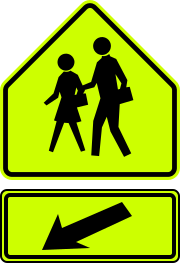
- A school crossing
- A playground parking entrance
- A library drop off loop
- A hospital quiet zone
Show answer
A school crossing. This sign warns of a school crossing. Its image is a yellow green sign with school children crossing. Fluorescent yellow green in the guide list warns of school, pedestrian, and bicycling activity. A playground parking entrance, a library drop off loop, and a hospital quiet zone are places this children crossing symbol does not name. Traffic signs tell you about hazards, roadway directions, and roadway services.
Study this in the handbook: Traffic signs
14. Distracted Washington drivers are more prone to which failure?
- Stopping too early at green lights
- Missing traffic signals, stop signs, and people on the road
- Yielding too often at uncontrolled intersections
- Overusing mirrors on empty streets
Show answer
Missing traffic signals, stop signs, and people on the road. Distracted drivers are more prone to swerving out of their lane, speeding or driving too slowly, missing traffic signals, stop signs, motorcyclists, bicyclists, or pedestrians, and following too closely. Keeping full attention on the road helps drivers react faster, make better decisions, and improve situational awareness. Failing to see traffic signals, stop signs, motorcyclists, bicyclists, or pedestrians. Stopping early at green lights is not one of the distraction patterns listed in the guide.
15. How early may you renew a Washington driver license before it expires?
- Only during the final 30 days before expiration
- Only after expiration with a late fee added
- At the counter only, never online in advance
- Up to one year before the expiration date, online or at an office
Show answer
Up to one year before the expiration date, online or at an office. You can renew your Washington driver license up to one year before it expires, online through License Express or at a driver licensing office. Renewing after expiration might require an additional fee. If the license is eight or more years expired, you must retake the skills and knowledge tests. Your expiration date can be found near the bottom of your license. You can renew your license up to one year before it expires.
Study this in the handbook: License exams, renewal and losing your license
16. How much space should you leave between your vehicle and a light rail train?
- At least 3 feet
- At least 15 feet
- At least one car length or more
- No set distance if you are parked
Show answer
At least one car length or more. Leave at least one car length between your vehicle and a light rail train. Pay attention to signs and road markings, watch for approaching trains, never stop or park on the tracks, and park with plenty of room for rail trains to pass. Leave at least one car length (or more) between your vehicle and light rail trains. Three feet is the passing space for bicyclists and farm vehicles, not light rail clearance.
Study this in the handbook: Railroad crossings, emergency vehicles and emergency zones
17. A bicyclist is riding through a crosswalk. How must you treat the rider?
- As a vehicle that must yield to cars
- As a pedestrian; yield in marked and unmarked crosswalks and intersections
- As a pedestrian only on sidewalks
- As traffic that may be passed inside the crosswalk
Show answer
As a pedestrian; yield in marked and unmarked crosswalks and intersections. Inside a crosswalk, a bicyclist counts as a pedestrian, so you yield in both marked and unmarked crosswalks and at intersections. That treatment flips at other points on the road, where bicyclists hold the same rights and duties as vehicle drivers and you yield to them at intersections as you would to a vehicle. Passing inside a crosswalk or limiting pedestrian treatment to sidewalks misreads where riders cross. When turning a corner or entering a driveway, scan crosswalks and sidewalks for riders before your bumper reaches them.
Study this in the handbook: Large vehicles, motorcycles, bicycles and farm vehicles
18. You believe a Washington officer stopped you unfairly. What response does the guide support?
- Ask respectfully, avoid roadside argument, and contest the decision in court
- Refuse documents until a supervisor arrives
- Debate the law until the officer changes course
- Drive away slowly if the stop feels unjust
Show answer
Ask respectfully, avoid roadside argument, and contest the decision in court. You may respectfully ask the officer questions. If you disagree with the decision or action, do not prolong the contact by arguing; you may contest the decision in court. For concerns about conduct, contact the officer's agency and request a supervisor as soon as possible after the stop. You are allowed to respectfully ask the officer questions. If you disagree with the officer’s decision or course of action, do not prolong the contact by arguing with the officer.
Study this in the handbook: Breakdowns, collisions and power lines
19. What does adaptive cruise control do differently from ordinary cruise control in Washington vehicles?
- It steers back to lane center after every drift
- It holds a set speed yet adjusts that speed by distance to the vehicle ahead
- It brakes to a full stop for every red light ahead
- It reads speed signs and resets the limit for you
Show answer
It holds a set speed yet adjusts that speed by distance to the vehicle ahead. Adaptive cruise control maintains a set speed but adjusts it based on the distance to the vehicle ahead. This helps maintain a safe following distance and reduces the need for constant speed adjustments on long drives. Vehicle assistance systems support driving habits; the driver remains responsible for operating the vehicle. Adaptive cruise control (ACC). Maintains a set speed but adjusts it based on the distance to the vehicle in front, ensuring a safe following distance.
20. A crash victim in Washington is bleeding heavily. What order does the guide give for stopping the bleeding?
- Pressure with hands, then a bandage or dressing, then a tourniquet
- A tourniquet first, then loose bandaging later
- Water to drink, then pressure after rest
- A blanket first, then bleeding checks after warmth
Show answer
Pressure with hands, then a bandage or dressing, then a tourniquet. Call 911. Check for breathing, then bleeding. For bleeding, the guide lists hand pressure, a bandage or dressing, and then a tourniquet. Do not give injured people anything to drink, even water. Cover them with a blanket or coat to keep them warm and help prevent shock. Do not move them unless they are in a burning vehicle or otherwise in immediate danger.
Study this in the handbook: Breakdowns, collisions and power lines
QualitySpace is expanding to Washington
We are a California-based independent insurance brokerage working on licensing in more states. We cannot help with Washington insurance yet. Leave your email and we will let you know when we can.
Every question is written from the official Washington State Driver Guide. Need paper? Printable WA practice test with answer key.
Last verified 2026-10-05. How we check every question · Study all 500 as flashcards
Frequently asked questions
How many questions are on this Washington practice test?
This fixed set has 20 questions. It is test 19 of 25 from the 500 question Washington bank. The real WA exam asks 40 questions and you need 32 correct.
What is the passing score for the real Washington test?
32 out of 40 correct answers (80%) That figure comes from the official Washington source cited on the DMV facts page.
How does this fixed test relate to the full Washington bank?
Each numbered test is a fixed set of questions in a fixed order, so you can retake the same test later and compare. Every test mixes road signs and the other topics in about the same proportion as the full bank. Tests 1 to 25 together cover every question in the Washington bank once. The full practice page mixes the whole bank at random.
Last verified 2026-10-05. See the Washington DMV facts page for sourced state details.
Return to the full Washington practice test · Study road signs