
Key points
The passing driver must pass at least two feet to the left of the vehicle being passed.
Source: Handbook p. 55
“The law requires the passing driver to pass at least two feet to the left of the vehicle being passed.”
North Carolina Driver Handbook, Handbook p. 55Passing is unsafe and usually illegal on any curve or hill where you cannot see at least 500 feet ahead.
Source: Handbook p. 55
“On any curve or hill where the driver cannot see at least 500 feet ahead;”
North Carolina Driver Handbook, Handbook p. 55Passing on the right is illegal except where specifically permitted.
Source: Handbook p. 55
“Passing on the right is against the law except in areas where it is specifically permitted.”
North Carolina Driver Handbook, Handbook p. 55When backing, go no faster than 10 mph.
Source: Handbook p. 56
“Back very slowly, not more than 10 mph”
North Carolina Driver Handbook, Handbook p. 56Always park on the right side of the road, except on one-way streets.
Source: Handbook p. 56
“Always park on the right side of the road, except on one-way streets.”
North Carolina Driver Handbook, Handbook p. 56Before pulling out of a parallel space, check traffic and give a left-turn signal.
Source: Handbook p. 56
“Before pulling out from a parallel parking space, check for approaching traffic and give a left-turn signal”
North Carolina Driver Handbook, Handbook p. 56Do not park within 25 feet of the curb line of an intersecting street, or 15 feet of the right of way lines if there is no curb.
Source: Handbook p. 56
“Within 25 feet of the curb line of an intersecting street or within 15 feet of the intersecting right of way lines if there is no curb;”
North Carolina Driver Handbook, Handbook p. 56Do not park within 15 feet of a fire hydrant or fire station entrance.
Source: Handbook p. 56
“Within 15 feet of a fire hydrant or entrance to a fire station;”
North Carolina Driver Handbook, Handbook p. 56Parking on the shoulder is illegal unless the car can be seen from 200 feet in both directions.
Source: Handbook p. 56
“parking on the shoulder is also against the law unless the parked vehicle can be seen by approaching drivers from both directions for a distance of at least 200 feet;”
North Carolina Driver Handbook, Handbook p. 56
Numbers to know
| Number | What it means | Manual |
|---|---|---|
| 2 feet | minimum passing clearance | Handbook p. 55 |
| 500 feet | sight distance needed to pass on a curve or hill | Handbook p. 55 |
| 10 mph | maximum backing speed | Handbook p. 56 |
| 25 feet | no parking distance from an intersecting curb line | Handbook p. 56 |
| 15 feet | no parking distance when there is no curb | Handbook p. 56 |
| 15 feet | no parking distance from a hydrant or fire station | Handbook p. 56 |
| 200 feet | visibility needed to park on the shoulder | Handbook p. 56 |
Recognize these signs
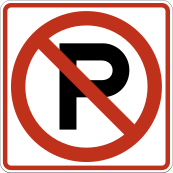
No parking 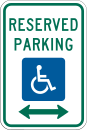
Disabled parking
3 questions from the North Carolina practice test
1. Where should a driver generally park on a North Carolina road?
- Across the center of a two-way road
- On the left side of every road
- On the right side of the road, except on a one-way street
- On the shoulder whenever the road has two-way traffic
Show answer
On the right side of the road, except on a one-way street. North Carolina directs drivers to park on the right side of the road, with an exception for one-way streets. On a one-way street, parking on the left may be permitted because traffic travels in one direction, but that exception does not change the general rule for two-way roads. Parking across the center of a two-way roadway creates a conflict with approaching traffic, and using the shoulder whenever traffic moves both ways is not the handbook rule. Use the curb-side cue: on ordinary roads, place the vehicle on the right before securing it.
2. When leaving a parallel parking space, what should a North Carolina driver do before pulling into traffic?
- Move out immediately because parked vehicles have priority
- Use the right turn signal and leave without checking behind
- Sound the horn while backing into the nearest travel lane
- Check for approaching traffic and give a left turn signal
Show answer
Check for approaching traffic and give a left turn signal. A driver leaving a parallel space should first check for approaching traffic and signal left before pulling out. The parked position does not grant priority over vehicles already moving along the roadway. A right signal communicates the wrong movement, and a horn cannot replace a visual check. Backing into a travel lane without looking creates a conflict with passing traffic. Use the mirror and a shoulder check, signal clearly, then enter only after the lane is open.
3. When is parking on a North Carolina highway shoulder legal?
- Any time the vehicle is off the pavement
- Only at night with flashers on
- Only if the parked vehicle can be seen by approaching drivers from both directions for at least 200 feet
- Never
Show answer
Only if the parked vehicle can be seen by approaching drivers from both directions for at least 200 feet. Parking on the paved or primary travel portion of any North Carolina highway is illegal, and parking on the shoulder is also against the law unless the parked vehicle can be seen by approaching drivers from both directions for a distance of at least 200 feet. Getting off the pavement is not enough on a curve or hill. The same list bars parking within 15 feet of a fire hydrant or a fire station entrance.
Practice this topic
Lock it in with parking questions from the free North Carolina practice test. Every answer comes with a plain English explanation.
Source: the North Carolina Driver Handbook, Chapter 4: Your Driving. This lesson is a plain English summary, not the law itself; where it differs, the manual and the statute govern. Last checked 2026-09-27.