
Test 10 of 10 · 20 questions · Free 2026
NC Permit Practice Test 10
Jump to the test ↓A fixed 20 question set from the North Carolina bank with answers and plain English explanations.
Question 1 of 20 · 0 right so far
All 20 questions in test 10
Every question below comes from the North Carolina question bank on this page. Open a question to see the correct answer and the explanation. Nothing here is hidden behind a signup.
1. What does the North Carolina handbook call the safest way to pass a bicyclist?
- Change lanes
- Sound the horn and pass closely
- Pass on the right
- Squeeze by in the same lane
Show answer
Change lanes. The safest way to pass a bicyclist is to change lanes, and to pass lawfully a driver must follow the vehicle passing laws in the General Statutes. The handbook adds that a driver may pass a bicyclist only when there is abundant clearance and no oncoming traffic in the opposing lane. Squeezing past in the same lane leaves too little room, and honking while passing closely does not create that clearance. Passing on the right is against the law except where specifically permitted, so it is not the method the handbook recommends.
Study this in the handbook: Bicycles, mopeds, trucks and insurance
2. In North Carolina, how far to the left must a passing driver pass the vehicle being overtaken?
- At least two feet
- At least six inches
- At least one foot
- At least ten feet
Show answer
At least two feet. The passing rule requires the driver to pass at least two feet to the left of the vehicle being passed. Six inches and one foot provide less separation than the handbook states, while ten feet is not the listed legal distance. The driver still needs enough sight distance and room to return safely before meeting oncoming traffic. A concrete cue is to pair the two foot lateral minimum with the requirement to maintain a steady speed and leave plenty of room during the maneuver. Passing distance does not replace checking whether passing is permitted.
Study this in the handbook: Passing, backing and parking
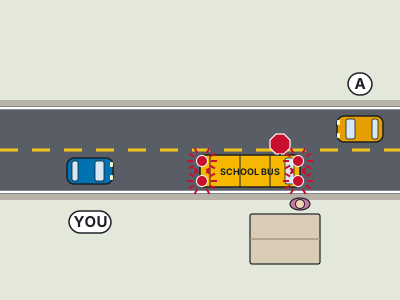
3. When a school bus is displaying its stop signal or flashing red lights, what must an approaching driver do?
- Pass after checking that no child is visible
- Stop only when following directly behind the bus
- Continue if the driver can see the bus driver
- Stop and not attempt to pass until the stop signal is withdrawn
Show answer
Stop and not attempt to pass until the stop signal is withdrawn. When a school bus displays its mechanical stop signal or flashing red lights, an approaching driver must stop and may not attempt to pass. The bus signal, not a visual check for children, controls the movement. Waiting for the signal to be withdrawn is part of the rule, and the bus’s location or the driver’s view does not remove that duty. Treat the flashing red lights as a complete stop command, then remain stopped until the bus has finished the passenger activity and the required signals are no longer active.
Study this in the handbook: Pedestrians, school buses and emergency vehicles
4. How many driver license points may trigger assignment to a driver improvement clinic in North Carolina?
- Seven points
- Eight points
- Five points
- Twelve points
Show answer
Seven points. Accumulating seven driver license points may lead to assignment to a driver improvement clinic. Twelve points within three years may lead to a license suspension, so that larger number is a different threshold. Eight points has significance after reinstatement, and five points is listed for some individual offenses rather than clinic assignment. The clinic fee is $83.50, and satisfactory completion deducts three points from the driving record. The exam cue is to distinguish the clinic threshold of seven from the suspension threshold of twelve.
Study this in the handbook: Keeping your license: points, suspensions and renewal
5. When has a North Carolina driver not passed safely?
- When the passing driver signals before moving left
- When the driver returns to the original lane before meeting oncoming traffic
- When the vehicle being passed must slow down to let the driver return to the correct lane
- When the passed vehicle maintains its speed
Show answer
When the vehicle being passed must slow down to let the driver return to the correct lane. A pass is not safe if the vehicle being passed must slow down so the passing driver can return to the correct lane. That outcome means the passing maneuver was started or completed without enough room, forcing the other driver to compensate. Signaling before moving left is required communication, not evidence of failure. Returning before meeting oncoming traffic is part of completing the maneuver safely, and the passed vehicle maintaining speed does not by itself make the pass unsafe. Leave enough time and distance to finish without making the other driver change speed.
Study this in the handbook: Passing, backing and parking
6. According to the North Carolina handbook, how long does a vehicle at 55 mph take to travel the length of a football field?
- About 3.7 seconds
- About 1 second
- About 10 seconds
- About 20 seconds
Show answer
About 3.7 seconds. The handbook uses a football field to make speed feel real. At 55 mph you cover that whole length, roughly 100 yards, in about 3.7 seconds. The point is that a glance at a phone or a brief drift of attention eats the entire distance before you notice anything. Ten or twenty seconds would mean you were crawling, and one second would require highway speeds far above any posted limit. Keep the figure in mind when judging following distance and when deciding whether something can wait until you are parked.
Study this in the handbook: Speed limits and stopping distance
7. A 25-year-old in North Carolina lends a driver license to a 19-year-old to buy alcohol. What can happen to the 25-year-old's license?
- License revocation for a full year
- Nothing, because the 25-year-old is of legal age
- A 30 day suspension
- Only a fine
Show answer
License revocation for a full year. North Carolina's one year revocation list includes any person who lets an underage person use their driver license or ID to buy or try to buy alcohol, so the adult who lends the card faces a one year revocation on conviction. Being 21 or older is no protection here. A 30 day suspension or a fine alone understates the rule. Anyone who gives alcohol to an underage person also faces a one year revocation.
Study this in the handbook: Driving while impaired and alcohol limits
8. How many points does North Carolina assess for following too closely?
- 1 point
- 2 points
- 5 points
- 4 points
Show answer
4 points. North Carolina assigns 4 points for following too closely, the same as hit and run with property damage only, driving on the wrong side of the road, and illegal passing. One point is for littering from a vehicle, and 2 points is for most other moving violations. Five points is for passing a stopped school bus or aggressive driving. Keep at least a two second gap in normal conditions.
Study this in the handbook: Keeping your license: points, suspensions and renewal
9. A North Carolina driver's chemical test shows 0.08 percent. What happens to the driving privilege?
- Nothing until the court date
- A warning is issued
- It is revoked immediately, and the limit is 0.04 for a commercial motor vehicle
- It is suspended only if a crash occurred
Show answer
It is revoked immediately, and the limit is 0.04 for a commercial motor vehicle. If your blood alcohol concentration test shows a BAC of 0.08 percent or more, or 0.04 or more if you are driving a commercial motor vehicle, your driving privilege is revoked immediately for a minimum period set by law. The revocation does not wait for a conviction or a crash. Willfully refusing the test brings its own revocation, with a limited driving privilege possible only after part of that period has passed.
Study this in the handbook: Driving while impaired and alcohol limits
10. A flashing yellow signal has the same meaning as what type of sign?
- A stop sign
- A speed-limit sign
- A railroad-crossing sign
- A warning sign
Show answer
A warning sign. The handbook gives a flashing yellow signal the same meaning as a warning sign. It tells the driver to slow down and proceed with caution, rather than to stop automatically as required by a flashing red signal. A speed-limit sign controls a posted maximum, and a railroad-crossing sign addresses a different hazard. The visual cue is the yellow flash: reduce speed, scan for vehicles and pedestrians, and continue only when the path is safe. Treat the warning as an instruction to prepare for changing conditions, not as permission to maintain speed.
Study this in the handbook: Traffic signals and pavement markings
11. How does a North Carolina license show that the holder is an organ donor?
- A red stripe on the back
- A heart symbol on the front of the card
- There is no indicator
- A separate paper card
Show answer
A heart symbol on the front of the card. You may indicate your decision to be an organ donor when you apply for or renew a North Carolina license or ID card. Donors' licenses and ID cards carry a heart symbol on the front, representing consent to be an organ and eye donor. The handbook also highly recommends discussing your wishes with your family so they know your decision. A red stripe, a separate paper card, or no indicator at all does not match the handbook.
12. During rain, what following distance does the handbook recommend?
- One car length regardless of speed
- The same distance used on dry pavement
- Half the normal distance so other vehicles cannot merge
- At least twice the normal following distance
Show answer
At least twice the normal following distance. Rain makes pavement slippery and increases stopping distance, so the handbook advises allowing at least twice the normal following distance. Keeping the dry pavement interval ignores the reduced traction and longer braking path. A shorter gap is especially dangerous because it removes reaction time, and one car length has no fixed safety value at different speeds. Slow down, use headlights and wipers, and leave a larger time based gap behind the vehicle ahead.
Study this in the handbook: Turn signals, headlights and bad weather
13. What is the recommended response when the brakes fail on a vehicle with an automatic transmission?
- Turn off the engine and coast in neutral
- Apply the emergency brake and move the gear lever into low range
- Pump the accelerator to restore braking
- Shift into reverse at highway speed
Show answer
Apply the emergency brake and move the gear lever into low range. For brake failure in an automatic vehicle, the handbook recommends applying the emergency brake and moving the gear control lever into the low-range position. Lower gearing helps control speed, while the emergency brake provides another way to slow the vehicle. Turning off the engine or selecting reverse can remove useful control and may cause additional hazards. The accelerator cannot restore failed service brakes. This procedure can damage the emergency brake or transmission, but the handbook identifies it as the best choice under the emergency. Keep steering under control and seek a safe place to stop.
14. Who must wear a safety belt in a moving vehicle in North Carolina?
- Only the driver
- Every person occupying the vehicle
- Only front seat occupants
- Only passengers under 16
Show answer
Every person occupying the vehicle. North Carolina's law is broad: every person occupying a vehicle in motion must have a safety belt properly fastened. Children should ride in a rear seat in child safety seats approved for their age and size. Air bags are supplemental protection, not a substitute, and the lap belt should be worn under the abdomen and low across the hips with the shoulder portion over the collarbone. Failing to restrain a child also adds points.
Study this in the handbook: Seat belts, child restraints and window tint
15. Which sign shape is used only for stop signs?
- The circular sign
- The five-sided pentagon
- The eight-sided octagon
- The triangular sign
Show answer
The eight-sided octagon. The eight-sided shape is reserved for stop signs, making the sign recognizable even when its words or face are difficult to see. A pentagon warns of a school zone or school crossing. A circular sign can provide advance warning of a railroad crossing, and a triangle identifies a yield sign. The shape therefore supplies an important recognition cue before the driver reads the message. When the outline is an octagon, prepare for the full stop required by the stop sign and do not treat it as a warning-only device or a yield instruction.
Study this in the handbook: Sign shapes and colors
16. What must an applicant do before taking the North Carolina on the road driving test?
- Complete the road test before the vision test
- Pass all the other required tests first
- Take the road test before attempting traffic signs
- Skip every earlier test if the applicant has driven elsewhere
Show answer
Pass all the other required tests first. The driving skills examination is the final practical demonstration in the sequence described by the handbook. An applicant must pass the other tests before taking the on the road test. That means the vision, signs, and knowledge requirements cannot simply be postponed or bypassed because someone has previous driving experience. The road test checks actual vehicle control, but it is not a replacement for the earlier examinations. Think of the order as prerequisites first, driving demonstration afterward.
Study this in the handbook: License tests, teen phone ban and full provisional license
17. How soon before registration expiration may a North Carolina vehicle receive its inspection?
- Within 30 days
- Within 90 days
- Only on the expiration date
- Within six months
Show answer
Within 90 days. The handbook allows an inspection during the 90-day window before registration expires. This gives the owner time to finish the requirement before renewal is due. Six months is not the inspection timing stated in the handbook, and waiting for the exact expiration date creates avoidable risk if the vehicle fails or an appointment is delayed. Use the registration expiration date to count backward and schedule appropriately.
Study this in the handbook: Bicycles, mopeds, trucks and insurance
18. What does the handbook say about special speed limits in North Carolina?
- Drivers may ignore a special limit when traffic is light
- Special areas must always use the city and town limit
- A special limit applies only to interstate highways
- Special speed limits may be posted for special areas
Show answer
Special speed limits may be posted for special areas. North Carolina allows special speed limits to be posted for special areas. That means the driver must read the sign controlling the location instead of automatically applying the ordinary city, rural-road, or interstate number. Light traffic does not cancel a posted limit, and the rule is not confined to interstates. A special area may also require a speed below the posted maximum when conditions call for extra care. The visual cue is the sign at the roadway: identify the local limit first, then choose a safe speed at or below it.
Study this in the handbook: Speed limits and stopping distance
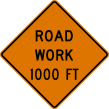
19. When diamond-shaped warning signs are orange with black messages, what do they warn about?
- Hospital entrances and telephone services
- Railroad crossings with multiple tracks
- Construction or maintenance areas
- The beginning of a city speed zone
Show answer
Construction or maintenance areas. Orange diamond-shaped signs with black messages warn about construction or maintenance areas. Drivers should expect unusual lane arrangements, workers, equipment, or changing pavement conditions and respond with extra care. A railroad crossing has its own circular advance warning sign and crossbuck, while blue and white signs identify services such as a hospital or telephone. A city speed zone is a regulatory matter shown by a different sign style. The orange background is the key cue that road work or maintenance conditions may affect the normal path.
Study this in the handbook: Sign shapes and colors
20. When is parking on a North Carolina highway shoulder legal?
- Any time the vehicle is off the pavement
- Only at night with flashers on
- Only if the parked vehicle can be seen by approaching drivers from both directions for at least 200 feet
- Never
Show answer
Only if the parked vehicle can be seen by approaching drivers from both directions for at least 200 feet. Parking on the paved or primary travel portion of any North Carolina highway is illegal, and parking on the shoulder is also against the law unless the parked vehicle can be seen by approaching drivers from both directions for a distance of at least 200 feet. Getting off the pavement is not enough on a curve or hill. The same list bars parking within 15 feet of a fire hydrant or a fire station entrance.
Study this in the handbook: Passing, backing and parking
QualitySpace is expanding to North Carolina
We are a California-based independent insurance brokerage working on licensing in more states. We cannot help with North Carolina insurance yet. Leave your email and we will let you know when we can.
Every question is written from the official North Carolina Driver Handbook. Need paper? Printable NC practice test with answer key.
Last verified 2026-10-05. How we check every question · Study all 207 as flashcards
Frequently asked questions
How many questions are on this North Carolina practice test?
This fixed set has 20 questions. It is test 10 of 10 from the 207 question North Carolina bank.
How does this fixed test relate to the full North Carolina bank?
Each numbered test is a fixed set of questions in a fixed order, so you can retake the same test later and compare. Every test mixes road signs and the other topics in about the same proportion as the full bank. Tests 1 to 10 together cover 200 of the 207 questions in the North Carolina bank, each once. The full practice page mixes the whole bank at random.
Last verified 2026-10-05. See the North Carolina DMV facts page for sourced state details.
Return to the full North Carolina practice test · Study road signs