
Test 12 of 25 · 20 questions · Free 2026
NC Permit Practice Test 12
Jump to the test ↓A fixed 20 question set from the North Carolina bank with answers and plain English explanations.
Question 1 of 20 · 0 right so far
All 20 questions in test 12
Every question below comes from the North Carolina question bank on this page. Open a question to see the correct answer and the explanation. Nothing here is hidden behind a signup.
1. A bicyclist in North Carolina has been drinking. Do the state's DWI laws apply to the rider?
- Yes, bicycles are vehicles under the law
- No, DWI rules are written for car drivers
- Only if the rider is on a highway
- Only if the bicycle has a motor
Show answer
Yes, bicycles are vehicles under the law. North Carolina law considers bicycles to be vehicles, so bicyclists must obey the same traffic laws as other drivers, and the handbook says that includes DWI laws. Like drivers, bicyclists must ride on the right side of the road, stop for stop signs and red lights, and give hand signals. The rule does not depend on the type of road or on the bicycle having a motor.
2. When may a driver use the emergency warning flashers?
- To show you are driving slowly in the far left lane
- To warn of danger or a stopped or disabled vehicle
- To park in a no-parking zone for a short time
- To drive through a red light in an emergency
Show answer
To warn of danger or a stopped or disabled vehicle. Vehicles have an emergency warning device that flashes all four turn signal lights. The handbook says any vehicle can use these flashers to warn other drivers of a possible danger or that the vehicle is stopped or disabled. The handbook calls for them when you break down at night, when you stop off the road in thick fog, and when parking along a highway at night. They do not make illegal parking legal or allow running a red light.
3. You are about to be hit from behind and cannot move forward. How should you brace yourself?
- Press your head back against the head rest
- Lean forward toward the steering wheel
- Turn around to watch the other vehicle
- Unbuckle so you can move away quickly
Show answer
Press your head back against the head rest. If you are about to be hit from the rear and there are no vehicles in front, the handbook says to press the accelerator and move away if you can, and be ready to brake if there is no room. Brace yourself between the steering wheel and the seat, and press the back of your head firmly against the head rest. Leaning forward or turning to look leaves your head away from that support, and your seat belt should stay fastened.
Study this in the handbook: Blowouts, breakdowns and crashes
4. When there is no sidewalk, on which side of the road should a pedestrian walk?
- The right side, with traffic
- The left side, facing traffic
- Either side, depending on the sun
- Down the middle, so cars see them
Show answer
The left side, facing traffic. When you are a pedestrian, the handbook says to do all you can to be visible and help drivers avoid crashes. Pedestrians should walk on the left side of the road facing traffic, wear or carry something white, and use a flashlight at night. The handbook also says to be ready to move out of the way in case a driver cannot see you. Bicyclists are the opposite: they ride on the right, with traffic.
5. Your light turns green, but an elderly pedestrian is still crossing in front of you. What must you do?
- Wait until the pedestrian finishes crossing
- Go, since the light gives you the right of way
- Honk so the pedestrian hurries
- Drive around the pedestrian slowly
Show answer
Wait until the pedestrian finishes crossing. If a signal changes while any pedestrian is still in the street, North Carolina requires drivers to let that pedestrian complete the crossing safely. Your green light does not override that duty. Honking to hurry the person or steering around them puts the pedestrian at risk. Wait until the person has reached the other side, then continue through the intersection with care.
Study this in the handbook: Pedestrians, school buses and emergency vehicles
6. Before driving after taking a new prescription or over-the-counter medicine, what should you do first?
- Drink coffee to offset any drowsiness it causes
- Drive only on roads you know well
- Find out how the medicine will affect you
- Take half the dose and drive normally
Show answer
Find out how the medicine will affect you. The handbook warns that both prescriptions and over-the-counter medicines can affect your driving, so find out how a medicine will affect you before taking it. It also advises doing as little driving as possible while on any medication and being especially careful if you must drive, because you may not be as alert as usual. Coffee does not cancel those effects, and a familiar route does not protect a drowsy driver. Changing your dose on your own is not the handbook's advice.
7. Why does the North Carolina handbook tell you to leave at least twice your normal following distance in the rain?
- Rain makes other drivers brake later
- Stopping can take two to 10 times farther
- Wipers block part of your view ahead
- Wet roads lower every posted speed limit
Show answer
Stopping can take two to 10 times farther. Rain reduces visibility and makes pavement dangerous. The handbook says stopping distances on slippery pavement can be two to 10 times longer than on dry pavement, and that is the reason it tells you to slow down and leave at least twice your normal following distance. Extra space gives you room to stop when the car ahead brakes. Use headlights and wipers in the rain, and drive at least five to 10 mph slower than on dry pavement.
Study this in the handbook: Turn signals, headlights and bad weather
8. A flashing yellow arrow is showing for your left turn, and a pedestrian is crossing the street you are turning into. What should you do?
- Yield to the pedestrian, then turn
- Turn, since the arrow lets you go
- Wait for the arrow to turn green
- Honk and turn ahead of the pedestrian
Show answer
Yield to the pedestrian, then turn. A flashing yellow arrow means the turn is permitted, but you must first yield to oncoming traffic and pedestrians. A pedestrian crossing the street you are turning into is someone you must yield to. You do not need to wait for a green arrow once the path clears, but you may not cut in front of the walker. A solid green arrow is the signal that normally lets you turn without yielding.
Study this in the handbook: Traffic signals and pavement markings
9. Ahead you see a red-and-white triangular sign with one point facing down, but glare hides its letters. What should you do?
- Slow down and be ready to yield or stop
- Come to a full stop every time
- Speed up to merge before the intersection
- Treat it as a school zone warning
Show answer
Slow down and be ready to yield or stop. Shape and color let you recognize a sign at a glance. A red-and-white triangle with the point at the bottom is a yield sign. The handbook says that when you approach a yield sign, you must slow down and yield the right of way, stopping if needed to avoid interfering with traffic on the intersecting street. A full stop is not automatic, and speeding up to merge ignores the duty to yield.
Study this in the handbook: Sign shapes and colors
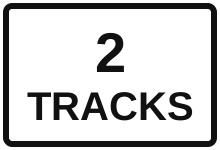
10. This sign is mounted below the crossbuck at a crossing. A train has just passed. What should you keep in mind?
- The crossing is closed to cars for the day
- Only one train can use this crossing at a time
- You may cross as soon as the first train clears
- A second train may be coming on the other track
Show answer
A second train may be coming on the other track. A smaller sign below the crossbuck shows that more than one track crosses the road. That matters because the handbook warns not to move immediately after a train passes, since another train may be moving in the opposite direction or following the first one. Wait until the red lights stop flashing, look both ways again, and cross only when every track is clear.
Study this in the handbook: Railroad crossings and funeral processions
11. The center of a two-lane road is marked with double solid yellow lines. When may you cross them to pass?
- When the road ahead looks clear
- When passing a slow-moving truck
- Only during daylight hours
- Never, in either direction
Show answer
Never, in either direction. Yellow center lines separate traffic moving in opposite directions. When continuous double solid yellow lines are the center lines, the handbook says you cannot cross them to pass in either direction. A clear road ahead or a slow truck does not change that. Passing with care is permitted only where a broken yellow line is on your side of the center. The handbook also lists double solid yellow lines among the places where passing is always unsafe.
Study this in the handbook: Traffic signals and pavement markings
12. Which of these is a place where you should not park in North Carolina?
- 30 feet from an intersecting curb line
- 20 feet from a fire hydrant
- Across the front of a driveway
- At the right curb of a two-way street
Show answer
Across the front of a driveway. The handbook's no-parking list begins with parking at an intersection or in front of a driveway. The same list sets distance rules: stay at least 25 feet from the curb line of an intersecting street and 15 feet from a fire hydrant, so 30 feet and 20 feet are both far enough away. The handbook also says to always park on the right side of the road except on one-way streets, so the right curb of a two-way street is correct.
Study this in the handbook: Passing, backing and parking
13. In city traffic, you realize you are not in the proper lane for the turn you planned. What should you do?
- Stop in your lane and wait until a gap opens to cut over
- Turn from the wrong lane as long as you signal first
- Cut across quickly while traffic is moving slowly
- Continue to the next intersection and turn there
Show answer
Continue to the next intersection and turn there. City driving brings heavy traffic and drivers who make quick stops. If you discover you are not in the proper lane for a turn, the handbook says to continue to the next intersection and turn there. Cutting across lanes or stopping in a travel lane goes against the handbook's advice to stay in one lane when you can and to avoid weaving. Planning lane changes ahead of time prevents the problem in the first place.
14. You miss your exit on a North Carolina interstate. What should you do?
- Back up slowly on the shoulder to the exit
- Go on to the next exit and leave there
- Stop in the lane and wait for a gap to turn around
- Use a median crossover to turn back
Show answer
Go on to the next exit and leave there. The handbook calls trying to leave the highway after missing an exit a dangerous error. If you miss an exit, do not slow down, back up, or try to turn around. Go on to the next exit and leave the highway there; you can always find a service or side street to get back to where you meant to go. The handbook's interstate rules also say never to stop in the travel lane.
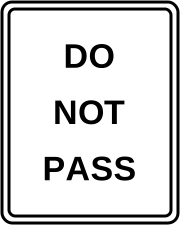
15. This rectangular sign is posted on the right side of a two-lane road, and a yellow pennant sign appears on the left. Which one sets the actual rule?
- The yellow pennant on the left
- Neither, since both are only advice
- This rectangular regulatory sign
- Whichever sign you saw first
Show answer
This rectangular regulatory sign. The handbook explains that the pennant-shaped yellow warning sign emphasizes, rather than replaces, the rectangular regulatory DO NOT PASS sign. The rectangular sign is the rule; the pennant on the left side of the road marks where the no-passing zone begins and draws attention to it. Failing to obey regulatory signs is unsafe and a violation of traffic laws. Do not start a pass in the zone these signs mark.
Study this in the handbook: Sign shapes and colors
16. At or above what speed limit does North Carolina call for signaling at least 200 feet before a turn?
- 25 mph
- 35 mph
- 45 mph
- 65 mph
Show answer
45 mph. The handbook says to signal at least the last 100 feet before turning or stopping. If the speed limit is 45 mph or more, signal at least the last 200 feet before turning. The faster you are driving, the farther ahead you should signal, because others need more time to react. A flashing turn signal is enough at night, while low sun can make it hard to see in the early morning or late afternoon.
Study this in the handbook: Turn signals, headlights and bad weather
17. How far in front of a tractor-trailer's cab can a car disappear into the trucker's blind spot?
- Up to 5 feet
- Up to 20 feet
- Up to 100 feet
- Up to 200 feet
Show answer
Up to 20 feet. Truckers sit high, but they still have serious blind spots called no-zones. The handbook says these extend up to 20 feet in front of the cab, along either side of the tractor-trailer, especially beside the cab, and up to 200 feet behind it. Cutting in close in front of a truck puts you where the driver may not see you. If you cannot see the truck driver in their side mirror, they cannot see you.
Study this in the handbook: Bicycles, mopeds, trucks and insurance
18. You arrive at a roundabout, and a bicyclist is already riding around the circle toward your entry point. What should you do?
- Enter first, since cars have priority
- Honk so the bicyclist stops
- Yield and let the bicyclist pass first
- Enter beside the bicyclist in the same lane
Show answer
Yield and let the bicyclist pass first. Drivers entering a roundabout yield to any vehicles or bicyclists already in it. Everyone inside moves counterclockwise, and those already circulating do not yield to approaching vehicles. A bicyclist in the roundabout gets the same priority as a car. Wait for a safe gap, then enter, and do not pass a bicyclist while you are inside the roundabout. The handbook gives the same rule for vehicles and for bicyclists already circulating.
Study this in the handbook: Right of way at intersections and roundabouts
19. Your 14-year-old cousin wants to ride in the open bed of your pickup to the store. What does North Carolina law say?
- It is fine for short trips under 25 mph
- It is fine if the tailgate is closed
- It is fine for anyone 12 or older
- It is not allowed for riders under 16
Show answer
It is not allowed for riders under 16. North Carolina law prohibits children less than age 16 from riding in the open bed of a pickup truck, meaning a bed without permanent overhead restraining construction. The driver is responsible for following this law. The statute has limited exceptions, such as an adult in the bed supervising the child, an emergency, a parade, or certain farm work, but a short trip to the store is not one of them.
Study this in the handbook: Seat belts, child restraints and window tint
20. Your car stalls on the railroad tracks, and no train is in sight yet. What should everyone in the car do first?
- Keep trying to restart the engine
- Push the car off the tracks together
- Stay inside with seat belts fastened
- Get out right away and move off the tracks
Show answer
Get out right away and move off the tracks. If your vehicle stalls on or near the tracks, the handbook says to get out immediately. Move away from the vehicle and the tracks, walking quickly to a safe location. A train at 55 mph can need more than a mile to stop, so one that is not yet visible can still arrive before you restart or push the car. Once safely away, call the number on the blue Emergency Notification System sign at the crossing.
Study this in the handbook: Railroad crossings and funeral processions
Every question is written from the official North Carolina Driver Handbook. Need paper? Printable NC practice test with answer key.
Last verified 2026-10-05. How we check every question · Study all 500 as flashcards
Frequently asked questions
How many questions are on this North Carolina practice test?
This fixed set has 20 questions. It is test 12 of 25 from the 500 question North Carolina bank.
How does this fixed test relate to the full North Carolina bank?
Each numbered test is a fixed set of questions in a fixed order, so you can retake the same test later and compare. Every test mixes road signs and the other topics in about the same proportion as the full bank. Tests 1 to 25 together cover every question in the North Carolina bank once. The full practice page mixes the whole bank at random.
Last verified 2026-10-05. See the North Carolina DMV facts page for sourced state details.
Return to the full North Carolina practice test · Study road signs