
Test 8 of 10 · 20 questions · Free 2026
NC Permit Practice Test 8
Jump to the test ↓A fixed 20 question set from the North Carolina bank with answers and plain English explanations.
Question 1 of 20 · 0 right so far
All 20 questions in test 8
Every question below comes from the North Carolina question bank on this page. Open a question to see the correct answer and the explanation. Nothing here is hidden behind a signup.
1. When driving through changing areas such as open country, residential communities and school zones, what should a driver do?
- Watch for changing conditions and adjust speed accordingly
- Accelerate whenever entering a residential community
- Use the interstate speed in every school zone
- Keep the posted speed regardless of conditions
Show answer
Watch for changing conditions and adjust speed accordingly. The handbook warns that driving conditions change as a trip moves through open country, residential communities and school zones. A driver should watch for pedestrians, animals and other changes, then adjust speed accordingly. Keeping the posted speed in every circumstance ignores the requirement to respond to conditions. Accelerating in a residential area or applying an interstate speed in a school zone creates the same hazard by treating location as permission to travel faster. Scan ahead whenever the surroundings change, and ease off early when people, animals, congestion or limited visibility reduce the safe margin.
Study this in the handbook: Speed limits and stopping distance
2. The pictured prohibition sign is an example of a sign used to show what?
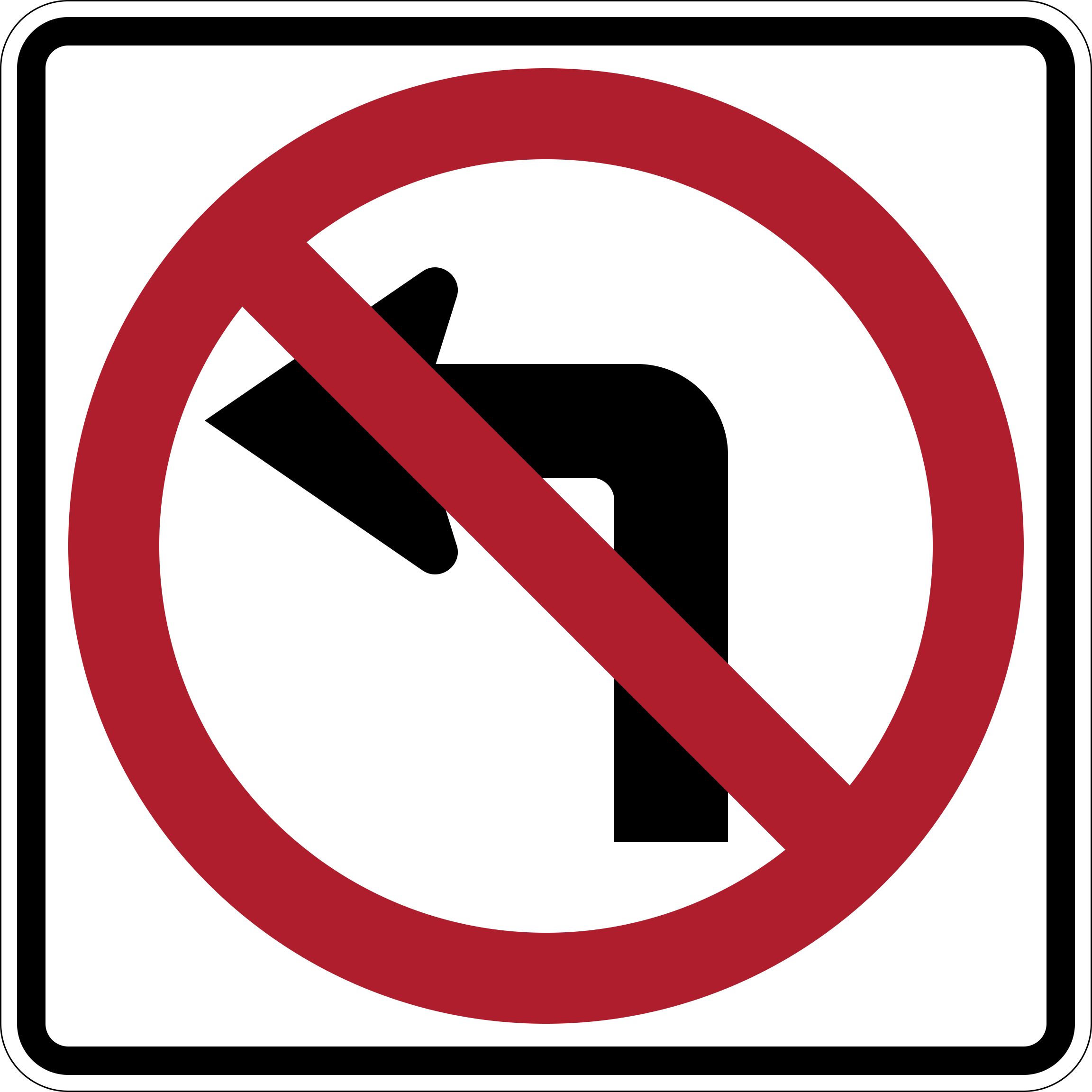
- A route direction
- A driver service
- A road hazard
- A traffic regulation
Show answer
A traffic regulation. The pictured prohibition communicates a rule governing what drivers may do at that location. The handbook explains that rectangular and square-shaped signs are used to show speed limits and other regulations, and it warns that ignoring them violates traffic laws. A route direction belongs to guide signs, a road hazard is the role of a warning sign, and a driver service identifies facilities such as food or fuel. Read the symbol and obey the movement restriction before proceeding.
Study this in the handbook: Sign shapes and colors
3. What does the circular yellow RR sign warn you about?

- A school zone beginning immediately
- A railroad crossing ahead
- A required route around a work zone
- A hospital entrance ahead
Show answer
A railroad crossing ahead. The circular yellow sign with RR and a black cross gives advance warning of a railroad crossing ahead. It tells you to reduce speed and be prepared to stop if needed so the vehicle can clear the tracks safely. The sign is not a school, hospital, or construction route marker. Advance warning is the key distinction: the sign appears before the crossing, while the crossbuck is positioned at the tracks. Scan both directions as you approach.
Study this in the handbook: Sign shapes and colors
4. How many hours must a North Carolina teen log on the Driving Log before a Level Two license, and how many at night?
- At least 40 hours, with 6 at night
- At least 50 hours, with 10 at night
- At least 60 hours, with at least 10 at night
- At least 30 hours, all in daylight
Show answer
At least 60 hours, with at least 10 at night. A Level One permit holder receives a Driving Log that must detail a minimum of 60 hours of operation, and at least 10 of those hours must occur during nighttime hours. Daytime driving counts from sunrise to sunset, and nighttime driving is after sunset and before sunrise. Totals of 30, 40, or 50 hours fall short of the North Carolina minimum, and an all daylight log skips the required night hours. The completed log is presented when applying for the Level Two license.
Study this in the handbook: Graduated licensing: learner permit to full license
5. What is the maximum speed for backing a vehicle under the North Carolina handbook’s backing guidance?
- Not more than 25 mph
- Not more than 5 mph
- Not more than 40 mph
- Not more than 10 mph
Show answer
Not more than 10 mph. The backing guidance says to back very slowly, not more than 10 mph, because a vehicle is harder to control and stop while moving backward. Twenty five and forty miles per hour are plainly too fast for the limited visibility of reversing, while five is not the handbook’s stated maximum. The exam cue is the exact figure ten, paired with the reason that control and stopping are more difficult. Even at or below that ceiling, the driver must check behind the vehicle and maintain a full view rather than rely on speed alone.
Study this in the handbook: Passing, backing and parking
6. What is the legal purchase age for any alcoholic beverage in North Carolina?
- 18
- 19
- 25
- 21
Show answer
21. North Carolina sets the legal purchase age for any alcoholic beverage at 21. Ages 18 and 19 are younger than that figure, so they do not state the rule, and twenty-five is also not the handbook figure. The simplest cue is to connect alcohol purchase with the number 21, while remembering that safe driving requires avoiding drinking and driving at every age.
Study this in the handbook: Driving while impaired and alcohol limits
7. What BAC level does the North Carolina handbook identify as the point at which everyone's driving is impaired?
- 0.02 percent
- 0.08 percent
- 0.05 percent
- 0.15 percent
Show answer
0.08 percent. The handbook identifies 0.08 as the blood alcohol concentration at which everyone's driving is impaired. The smaller figures are not the general benchmark stated in this passage, while 0.15 appears in discussion of enhanced DWI consequences rather than the basic impairment statement. Do not treat the number as permission to drink and drive. Its safety message is that impairment is universal at that level, even when a person believes they feel normal.
Study this in the handbook: Driving while impaired and alcohol limits
8. How long must a North Carolina supervising driver have been licensed?
- At least one year
- At least three years
- At least five years
- At least ten years
Show answer
At least five years. A North Carolina supervising driver must hold a valid license and have been licensed for at least five years. The supervisor must be a parent, grandparent, or guardian, or a responsible person the parent or guardian approves. One and three years fall short of the rule, and ten years is more than required. The same supervisor rules apply at Level One and Level Two.
Study this in the handbook: Graduated licensing: learner permit to full license
9. What happens to a North Carolina driver's license points when the driving privilege is reinstated after a suspension?
- They are doubled
- They stay for three more years
- All previous driver license points are canceled, though insurance points are not affected
- Half are removed
Show answer
All previous driver license points are canceled, though insurance points are not affected. When a North Carolina driving privilege is reinstated, all earlier driver license points are canceled. That does not apply to insurance points, which insurers track under a separate system. Points are not doubled, kept, or halved. After reinstatement, though, 8 new points within three years can lead to a second suspension, so a clean slate does not mean a long grace period.
Study this in the handbook: Keeping your license: points, suspensions and renewal
10. How long must a North Carolina driver hold a Level Two Limited Provisional License before applying for a Full Provisional License?
- At least 30 days
- At least six months
- At least nine months
- At least two years
Show answer
At least six months. A North Carolina Level Two Limited Provisional License must be held at least six months before applying for a Level Three Full Provisional License. Nine months is the holding period for the Level One permit. Thirty days and two years are not the Level Two figure. Level Two drivers may drive alone only from 5 a.m. to 9 p.m., except for direct trips to work or volunteer emergency service.
Study this in the handbook: Graduated licensing: learner permit to full license
11. What do white lines separating travel lanes indicate?
- The lanes always move in opposite directions
- Passing is prohibited in both directions
- The lane is reserved for railroad traffic
- The lanes move in the same direction
Show answer
The lanes move in the same direction. White lines separate travel lanes moving in the same direction. They help a driver understand the roadway's direction pattern, but the line type and other signs still determine whether a lane change or special movement is allowed. Yellow lines separate lanes moving in opposite directions, so choosing that answer reverses the handbook's color rule. The remaining choices describe restrictions or uses that color alone does not establish. Use the cue at the pavement: white means same-direction lanes, while yellow signals opposing traffic or a left edge on a divided highway.
Study this in the handbook: Traffic signals and pavement markings
12. About how many crashes and fatalities occur on North Carolina roads each year, according to the handbook?
- About 284,000 crashes and nearly 1,700 fatalities
- About 50,000 crashes and 200 fatalities
- About 1 million crashes and 10,000 fatalities
- About 10,000 crashes and 50 fatalities
Show answer
About 284,000 crashes and nearly 1,700 fatalities. The handbook opens with the scale of the problem: in North Carolina there are about 284,000 crashes and nearly 1,700 fatalities on the roadways each year. It asks every driver to use caution and to be attentive to others traveling on or along the road, and it says drivers can help reduce these numbers by following the rules of the road and driving safely. Fifty thousand, ten thousand, and one million crashes do not match the handbook's figure, and the fatality counts paired with them are also wrong.
13. How does the North Carolina handbook characterize passing on the right?
- It is legal whenever the passing vehicle uses its horn
- It is against the law except in specifically permitted areas
- It is required on every highway with two lanes
- It is legal whenever the vehicle ahead is slower
Show answer
It is against the law except in specifically permitted areas. The handbook gives a general prohibition followed by specific exceptions. Passing on the right is against the law unless the location and lane arrangement make it specifically permitted. A horn does not create legal permission, a two-lane highway does not automatically require the maneuver, and a slower vehicle alone does not change the rule. Before moving right, identify an actual exception and confirm that the pass can be completed safely. The useful memory cue is prohibited first, permitted only under a stated roadway condition.
Study this in the handbook: Passing, backing and parking
14. Why should you leave generous space when driving beside a large truck?
- The truck is legally allowed to cross into your lane
- Large vehicles always travel faster than posted limits
- A truck’s brakes cannot work on level pavement
- Air currents from the larger vehicle can affect your steering
Show answer
Air currents from the larger vehicle can affect your steering. The handbook warns that wind currents created by a large vehicle may affect your steering, so the practical response is to give the truck plenty of room. That effect does not grant the truck permission to cross lanes, imply that it exceeds speed limits, or mean its brakes fail on level ground. Keep a stable path, avoid lingering beside the truck, and use the extra space as a buffer. The visual cue is the truck’s size and the air movement around it.
15. What does a solid red arrow mean for traffic intending to turn?
- Turning traffic must stop
- The turn is allowed after sounding the horn
- Only pedestrians must stop
- The turn is protected and may proceed
Show answer
Turning traffic must stop. A red arrow stops the movement shown by the arrow. Turning traffic must wait rather than treating the indication like a permissive turn. A green arrow is the protected movement that allows a cautious entry, while a flashing yellow arrow permits a turn only after yielding to oncoming traffic and pedestrians. Sounding the horn cannot replace the signal indication, and pedestrians are not the only road users governed by the red arrow. Identify the arrow direction, stop before entering the intersection, and wait for a signal that authorizes the intended movement.
Study this in the handbook: Traffic signals and pavement markings
16. If a blowout occurs, what should a driver do before applying the brakes?
- Press the brake pedal as hard as possible
- Turn sharply toward the shoulder
- Reduce speed by lifting the foot from the accelerator
- Shift into reverse immediately
Show answer
Reduce speed by lifting the foot from the accelerator. During a blowout, first hold the steering wheel tightly, try to keep the vehicle straight on your side of the road, and reduce speed by lifting your foot from the accelerator. The handbook says not to apply the brakes until the engine has slowed the vehicle enough for you to maintain control. Hard braking can worsen the loss of stability, while a sharp turn can send the vehicle across the roadway. After control and speed improve, find a safe place to move completely off the road. The cue is smooth control first, braking later.
Study this in the handbook: Blowouts, breakdowns and crashes
17. As driving speed increases, what does the North Carolina handbook say about the distance needed for stopping?
- The driver must be able to see farther ahead
- The driver needs the same view at every speed
- The driver may rely on the shoulder as stopping space
- The driver can shorten the following gap
Show answer
The driver must be able to see farther ahead. The handbook connects higher speed with a need to see farther ahead so there is enough distance to stop. Faster travel covers more roadway during the driver’s reaction time and requires more room for braking. Shortening the following gap moves in the opposite direction, while an unchanged view ignores the extra stopping distance. The shoulder is not a planned substitute for safe spacing. Scan farther down the road as speed rises, preserve a usable gap, and reduce speed when curves, hills, traffic, or weather limit how far you can see.
Study this in the handbook: Speed limits and stopping distance
18. Where should a driver generally park on a North Carolina road?
- Across the center of a two-way road
- On the left side of every road
- On the right side of the road, except on a one-way street
- On the shoulder whenever the road has two-way traffic
Show answer
On the right side of the road, except on a one-way street. North Carolina directs drivers to park on the right side of the road, with an exception for one-way streets. On a one-way street, parking on the left may be permitted because traffic travels in one direction, but that exception does not change the general rule for two-way roads. Parking across the center of a two-way roadway creates a conflict with approaching traffic, and using the shoulder whenever traffic moves both ways is not the handbook rule. Use the curb-side cue: on ordinary roads, place the vehicle on the right before securing it.
Study this in the handbook: Passing, backing and parking
19. At a North Carolina railroad crossing, which road user has the right of way?
- The train over all highway traffic
- The first automobile to reach the rails
- A vehicle facing a green signal on a nearby road
- A police vehicle approaching with warning lights
Show answer
The train over all highway traffic. Trains have priority at railroad crossings, including over police, fire, and ambulance vehicles. The first automobile to reach the rails cannot claim precedence, and a green signal on a nearby road does not control the train crossing. Rail equipment needs a great distance to stop and cannot swerve around a vehicle. When approaching tracks, reduce speed, look both ways, listen, and be prepared to stop before the crossing rather than trying to beat the train.
Study this in the handbook: Railroad crossings and funeral processions
20. A driver has just moved to North Carolina and holds a license from another state. How long does the new resident have to get a North Carolina license or learner permit?
- 10 days after arriving in the state
- 60 days after establishing residence
- One year, as long as the old license stays valid
- Only when the old license expires
Show answer
60 days after establishing residence. The North Carolina handbook gives a newcomer a fixed window rather than letting an out of state license run until it expires. Once a person establishes residence in North Carolina, the person has 60 days to obtain a North Carolina license or learner permit. A commercial driver who wants to keep a commercial license has a shorter deadline of 30 days after becoming a resident, so the two periods should not be confused. A ten day period or a full year are not the rule for an ordinary license, and the old license expiring is not what starts the clock.
Study this in the handbook: License tests, teen phone ban and full provisional license
QualitySpace is expanding to North Carolina
We are a California-based independent insurance brokerage working on licensing in more states. We cannot help with North Carolina insurance yet. Leave your email and we will let you know when we can.
Every question is written from the official North Carolina Driver Handbook. Need paper? Printable NC practice test with answer key.
Last verified 2026-10-05. How we check every question · Study all 207 as flashcards
Frequently asked questions
How many questions are on this North Carolina practice test?
This fixed set has 20 questions. It is test 8 of 10 from the 207 question North Carolina bank.
How does this fixed test relate to the full North Carolina bank?
Each numbered test is a fixed set of questions in a fixed order, so you can retake the same test later and compare. Every test mixes road signs and the other topics in about the same proportion as the full bank. Tests 1 to 10 together cover 200 of the 207 questions in the North Carolina bank, each once. The full practice page mixes the whole bank at random.
Last verified 2026-10-05. See the North Carolina DMV facts page for sourced state details.
Return to the full North Carolina practice test · Study road signs