
Test 20 of 25 · 20 questions · Free 2026
NC Permit Practice Test 20
Jump to the test ↓A fixed 20 question set from the North Carolina bank with answers and plain English explanations.
Question 1 of 20 · 0 right so far
All 20 questions in test 20
Every question below comes from the North Carolina question bank on this page. Open a question to see the correct answer and the explanation. Nothing here is hidden behind a signup.
1. What can happen if a vehicle towing a trailer has to brake suddenly?
- The trailer might jackknife sideways
- The trailer will stop sooner than a car
- The towing vehicle gains extra traction
- Nothing, since trailers have their own brakes
Show answer
The trailer might jackknife sideways. Vehicles towing trailers need special care from everyone around them. The handbook says to watch for sway and for hazards such as crosswinds or slippery curves, and to be aware that sudden braking might cause the trailer to jackknife. Recreational vehicles and trailers accelerate and stop more slowly than cars, so cutting in close ahead of one leaves its driver too little room. Give towing vehicles extra space.
Study this in the handbook: Bicycles, mopeds, trucks and insurance
2. Under North Carolina law, which bicycle riders must wear an approved protective helmet?
- Riders on roads posted above 35 mph
- Adult riders over age 18
- Riders and passengers under age 16
- Riders who are carrying a passenger
Show answer
Riders and passengers under age 16. North Carolina requires all bicycle riders and passengers under age 16 to wear an approved protective bicycle helmet and to be seated on a saddle seat. A passenger who weighs less than 40 pounds or is less than 40 inches tall must ride in a bicycle restraining seat. The helmet rule is based on age, not on the speed limit of the road or whether the rider carries a passenger.
Study this in the handbook: Bicycles, mopeds, trucks and insurance
3. You come to a railroad crossing where a stop sign is posted. No train is in sight. What must you do?
- Slow down and cross if the tracks look clear
- Stop only if the crossing lights are flashing
- Stop only when you hear a train horn
- Come to a full stop before safely crossing
Show answer
Come to a full stop before safely crossing. The handbook says that if there is a stop sign at a railroad crossing, you must come to a full stop before safely crossing. Trains can approach a crossing at any time from any direction, and the train always has the right of way. A clear view of the tracks, silent horns, and dark lights do not replace the required stop.
Study this in the handbook: Railroad crossings and funeral processions
4. On a divided highway at night, you notice a solid yellow line on your right and a solid white line on your left. What does this mean?
- You are traveling in the wrong direction
- You are in a two-way left-turn lane
- You are in a lane that is ending soon
- You are on the correct side of the highway
Show answer
You are traveling in the wrong direction. On divided highways, a single solid white line marks the right edge of the road and a single solid yellow line marks the left edge. The handbook says that if you see the reverse, with yellow on your right and white on your left, you are traveling in the wrong direction. Red reflective pavement markers are another warning of wrong-way movement. On an interstate, pull onto the right shoulder, stop, and turn around when the way is clear.
Study this in the handbook: Traffic signals and pavement markings
5. In North Carolina, on a two-lane road, a school bus coming toward you stops and turns on its flashing red lights. What must you do?
- Keep going, since you are in the other lane
- Slow to 20 mph and pass carefully
- Stop only if children are already in the road
- Stop, because traffic from both directions must stop
Show answer
Stop, because traffic from both directions must stop. On a two-lane roadway, when a school bus stops for passengers, all traffic from both directions must stop. Being in the opposite lane does not excuse you, and slowing down to pass carefully is not allowed. Stay stopped until the stop signal is withdrawn, the flashing red lights are off, and the bus has started to move. Children waiting for or leaving the bus might dart into traffic.
Study this in the handbook: Pedestrians, school buses and emergency vehicles
6. On a sunny spring or summer day, how much hotter than the outside air can the inside of a parked car become?
- About 5 to 10 degrees hotter
- About 15 to 20 degrees hotter
- About 90 to 100 degrees hotter
- About 40 to 50 degrees hotter
Show answer
About 40 to 50 degrees hotter. The handbook calls it dangerous and deadly to leave children or animals in a vehicle. After sitting in the sun during spring and summer, even with a window slightly open, the temperature inside can rise roughly 40 to 50 degrees higher than outside, and it can rise rapidly. Dehydration, heat stroke, and death can result from that heat. A slightly opened window does not prevent the buildup, so a parked car is no place for a child or a pet.
Study this in the handbook: Pedestrians, school buses and emergency vehicles
7. At what blood alcohol concentration does research cited in the North Carolina handbook show crash risk starting to rise?
- 0.02 percent
- 0.05 percent
- 0.08 percent
- 0.10 percent
Show answer
0.05 percent. The handbook says everyone's driving is impaired at 0.08 percent, but it also notes that many people are affected at much lower levels. Research it cites shows the chance of being in a crash goes up when alcohol reaches 0.05 percent, and at 0.08 the risk of causing a fatal crash is greater still. So 0.08 is the legal line for adult drivers, not the point where danger begins. A level below the legal limit can still hurt your driving.
Study this in the handbook: Driving while impaired and alcohol limits
8. Your friend asks you to wait in a space marked with this sign for two minutes. Your car has no handicap plate or placard. May you park there?
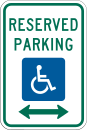
- Yes, for any stop under five minutes
- No, a plate or placard must be displayed
- Yes, if you stay in the driver's seat
- Yes, if the lot is nearly empty
Show answer
No, a plate or placard must be displayed. The handicap parking sign shows that a space is reserved for people who qualify for and are displaying a handicap license plate or a dashboard placard. A short stop, staying in the car, or an empty lot does not change that. The handbook also lists handicap spaces among places you should not park unless your vehicle is displaying the plate or placard. Find a regular space and wait there instead.
Study this in the handbook: Sign shapes and colors
9. As you slow to a stop on a snowy road, what does the North Carolina handbook suggest doing with your feet?
- Press the brake hard and hold it down
- Shift into neutral and coast to a stop
- Pump the gas pedal to keep the wheels turning
- Stay off the brake; let the engine slow you
Show answer
Stay off the brake; let the engine slow you. For starting and stopping on snowy or icy roads, the handbook lists several habits: increase speed slowly, test your steering and braking to get the feel of the road, and allow at least three times the normal stopping distance. When you stop, keep your foot off the brake and let the engine slow the vehicle. Hard braking is the opposite of that advice, and coasting in neutral takes away the engine's slowing effect.
Study this in the handbook: Turn signals, headlights and bad weather
10. On a clear day, traffic around you is going about 60 mph past this sign. Is the number on it just a suggestion?

- Yes, it is advice that you may adjust
- No, it is a legal limit you must obey
- Yes, if traffic is moving faster
- Yes, outside of business hours
Show answer
No, it is a legal limit you must obey. Rectangular black-and-white signs that show speed limits are regulatory signs. The handbook says failure to obey these signs is unsafe as well as a violation of the traffic laws, so the number is a legal maximum, not advice. Other drivers going faster does not change that. The handbook's speed rule also says never to drive faster than the posted limit, and to go slower when conditions make that speed unwise.
Study this in the handbook: Sign shapes and colors
11. A child has outgrown a standard child safety seat but is not yet big enough for an adult belt to fit. What should the child use?
- The adult belt, tightened as much as possible
- The front seat with the air bag turned off
- A lap belt only, with no shoulder strap
- A booster seat that meets federal standards
Show answer
A booster seat that meets federal standards. The handbook says booster seats that meet federal safety standards should be used for children who have outgrown their standard safety seats, until they are big enough for seat belts. Adult belts should not be used until they fit correctly, with the lap belt across the hips and the shoulder belt across the chest. Belt-positioning boosters raise a child for that fit. Children age 12 and under should ride buckled in a rear seat.
Study this in the handbook: Seat belts, child restraints and window tint
12. You are following a school bus on a state highway posted at 55 mph. What is the fastest the bus is allowed to travel?
- 45 mph, even though the road allows 55
- 55 mph, the same as other traffic on the road
- 50 mph, five under the posted limit
- 35 mph, because children are aboard
Show answer
45 mph, even though the road allows 55. The handbook sets the maximum speed limit for a school bus at 45 mph. That cap stays in place on a road with a higher posted limit, so a bus on a 55 mph highway may not go faster than 45. The handbook also asks drivers to be especially careful during the hours when school buses operate, generally 7 to 9 a.m. and 2 to 4 p.m.
Study this in the handbook: Pedestrians, school buses and emergency vehicles
13. How should pedestrians cross at a North Carolina roundabout?
- Walk across the central island
- Cross wherever traffic is lightest
- Use the marked crosswalks along the outside
- Wait for drivers to stop inside the circle
Show answer
Use the marked crosswalks along the outside. The handbook tells pedestrians to use the marked crosswalks along the outside of a roundabout and not to walk through the middle of it. Drivers, in turn, should signal when exiting and yield to pedestrians using those crosswalks. Traffic inside the roundabout keeps moving counterclockwise, so waiting for it to stop in the circle is not how crossing works. Knowing where pedestrians cross tells drivers where to look.
Study this in the handbook: Right of way at intersections and roundabouts
14. You are about to start down a long, steep grade. How does the North Carolina handbook say to control your speed without wearing out the brakes?
- Ride the brake pedal lightly all the way down
- Shift into neutral and coast to the bottom
- Shift to a lower gear at the top of the hill
- Turn off the engine to save the brakes
Show answer
Shift to a lower gear at the top of the hill. To prevent excessive brake wear on a long hill or steep grade, the handbook says to use a lower gear instead of the brake pedal to control your speed. It is best to shift into the lower gear at the top of the hill, before you start down. Riding the brake all the way down is the wear the handbook wants you to avoid. Coasting in neutral or shutting off the engine is not part of its advice.
15. A deer crosses the road in front of you and disappears into the woods. What does the North Carolina handbook say to expect?
- More deer may be close behind it
- The deer will not return to the road
- Deer travel alone, so the danger is over
- Animals stay away from roads after dark
Show answer
More deer may be close behind it. The handbook warns drivers to expect more than one animal. Many species, including deer, elk, and wild boars, travel in groups or family units, and they often move one right behind the other. If you see one, others may be close behind, such as young animals following their mother. Slow down and keep scanning the road edges. Wildlife is most active at dawn, dusk, and in the first few hours after dark, not less active.
16. According to the North Carolina handbook, hydroplaning can start at speeds as low as what?
- 10 mph
- 30 mph
- 50 mph
- 65 mph
Show answer
30 mph. Hydroplaning happens when a thin sheet of water gets between the road and your tires, so they lose contact and the vehicle begins to skid. The handbook says it can start at speeds as low as 30 miles per hour, in water little more than 1/8 inch deep. The faster you go, the greater the chance. Once it starts, any sudden steering or even a strong gust of wind can send you into an uncontrollable skid.
Study this in the handbook: Turn signals, headlights and bad weather
17. Parked cars line your right side and oncoming traffic fills the lane to your left, leaving little room. What does the handbook advise when the dangers are equal?
- Squeeze between them at a steady speed
- Stop and let the oncoming vehicles pass first
- Drift close to the parked cars to make room
- Speed up to get through the narrow gap fast
Show answer
Stop and let the oncoming vehicles pass first. The handbook teaches that when you face two dangers at once, you give the most room to the greater or more likely one. But when the dangers are equally hazardous, such as oncoming vehicles on one side and parked vehicles on the other, you should stop and let the oncoming vehicles pass safely before going on. Squeezing through or speeding up leaves no margin on either side. Once the oncoming traffic clears, you can move ahead with room to spare.
Study this in the handbook: Turn signals, headlights and bad weather
18. Traffic is backed up just beyond a railroad crossing. What does the North Carolina handbook warn you to check before driving onto the tracks?
- That the crossing gates are fully raised
- That a train horn is not sounding nearby
- That you will not be stuck on the tracks
- That the car ahead has its hazards on
Show answer
That you will not be stuck on the tracks. The handbook points out that crossing gates will not trap you, but stopping traffic might. Before you drive onto the tracks, be sure the traffic ahead of you will not stop and leave you blocked in on the crossing. If there is not room for your whole vehicle on the far side, wait before the crossing. Raised gates or a quiet horn do not mean you have space to clear the tracks.
Study this in the handbook: Railroad crossings and funeral processions
19. You are stuck behind a slow tractor on a two-lane road with a solid yellow line in your lane. The road ahead looks clear. May you pass?
- No, passing farm equipment in a no-passing zone is illegal
- Yes, farm equipment is an exception to no-passing rules
- Yes, if the tractor driver waves you on
- Yes, if you can pass within 10 seconds
Show answer
No, passing farm equipment in a no-passing zone is illegal. When sharing the road with farm equipment, you must obey the rules of the road. The handbook says it is illegal and very dangerous to pass farm equipment in a no-passing zone. Farm equipment may be wider than it looks and may need space in both lanes, and it can be hard to see oncoming traffic around it. Be patient; the only advisable time to pass is when the operator moves off the road to let traffic by.
20. The light turns yellow when you are only a few feet from the intersection, too close to stop safely. What should you do?
- Slam on the brakes and stop at once
- Speed up to clear it before the red
- Drive cautiously through the intersection
- Stop in the middle of the intersection
Show answer
Drive cautiously through the intersection. A steady yellow means the light is about to turn red. The handbook says to stop for a yellow unless you are too close to the intersection to stop safely, and in that case to drive cautiously through. Slamming on the brakes at the last moment is not what the rule asks, and stopping in the middle would block cross traffic. Speeding up to beat the red is never allowed.
Study this in the handbook: Traffic signals and pavement markings
Every question is written from the official North Carolina Driver Handbook. Need paper? Printable NC practice test with answer key.
Last verified 2026-10-05. How we check every question · Study all 500 as flashcards
Frequently asked questions
How many questions are on this North Carolina practice test?
This fixed set has 20 questions. It is test 20 of 25 from the 500 question North Carolina bank.
How does this fixed test relate to the full North Carolina bank?
Each numbered test is a fixed set of questions in a fixed order, so you can retake the same test later and compare. Every test mixes road signs and the other topics in about the same proportion as the full bank. Tests 1 to 25 together cover every question in the North Carolina bank once. The full practice page mixes the whole bank at random.
Last verified 2026-10-05. See the North Carolina DMV facts page for sourced state details.
Return to the full North Carolina practice test · Study road signs