
Printable NC Permit Practice Test
40 questions from the North Carolina question bank. Answer key on the last page. Last verified 2026-09-05 against the official North Carolina driver manual.
1. What does the North Carolina handbook say to do before a curve while traveling downhill?
- Shift to neutral
- Shift to a lower gear and begin braking earlier
- Speed up to carry momentum
- Brake hard in the middle of the curve
2. What maximum speed does the North Carolina handbook list for a school bus?
- 55 mph
- 35 mph
- 45 mph
- 70 mph
3. A North Carolina driver turning right on red fails to yield to a pedestrian starting to cross in front of stopped traffic. What penalty applies?
- A warning only, with no penalty
- A penalty of not less than $100 and not more than $500
- A flat $25 infraction
- A penalty of $1,000 to $2,000
4. What testing accommodation is available on request for a North Carolina applicant who has difficulty reading?
- A waiver of the traffic law examination
- An audio version of the knowledge test
- A road test that replaces the knowledge test
- Automatic passage without answering questions
5. How early may a North Carolina driver renew a license, and how often is online renewal allowed?
- Up to one year early, online every time
- Up to six months before expiration, online every other renewal
- Only in the last 30 days, in person only
- Any time, online every time
6. Unless a different limit is posted, what speed limit applies in North Carolina cities and towns?
- 25 mph in cities and towns
- 35 mph in cities and towns
- 45 mph in cities and towns
- 55 mph in cities and towns
7. A 16-year-old North Carolina driver is driving. Whom may the teen call on a cell phone in an emergency?
- Emergency responders, a hospital or clinic, law enforcement, or a parent, legal guardian, or spouse
- Anyone, if the call is hands free
- Only friends in the car
- No one, even in an emergency
8. Where is very slow driving especially dangerous?
- Just after the crest of a hill or around a curve
- In a parking lot
- On a straight road with no traffic
- In a school zone during school hours
9. For a driver age 21 or older, which BAC level is the North Carolina per se DWI threshold?
- A BAC of 0.08 percent or more
- A BAC of 0.05 percent or more
- A BAC of 0.10 percent or more
- A BAC of 0.15 percent or more
10. What does the North Carolina handbook call the safest way to pass a bicyclist?
- Change lanes
- Sound the horn and pass closely
- Pass on the right
- Squeeze by in the same lane
11. Where does a North Carolina highway work zone begin and end?
- Only where workers are present on the road
- From the first cone to the first flagger
- From the first work zone sign to the last one
- Within 500 feet of any construction equipment
12. A bicyclist in North Carolina has been drinking. Do the state's DWI laws apply to the rider?
- Yes, bicycles are vehicles under the law
- No, DWI rules are written for car drivers
- Only if the rider is on a highway
- Only if the bicycle has a motor
13. You are already crossing the tracks when the warning lights begin flashing. What does the North Carolina handbook say to do?
- Stop right away on the tracks and wait
- Back up off the tracks as fast as possible
- Keep moving and finish crossing
- Stop and get everyone out of the car
14. This sign is posted at an intersection where you wanted to turn around. What does it require?

- Make a U-turn only after stopping
- U-turns are allowed for cars, not trucks
- Turn left only, then make a U-turn
- Do not make a U-turn here
15. The temperature is just above freezing and the road feels wet but not icy. You are approaching a bridge. What should you expect?
- Bridges stay warmer than the road
- Ice forms on bridges only at night
- The bridge may freeze before the road does
- Bridges are salted, so they are always safe
16. As you approach a railroad crossing, the flashing lights come on and the gates start to come down. What must you do?
- Speed up so you clear the tracks before the gates are down
- Stop before the gates lower across your side of the road
- Drive around the gate if no train is visible
- Slow down and cross once the gates finish moving
17. Police are working a crash on your street, and you want to park and wait for a friend. How close to the stopped police car may you park?
- Right behind it with flashers on
- No closer than 100 feet
- No closer than 25 feet
- Anywhere if you stay in the car
18. Your gas pedal sticks while you are driving. Which response does the North Carolina handbook list?
- Turn the engine off and steer to the median
- Pump the brakes rapidly while in drive
- Pull the parking brake as hard as possible
- Shift to neutral and brake firmly
19. You are driving beside a tractor-trailer and cannot see the driver's face in the truck's side mirror. What does that tell you?
- The driver is looking straight ahead
- You are too far away to matter
- The truck driver probably cannot see you
- The truck is about to change lanes
20. What can happen if a vehicle towing a trailer has to brake suddenly?
- The trailer might jackknife sideways
- The trailer will stop sooner than a car
- The towing vehicle gains extra traction
- Nothing, since trailers have their own brakes
21. You pass a car on a two-lane road, but the driver you passed has to brake to let you back into the lane. What does this mean?
- The other driver was going too slowly
- You did not leave enough room to pass safely
- You passed correctly, since you got back in
- The other driver broke the law by braking
22. When entering a North Carolina interstate from an on-ramp, how should you use the acceleration lane?
- Stop at its end and wait for a large gap
- Use it to match the speed of traffic, then merge
- Merge right away at the start of the lane
- Drive slowly so traffic can see you coming
23. A bike lane runs along the right side of the street. When you plan to turn right at an intersection, what crash risk does the handbook point out?
- A cyclist turning left across your path from ahead
- A cyclist going straight beside you as you turn
- A cyclist stopping suddenly in the bike lane
- A cyclist riding against traffic on the sidewalk
24. On a city street with curbs, you see a parking space that starts 20 feet from the curb line of a cross street. May you park there?
- Yes, 20 feet is plenty of room
- No, you must stay at least 25 feet away
- Yes, if you are on the right side
- No, you must stay 100 feet away
25. It has not rained for weeks, and a light shower has just started. When is the road likely to be most slippery?
- After an hour of steady rain
- Only once puddles have formed
- Only after the rain stops
- During the first 10 to 15 minutes
26. What must every vehicle in a North Carolina funeral procession display?
- Nothing special
- High beams only
- A flag on the antenna
- Headlights on, and hazard warning signals if equipped
27. When leaving a parallel parking space, what should a North Carolina driver do before pulling into traffic?
- Move out immediately because parked vehicles have priority
- Use the right turn signal and leave without checking behind
- Sound the horn while backing into the nearest travel lane
- Check for approaching traffic and give a left turn signal
28. After a North Carolina crash with no injuries, at what amount of apparent property damage must the driver immediately report it to law enforcement?
- $100 or more
- $5,000 or more
- Only when a vehicle must be towed
- $1,000 or more
29. What license suspension does North Carolina list for prearranged racing with another vehicle on the highway?
- A 30-day suspension
- 90 days
- 1 year
- 3 years
30. In which direction do vehicles travel around a traffic circle or roundabout?
- To the right around the circle in a counterclockwise direction
- Straight across the center whenever traffic is light
- In either direction according to the driver’s preferred lane
- To the left around the circle in a clockwise direction
31. Which headlights does the North Carolina handbook say to use when driving at night in a city?
- High-beam headlights
- Parking lights only
- Low-beam headlights
- No headlights where streetlights are on
32. How long is the first suspension under North Carolina's point system?
- 30 days only
- 60 days
- 6 months
- 12 months
33. What does the DO NOT STOP ON TRACKS sign shown remind you to do?
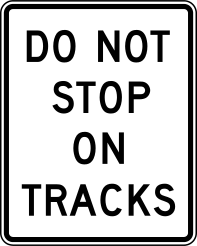
- Stop on the tracks only if traffic ahead is stopped
- Stop on the tracks to look for trains
- Speed up and cross every track without looking
- Do not stop on the railroad tracks for any reason
34. Before a North Carolina driver under 18 may take the learner permit or license test, what driver education instruction is required?
- Ten classroom hours and two road hours
- At least 30 classroom hours and six behind-the-wheel hours
- Six classroom hours and 30 road hours
- Twenty classroom hours with no driving instruction
35. In North Carolina, how far to the left must a passing driver pass the vehicle being overtaken?
- At least two feet
- At least six inches
- At least one foot
- At least ten feet
36. An ambulance with lights and siren approaches from the opposite direction on a four-lane, limited-access highway with a center median. Must you yield?
- Yes, traffic both ways must pull over and stop
- Yes, but only if the ambulance uses the left lane
- No, opposite traffic on that highway need not yield
- No, ambulances never get the right of way on highways
37. When may a driver use the emergency warning flashers?
- To show you are driving slowly in the far left lane
- To warn of danger or a stopped or disabled vehicle
- To park in a no-parking zone for a short time
- To drive through a red light in an emergency
38. You have a green light when you hear a siren and see a fire engine with flashing lights coming toward the intersection from the side. Who has the right of way?
- You, since your green light gives you priority over any vehicle
- Whoever reaches the crossing first
- The fire engine, but only if your light turns red
- The fire engine, even though your light is green
39. When does a motorcycle usually stop more slowly than normal?
- When it is traveling uphill
- When carrying a second rider
- When the rider uses both brakes
- When the road is dry and smooth
40. Fast-moving water about six inches deep is flowing across the road ahead after a storm. What should you do?
- Do not drive into it; it can sweep a car away
- Drive through slowly in a low gear
- Drive through quickly before it rises
- Follow the pickup truck ahead through it
Answer key
- 1. B
- 2. C
- 3. B
- 4. B
- 5. B
- 6. B
- 7. A
- 8. A
- 9. A
- 10. A
- 11. C
- 12. A
- 13. C
- 14. D
- 15. C
- 16. B
- 17. B
- 18. D
- 19. C
- 20. A
- 21. B
- 22. B
- 23. B
- 24. B
- 25. D
- 26. D
- 27. D
- 28. D
- 29. D
- 30. A
- 31. C
- 32. B
- 33. D
- 34. B
- 35. A
- 36. C
- 37. B
- 38. D
- 39. B
- 40. A