
Test 2 of 10 · 20 questions · Free 2026
NC Permit Practice Test 2
Jump to the test ↓A fixed 20 question set from the North Carolina bank with answers and plain English explanations.
Question 1 of 20 · 0 right so far
All 20 questions in test 2
Every question below comes from the North Carolina question bank on this page. Open a question to see the correct answer and the explanation. Nothing here is hidden behind a signup.
1. What maximum speed does the North Carolina handbook list for a school bus?
- 55 mph
- 35 mph
- 45 mph
- 70 mph
Show answer
45 mph. The maximum speed limit listed for a school bus is 45 mph. Thirty-five mph is the general city and town figure, 55 mph applies to several other settings, and 70 mph is the interstate entry in the maximum speed table. The figure does not reduce the separate duty of other drivers to stop for a school bus displaying its stop signal or flashing red lights. Remember 45 as the bus-specific maximum.
Study this in the handbook: Pedestrians, school buses and emergency vehicles
2. When leaving a parallel parking space, what should a North Carolina driver do before pulling into traffic?
- Move out immediately because parked vehicles have priority
- Use the right turn signal and leave without checking behind
- Sound the horn while backing into the nearest travel lane
- Check for approaching traffic and give a left turn signal
Show answer
Check for approaching traffic and give a left turn signal. A driver leaving a parallel space should first check for approaching traffic and signal left before pulling out. The parked position does not grant priority over vehicles already moving along the roadway. A right signal communicates the wrong movement, and a horn cannot replace a visual check. Backing into a travel lane without looking creates a conflict with passing traffic. Use the mirror and a shoulder check, signal clearly, then enter only after the lane is open.
Study this in the handbook: Passing, backing and parking
3. Rectangular and square-shaped signs that are normally black and white or red and white are used for what purpose?
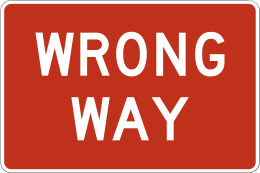
- Warning that a railroad crossing is immediately ahead
- Showing speed limits and other traffic regulations
- Identifying hospitals and roadside telephone locations
- Marking the beginning of every passing zone
Show answer
Showing speed limits and other traffic regulations. North Carolina uses rectangular and square-shaped signs for speed limits and other regulations. Their black and white or red and white designs can present instructions that govern how traffic uses the road. A railroad warning uses a circular sign with a black cross and RR, while blue and white signs identify certain services. The beginning of a no-passing zone is marked by a pennant-shaped warning sign. When a rectangular panel gives a number, restriction, or movement instruction, treat it as a rule-setting message and follow its wording.
Study this in the handbook: Sign shapes and colors
4. Without supervision or any immediate-family or household passengers aboard, how many outside passengers under 21 may a North Carolina Level Two driver carry?
- No more than one
- Two unrelated passengers under 21 on every trip
- No passengers under 21 under any circumstance
- Three passengers if each wears a seat belt
Show answer
No more than one. The limit is one passenger under 21 from outside the driver’s immediate family and household. If an under-21 family or household member rides, an outside passenger under 21 is generally not allowed. The school exception permits one outside student on a direct trip to or from school alongside the family or household passenger. It does not increase the number of outside passengers to two. Seat-belt capacity does not change this rule.
Study this in the handbook: Graduated licensing: learner permit to full license
5. When an eligible North Carolina Level Two driver reaches age 18, which upgrade is available online?
- A commercial driver license automatically
- A motorcycle endorsement without testing
- A regular Class C license
- A Level One Limited Learner Permit
Show answer
A regular Class C license. At age 18, an eligible driver may upgrade to a regular Class C license online. That provision does not automatically grant commercial privileges or a motorcycle endorsement, and moving backward to a learner permit is unrelated. A useful distinction is between the normal graduated path and the age milestone: Level Two can progress to Level Three, but age 18 opens the direct Class C upgrade described in the handbook.
Study this in the handbook: Keeping your license: points, suspensions and renewal
6. At night, what should a pedestrian use to make it easier for drivers to see them?
- Dark clothing only
- A vehicle’s high beams
- The center of the roadway
- A flashlight
Show answer
A flashlight. The handbook warns that pedestrians are harder for drivers to see at night and advises using a flashlight. Dark clothing reduces visibility rather than improving it, walking in the center of the roadway creates an added hazard, and a pedestrian cannot rely on a vehicle’s high beams as personal lighting. Carry a light and remain alert for vehicles that may not see you immediately. The cue is nighttime visibility: help the driver detect your position before you enter the vehicle’s path.
7. What does North Carolina law require of the total light transmission of an after-factory tinted vehicle window?
- At least 50 percent
- At least 35 percent
- At least 20 percent
- Any level, as long as the windshield is clear
Show answer
At least 35 percent. North Carolina General Statute 20-127 says the total light transmission of a tinted window must be at least 35 percent, and a window that meters above 32 percent on an approved light meter is presumed to comply. Darker film is a misdemeanor for the installer and for the driver who uses it on a highway. Since December 1, 2025, NCDMV no longer checks tint during the safety inspection and the old $10 tint fee is gone, but the 35 percent limit itself still applies, so an officer can still cite a window that is too dark.
Study this in the handbook: Seat belts, child restraints and window tint
8. When being passed on a North Carolina road, what must the driver of the vehicle being overtaken do?
- Accelerate to keep the other vehicle beside you
- Brake hard in the travel lane
- Move left to block the passing vehicle
- Move to the right edge and never increase speed
Show answer
Move to the right edge and never increase speed. When another driver is passing, the handbook requires the overtaken driver to help by moving to the right edge of the road and never increasing speed. Accelerating can prevent the passing maneuver and, if a crash causes injury or property damage, may lead to a misdemeanor. Moving left blocks the pass, while hard braking creates a new hazard. The practical cue is simple: give space on the right and hold or reduce speed. This duty applies when the passing driver signals with the horn and is working to complete the maneuver safely.
Study this in the handbook: Passing, backing and parking
9. After slowing before a curve, what does the North Carolina handbook advise to maintain traction?

- Brake sharply throughout the curve
- Gradually increase speed while rounding the curve
- Cross the center line to straighten the curve
- Accelerate suddenly before the road begins to turn
Show answer
Gradually increase speed while rounding the curve. After a driver slows before entering a curve, the handbook advises gradually increasing speed to maintain the traction needed for control while rounding it. Sudden braking can upset the vehicle, and crossing the center line creates a conflict with opposing traffic. A sharp acceleration is also different from the smooth adjustment described in the handbook. The practical cue is to make the speed change progressively, keep the vehicle on its side of the road, and maintain enough control to follow the curve without abrupt steering or braking.
Study this in the handbook: Speed limits and stopping distance
10. When does the North Carolina stop-sign rule for a malfunctioning traffic light not apply?
- When a law enforcement officer or another authorized person is directing traffic, or another traffic control device is operating
- When the signal has been dark for less than one minute
- When the main road has more traffic
- When a driver has already entered the intersection
Show answer
When a law enforcement officer or another authorized person is directing traffic, or another traffic control device is operating. A failed traffic light is handled as a stop-sign intersection on all approaches, but the handbook identifies exceptions. The stop-sign treatment does not apply when a law enforcement officer or another authorized person is directing traffic, or when another type of traffic control device is operating. Traffic volume, the length of the outage, and a driver’s position do not create exceptions. Before proceeding, look for an officer, an authorized traffic director, or another operating control device that tells drivers how to move.
Study this in the handbook: Traffic signals and pavement markings
11. What shape does a North Carolina yield sign have, and where is its point?
- An octagon with the point at the top
- A diamond with the point at the side
- A circle with the point at the bottom
- A triangle with the point at the bottom
Show answer
A triangle with the point at the bottom. A North Carolina yield sign is triangular, with its point directed downward. That shape distinguishes it from the octagonal stop sign and from diamond-shaped warning signs. The sign’s red and white treatment also helps identify the instruction, but the downward point is the visual cue asked about here. When approaching it, slow down and yield to traffic as required; stopping depends on the traffic on the intersecting street. Do not confuse the triangle with a stop sign, which requires a full stop before proceeding when the way is clear.
Study this in the handbook: Sign shapes and colors
12. At an uncontrolled intersection, which vehicle has priority before the other vehicle enters?
- The vehicle already in the intersection
- The vehicle traveling faster
- The vehicle that flashes its headlights
- The vehicle on the wider roadway
Show answer
The vehicle already in the intersection. North Carolina gives priority to the vehicle that has already entered an intersection when the other vehicle has not entered yet. The width of either roadway does not change that sequence, and speed cannot create priority. Flashing headlights is a communication signal, not a replacement for yielding. Approach an uncontrolled crossing slowly, identify whether another vehicle is already inside it, and wait until that vehicle clears. The practical cue is location, not vehicle size or driver confidence: a car occupying the intersection goes first, while the approaching car remains outside the shared space.
Study this in the handbook: Right of way at intersections and roundabouts
13. What should a driver do when an authorized emergency vehicle approaches with its warning equipment operating?
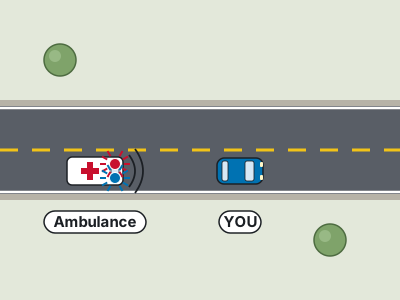
- Speed up to clear the lane
- Move right and stop until it passes
- Stop in the center of the intersection
- Follow immediately behind it
Show answer
Move right and stop until it passes. The emergency response rule requires a driver to yield room for the authorized vehicle by moving toward the right side and stopping until it has passed, unless a law enforcement officer directs otherwise. Accelerating creates conflict, stopping in the intersection can block the route, and following behind the emergency vehicle is unsafe. Scan mirrors as well as the road ahead so the move begins before the emergency vehicle reaches your position.
Study this in the handbook: Pedestrians, school buses and emergency vehicles
14. What BAC level can establish impaired driving for someone operating a commercial motor vehicle in North Carolina?
- 0.08 percent or more because commercial drivers use the ordinary limit
- 0.04 percent or more for a commercial motor vehicle driver
- 0.02 percent or more only when the vehicle carries passengers
- 0.15 percent or more unless the driver has a prior DWI
Show answer
0.04 percent or more for a commercial motor vehicle driver. Commercial motor vehicle operation uses a lower BAC threshold than ordinary driving. The handbook identifies 0.04 percent or more for a commercial motor vehicle, while 0.08 percent is the general figure. The 0.02 option invents a passenger condition, and 0.15 is associated with an ignition interlock requirement rather than the basic commercial threshold. When reviewing a BAC item, first identify the vehicle category, then apply the matching number rather than carrying the standard adult figure into commercial operation.
Study this in the handbook: Driving while impaired and alcohol limits
15. A North Carolina family faces hardship if their 16-year-old cannot drive. Can the teen get a hardship license?
- Yes, with a parent's letter
- Yes, after six months
- No, North Carolina does not issue a hardship permit or license
- Yes, for school trips only
Show answer
No, North Carolina does not issue a hardship permit or license. North Carolina does not issue a hardship driving permit or license. Hardship can matter for the Driving Eligibility Certificate, which a school administrator may sign when losing a license would place substantial hardship on the family, but the teen must still follow every graduated licensing step. A parent's letter, a waiting period, or school trips do not create a hardship license.
16. Under North Carolina law, which children are prohibited from riding in the open bed of a pickup truck?
- Children less than age 16
- Only children under age 8
- Only children under age 12
- No one, as long as the truck stays under 35 mph
Show answer
Children less than age 16. North Carolina law, cited in the handbook as NCGS 20-135.2B, prohibits children less than age 16 from riding in the open bed of a pickup truck. An open bed is a bed or cargo area without permanent overhead restraining construction, and the operator of the truck is responsible for compliance. The law has narrow exemptions, such as an adult supervising in the bed, an emergency, a parade, or agricultural work, but low speed is not one of them. Ages 8 and 12 come from child restraint guidance, not from this rule.
Study this in the handbook: Seat belts, child restraints and window tint
17. When does North Carolina require headlights because of darkness or limited visibility?
- Only after midnight on roads outside cities
- From sunset to sunrise and when visibility is 400 feet or less
- Only when windshield wipers have run for ten minutes
- Only when traveling faster than 45 mph
Show answer
From sunset to sunrise and when visibility is 400 feet or less. North Carolina requires headlights from sunset to sunrise and whenever visibility is 400 feet or less. The rule is based on darkness or sight distance, not on a midnight cutoff, a particular roadway type, wiper duration, or vehicle speed. Headlights help the driver see and help other road users notice the vehicle. Check the light conditions before visibility becomes severely restricted, and use the appropriate beam for the surroundings. The two cues to remember are the daily period from sunset to sunrise and the 400-foot visibility threshold.
Study this in the handbook: Turn signals, headlights and bad weather
18. Why does the handbook require space between your vehicle and the one ahead?
- It prevents every vehicle from passing you on the left
- It lets you avoid using turn signals in heavy traffic
- It gives time to react if the vehicle ahead stops suddenly
- It guarantees that the vehicle ahead will never brake hard
Show answer
It gives time to react if the vehicle ahead stops suddenly. Following too closely removes the time needed to react when the vehicle ahead stops suddenly. The handbook also connects adequate space with allowing a passing vehicle to move safely into the gap on an open road. Space cannot prevent every pass or guarantee another driver’s behavior. The useful cue is to watch the vehicle ahead pass a fixed point and preserve the two second interval, adding more room whenever speed, weather, or traffic makes stopping harder.
19. When driving in fog in North Carolina, which headlights should a driver use?
- High-beam headlights only
- Parking lights without headlights
- Low-beam headlights
- Hazard flashers instead of headlights
Show answer
Low-beam headlights. The handbook directs a driver who must travel in fog to turn on low-beam headlights. High beams can reflect from moisture and make the forward view harder to read, while parking lights alone provide too little illumination and visibility. Hazard flashers are not a substitute for the normal lighting instruction. Pair the low beams with reduced speed and attention to taillights ahead. Fog can hide a stopped vehicle or a changing lane edge, so the lighting choice should help the driver see without producing unnecessary glare.
Study this in the handbook: Turn signals, headlights and bad weather
20. What is the first priority when a vehicle breaks down on a roadway?
- Move the vehicle completely onto the shoulder
- Stand behind it to direct traffic
- Leave it blocking the lane with no lights
- Repair it in the travel lane
Show answer
Move the vehicle completely onto the shoulder. For a breakdown, the handbook says to exit the main part of the road and move the vehicle completely onto the shoulder. Repairs should not be attempted where passing traffic can reach you. Standing in front of or behind the vehicle creates a serious exposure, so passengers should leave from the passenger side and stand away from the road. The vehicle should also be made visible with parking lights or emergency flashers when it is dark. The immediate cue is separation: get the disabled vehicle and people out of the active travel path before seeking a tow truck or mechanic.
Study this in the handbook: Blowouts, breakdowns and crashes
QualitySpace is expanding to North Carolina
We are a California-based independent insurance brokerage working on licensing in more states. We cannot help with North Carolina insurance yet. Leave your email and we will let you know when we can.
Every question is written from the official North Carolina Driver Handbook. Need paper? Printable NC practice test with answer key.
Last verified 2026-10-05. How we check every question · Study all 207 as flashcards
Frequently asked questions
How many questions are on this North Carolina practice test?
This fixed set has 20 questions. It is test 2 of 10 from the 207 question North Carolina bank.
How does this fixed test relate to the full North Carolina bank?
Each numbered test is a fixed set of questions in a fixed order, so you can retake the same test later and compare. Every test mixes road signs and the other topics in about the same proportion as the full bank. Tests 1 to 10 together cover 200 of the 207 questions in the North Carolina bank, each once. The full practice page mixes the whole bank at random.
Last verified 2026-10-05. See the North Carolina DMV facts page for sourced state details.
Return to the full North Carolina practice test · Study road signs