
Test 16 of 25 · 20 questions · Free 2026
NC Permit Practice Test 16
Jump to the test ↓A fixed 20 question set from the North Carolina bank with answers and plain English explanations.
Question 1 of 20 · 0 right so far
All 20 questions in test 16
Every question below comes from the North Carolina question bank on this page. Open a question to see the correct answer and the explanation. Nothing here is hidden behind a signup.
1. As you approach a railroad crossing, the flashing lights come on and the gates start to come down. What must you do?
- Speed up so you clear the tracks before the gates are down
- Stop before the gates lower across your side of the road
- Drive around the gate if no train is visible
- Slow down and cross once the gates finish moving
Show answer
Stop before the gates lower across your side of the road. Many crossings have flashing red lights alone or flashing lights with gates. If the warning signal activates as you approach, the handbook says you must stop before the gates lower across your side of the road. Moving through a crossing while the gates are lowered is unlawful and extremely dangerous, because you will not be able to cross before the train arrives and the train cannot stop. Wait until the gates rise and the lights stop flashing.
Study this in the handbook: Railroad crossings and funeral processions
2. Besides slowing reactions, why do many distractions make it harder to swerve or brake to avoid a crash?
- They often take at least one hand off the wheel
- They mostly happen while the car is stopped at a light
- They matter only on roads with heavy traffic
- They affect passengers more than the driver
Show answer
They often take at least one hand off the wheel. The handbook explains that distracted drivers react more slowly and miss hazards such as pedestrians or debris. It adds a physical problem: many distractions force a driver to take at least one hand off the steering wheel, which makes preventive or evasive moves harder. Eating, grooming, and holding a phone are all on its list of distractions. Distraction is not limited to heavy traffic, and it endangers bystanders and passengers as well as the driver.
3. A North Carolina driver charged with DWI refuses the breath test, hoping to leave the court with no alcohol evidence. What does the handbook say about that refusal?
- It cannot be mentioned at the trial
- It is ignored if the driver is under 21
- It replaces the need for any other evidence
- It can be used as evidence in court
Show answer
It can be used as evidence in court. The handbook states that both the results of a chemical test and the fact that a driver refused the test can be admitted as evidence in court. Refusing therefore does not keep the matter away from a judge. Refusal also brings its own penalty: an immediate revocation of at least 30 days plus an additional minimum 12-month revocation by the DMV. Impairment can still be proven by showing the driver's physical or mental fitness was appreciably impaired, so a refusal is one piece of evidence rather than the whole case.
Study this in the handbook: Driving while impaired and alcohol limits
4. A driver extends the left arm out the window, pointing down with the palm facing back. What is the driver signaling?
- Turning left at the next corner
- Turning right at the next corner
- Stopping or slowing down
- Inviting you to pass now
Show answer
Stopping or slowing down. North Carolina hand signals use the driver's left arm. Pointing the arm and hand down with the palm facing back means the driver is stopping or slowing down. A straight-out arm with a pointing finger signals a left turn, and an arm bent up at the elbow with the palm forward signals a right turn. No hand signal in the handbook invites another driver to pass. When you see this one, be ready to slow down behind that vehicle.
Study this in the handbook: Turn signals, headlights and bad weather
5. What does the North Carolina handbook say you must do before you signal a turn or lane change?
- Honk to warn nearby drivers
- Slow to below the speed limit
- Make sure the move can be made safely
- Check that someone is behind you
Show answer
Make sure the move can be made safely. Communicating means letting others know your plans early enough to avoid a crash. The handbook says to signal whenever you plan to slow down, stop, turn, change lanes, or pull away from the curb, and to make it a habit even when you do not see anyone else. Before you signal, though, you must first see that the movement can be made safely. A signal announces a safe move; it does not create one.
6. This sign is the only device at a country railroad crossing, with no lights or gates. A train is approaching. What must you do?

- Cross quickly, since there are no gates
- Cross if the train is still far away and slow
- Honk and cross ahead of the train
- Yield to the train before crossing
Show answer
Yield to the train before crossing. A crossbuck is the X-shaped sign posted right at a railroad crossing. The handbook says vehicles must always yield to a train, even when the crossing has only a crossbuck and no lights or gates. Missing gates do not mean the crossing is safe to rush. A train traveling 55 mph can take more than a mile to stop, and trains can approach at any time from any direction.
Study this in the handbook: Railroad crossings and funeral processions
7. When a railroad crossing signal warns of an approaching train, what is the closest you may stop to the nearest rail?
- 5 feet
- 10 feet
- 15 feet
- 50 feet
Show answer
15 feet. North Carolina law requires you to stop within 50 feet, but not less than 15 feet, from the nearest rail when a signal, lowered gate, flagger, or approaching train warns of danger. So 15 feet is the closest you may stop, and 50 feet is the farthest. Stopping closer than 15 feet is not allowed. Do not move again until you can cross safely.
Study this in the handbook: Railroad crossings and funeral processions
8. You pass this sign at dusk on a two-lane rural road. What does the North Carolina handbook suggest you do?

- Turn on high beams and speed up
- Honk your horn every few seconds
- Keep your speed; deer avoid cars
- Slow down and scan the road edges
Show answer
Slow down and scan the road edges. Wildlife crossing signs are placed at known hot spots for collisions with animals. The handbook says slowing down and scanning the road's edges, especially at dawn, dusk, and into the night, can help prevent crashes. Watch for movement and eye shine, and expect more than one animal. High beams can freeze some animals in place, so use them only when no traffic is oncoming and no animal is directly ahead.
9. Thick fog rolls in on a road posted at 55 mph, and you can see only a short distance ahead. What speed rule applies?
- You may still drive 55, since it is the posted limit
- Drive slower than 55 if conditions make it unwise
- Speed up so you spend less time in the fog
- Drive at least 45 to avoid being hit from behind
Show answer
Drive slower than 55 if conditions make it unwise. The handbook's most important speed rule is never to drive faster than the posted limit or at a speed that is unreasonable or unwise for the existing conditions. A posted limit is a maximum, not a promise that the speed is safe in fog. In fog, turn on low beams, reduce speed, and watch for the taillights ahead and the vehicles behind. If you have extreme trouble seeing, pull far off the road and stop.
Study this in the handbook: Speed limits and stopping distance
10. A fire truck with its siren on passes you on the way to a fire alarm. You want to follow and see what is happening. How close may you drive behind it?
- No closer than one block
- No closer than 100 feet
- As close as two car lengths
- Any distance once the siren stops
Show answer
No closer than one block. The handbook says not to drive or park closer than one block from fire trucks responding to a fire alarm. Following a responding fire truck to watch the scene would put you inside that space. The separate 100-foot rule applies to parking near an emergency vehicle stopped at an accident. Once at a fire scene, never drive a vehicle over a fire hose.
Study this in the handbook: Pedestrians, school buses and emergency vehicles
11. You stop at a stop sign. The cross street has no stop sign, and a car on it is approaching. What should you do?
- Go, since you stopped first
- Pull halfway out so the driver sees you
- Proceed if the car is going under the limit
- Yield and wait until you can proceed safely
Show answer
Yield and wait until you can proceed safely. At a stop sign, the handbook says you must come to a complete stop and yield to traffic on the through street, which has no stop sign. Do not move ahead or turn until you can proceed safely. Stopping first gives you no priority over through traffic, and pulling halfway into the intersection puts you in that driver's path. Wait for the approaching car to pass, then go when there is a safe gap.
Study this in the handbook: Right of way at intersections and roundabouts
12. When stopping on snowy or icy roads, how much distance does the North Carolina handbook say to allow?
- At least the normal stopping distance
- At least twice the normal stopping distance
- At least three times the normal stopping distance
- At least ten times the normal stopping distance
Show answer
At least three times the normal stopping distance. When you are starting or stopping on snowy or icy roads, the handbook says to increase speed slowly, test your steering and braking to get the feel of the road, and allow at least three times the normal stopping distance to slow down. It also says to keep extra distance from the vehicle in front of you. Twice the normal distance is the handbook's rain advice for following distance, not the figure for snow and ice.
Study this in the handbook: Turn signals, headlights and bad weather
13. You hit a deer, and it is lying injured beside the road. What does the North Carolina handbook tell you to do?
- Get out and move the animal off the road
- Drive on without stopping or reporting it
- Check on the animal up close to see if it is alive
- Pull off safely, stay in the car, and turn on hazards
Show answer
Pull off safely, stay in the car, and turn on hazards. If you hit an animal or come across an injured one, the handbook says to pull off to the side of the road safely, stay in your car, lock your doors, and turn on your hazard lights. Do not approach the animal, because it may be dangerous. Report the incident to NCDOT and to the nearest wildlife rehabilitators, who can check whether the animal is alive or has young nearby. Driving away without reporting is not the handbook's advice.
14. Some intersections have special signals for people on foot in addition to the regular traffic lights. When both are working, which do pedestrians obey?
- The regular green, yellow, and red lights
- The Walk and Don't Walk signals
- Whichever signal changes first
- The signal facing the nearest driver
Show answer
The Walk and Don't Walk signals. Some North Carolina intersections have special pedestrian signals that say Walk or Don't Walk. When these signals are operating, pedestrians must obey them rather than the regular traffic lights. A pedestrian crossing with a Walk signal has the right of way just as if crossing on a green light, so drivers turning across that path must yield. Where no pedestrian signal exists, pedestrians follow the same lights as drivers traveling in their direction.
Study this in the handbook: Pedestrians, school buses and emergency vehicles
15. You are driving straight through an intersection and notice your lane is moving slower. What does the handbook say about changing lanes now?
- Change lanes after signaling for 100 feet
- Do not change lanes inside the intersection
- Change lanes if no car is beside you
- Change lanes as long as you do not turn
Show answer
Do not change lanes inside the intersection. The handbook states plainly that you should never change lanes while moving straight ahead through an intersection. Intersections are where crashes occur most frequently, and turning vehicles and pedestrians make the space crowded. Hold your lane until you are through, then check mirrors and your blind spot, signal, and change lanes on the open road. Signaling or an empty space beside you does not make a lane change inside the intersection acceptable.
Study this in the handbook: Right of way at intersections and roundabouts
16. You reach an unmarked intersection where buildings make it hard to see in all directions. What does the North Carolina handbook advise?
- Stop, then move forward slowly and cautiously
- Speed up to get through the blind spot quickly
- Sound the horn and proceed at normal speed
- Yield only if another car is already visible
Show answer
Stop, then move forward slowly and cautiously. Where an intersection has no signs or signals and your view is blocked, the handbook says to stop and then move forward slowly and cautiously. Hurrying through is the opposite of that advice. The handbook's scanning section adds that when buildings, bushes, or parked vehicles create blind spots, you should ease forward until you can see clearly. Remember that at an uncontrolled intersection, a vehicle already in it has the right of way.
Study this in the handbook: Right of way at intersections and roundabouts
17. Before changing lanes on a North Carolina highway, which set of checks is required?
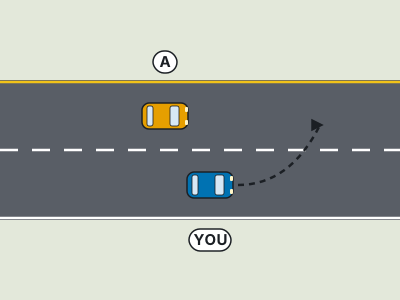
- Mirrors, a shoulder check for the blind spot, and an advance signal
- A stop in the current lane before signaling
- A speed increase without checking beside the vehicle
- Only the rearview mirror and horn
Show answer
Mirrors, a shoulder check for the blind spot, and an advance signal. The handbook’s lane change reminders are to check the side and rearview mirrors, look over the shoulder to clear the blind spot, signal the intended movement in advance, and then proceed. The mirror only choice omits the blind spot, while stopping in a travel lane or accelerating without checking introduces risk. A practical cue is the sequence mirror, shoulder, signal, move. Checking the lane beyond the one being entered is also recommended because another vehicle may be planning to move into the same space.
18. An orange work zone sign warns that the right lane closes one mile ahead. Traffic is light. When should you move to the open lane?
- At the first cone, at the last moment
- Only if a flagger points you over
- Soon, when it is safe to move over
- After the right lane actually ends
Show answer
Soon, when it is safe to move over. Black-on-orange work zone signs give their message far in advance so drivers have time to act, such as shifting to another lane. The handbook says not to wait until the last minute, because the signs provide enough time to react without impeding traffic. With light traffic, moving over soon and safely is easy. Waiting for the cones or for the lane to end forces a late merge in a confined area.
Study this in the handbook: Turn signals, headlights and bad weather
19. How must a North Carolina child under age eight who weighs less than 80 pounds be secured?
- In a weight-appropriate child passenger restraint system
- With no restraint if seated in the rear seat
- With an adult lap belt only in every vehicle
- In the front seat with the shoulder belt behind the back
Show answer
In a weight-appropriate child passenger restraint system. North Carolina requires a child under age eight who weighs less than 80 pounds to ride in a weight-appropriate child passenger restraint system. The rule focuses on both age and weight, so a rear seat alone does not remove the restraint requirement. An adult lap belt may be insufficient for a smaller child, and placing the shoulder belt behind the back defeats the protection the belt is designed to provide. Check the child’s current size against the restraint manufacturer’s limits, then secure the seat or harness as directed before driving.
Study this in the handbook: Seat belts, child restraints and window tint
20. Driving through heavy rain, you feel the steering go light and the car starts to slide on a sheet of water. What should you do?
- Brake hard so the car slows down right away
- Lift off the gas and hold the wheel straight
- Steer sharply toward the shoulder to escape
- Speed up to push through the water faster
Show answer
Lift off the gas and hold the wheel straight. That loose feeling means the car may be hydroplaning: a thin layer of water has lifted the tires off the road. The handbook says to take your foot off the gas pedal and resist the instinct to brake. Keep the steering wheel straight and let the car's momentum decrease until the tires grip again. Any sudden jerk of the wheel can send you into an uncontrollable skid, so steering sharply is the wrong move.
Study this in the handbook: Turn signals, headlights and bad weather
Every question is written from the official North Carolina Driver Handbook. Need paper? Printable NC practice test with answer key.
Last verified 2026-10-05. How we check every question · Study all 500 as flashcards
Frequently asked questions
How many questions are on this North Carolina practice test?
This fixed set has 20 questions. It is test 16 of 25 from the 500 question North Carolina bank.
How does this fixed test relate to the full North Carolina bank?
Each numbered test is a fixed set of questions in a fixed order, so you can retake the same test later and compare. Every test mixes road signs and the other topics in about the same proportion as the full bank. Tests 1 to 25 together cover every question in the North Carolina bank once. The full practice page mixes the whole bank at random.
Last verified 2026-10-05. See the North Carolina DMV facts page for sourced state details.
Return to the full North Carolina practice test · Study road signs