
Test 1 of 10 · 20 questions · Free 2026
NC Permit Practice Test 1
Jump to the test ↓A fixed 20 question set from the North Carolina bank with answers and plain English explanations.
Question 1 of 20 · 0 right so far
All 20 questions in test 1
Every question below comes from the North Carolina question bank on this page. Open a question to see the correct answer and the explanation. Nothing here is hidden behind a signup.
1. What does the North Carolina handbook say to do before a curve while traveling downhill?
- Shift to neutral
- Shift to a lower gear and begin braking earlier
- Speed up to carry momentum
- Brake hard in the middle of the curve
Show answer
Shift to a lower gear and begin braking earlier. When you meet a curve while traveling downhill, consider the pull of gravity, shift to a lower gear before moving downhill, and begin to brake earlier and approach the curve more slowly than you would on a level roadway. Gravity adds speed through the curve, so entering slower matters. Neutral removes engine braking, and braking hard inside the curve can break the tires' grip.
2. What must every vehicle in a North Carolina funeral procession display?
- Nothing special
- High beams only
- A flag on the antenna
- Headlights on, and hazard warning signals if equipped
Show answer
Headlights on, and hazard warning signals if equipped. Every vehicle in a North Carolina funeral procession must have its headlights on, and the hazard warning signals must also be on if the vehicle has them. The operator of the lead vehicle must comply with all traffic control signals, but once the lead vehicle has crossed an intersection lawfully or under an officer's direction, the following vehicles may proceed through without stopping. Other drivers must not cut through the line.
Study this in the handbook: Railroad crossings and funeral processions
3. On a highway with only one lane in your direction, how should you pass a stopped emergency vehicle with warning lights activated?
- Slow down and use a reduced, safe speed until completely past it
- Stop directly beside it
- Speed up to minimize the time nearby
- Change into the oncoming lane without checking
Show answer
Slow down and use a reduced, safe speed until completely past it. When only one lane travels in your direction, there is no adjacent same-direction lane for a standard move-over. The required response is to slow down and drive at a reduced, safe speed until completely past the stopped emergency vehicle. Entering an oncoming lane without a safe and lawful opportunity creates a head-on risk, while stopping beside the responder leaves the hazard unresolved. Speeding increases danger for workers and passing traffic. Look well ahead, release the accelerator, reduce speed smoothly, and maintain a safe path until the entire emergency vehicle is behind you.
4. On a street with curbs, how close to the curb line of an intersecting street may a North Carolina driver park?
- No closer than 25 feet
- No closer than 10 feet
- No closer than 15 feet
- Right up to the crosswalk paint
Show answer
No closer than 25 feet. North Carolina keeps parked cars back from intersections so that drivers and pedestrians can see one another. The handbook says not to park within 25 feet of the curb line of an intersecting street. Where there is no curb, the distance changes to 15 feet of the intersecting right of way lines, which is why fifteen feet is a trap on a curbed street. Ten feet or parking up to the crosswalk paint would leave the parked car close enough to hide crossing pedestrians and turning traffic from view.
Study this in the handbook: Passing, backing and parking
5. A North Carolina student under 18 is suspended from school for more than 10 consecutive days for possessing alcohol on school property. What happens to the driver license?
- Nothing, since school and driving are separate
- It is lost for 10 days
- It is lost until age 21
- It is lost for 12 months or until a Driving Eligibility Certificate is obtained
Show answer
It is lost for 12 months or until a Driving Eligibility Certificate is obtained. Under North Carolina's Lose Control, Lose Your License rule, a student suspended for more than 10 consecutive days, or assigned to an alternative school setting for discipline for more than 10 days, loses the license. The loss lasts 12 months or until a Driving Eligibility Certificate is obtained. School discipline clearly affects driving here, 10 days is the trigger rather than the length, and age 21 is not the end point.
Study this in the handbook: License tests, teen phone ban and full provisional license
6. How far away must a North Carolina vehicle horn be audible?
- At least 200 feet
- At least 20 feet
- At least one mile
- A horn is optional on licensed vehicles
Show answer
At least 200 feet. North Carolina treats the horn as required safety equipment. Every licensed motor vehicle must be equipped with a horn in good working order, and the horn must be loud enough to be heard for at least 200 feet. It also must not make an unreasonably loud or harsh sound, so a horn that carries a mile is not the goal. Twenty feet would not warn anyone in time. If the horn fails, the handbook says to have it repaired immediately, and it should be used only as a reasonable warning device.
7. Why can driving far below the posted speed limit create danger on a North Carolina roadway?
- It is automatically illegal whenever the road has two lanes
- It always causes a license revocation after one observation
- It can cause following drivers to bunch up or take risky passing actions
- It gives the slower vehicle priority at every intersection
Show answer
It can cause following drivers to bunch up or take risky passing actions. Very slow travel can create a hazard because vehicles behind may collect, creep along, or attempt an unnecessary pass. The handbook does not say that every slow trip is illegal or that one observation causes revocation. Nor does low speed create intersection priority. Drivers should adjust for conditions and obey a posted minimum, but when traffic builds behind them they should pull over, stop, and let the line pass. The safety cue is traffic gathering behind you, not a particular speed alone.
Study this in the handbook: Speed limits and stopping distance
8. After the first restoration of a license following a DWI suspension, what alcohol concentration restriction does North Carolina require?
- A 0.04 restriction applies after the first restoration
- A 0.08 restriction applies after the first restoration
- A 0.00 restriction applies after every first restoration
- No alcohol concentration restriction applies once driving privileges return
Show answer
A 0.04 restriction applies after the first restoration. Restoring the license does not erase every alcohol condition. The first restoration after a DWI suspension carries a 0.04 alcohol concentration restriction. The ordinary 0.08 number describes the general impaired driving standard, while 0.00 is reserved for a second or subsequent restoration and several other listed circumstances. The claim that restoration removes all restriction overlooks the separate restoration rule. The practical memory cue is sequence: first restoration, four hundredths; later restoration, zero.
Study this in the handbook: Driving while impaired and alcohol limits
9. What mirror check helps a driver avoid lingering in a tractor-trailer’s rear blind spot?
- If you see the truck driver, remain beside the cab
- If the truck has two mirrors, its blind spots do not matter
- If you cannot see the truck driver in the side-view mirror, the driver cannot see you
- If you are within one car length, the truck driver can always see you
Show answer
If you cannot see the truck driver in the side-view mirror, the driver cannot see you. The handbook gives a practical mirror rule for sharing the road with a tractor-trailer: if you cannot see the truck driver in the side-view mirror, the driver cannot see your vehicle. That means the car is lingering in a blind spot and should increase space or pass only when legal and clear. Seeing the driver does not make it safe to remain beside the cab, and extra mirrors do not eliminate every no-zone. Use the mirror check whenever you travel behind or alongside a large truck, especially before changing position or slowing.
Study this in the handbook: Bicycles, mopeds, trucks and insurance
10. What color pattern does the North Carolina handbook say diamond-shaped caution or warning signs normally use?
- Blue on white
- White on red
- Black on yellow
- Green on brown
Show answer
Black on yellow. The handbook describes diamond-shaped signs as caution or warning signs that are normally black on yellow. This combination alerts drivers to a roadway condition or hazard ahead. Black on orange has a narrower use in the handbook, warning about construction or maintenance areas. White on red is associated with other traffic messages, while blue, green, and brown commonly appear on guide or informational signs. The yellow diamond is the visual cue to scan ahead, adjust speed if needed, and prepare for the condition shown.
Study this in the handbook: Sign shapes and colors
11. What driving error does the North Carolina handbook say to avoid by watching for a DO NOT ENTER sign?
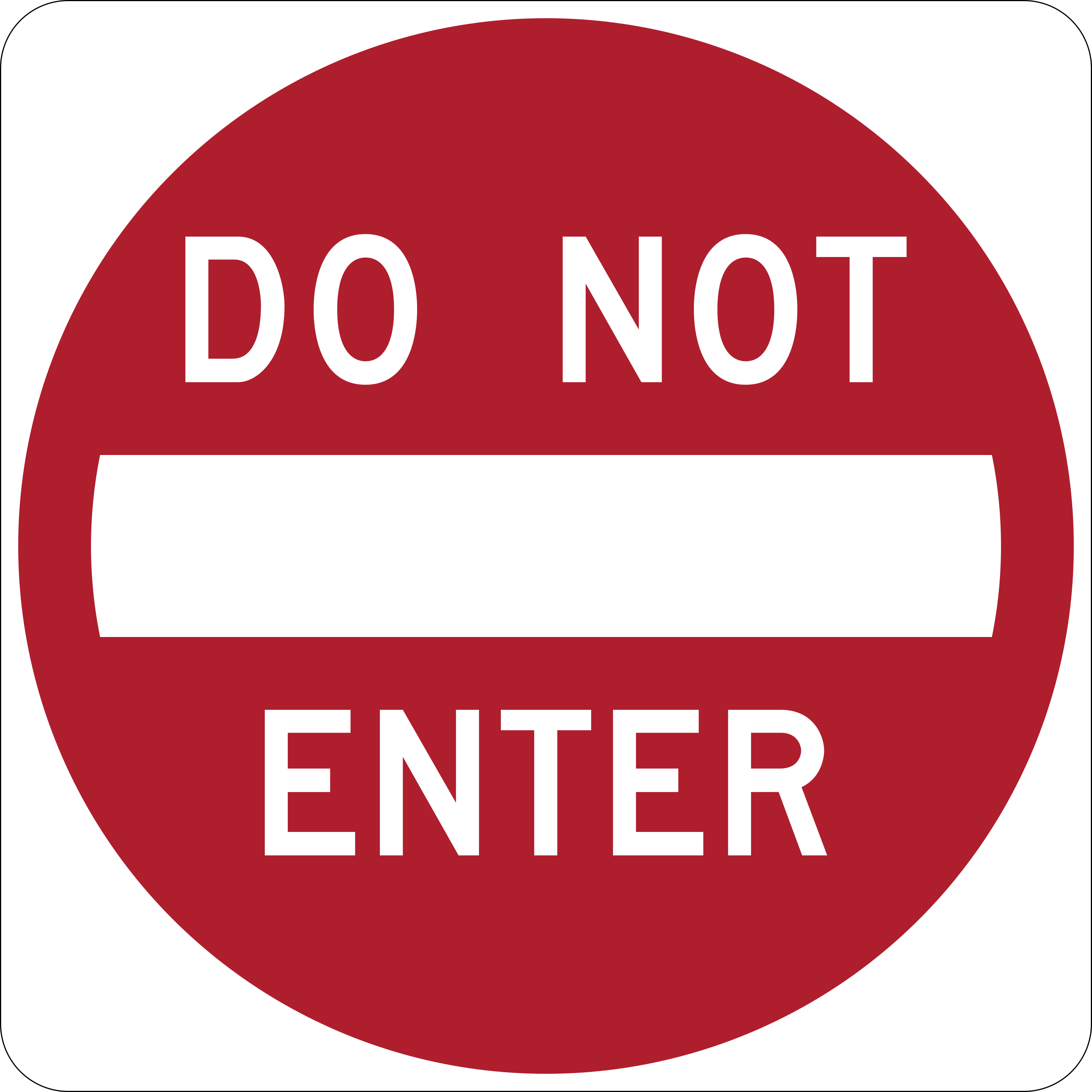
- Parking beside a fire hydrant
- Traveling the wrong way on an interstate
- Passing a school bus with red lights
- Stopping on railroad tracks
Show answer
Traveling the wrong way on an interstate. The handbook places the DO NOT ENTER reminder in its interstate-driving guidance, where a driver may accidentally enter a ramp or roadway in the wrong direction. The sign warns against traveling into opposing traffic. Fire-hydrant parking, school-bus passing, and stopping on tracks are separate safety rules with different signs or signals. If the roadway layout seems confusing, slow down, read the regulatory signs, and pull over safely rather than continuing into a prohibited entrance.
12. What road condition does a pedestrian crossing warning sign tell you to anticipate?

- Pedestrians are prohibited from entering the roadway
- A sidewalk is closed for maintenance
- People may be crossing, so watch and prepare to yield
- Only school buses may use the next lane
Show answer
People may be crossing, so watch and prepare to yield. A pedestrian crossing warning calls attention to people who may be using the roadway ahead. The driver should watch carefully, reduce risk through appropriate speed, and be ready to yield rather than assume the path is clear. The sign does not ban pedestrians, announce sidewalk repairs, or reserve a lane for school buses. Its practical cue is the walking figure: scan the crossing area, check both sides, and anticipate someone entering your path.
13. What action is required at a flashing yellow traffic signal?
- Stop and remain stopped until a green signal appears
- Speed up to clear the intersection
- Slow down and proceed with caution
- Turn around before entering the intersection
Show answer
Slow down and proceed with caution. The flashing yellow signal has the same meaning as a warning sign. Drivers should slow down and proceed with caution after checking for traffic, pedestrians, and other hazards. It is not an automatic stop, so the choice requiring a wait for green adds a condition the signal does not state. Speeding through removes the time needed to respond. Reduce speed, scan the intersection, and continue only when the movement can be made safely.
Study this in the handbook: Traffic signals and pavement markings
14. According to the North Carolina handbook, what share of tropical weather deaths since 1970 came from inland flooding, and what caused half of them?
- 10 percent, mostly from wind
- 85 percent, with half caused by people driving into known flooded roads
- 50 percent, mostly at the coast
- 25 percent, mostly from falling trees
Show answer
85 percent, with half caused by people driving into known flooded roads. Since 1970, inland flooding has been responsible for 85 percent of deaths associated with tropical weather in North Carolina, and half of those deaths were caused by people driving into known flooded roads. Never drive through standing water on a roadway, because the water level may be much higher than it appears and the road beneath may be gone. Turn around and find another route.
Study this in the handbook: Turn signals, headlights and bad weather
15. What is the minimum fine for a first littering conviction from a vehicle in North Carolina?
- $25
- $100
- $2,000
- $250
Show answer
$250. The North Carolina handbook treats littering as a real offense, not a minor nuisance. When litter is thrown or blown from a vehicle, the driver is held responsible. If convicted, the minimum fine is $250 and the maximum is $1,000. A second or later offense within three years can bring a fine from $500 up to $2,000. Litter on roadsides also draws wildlife toward the road edge and raises the risk of a collision. Twenty five dollars and one hundred dollars are below the floor, and two thousand applies only to repeat offenses.
Study this in the handbook: Bicycles, mopeds, trucks and insurance
16. An unmarked car signals a North Carolina driver to pull over, and the driver doubts it is a real officer. What does the handbook allow?
- Speed away to the nearest police station
- Call 9-1-1 before pulling over to verify the stop
- Ignore the car until it turns on a siren
- Get out and walk back to check the badge
Show answer
Call 9-1-1 before pulling over to verify the stop. The North Carolina handbook explains what to do when stopped by law enforcement. If an unmarked car is stopping you and you have a legitimate question about whether it is an actual law enforcement officer, you may call 9-1-1 before pulling over and report your name and location so the stop can be verified. Speeding off or ignoring the signal is not allowed, and getting out of the vehicle conflicts with the advice that you and your passengers remain seated. If an officer is not in uniform, you may also ask to see credentials.
17. For a suspension that did not come from a DWI conviction or a medical evaluation, what restoration fee does North Carolina DMV require before it can be cleared?
- $25.00
- $10.00
- $500.00
- $83.50
Show answer
$83.50. North Carolina requires an $83.50 restoration fee to be paid to DMV before a suspension or revocation can be cleared. The fee is not required when the license was taken for medical or health reasons after a medical evaluation. A revocation from a DWI conviction carries a higher restoration fee, and a separate $50 service fee applies unless the license was surrendered to the court or mailed to DMV before the effective date. Ten, 25, and 500 dollars are not the restoration fee.
Study this in the handbook: Keeping your license: points, suspensions and renewal
18. A North Carolina Level Two driver is unsupervised and carries an under-21 family or household passenger. When may one other under-21 passenger from outside the family and household ride?
- Any time the driver has held the license for one month
- When that passenger is a student being driven directly to or from school
- Never
- Only after 9 p.m.
Show answer
When that passenger is a student being driven directly to or from school. The additional passenger must be a student being driven directly to or from school. Ordinarily, an unsupervised Level Two driver carrying an under-21 immediate-family or household passenger cannot also carry an under-21 passenger from outside those groups. The school trip creates a limited exception for one outside student. It does not permit two outside passengers, and holding the license for a month does not remove this restriction.
Study this in the handbook: Graduated licensing: learner permit to full license
19. What helmet standard applies to motorcycle and moped riders in North Carolina?
- Federal Motor Vehicle Safety Standard FMVSS 218
- A helmet certified only by the vehicle dealer
- Any bicycle helmet with a chin strap
- No standard if the trip is under one mile
Show answer
Federal Motor Vehicle Safety Standard FMVSS 218. North Carolina requires motorcycle and moped operators and passengers to wear a safety helmet complying with Federal Motor Vehicle Safety Standard FMVSS 218. A bicycle helmet or an informal dealer label does not satisfy that named standard. The rule applies based on the type of vehicle and the rider's position, not on trip length. Riders should look for compliant equipment before starting, because protective gear is part of lawful road sharing.
Study this in the handbook: Seat belts, child restraints and window tint
20. In North Carolina, how much space must a driver allow when passing a moped?
- At least six inches to the moped's right
- No clearance if the moped is near the shoulder
- One full lane to the moped's right without changing position
- At least two feet to the moped's left
Show answer
At least two feet to the moped's left. A driver passing a moped must stay at least two feet to the moped's left. The handbook also says a moped should travel using the right side of the lane, and the same two foot figure appears in the general rule that a passing driver must pass at least two feet to the left of the vehicle being passed. Passing on the moped's right, using six inches, or giving no clearance near the shoulder does not meet the rule. Plan the maneuver with a visible gap and wait when traffic or roadway width prevents the required clearance.
Study this in the handbook: Bicycles, mopeds, trucks and insurance
QualitySpace is expanding to North Carolina
We are a California-based independent insurance brokerage working on licensing in more states. We cannot help with North Carolina insurance yet. Leave your email and we will let you know when we can.
Every question is written from the official North Carolina Driver Handbook. Need paper? Printable NC practice test with answer key.
Last verified 2026-10-05. How we check every question · Study all 207 as flashcards
Frequently asked questions
How many questions are on this North Carolina practice test?
This fixed set has 20 questions. It is test 1 of 10 from the 207 question North Carolina bank.
How does this fixed test relate to the full North Carolina bank?
Each numbered test is a fixed set of questions in a fixed order, so you can retake the same test later and compare. Every test mixes road signs and the other topics in about the same proportion as the full bank. Tests 1 to 10 together cover 200 of the 207 questions in the North Carolina bank, each once. The full practice page mixes the whole bank at random.
Last verified 2026-10-05. See the North Carolina DMV facts page for sourced state details.
Return to the full North Carolina practice test · Study road signs