
Test 11 of 25 · 20 questions · Free 2026
NC Permit Practice Test 11
Jump to the test ↓A fixed 20 question set from the North Carolina bank with answers and plain English explanations.
Question 1 of 20 · 0 right so far
All 20 questions in test 11
Every question below comes from the North Carolina question bank on this page. Open a question to see the correct answer and the explanation. Nothing here is hidden behind a signup.
1. Where does a North Carolina highway work zone begin and end?
- Only where workers are present on the road
- From the first cone to the first flagger
- From the first work zone sign to the last one
- Within 500 feet of any construction equipment
Show answer
From the first work zone sign to the last one. The handbook defines a highway work zone as the area between the first sign showing the beginning of the work zone and the last sign showing its end. The posted work zone speed limit applies through that whole stretch, whether or not workers are visible at the moment. Unique orange warning signs immediately before the zone make it easy to identify, and black-on-orange signs inside it give directions as you travel through.
2. An ambulance with lights and siren approaches from the opposite direction on a four-lane, limited-access highway with a center median. Must you yield?
- Yes, traffic both ways must pull over and stop
- Yes, but only if the ambulance uses the left lane
- No, opposite traffic on that highway need not yield
- No, ambulances never get the right of way on highways
Show answer
No, opposite traffic on that highway need not yield. North Carolina requires all vehicles, whatever their direction, to yield to an approaching emergency vehicle. The handbook names one exception: vehicles traveling in the opposite direction on a four-lane, limited-access highway with a center median. On an ordinary road, including a four-lane road without a median, you must pull to the right edge and stop no matter which way the emergency vehicle is headed. Emergency vehicles with lights and sirens always have the right of way.
Study this in the handbook: Pedestrians, school buses and emergency vehicles
3. A slow tractor ahead of you shows a left-hand signal and begins to slow. Why does the North Carolina handbook warn against passing now?
- It may be turning left as you try to pass
- Tractors must pull onto the shoulder before turning
- Farm equipment may not turn left on public roads
- The signal means the driver wants you to pass
Show answer
It may be turning left as you try to pass. The handbook says typical farm equipment crashes are sideswipes and angle crashes that happen while the equipment is turning left and another vehicle tries to pass. An operator's left-hand signal can be mistaken as an invitation to pass, but the machine may be about to turn. When it slows for the turn, the passing vehicle crashes into it. Treat a left signal from farm equipment as a possible turn, stay back, and be patient.
4. What should drivers do when leaving a North Carolina roundabout?
- Speed up so the drivers waiting behind can enter quickly
- Exit from the inside lane to save time
- Stop inside the circle before turning out
- Signal and yield to pedestrians in the crosswalk
Show answer
Signal and yield to pedestrians in the crosswalk. The handbook tells drivers to use their turn signals when exiting a roundabout and to yield to pedestrians using the crosswalk there. Pedestrians cross on marked crosswalks along the outside of the roundabout, so they are right where you leave the circle. Speeding up as you exit makes yielding harder, and stopping inside the circle is not part of the process. In a multi-lane roundabout, you typically use the right lane to exit right.
Study this in the handbook: Right of way at intersections and roundabouts
5. You and another car reach an intersection with no signs or signals at the same moment. The other car is on your left. Who goes first?
- The other car, because it is on your left
- You, because you are on its right
- Whichever driver honks first
- The larger of the two vehicles
Show answer
You, because you are on its right. When two or more vehicles reach an intersection without signs or signals at the same time, the vehicle to the right has the right of way. If the other car is on your left, you are on its right, so you may go first. That changes only if one vehicle is already in the intersection, since that vehicle goes ahead of any that has not entered. Even with the right of way, slow down and watch for drivers who do not yield.
Study this in the handbook: Right of way at intersections and roundabouts
6. You have a green light and want to turn right, but a pedestrian is crossing the street you are turning into on the same green signal. Who has the right of way?
- You, because turning traffic moves first on green
- The pedestrian, even though you are turning
- Whoever entered the intersection first
- You, if you signaled before the pedestrian stepped off
Show answer
The pedestrian, even though you are turning. North Carolina gives pedestrians crossing with a green signal the right of way over all vehicles, and the handbook specifically includes vehicles turning across the pedestrians' path. Your green light lets you turn only after the crossing pedestrian is clear. Signaling early does not change that, and arriving first is not the test. At ordinary signals, pedestrians obey the same lights as drivers going their direction, so a pedestrian on green is crossing lawfully.
Study this in the handbook: Pedestrians, school buses and emergency vehicles
7. To handle skids in the rain, where does the North Carolina handbook say tire pressure is better kept?
- On the low side of the maker's range
- Well below the maker's lowest number
- Well above the maker's highest number
- On the high side of the maker's range
Show answer
On the high side of the maker's range. Before driving in rainy weather, the handbook says to check your tires. Deep, open treads let water escape and help prevent hydroplaning at moderate speeds, while worn or under-inflated tires have less grip and raise the chance of hydroplaning. To handle skids properly, it is better to keep tire pressure on the high side of the manufacturer's specifications, not the low side. The handbook also warns that overinflated tires reduce traction.
Study this in the handbook: Turn signals, headlights and bad weather
8. How should you handle your speed when making a right turn?
- Keep a steady speed all the way through
- Slow before the turn, then speed up slightly
- Brake hard in the middle of the turn
- Speed up before the turn, then brake
Show answer
Slow before the turn, then speed up slightly. For right turns, the handbook says to stay close to the right edge of the road so another vehicle cannot slip between you and the curb. Reduce speed before you make the turn, then accelerate slightly as you complete it. Braking hard mid-turn or entering at full speed works against that smooth approach. Motorcycles and bicycles are especially hard to see during a turn, so signal and look before turning.
9. A car ahead of you begins pulling out of a parallel parking space. What should you do?
- Slow down and be prepared to stop
- Honk and keep going at the same speed
- Speed up to pass before it moves out
- Swerve into the oncoming lane right away
Show answer
Slow down and be prepared to stop. The handbook says that if you notice a vehicle ahead pulling out from a parallel parking space, slow down and be prepared to stop. The other driver should check traffic and signal before pulling out, but you cannot count on that. Honking while holding your speed or racing past leaves you no room if the car keeps coming. In city driving, watch for parked vehicles that might pull out and for people stepping out between them.
Study this in the handbook: Passing, backing and parking
10. Your right wheels drop off the pavement onto the shoulder. What does the North Carolina handbook say to do first?
- Brake hard and steer sharply back onto the road
- Ease off the gas and steer straight ahead
- Speed up to climb back onto the pavement
- Stop in the travel lane right away
Show answer
Ease off the gas and steer straight ahead. If your vehicle runs off the pavement onto the shoulder, the handbook says not to brake immediately or try to turn back, because you could skid, lose control, or overturn. Slowly take your foot off the accelerator, steer straight ahead, and let the engine slow the vehicle. When you are stopped or nearly stopped, check for approaching traffic and, if it is safe, gradually drive back onto the road.
Study this in the handbook: Blowouts, breakdowns and crashes
11. A North Carolina provisional licensee drives after consuming a small amount of alcohol. What license consequence can follow a conviction?
- A revocation occurs only when BAC reaches 0.08 percent
- The driver receives a warning unless a passenger was injured
- The license is suspended for exactly thirty days
- A one year license revocation can result
Show answer
A one year license revocation can result. The provisional rule is based on any consumption, not on reaching the adult BAC benchmark. A conviction for driving after consuming any amount of alcohol or drugs brings a one year license revocation. The 0.08 percent figure belongs to the general per se DWI standard and cannot be used as a safe harbor by a provisional licensee. A warning is not the stated outcome, while thirty days describes a different immediate revocation provision. Remember the young driver rule as zero amount, one year.
Study this in the handbook: Driving while impaired and alcohol limits
12. Your car has an active passenger air bag and a back seat. You are driving a 4-year-old who weighs 35 pounds in an ordinary forward-facing car seat. Where must the seat go?
- In the rear seat, away from the air bag
- In the front seat, where you can watch
- Either seat, as long as the belt is snug
- In front, with the seat pushed all the way back
Show answer
In the rear seat, away from the air bag. When a vehicle has an active passenger-side front air bag and a rear seat, North Carolina requires a child under age 5 who weighs less than 40 pounds to ride in the rear seat. Only a child restraint built for use with a front air bag may be used up front instead. A 4-year-old at 35 pounds meets both conditions, so an ordinary car seat belongs in back. Children riding in front can be seriously injured or killed when an air bag comes out.
Study this in the handbook: Seat belts, child restraints and window tint
13. Why can driving on rural roads be more dangerous than driving in heavy city traffic?
- Rural roads have more traffic signals
- The roads may be narrower, darker, and faster
- Rural drivers are not required to signal
- Speed limits are lower in the country
Show answer
The roads may be narrower, darker, and faster. The handbook gives three reasons rural roads are often more dangerous than heavy city traffic: the road may not be as wide, the lighting is often not as good, and travel speeds may be higher. It also asks drivers to stay alert for others moving slower than the posted limit and to scan for unpredictable wildlife along the roadside. Rural roads do not have more signals or lower limits, and signaling rules apply everywhere.
14. Who may park in a space marked with the handicap parking sign shown?
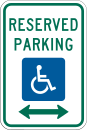
- Any driver with a passenger aboard
- Anyone stopping for less than 15 minutes
- Vehicles displaying a handicap plate or placard
- Any vehicle when other spaces are full
Show answer
Vehicles displaying a handicap plate or placard. The handicap parking sign shows that the space is reserved for people who qualify for and are displaying a handicap license plate or a dashboard placard. A short stop, carrying a passenger, or a full parking lot does not give other drivers permission to use it. The handbook lists this sign with the regulatory signs, and failure to obey regulatory signs is a violation of the traffic laws. Look for another space if your vehicle does not display the plate or placard.
Study this in the handbook: Sign shapes and colors
15. What does a hybrid beacon at a mid-block crosswalk display when no one has activated it?
- Nothing; it stays dark
- A steady green light
- A flashing yellow light
- A steady red light
Show answer
Nothing; it stays dark. Hybrid beacons may control traffic at mid-block crosswalks and at entrances to emergency response facilities. The handbook says they remain dark until activated by pedestrians or emergency response personnel. Once activated, they flash yellow for a few seconds, then show steady yellow and steady red so moving vehicles can stop safely. A dark beacon means no crossing has been requested at that moment.
16. Why does the North Carolina handbook tell bicyclists to ride with traffic instead of facing it?
- Riding against traffic lets cyclists see cars sooner
- Facing traffic is required for cyclists under 16
- It keeps cyclists out of bike lanes
- Drivers often fail to look for wrong-way riders
Show answer
Drivers often fail to look for wrong-way riders. The handbook stresses that bicyclists should go with the flow of traffic, not against it. Ride on the right, with traffic, not facing it, because motorists often do not look in the direction of bicyclists riding the wrong way. That rule is the reverse of the pedestrian rule, since pedestrians should walk on the left side of the road facing traffic. Bicyclists are vehicles and follow the rules drivers follow.
Study this in the handbook: Bicycles, mopeds, trucks and insurance
17. On a long trip, how often does the North Carolina handbook suggest getting out of the car to stretch and walk?
- At least every 30 minutes
- At least every 4 hours
- At least every 2 hours
- Only when you feel sleepy
Show answer
At least every 2 hours. To prevent drowsy driving, the handbook recommends stopping regularly on long trips and getting out of the car at least every 2 hours to stretch and walk briskly. Waiting until you feel sleepy is risky, because a tired driver cannot predict when a short sleep may happen. Stopping every 30 minutes is more than the handbook asks, and four hours is too long a stretch. A full night of rest before the trip matters too.
Study this in the handbook: Speed limits and stopping distance
18. This sign warns of a sharp turn ahead. Why does the North Carolina handbook say to slow down before you reach the turn?

- So you will not need to brake while in the turn
- Because the speed limit drops to 25 mph there
- So drivers behind you can pass on the right
- Because braking is illegal on curves
Show answer
So you will not need to brake while in the turn. The handbook's first rule for handling a curve is to slow down before you enter it, so you will not need to brake while you are in the curve. Then gradually increase your speed as you round the curve to keep the traction needed for good control. If you must brake in a curve, do it gradually. No rule makes braking in a curve illegal, and the warning sign does not set a fixed speed limit.
Study this in the handbook: Speed limits and stopping distance
19. You are driving fast on a dark country road. A stopped truck suddenly appears at the edge of your headlight beam and you cannot stop in time. Which handbook rule did you break?
- Always use your high beams when passing a parked truck at night
- Use only low beams when you drive on an open country road
- Never go faster than lets you stop within the distance you can see
- Match your speed to the other traffic that is on the road
Show answer
Never go faster than lets you stop within the distance you can see. The handbook says never to drive at a speed at which you cannot stop within the distance you can see on the road ahead. At night your headlights show only a limited stretch of road, so driving faster than that lets you stop leaves no time to react to a hazard such as a stopped truck. Slowing down is the safe response, and following other traffic does not replace it.
Study this in the handbook: Turn signals, headlights and bad weather
20. A driver ahead puts the left arm out the window with the forearm and hand pointing straight up and the palm facing forward. What is the driver about to do?
- Make a left turn
- Slow down or stop
- Let you pass first
- Make a right turn
Show answer
Make a right turn. Hand signals are given from the driver's window with the left arm and hand. To signal a right turn, the driver holds the arm straight out with the forearm and hand straight up and the palm facing forward. A left turn is shown by pointing the first finger with the arm straight out, and slowing or stopping is shown by pointing the arm and hand down.
Study this in the handbook: Turn signals, headlights and bad weather
Every question is written from the official North Carolina Driver Handbook. Need paper? Printable NC practice test with answer key.
Last verified 2026-10-05. How we check every question · Study all 500 as flashcards
Frequently asked questions
How many questions are on this North Carolina practice test?
This fixed set has 20 questions. It is test 11 of 25 from the 500 question North Carolina bank.
How does this fixed test relate to the full North Carolina bank?
Each numbered test is a fixed set of questions in a fixed order, so you can retake the same test later and compare. Every test mixes road signs and the other topics in about the same proportion as the full bank. Tests 1 to 25 together cover every question in the North Carolina bank once. The full practice page mixes the whole bank at random.
Last verified 2026-10-05. See the North Carolina DMV facts page for sourced state details.
Return to the full North Carolina practice test · Study road signs