
Test 18 of 25 · 20 questions · Free 2026
NC Permit Practice Test 18
Jump to the test ↓A fixed 20 question set from the North Carolina bank with answers and plain English explanations.
Question 1 of 20 · 0 right so far
All 20 questions in test 18
Every question below comes from the North Carolina question bank on this page. Open a question to see the correct answer and the explanation. Nothing here is hidden behind a signup.
1. Your gas pedal sticks while you are driving. Which response does the North Carolina handbook list?
- Turn the engine off and steer to the median
- Pump the brakes rapidly while in drive
- Pull the parking brake as hard as possible
- Shift to neutral and brake firmly
Show answer
Shift to neutral and brake firmly. If your gas pedal sticks, the handbook lists three steps: tap the gas pedal or lift it with your foot to try to free the throttle linkage, shift to neutral and apply firm pressure to the brakes without locking the wheels, and find a safe place to move the vehicle completely off the road. Turning off the engine or yanking the parking brake are not on that list. Above all, the handbook says not to panic but to react promptly.
2. As the temperature drops on a winter day, which spots does the North Carolina handbook say often freeze first?
- Shady spots, bridges, and overpasses
- Sunny stretches of flat highway
- Roads near busy intersections
- Lanes that were recently repaved
Show answer
Shady spots, bridges, and overpasses. Snow and ice make roads very slippery, and hard-packed snow increases the danger of skidding. The handbook tells drivers to watch for shady spots, bridges, and overpasses, because these places are often the first to freeze as the temperature drops. A road can feel fine and then turn icy on the next bridge. If you must drive in a snowstorm, reduce speed, use your wipers, and turn on your low beams.
Study this in the handbook: Turn signals, headlights and bad weather
3. How much slower does the North Carolina handbook suggest driving on wet pavement than on dry pavement?
- At least 20 to 25 mph slower
- About 1 to 2 mph slower
- No change if your tires are new
- At least 5 to 10 mph slower
Show answer
At least 5 to 10 mph slower. Along with leaving extra following distance, the handbook says to drive at least five to 10 miles per hour slower on wet pavement than you would on dry pavement. Higher speed raises the chance of hydroplaning, and your ability to stop or even slow down drops once the tires lose contact with the road. Good tires help, but they do not remove the need to slow down. If conditions are worse, slow down further.
Study this in the handbook: Turn signals, headlights and bad weather
4. When does the North Carolina handbook say you should never use cruise control?
- On interstates with light traffic
- When driving more than 100 miles
- When it is raining or has been raining
- When driving at speeds above 45 mph
Show answer
When it is raining or has been raining. The handbook says never to use cruise control when it is raining or after it has been raining. If the vehicle starts to hydroplane, the moment it takes to switch off cruise control or tap the brake to release it could decide whether you keep or lose control. Light interstate traffic, long trips, and highway speeds are not reasons to avoid cruise control on a dry road. Puddles can linger long after a storm ends.
Study this in the handbook: Turn signals, headlights and bad weather
5. A pedestrian steps into the road in front of your car, even though the pedestrian does not have the right of way. What does the North Carolina handbook say a safe driver does?
- Keeps going, since the pedestrian has no right of way
- Speeds up so the pedestrian can pass behind the car
- Honks and keeps going when the pedestrian is not entitled to cross
- Yields to the pedestrian whether or not the pedestrian is entitled to it
Show answer
Yields to the pedestrian whether or not the pedestrian is entitled to it. The handbook says that if the pedestrian does not stop, the driver must. It adds that saving a pedestrian's life is always worth the driver's lost right of way, and that the safe driver yields to a pedestrian whether or not the pedestrian is entitled to it. A pedestrian who steps out wrongly does not take away your duty to avoid a collision, so the answer is to yield rather than insist on your own right of way.
Study this in the handbook: Pedestrians, school buses and emergency vehicles
6. You are pulling out of a private driveway onto a North Carolina street. What must you do?
- Stop and yield to all vehicles and pedestrians
- Yield only to vehicles coming from your left
- Enter slowly without stopping if the street looks clear
- Stop only when a pedestrian is on the sidewalk
Show answer
Stop and yield to all vehicles and pedestrians. The handbook's rule for leaving a private driveway is simple: stop, then yield to all other vehicles and to pedestrians. Traffic on the street from both directions has priority, not just vehicles from one side. Rolling out because the street looks empty skips the required stop. People on the sidewalk also go first, whether or not you can see one at the moment you begin to move.
Study this in the handbook: Right of way at intersections and roundabouts
7. Your car has an automatic shoulder harness that moves into place by itself. What else does North Carolina law require?
- Nothing more, since the harness is enough
- You must fasten the lap belt as well
- A booster seat for every adult rider
- The air bag switch must be turned off
Show answer
You must fasten the lap belt as well. Some vehicles have automatic shoulder harnesses that slide into place without the rider doing anything. The handbook states that when a vehicle has these harnesses, the lap belt must also be worn. Its adult safety points say everyone should buckle up with both lap and shoulder belts on every trip. The lap belt should sit under the abdomen and low across the hips. Turning off an air bag or adding a booster seat for an adult is not part of this rule.
Study this in the handbook: Seat belts, child restraints and window tint
8. In a single-lane roundabout, how far around do you travel to make what would be a left turn at a regular intersection?
- One quarter of the way around
- About three-quarters around
- Halfway around the circle
- The full way around the circle
Show answer
About three-quarters around. In a single-lane roundabout, everyone travels counterclockwise and exits to the right. To go where a left turn would take you at a regular intersection, you travel about three-quarters of the way around and then exit right. A quarter of the way gets you the next street to the right, halfway continues straight, and a full circle makes a U-turn. Signal as you exit and yield to pedestrians in the crosswalk.
Study this in the handbook: Right of way at intersections and roundabouts
9. In winter, why can warming up a car be dangerous after a heavy snowfall?
- Snow can block the exhaust and send carbon monoxide inside
- Melting snow can leak into the engine and stall it quickly
- Idling in the cold drains the battery within a few minutes
- A cold engine can overheat when it idles in deep snow
Show answer
Snow can block the exhaust and send carbon monoxide inside. The handbook warns that during winter, snow can block a car's exhaust pipe, and warming up the car can then cause carbon monoxide to back up inside. Carbon monoxide is an invisible gas with no smell, taste, or color, yet it is poisonous and can be deadly. In its exhaust system section, the handbook adds that even small amounts can make you sleepy or unconscious. Because you cannot sense the gas, a blocked exhaust pipe is a serious hazard.
Study this in the handbook: Pedestrians, school buses and emergency vehicles
10. To keep a margin of safety, where in your lane does the North Carolina handbook suggest driving?
- Close to the center line to avoid parked cars
- In the middle, with space on both sides
- Close to the right edge at all times
- Wherever the lane feels widest
Show answer
In the middle, with space on both sides. Keeping a margin of safety means staying clear of other vehicles so you have room to pass or stop. The handbook says to stay in the middle of your lane and leave space on both sides of your vehicle, allowing ample room between you, parked vehicles, and oncoming traffic. Hugging the center line crowds oncoming cars, and hugging the edge crowds parked cars. A centered position gives you room to react on either side.
Study this in the handbook: Turn signals, headlights and bad weather
11. In most North Carolina crashes between a car and a motorcycle, what does the handbook say usually happened?
- The motorcyclist was speeding at the time
- The crash happened on an interstate highway
- The car driver was at fault, often not seeing it
- The motorcycle had a sudden mechanical failure
Show answer
The car driver was at fault, often not seeing it. The handbook reports that about two-thirds of motorcycle crashes in North Carolina involve a car, and in most of those crashes the car driver is at fault. The driver usually claims not to have seen the motorcycle. Because a motorcycle offers little or no protection, the rider is often seriously injured or killed. Motorcycles are easy to miss in blind spots and during left turns, so look for them before you turn, change lanes, or pull out.
Study this in the handbook: Bicycles, mopeds, trucks and insurance
12. At a single-point interchange, how are through traffic and left turns onto and off the interchange controlled?
- By one set of traffic signals at the center
- By separate signals at each ramp end
- By stop signs posted on every ramp
- By a roundabout at both ends
Show answer
By one set of traffic signals at the center. A single-point interchange compresses two intersections into one, built over or under a free-flowing road. Through traffic and traffic turning left onto or off the interchange are controlled by a single set of traffic signals located at the center or top of the interchange. This design lets vehicles clear the intersection more quickly and moves large volumes of traffic through limited space. Follow that one signal set rather than looking for a second intersection.
Study this in the handbook: Right of way at intersections and roundabouts
13. When should you use high-beam headlights on an open road at night?
- Whenever you are outside city limits
- While you are passing another vehicle
- When no vehicle is oncoming or close ahead
- In rain or fog, to see farther down the road
Show answer
When no vehicle is oncoming or close ahead. The handbook says to use low beams when driving at night in a city, and on the open road to use high beams unless you are approaching or following another vehicle. High beams light more of the road, but a driver can be blinded by the headlights of oncoming vehicles. In fog and in snowstorms, the handbook calls for low beams instead. Switch to low beams as soon as a vehicle approaches or you close in behind one.
Study this in the handbook: Turn signals, headlights and bad weather
14. An orange sign far ahead of a work zone tells you to shift to another lane. When should you move over?
- Wait until you reach the cones, then merge
- Soon, using the time the sign gives you
- Stay in your lane until a flagger directs you
- Move over only if traffic behind you is heavy
Show answer
Soon, using the time the sign gives you. Advance work zone signs may require you to act, such as shifting your vehicle to another lane. The handbook explains that black-on-orange signs give the message far in advance so you have enough time, and it says not to wait until the last minute. The signs provide enough time to react without impeding traffic. Waiting until you reach the cones forces a late, abrupt merge, and you do not need a flagger's direction to follow a posted lane shift.
Study this in the handbook: Turn signals, headlights and bad weather
15. You come up behind a bicyclist on a two-lane road, and a car is approaching in the oncoming lane. What should you do?
- Squeeze past the bicyclist within your lane
- Wait until the oncoming lane is clear
- Honk so the bicyclist moves onto the shoulder
- Pass now if you can leave three feet
Show answer
Wait until the oncoming lane is clear. Drivers may pass a bicyclist only when there is abundant clearance and no oncoming traffic is in the opposing lane. With a car coming toward you, wait behind the cyclist until the oncoming lane is clear. The handbook calls changing lanes the safest way to pass a bicyclist, and passing must follow the same laws as passing any vehicle. Squeezing by in the same lane or honking a cyclist off the road is not allowed.
Study this in the handbook: Bicycles, mopeds, trucks and insurance
16. After passing this sign, you see a lower speed limit sign for the work zone, but no workers are in sight. What speed applies?
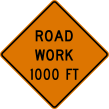
- The normal limit, since no one is working
- Any speed up to the normal limit
- Whatever speed traffic is going
- The lower limit, even with no workers
Show answer
The lower limit, even with no workers. Orange diamond signs with black messages warn about construction or maintenance areas. Inside a work zone, the handbook says it is unlawful to drive faster than the speed limit set and posted for that zone, and the zone runs from the first work zone sign to the last. The rule does not depend on whether you can see workers at the moment. Keep to the posted limit until you pass the sign marking the end of the zone.
17. You slowed down before the first curve shown by this sign. Now you are partway around it. What should you do with your speed?

- Brake firmly until the curve ends
- Shift into neutral and coast through it
- Keep slowing until you nearly stop
- Gradually increase it to keep good traction
Show answer
Gradually increase it to keep good traction. The handbook's method for curves is to slow down before entering, then gradually increase your speed as you round the curve to maintain the traction needed for good control. Begin turning just before the road bends, and stay on your side of the road, as far right as you can. Firm braking in the curve or coasting in neutral works against that control, and slowing to a near stop is not part of the method.
Study this in the handbook: Speed limits and stopping distance
18. You are stopped at a steady red light in North Carolina, and no sign prohibits turning. What may you do?
- Turn right without stopping if the way looks clear
- Turn left onto any street after a complete stop
- Turn right after a complete stop and yielding
- Wait for green, since turns on red are not allowed
Show answer
Turn right after a complete stop and yielding. A steady red circular signal means stop. Unless a sign says NO TURN ON RED, North Carolina allows a right turn after you come to a complete stop. Every driver turning right on red must yield to other traffic and pedestrians using the intersection, including pedestrians nearby who are starting to cross in front of the stopped traffic. Rolling through without stopping is not allowed, and the handbook's permission covers right turns.
Study this in the handbook: Traffic signals and pavement markings
19. You are on a two-lane road when an ambulance with lights and siren comes up behind you. What should you do?
- Speed up to stay ahead of it
- Stop right where you are in the lane
- Pull to the right edge and stop completely
- Move left so it can pass on the right
Show answer
Pull to the right edge and stop completely. When an emergency vehicle approaches from ahead or behind, the handbook says to drive to the right-hand curb or edge of the road and stop completely. Stay stopped until it has passed or a traffic officer directs you to move. Stopping in the middle of your lane or moving left leaves the ambulance without a clear path, and speeding up is never the right response. Emergency vehicles using lights and sirens always have the right of way.
Study this in the handbook: Pedestrians, school buses and emergency vehicles
20. A 35-year-old driving a pickup in North Carolina takes a breath test that shows 0.09. Is that result enough by itself to prove impaired driving?
- Yes, 0.08 or more proves impaired driving
- No, the officer must also see poor driving
- No, the limit for pickups is 0.10
- Only if the driver also failed a field test
Show answer
Yes, 0.08 or more proves impaired driving. North Carolina can prove driving while impaired in one of two ways: by showing the driver's physical or mental fitness was appreciably impaired, or by showing a blood alcohol concentration of 0.08 percent or more. A 0.09 result is over that line, so the test alone can establish the offense for an adult driving a personal vehicle. No separate proof of bad driving is required, and a pickup is not held to a different number.
Study this in the handbook: Driving while impaired and alcohol limits
Every question is written from the official North Carolina Driver Handbook. Need paper? Printable NC practice test with answer key.
Last verified 2026-10-05. How we check every question · Study all 500 as flashcards
Frequently asked questions
How many questions are on this North Carolina practice test?
This fixed set has 20 questions. It is test 18 of 25 from the 500 question North Carolina bank.
How does this fixed test relate to the full North Carolina bank?
Each numbered test is a fixed set of questions in a fixed order, so you can retake the same test later and compare. Every test mixes road signs and the other topics in about the same proportion as the full bank. Tests 1 to 25 together cover every question in the North Carolina bank once. The full practice page mixes the whole bank at random.
Last verified 2026-10-05. See the North Carolina DMV facts page for sourced state details.
Return to the full North Carolina practice test · Study road signs