
Test 17 of 25 · 20 questions · Free 2026
NC Permit Practice Test 17
Jump to the test ↓A fixed 20 question set from the North Carolina bank with answers and plain English explanations.
Question 1 of 20 · 0 right so far
All 20 questions in test 17
Every question below comes from the North Carolina question bank on this page. Open a question to see the correct answer and the explanation. Nothing here is hidden behind a signup.
1. Police are working a crash on your street, and you want to park and wait for a friend. How close to the stopped police car may you park?
- Right behind it with flashers on
- No closer than 100 feet
- No closer than 25 feet
- Anywhere if you stay in the car
Show answer
No closer than 100 feet. The handbook says not to park within 100 feet of an emergency vehicle that has stopped to investigate an accident or to give assistance. Turning on flashers or staying in your car does not shorten that distance. The rule is separate from the 15-foot hydrant rule and the 25-foot rule for intersecting curb lines, so do not mix up those numbers. If you drive past the scene, the Move Over law also applies.
Study this in the handbook: Pedestrians, school buses and emergency vehicles
2. Fog is forming on the road at night, and your high beams light up a bright white wall in front of you. Which lights should you use?
- High beams, to see farther
- Parking lights only
- No lights, to cut the glare
- Low-beam headlights
Show answer
Low-beam headlights. If you must drive in fog, the handbook says to turn on your low-beam headlights, reduce speed, watch for the taillights of the vehicle in front of you, and watch for vehicles behind you. High beams are for open roads at night without nearby traffic, not for fog. Parking lights alone or no lights make you hard to see. If the fog gets so thick you have extreme trouble seeing, pull far off the road and stop.
Study this in the handbook: Turn signals, headlights and bad weather
3. Your phone rings while you are driving alone in North Carolina. What does the handbook recommend?
- Answer quickly and keep the call under one minute
- Let it ring and return the call once stopped safely
- Answer on speaker and hold the phone low near your lap
- Slow down in your lane and then answer it
Show answer
Let it ring and return the call once stopped safely. The handbook's cell phone reminders say you do not have to answer when the phone rings. Let the caller leave a message and return the call when you are stopped at a safe location. A short call or speakerphone still pulls attention from the road, and slowing in the travel lane does not make a call safe. If a passenger is with you, the handbook suggests asking that person to place the call and speak for you if possible.
4. Your car stalled on railroad tracks, and everyone got out and moved well away. How can you quickly alert the railroad?
- Call the number on the blue sign at the crossing
- Wave a white cloth at the next train
- Phone the nearest DMV office to report the crossing
- Wait at the car until a train crew arrives
Show answer
Call the number on the blue sign at the crossing. If your vehicle stalls on or near the tracks, the handbook says to get out immediately and move away from the vehicle and the tracks. Once you are safely away, find the blue Emergency Notification System sign at or near the crossing and report the emergency using its information. The sign lists the crossing's identification number, the railroad's name, and an emergency phone number, which is the quickest way to stop a train. Never wait beside the stalled car.
Study this in the handbook: Railroad crossings and funeral processions
5. A train has just passed and the crossing looks clear. Why should you not start across immediately?
- The crossing gates must be inspected before anyone crosses
- Passing trains often leave debris on the rails
- The warning lights need a minute to reset
- Another train may be right behind or coming
Show answer
Another train may be right behind or coming. The handbook warns not to move immediately after a train passes, because another train may be moving in the opposite direction or following the first one. A smaller sign below the crossbuck tells you when there is more than one track. Always wait until the red lights have stopped flashing before moving ahead, and look both ways again. Gate inspections and debris are not the reason for the wait.
Study this in the handbook: Railroad crossings and funeral processions
6. A funeral procession is proceeding through a red light at an intersection while your light is green. What should you do?
- Go, because the green light gives you the right of way
- Wait unless you can go without crossing its path
- Honk so the procession stops for your green light
- Enter slowly between two cars of the procession
Show answer
Wait unless you can go without crossing its path. Once the lead vehicle has lawfully crossed, the rest of a funeral procession may continue through the intersection without stopping, even on a red light. For drivers outside the procession, the handbook says not to enter the intersection, even when facing a green light, unless it can be done safely and without crossing the procession's path. Driving between procession vehicles is also prohibited. Honking to stop the procession is not an option the law gives you.
Study this in the handbook: Railroad crossings and funeral processions
7. When can a car's flashing turn signals be hard for other drivers to see?
- At night on an unlit country road
- In light rain in the middle of the day
- Under thick clouds on a gray afternoon
- When low sun reflects off the signal lenses
Show answer
When low sun reflects off the signal lenses. Flashing turn signals are legal substitutes for hand signals, but the handbook warns they can be hard to see at times. In late afternoon and early morning, the lenses may reflect sunlight, making it difficult to tell whether they are flashing. At night, a flashing signal is much easier to see than a hand signal and is sufficient on its own. Use the type of signal you believe will communicate best.
Study this in the handbook: Turn signals, headlights and bad weather
8. Your car has anti-lock brakes, and you need to stop quickly. How should you brake?
- Pump the pedal quickly to avoid a skid
- Tap the brake lightly, then release it
- Brake hard and keep firm, steady pressure
- Shift to neutral before touching the brake
Show answer
Brake hard and keep firm, steady pressure. Anti-lock brakes help with stability, steering, and stopping. The handbook says that with ABS you should brake hard and keep firm, steady pressure on the pedal while stopping. Pumping the pedal or letting up on the pressure reduces how well the ABS works. The handbook reserves gentle pumping for vehicles that do not have anti-lock brakes. Keeping steady pressure also lets you steer the vehicle where you want it to go.
9. A sober adult is driving while a passenger in the back seat holds an open can of beer. Under North Carolina DWI laws, is this allowed?
- Yes, because the driver is not drinking
- Yes, if the passenger is at least 21 years old
- No, open containers are banned in the passenger area
- No, but only if the driver is under 21 years old
Show answer
No, open containers are banned in the passenger area. North Carolina DWI laws prohibit transporting an open container of any alcoholic beverage, including in the passenger area of the car. The rule is about where the open container is, not who is holding it. The handbook lists no exception for a sober driver or for a passenger of legal drinking age, and the driver's age does not change the rule either.
Study this in the handbook: Driving while impaired and alcohol limits
10. Why should you allow a greater following distance behind a motorcycle when the road is slippery?
- Motorcycles always brake harder than cars
- With two wheels, it can become unstable more easily
- Motorcycles cannot use their brakes on wet roads
- Riders are required to slow to 25 mph in rain
Show answer
With two wheels, it can become unstable more easily. The handbook lists several things to remember around motorcycles and mopeds. Never crowd them, because following too closely leaves no reaction time in an emergency. When road surfaces are slippery, allow a greater following distance, since a motorcycle or moped has only two wheels in contact with the road and becomes unstable more easily. Give riders plenty of room at railroad crossings and on rough or uneven roads as well.
Study this in the handbook: Bicycles, mopeds, trucks and insurance
11. You see this sign as you approach a sharp curve on a country road. What should you do?

- Slow down and get ready for a stop sign you cannot see yet
- Keep your speed until the intersection comes into view
- Come to a full stop right beside this sign
- Speed up to get through the curve quickly
Show answer
Slow down and get ready for a stop sign you cannot see yet. The STOP AHEAD sign is one of the most important warning signs. The handbook says it is placed far ahead of a stop sign when the driver's view of the stop sign is blocked by a curve or other objects. When you see it, begin slowing so you can stop at the stop sign once it comes into view. Waiting to see the intersection before slowing may leave too little room, and the warning sign itself is not where you stop.
Study this in the handbook: Sign shapes and colors
12. The light turns from green to steady yellow as you approach an intersection. What does the North Carolina handbook tell you to do?
- Stop, unless you are too close to stop safely
- Speed up to get through before it turns red
- Stop at once, even if you are in the intersection
- Keep going at the same speed, since yellow means go
Show answer
Stop, unless you are too close to stop safely. A circular yellow signal means caution and warns that the light is about to turn red. The handbook says to stop for a yellow signal unless you are too close to the intersection to stop safely; in that case, drive cautiously through. Never speed up to beat the red. Slamming on the brakes once you are already in the intersection is not what the rule asks, and yellow does not mean carry on as if the light were green.
Study this in the handbook: Traffic signals and pavement markings
13. You reach this sign as a car on the cross street comes close enough that you would cut it off. What must you do?
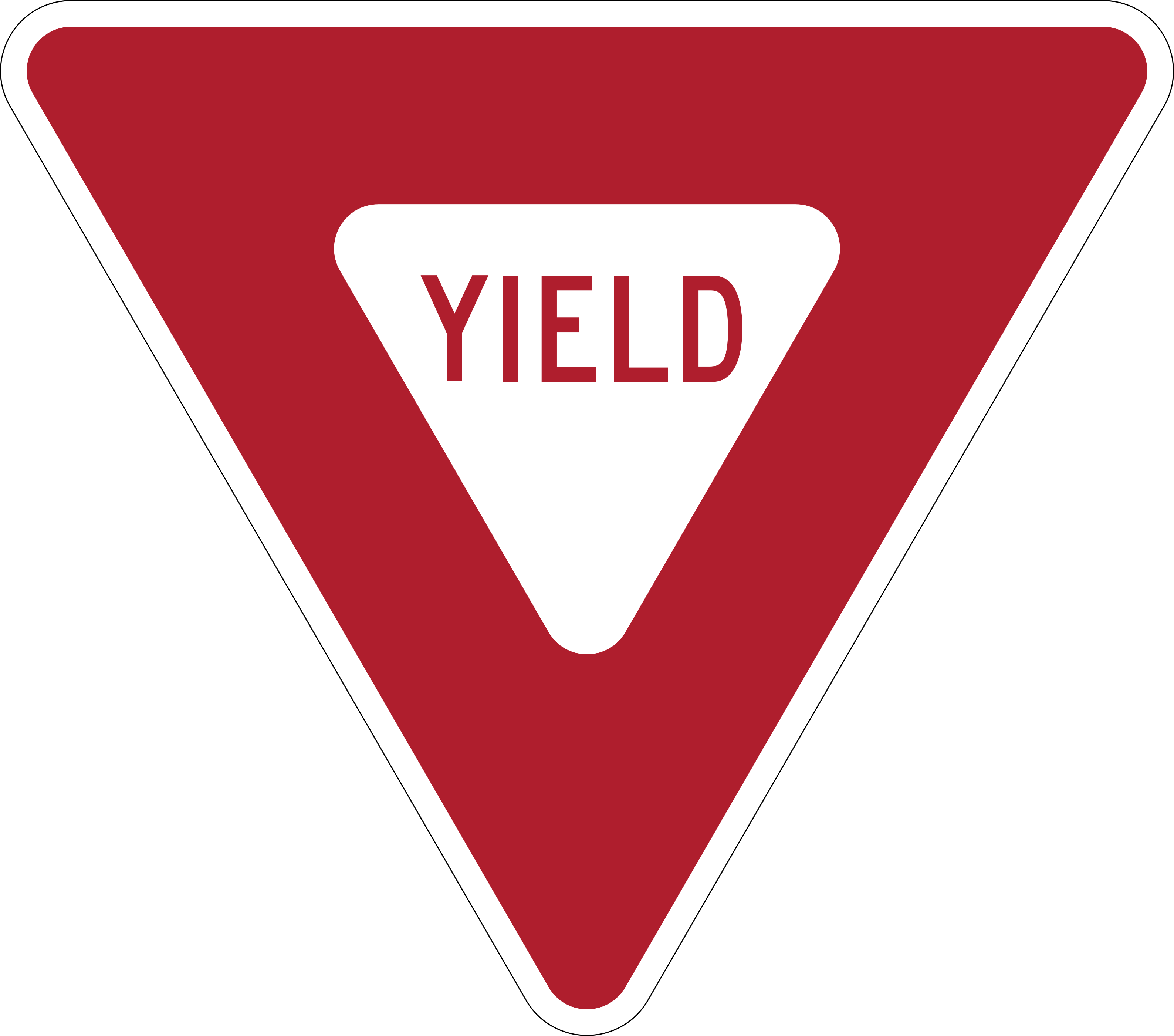
- Speed up to merge ahead of it
- Honk and enter, since you were there first
- Stop and wait for the car to pass
- Roll through slowly without stopping
Show answer
Stop and wait for the car to pass. At a yield sign, you must slow down and yield the right of way. Whether you also stop depends on the traffic on the intersecting street: if continuing would interfere with that traffic, you must stop and wait for it to pass. A yield sign does not always require a stop, but it never lets you cut in front of cross traffic. Arriving first gives you no priority over the traffic you are yielding to.
Study this in the handbook: Sign shapes and colors
14. You are driving 35 mph on a road with puddles after a storm. Could your car hydroplane at this speed?
- No, it only happens above 50 mph
- No, puddles are too shallow to matter
- Only on interstate highways
- Yes, it can start as low as 30 mph
Show answer
Yes, it can start as low as 30 mph. The handbook says hydroplaning can start at speeds as low as 30 miles per hour and in water little more than 1/8 inch deep, so 35 mph on a puddled road is enough. The handbook notes that puddles can linger for hours or days after a storm. Higher speed raises the risk further. If it happens, take your foot off the gas, avoid the brakes, keep the wheel straight, and let the car slow until the tires grip again.
Study this in the handbook: Turn signals, headlights and bad weather
15. At 55 mph under ideal conditions, about how far does a North Carolina handbook example say a vehicle needs to stop completely?
- Approximately 55 feet
- Approximately 500 feet
- Approximately 100 feet
- Approximately 211 feet
Show answer
Approximately 211 feet. The example says a vehicle traveling 55 mph requires approximately 211 feet to stop completely, even under ideal conditions. The number is much greater than the speed number itself, and the handbook warns that changing conditions can lengthen stopping distance. One hundred feet understates the example, while 500 feet is not the cited figure. Use the number as a mental reminder to preserve space and look far enough ahead for braking.
Study this in the handbook: Speed limits and stopping distance
16. On a four-lane North Carolina highway, the median between the two directions is more than 30 feet wide. How is each crossing treated?
- Both count as one single intersection
- As a crossover with no right-of-way rules
- Each one counts as a separate intersection
- As part of the highway, not an intersection
Show answer
Each one counts as a separate intersection. The handbook defines an intersection as any place where two or more roads meet or cross. On a four-lane highway whose median is more than 30 feet wide, each crossing of the two roadways is a separate intersection. So after crossing the first roadway, you check traffic and apply the right-of-way rules again before crossing the second. The law also requires slowing down at every intersection, even when you have the right of way.
Study this in the handbook: Right of way at intersections and roundabouts
17. Modern roundabouts in North Carolina are designed for vehicles to travel at about what speed?
- 15 to 20 mph
- 5 to 10 mph
- 25 to 30 mph
- 35 to 40 mph
Show answer
15 to 20 mph. The handbook explains that a modern roundabout is much smaller than an older traffic circle and requires vehicles to travel at lower speeds, about 15 to 20 mph. Those low speeds are part of why roundabouts are safer than traffic circles. NCDOT builds more of them to improve safety for drivers, pedestrians, and bicyclists and to reduce congestion. Slow down when you see the yellow roundabout ahead sign so you enter at that speed.
18. A deer suddenly appears in the road ahead of you. What does the North Carolina handbook advise?
- Swerve hard into the other lane to miss it
- Brake firmly, stay in your lane, and try to stop
- Speed up so it has less time to move into you
- Turn off your headlights so it can see you
Show answer
Brake firmly, stay in your lane, and try to stop. If wildlife is on the road, the handbook says to brake firmly, stay in your lane, and try to stop in time; you can also try honking the horn briefly. Swerving out of your lane is not the handbook's advice. Reduced speed gives both you and the animal more time to react, and the handbook notes that a deer hit at 35 mph has a much lower fatality rate than one hit at 55 or more, for the driver as well as the deer.
19. Where does North Carolina allow passing on the right?
- On any two-lane road when the shoulder is paved
- Whenever the driver ahead is going under the limit
- On highways with two or more lanes each way
- On curves where the left side is blocked
Show answer
On highways with two or more lanes each way. Passing on the right is against the law in North Carolina except where it is specifically permitted. The handbook's exceptions are highways with at least two lanes traveling in each direction, one-way streets where all lanes move the same way, passing a vehicle in the left-turn lane, and driving in a lane set aside for right turns. A paved shoulder is not a passing lane, and a slow driver ahead does not create an exception.
Study this in the handbook: Passing, backing and parking
20. Your car breaks down and you need help. What signal does the North Carolina handbook suggest?
- Raise the hood and tie a white cloth to the door
- Stand in the road and wave at passing cars
- Leave the trunk open and the engine running
- Turn on your high beams and honk every few minutes
Show answer
Raise the hood and tie a white cloth to the door. When your vehicle breaks down, the handbook says to move it completely onto the shoulder, have everyone leave by the passenger side, and stand off the road away from the vehicle. If you need help, tie a white cloth to the left door handle or the radio aerial and raise the hood. If it is dark, turn on the parking lights or emergency flashers. Standing in the road to wave is exactly where you should not be.
Study this in the handbook: Blowouts, breakdowns and crashes
Every question is written from the official North Carolina Driver Handbook. Need paper? Printable NC practice test with answer key.
Last verified 2026-10-05. How we check every question · Study all 500 as flashcards
Frequently asked questions
How many questions are on this North Carolina practice test?
This fixed set has 20 questions. It is test 17 of 25 from the 500 question North Carolina bank.
How does this fixed test relate to the full North Carolina bank?
Each numbered test is a fixed set of questions in a fixed order, so you can retake the same test later and compare. Every test mixes road signs and the other topics in about the same proportion as the full bank. Tests 1 to 25 together cover every question in the North Carolina bank once. The full practice page mixes the whole bank at random.
Last verified 2026-10-05. See the North Carolina DMV facts page for sourced state details.
Return to the full North Carolina practice test · Study road signs